Monday, January 31, 2022

OK Joe ...about that "Outta-Control-Juggernaut" after Spotify Lost $2.1 Billion Market Cap

What a surprise! Topline
Updated Jan 31, 2022, 04:24am EST

"Joe Rogan on Sunday addressed the controversy surrounding his podcast on Spotify, acknowledging that his show has grown into an “out-of-control juggernaut” and promised to offer more balanced perspectives in the future, after his show and host platform Spotify faced widespread criticism and a burgeoning boycott for platforming Covid-19 misinformation.

Joe Rogan Apologizes Over Spotify Podcast Controversy, Says He Will Try ‘Balance Things Out’ In The Future

i.insider.com/61df1f8d1025b20018bb6116?width=700

Joe Rogan on Sunday addressed the controversy surrounding his podcast on Spotify, acknowledging that his show has grown into an “out-of-control juggernaut” and promised to offer more balanced perspectives in the future, after his show and host platform Spotify faced widespread criticism and a burgeoning boycott for platforming Covid-19 misinformation.

“I will do my best to try to balance out these more controversial viewpoints with other people’s perspectives so we can maybe find a better point of view,” Rogan said. “I don’t want to just show the contrary opinion to what the narrative is. I want to show all kinds of opinions so we can all figure out what’s going on and not just about Covid, about everything, about health, about fitness, wellness, the state of the world itself.”

Earlier on Sunday, faced with a growing subscriber boycott and a tumbling stock price, Spotify CEO Daniel Ek outlined measures undertaken by the platform to “combat misinformation.”

Ek tweeted that the music streaming giant has “heard the criticism” and said Spotify will add a content warning to episodes talking about Covid-19 and link to coronavirus podcasts from reputable news sources going forward. Under Spotify’s new policy, Covid-19 misinformation will only be banned under four circumstances—saying that approved vaccines are intended to kill people, claiming Covid-19 is not real, encouraging people to intentionally get Covid-19 or promoting the consumption of bleach for medical treatment. Over the past two weeks, Spotify has been urged by doctors and scientists to establish a clear misinformation policy in response to “baseless conspiracy theories” and “misinformation” on the  “The Joe Rogan Experience” podcast. Following this musicians— Neil Young, Nils Lofgren, and Joni Mitchell—asked Spotify to take down their music library as they did not want to share the platform with Rogan’s “fake information.”

$2.1 billion. That’s the approximate drop in Spotify’s market cap that took place between last Wednesday and Friday, following the removal of Neil Young’s music from the platform."

FCC Announces $1.2B Grant for Broadband Deployment + RURAL BROADBAND ACCOUNTABILITY PLAN

Intro: The FCC calls this “the largest funding round to date,” and notes 23 broadband companies will provide service to more than one million new areas.

FCC announces $1.2 billion fund for broadband deployment in rural areas

New, 17 comments

The FCC plans to deploy broadband service in one million new areas

"The Federal Communications Commission (FCC) has announced over $1.2 billion in funding through the Rural Digital Opportunity Fund to expand broadband service across 32 states. The FCC calls this “the largest funding round to date,” and notes 23 broadband companies will provide service to more than one million new areas.

In addition, the FCC also introduced the Rural Broadband Accountability Plan, which will double the number of audits and verifications performed this year in comparison to 2021.

> It will also require the FCC to make the results of verifications, audits as well as speed and latency tests public on the Universal Service Administration Company’s (USAC) website.

Image result for community. broadband ANIMATED GIF

“The new Rural Broadband Accountability Plan will streamline our audit and verification processes while also making the results of verifications, audits, and latency testing publicly available for the first time,” FCC chairwoman Jessica Rosenworcel wrote on Twitter. “These safeguards will ensure that program providers do their jobs.”

The pandemic only amplified the gaps in connectivity affecting rural America, as employees transitioned to working from home and kids attended class virtually. To help remedy the issue, President Joe Biden signed off on a $1 trillion infrastructure package in November that allocates $65 billion to providing broadband to every American household.

The FCC also launched a program that provides cheaper internet to low-income households late last year.

In December 2020, the FCC awarded companies a total of $9.2 billion under the Rural Digital Opportunity fund, and that included an $886 million subsidy for SpaceX. The Elon Musk-owned company was supposed to deploy its satellite internet network in rural areas, but last year, the FCC warned SpaceX and other providers to stop misusing these funds to provide service to well-connected areas.

Sunday, January 30, 2022

US military stealth fighter jet crashes into the China Sea

Lavrov Jokes With Journo On Sanctioning Putin: Are You Saying I Am Not W...

Elon Musk SECRET MEETING With Putin Will SHOCK Everyone!

ABD'nin Ankara Büyükelçisi Jeff Flake, Anıtkabir'i ziyaret etti

Former Arizona Senator Jeff Flake arrived on a new mission to Turkey as the new American ambassador named by President Joe Biden a few months ago. This video is in Turkish with captions in English

PHOENIX SIZZLES

Intro: Phoenix is the country’s hottest and fifth most populous city, where businesses and people began flocking when affordable air conditioning became available in the 1950s. The population growth has led to a huge expansion in concrete infrastructure (buildings, roads and carparks) and a reduction in green areas, which has created heat islands – dangerously hot urban areas that absorb and re-emit the sun’s heat more than natural landscapes.
Scorching temperatures have made summers increasingly perilous for the city’s 1.4 million people, with mortality and morbidity rates creeping up over the past two decades, . .

America’s hottest city is nearly unlivable in summer. Can cooling technologies save it?

Phoenix’s new ‘heat tsar’ is betting on less asphalt, more green canopy and reflective surfaces to cool the sprawling heat island

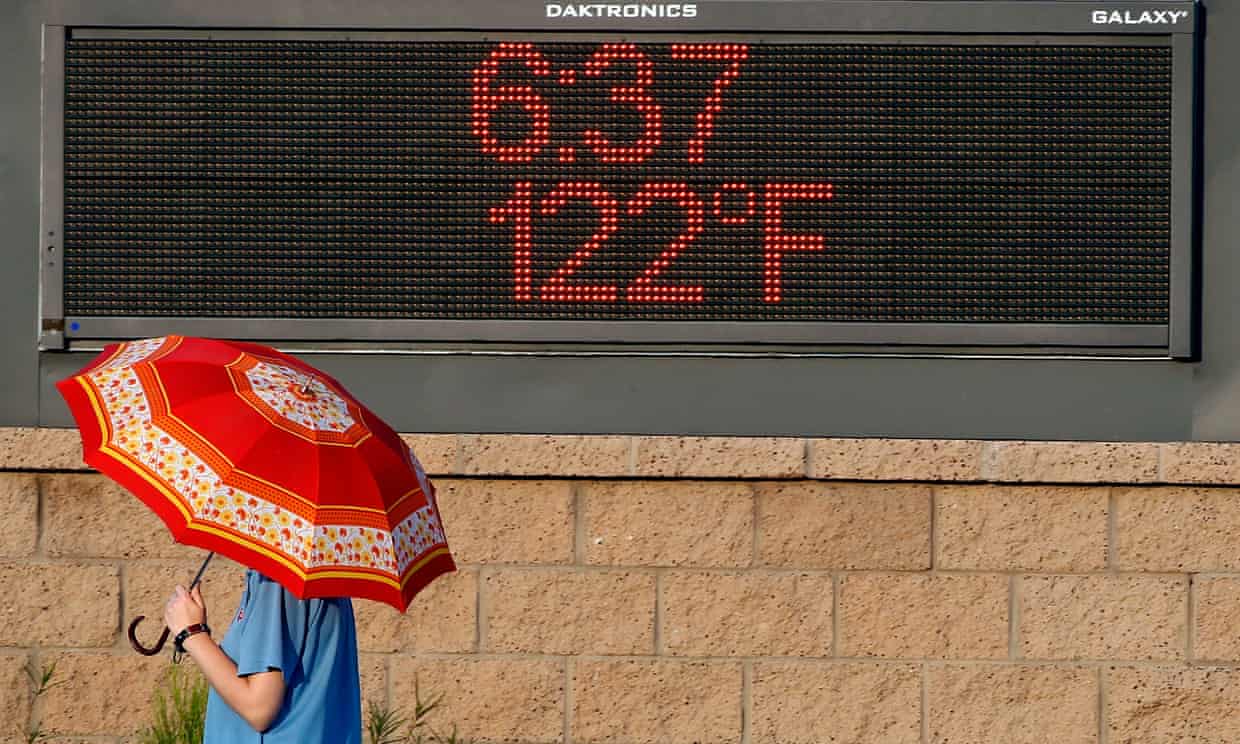
 <div class=__reading__mode__extracted__imagecaption>Temperatures in Phoenix are becoming deadly.  Photograph: Ralph Freso/Getty Images<br>Temperatures in Phoenix are becoming deadly.  Photograph: Ralph Freso/Getty Images</div>

"Phoenix’s new ‘heat tsar’ is betting on less asphalt, more green canopy and reflective surfaces to cool the sprawling heat island. . .David Hondula, the recently appointed director of Phoenix’s heat response and mitigation office has a warning, “2020 was a glimpse into the future – it’s the type of summer that could be normal by 2050 or 2080, so that’s what we need to be prepared for so that Phoenix is livable and thriving.”

For instance, the local health department has a highly-rated surveillance system but even then, the final tally and details of summer heat related fatalities are published the following February or March. “That leaves a very short window to plan for the next hot season, and deaths represent only the tip of a big iceberg … We have almost no knowledge about what conditions people experience in their homes,” said Hondula, a climate and health scientist who has spent more than a decade investigating the risks and vulnerabilities associated with heat.. .

[...] There are quick fire changes, or low-hanging fruit as Hondula puts it, which he thinks could have some immediate impact. . .

But it will take much broader changes to tackle the root causes driving deaths in the most vulnerable group: middle-aged men experiencing homelessness and substance misuse problems. “To reduce deaths, we need to be thinking way upstream and take steps to ease the housing affordability crisis and improve access to substance abuse and recovery services.”

Hondula recently submitted the 2022 heat response plan to city hall, in an attempt to coordinate the existing patchwork of services. “I’m impressed by the number of programs but the death and illness numbers are moving in the wrong direction, so there’s a disconnect we need to address,” he said. “If we mean to take a hazard seriously, relying on good fortune, luck and happenstance is not the best model.”

> Money is an issue. So far, the unit doesn’t have a budget for programs but there are options...The heat unit has bid for a slice of the city’s second American rescue plan installment, due in May, to fund a residential tree planting program targeting 25 neighborhoods with the least shade.

> Another sensitive and critical area is the city’s property development gravy train, which for years has been forging ahead faster than its ad hoc mitigation efforts. Hondula acknowledges that getting to grips with the gaps and loopholes in every part of the building process – from zoning and permitting to shade requirements and enforcement – will take time.

[...] Hondula argues, tackling urban heating could help turn around the city’s livability decline. “All cities have tiny hands on the big lever [of global heating] but the dominant driver of regional climate change has been urbanization, and that’s a lever we do have in our hands as local governments.

“Some modeling suggests with widespread deployment of cooling technologies like trees and reflective surfaces, we could end up with a city in the future that is cooler than we have today even with continued global scale warming, which is a very encouraging sign.”

NO CAPTAIN ONBOARD