Friday, February 18, 2022

ZIPCODES TELL A STORY: Funding Canada’s “Freedom Convoy”

Normally almost no one would be concerned about their zip code

New Leak Suggests Most Users Funding Canada's 'Freedom Convoy' Reside in U.S.

Nearly half of the total funding is linked to U.S. accounts, the unverified data says.
<div class=__reading__mode__extracted__imagecaption>The Intercept

"A data set leaked by an unknown hacker appears to show that Americans comprise a vast majority of the users donating to Canada’s “Freedom Convoy” protest via the website GiveSendGo, a Christian-oriented platform that’s raised more than $8.3 million to support the movement in opposition to public health measures intended to curb the spread of the covid-19 virus.

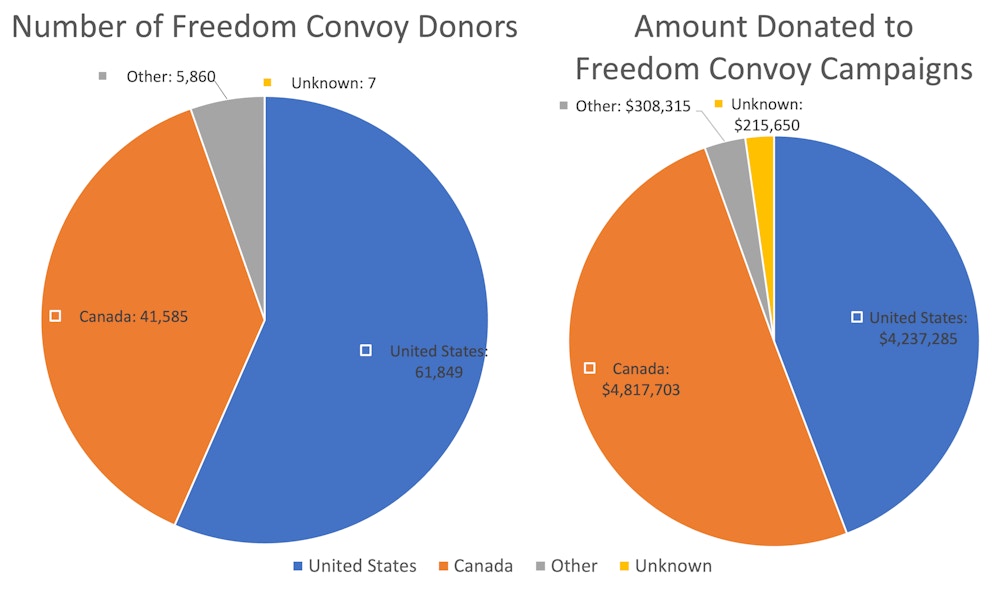
In total, 51,665 donations are linked to U.S. postal codes, compared to 36,201 in Canada.

While the data set shows donors in Canada are responsible for a majority of the cash, nearly half of the money—more than $3.6 million—appears to come from users with payment methods tied to U.S. residences.

The data was leaked Sunday night during the Super Bowl by a hacker who defaced GiveSendGo’s website, sending visitors to a separate site with a video that accused the company of trying to foment insurrection in Ottawa. A link to the data set was provided alongside the video.

QUESTION: Is it crowd-funding or a form of proxy warfare???

Hackers who took over the GiveSendGo crowdfunding website Sunday redirected visitors to a scene from Frozen, which included a message to the protesters occupying Ottawa.

Oath Keepers, Anti-Democracy Activists, and Others on the Far Right Are Funding Canada’s “Freedom Convoy”

The Intercept obtained the hacked donor data of GiveSendGo, including roughly 104,000 donors who contributed $9.6 million to “Freedom Convoy 2022” and “Adopt a Trucker.”


=====================================================================

Top 10 U.S. zip codes by number of donors to Canadian trucker convoy fundraising

An analysis of leaked data from two GiveSendGo online fundraising efforts shows that donations from Zip codes in the United States tended to come from areas that were high-income and with more registered Republicans.   

Source: Distributed Denial of Secrets, L2

GiveSendGo, which reportedly suffered a separate leak less than two weeks ago, has so far not responded to a request for comment attempting to confirm the veracity of the data. The company’s website is “currently offline for maintenance and server upgrades,” according to a message that appeared on its homepage at the time of publication.

At the time of writing, only a single donor had responded—only to say Gizmodo should investigate Black Lives Matter instead.

The data, which includes donors’ names, email addresses, and postal codes, as well as payment methods, shows thousands of dollars pouring in from other locales far from Canada, including $85,247 from Great Britain, $33,734 from Australia, $24,971 from Germany, $10,660 from the Netherlands, and $5,978 from New Zealand.

Smaller quantities of cash are linked to other distant countries such as Brazil ($483), China ($792), Ireland ($7,226), Japan ($2,338), South Africa ($1,034), and the United Arab Emirates ($2,130).

The map below shows the locations of donations originating from the United States based on zip codes included in the data. The sizes of the circles are relative to the amounts of money donated.

3 days ago · New Leak Suggests Most Users Funding Canada's 'Freedom Convoy' Reside ... to Canada's “Freedom Convoy” protest via the website GiveSendGo,...

This second map reveals the amount of funding originating from each state, with California in the lead at an amount of $545,513. By far, the most cash came from California’s 14th Congressional district; however, a single donor’s $90,000 contribution accounts for the vast majority of the money. (Idaho’s 1st Congressional district is otherwise in the lead, thanks to its own large donation from someone describing themselves as an American Cryptocurrency Compatriot.)

> Gizmodo acquired the data set from DDoSecrets, a journalist collective that works to provide reporters with access to newsworthy leaks, which had saved a copy of the data before GiveSendGo’s site went dark.

> GiveSendGo has previously hosted campaigns raising hundreds of thousands of dollars for members of the street-brawling neo-fascist group Proud Boys, including to fund travel to Washington, DC, ahead of the Jan. 6 U.S. Capitol insurrection, and afterward to defend members of the group from federal charges connected with the siege.

> Analysis by the threat detection company Pyrra showed a sharp increase of mentions of GiveSendGo across a range of alternative social media platforms, many of them known for hosting dangerous and extremist views. Mentions of the fundraising site spiked by 14,440% over the past 30 days, including on the QAnon hub GreatAwakening and forum 8kun, a site infamous for its violent and racist content that’s also linked to perpetrators of at least three mass shootings.

> Canadian press reported Monday that Prime Minister Justin Trudeau was preparing to seek access to Emergencies Act powers, granting him the authority to potentially force an evacuation of border crossing areas currently occupied by protesting truckers, as well as requisition tow trucks to remove vehicles disrupting key U.S.-Canada trade routes.
It would be the first time the Emergencies Act has ever been invoked; however, its predecessor—the War Measures Act—was invoked once during peacetime by Trudeau’s father, Prime Minister Pierre Trudeau, in 1970, after separatists from Quebec kidnapped then-Deputy Premier Pierre Laporte and British diplomat James Cross.

Update, 5:30pm: Trudeau has invoked the Emergencies Act. In a statement, the prime minister threatened to freeze the accounts of companies whose trucks are being used in the protest and have their vehicle insurance suspended.

Update, 7pm: Added new findings from The Independent in New Foundland and Labrador.

Update, 10pm: Added specific figures to provide further context around the claim that a majority of donors appear to be U.S. residents.


Thursday, February 17, 2022

Consent-Based Identity Verification: Controversial Facial Recognition Company Clearview AI

Preface: According to a report in WaPo, "Clearview "wants to expand beyond scanning faces for the police, saying. . .that it could monitor 'gig economy' workers and is researching a number of new technologies that could identify someone based on how they walk, detect their location from a photo or scan their fingerprints from afar,"
"Clearview is facing various privacy lawsuits and lost an important ruling Monday in a case over whether the company violated the Illinois Biometric Information Privacy Act by collecting and using facial images without people's consent.
A federal judge "rejected Clearview's First Amendment defense, denied the company's motion to dismiss, and allowed the lawsuits to move forward," the Electronic Frontier Foundation wrote yesterday.
"This is an important victory for our privacy over Clearview's profits."
 
A Vice report yesterday quoted Ton-That as saying that Airbnb, Lyft, and Uber have "expressed interest" in using Clearview facial recognition "for the purposes of consent-based identity verification, since there are a lot of issues with crimes that happen on their platforms."
However, Ton-That said, "there are no current plans to work with" those companies, and all three companies told Vice that they have no plans to use Clearview."

Clearview AI aims to put almost every human in facial recognition database

Investor pitch said 100 billion photos would make almost everyone "identifiable."

<div class=__reading__mode__extracted__imagecaption>EnlargeGetty Images | imaginima

"The controversial facial recognition company Clearview AI reportedly told investors that it aims to collect 100 billion photos—supposedly enough to ensure that almost every human will be in its database.

"Clearview AI is telling investors it is on track to have 100 billion facial photos in its database within a year, enough to ensure 'almost everyone in the world will be identifiable,' according to a financial presentation from December obtained by The Washington Post," the Post reported today. There are an estimated 7.9 billion people on the planet.

The December presentation was part of an effort to obtain new funding from investors, so 100 billion facial images is more of a goal than a firm plan. However, the presentation said that Clearview has already racked up 10 billion images and is adding 1.5 billion images a month, the Post wrote.

Clearview told investors it needs another $50 million to hit its goal of 100 billion photos, the Post reported:

The company said that its "index of faces" has grown from 3 billion images to more than 10 billion since early 2020 and that its data collection system now ingests 1.5 billion images a month.

With $50 million from investors, the company said, it could bulk up its data collection powers to 100 billion photos, build new products, expand its international sales team and pay more toward lobbying government policymakers to "develop favorable regulation."

Clearview collects photos from Internet

As the Post noted, "Clearview has built its database by taking images from social networks and other online sources without the consent of the websites or the people who were photographed. Facebook, Google, Twitter, and YouTube have demanded the company stop taking photos from their sites and delete any that were previously taken. Clearview has argued its data collection is protected by the First Amendment."

The increase in photos could be paired with an expanded business model. Clearview "wants to expand beyond scanning faces for the police, saying in the presentation that it could monitor 'gig economy' workers and is researching a number of new technologies that could identify someone based on how they walk, detect their location from a photo or scan their fingerprints from afar," the Post wrote.

We contacted Clearview about the presentation and received a short statement from Clearview founder and CEO Hoan Ton-That. "Clearview AI's database of publicly available images is lawfully collected, just like any other search engine, including Google. It is used by law enforcement for after-the-crime investigations to assist in identifying perpetrators of crimes," he told Ars.

Ton-That told the Post that the company has collected photos from "millions of different websites" on the public Internet. Ton-That said the company hasn't decided whether to sell its facial recognition service to nongovernment organizations.

Clearview “principles will be updated, as needed”

Clearview's website includes a statement of principles. "Clearview AI currently offers its solutions to only one category of customer—government agencies and their agents," the statement says. "It limits the uses of its system to agencies engaged in lawful investigative processes directed at criminal conduct, or at preventing specific, substantial, and imminent threats to people's lives or physical safety."

In his statement to the Post, Ton-That argued that "every photo in the data set is a potential clue that could save a life, provide justice to an innocent victim, prevent a wrongful identification, or exonerate an innocent person." However, the company's approach could change along with its business model. "Our principles reflect the current uses of our technology. If those uses change, the principles will be updated, as needed," Ton-That said.

Twitter, Facebook, and YouTube ordered Clearview AI to stop scraping their sites in early 2020. Police used Clearview technology to identify and arrest people accused of violence or destruction of property during Black Lives Matter protests later that year. After the January 6, 2021, attack on the US Capitol, Ton-That, said, "it is gratifying that Clearview AI has been used to identify the Capitol rioters who attacked our great symbol of democracy."

Bloomberg Markets Full Show (02/16/2022)

Are Space Elevators Growing Closer to Reality?

ETHICAL HACKING: The A to Z Cyber Security & IT Certification Training Bundle $39.99 Techdirt Deal

Ending In: 4 days
Courses12
Lessons 879
Enrolled 3,629


The A to Z Cyber Security & IT Certification Training Bundle

What's Included

Product Details

Access
Lifetime
Content
15 hours
Lessons
85

Ethical Hacking From Scratch to Advanced Techniques

Get Paid to Hack Computer Networks When You Become a Certified Ethical Hacker

By Mohamed Atef | in Online Courses

You hear about it all the time: companies getting hacked, having their websites shut down or their customers' data compromised. When that happens, it's time to call in ethical hackers to break into network systems, evaluate their security, and propose solutions. After this course you'll be well on your way to being one of these hackers, paid generously to hack networks, apps, emails, social media accounts, and more!

  • Access 85 lectures & 15 hours of content 24/7
  • Understand how to bypass different security layers after getting proper approval
  • Learn how to compromise computers, crack passwords, crash systems & compromise applications
  • Run a buffer overflow from scratch
  • Stride towards a career in this fast-growing IT profession

Instructor

Mohamed Atef is an ICT Consultant, Senior Penetration tester and certified instructor with more than 20 years of experience in professional and academic courses and 2 books published.

  • Certified Information System Security Professional (CISSP) ID #517943
  • Microsoft Certified Trainer (MCT) ID #3022752
  • EC Council Certified Instructor (CEI) ID #ECC51750391761
  • CEH: Certified Ethical Hacking ID #ECC64515022319
  • Certified Cisco System Instructor (CCSI)
  • Microsoft Certified System Engineer (MCSE)
  • Microsoft Certified IT Professional (Windows Server Administration 2008)
  • CompTIA Certified (Network +) ID #
  • CompTIA Certified (Server +)
  • CompTIA Certified (Linux +)
  • CompTIA Certified (Security +)
  • Cisco Certified Network Associate (CCNA)ID #CSCO11273248
  • Cisco Certified Network Professional (CCNP)
  • Project Management Professional (PMP) )ID #1772374

Important Details

  • Length of time users can access this course: lifetime
  • Access options: web streaming, mobile streaming
  • Certification of completion included
  • Redemption deadline: redeem your code within 30 days of purchase
  • Experience level required: all levels

Requirements

  • Internet required

Course Outline

The dark history of the overthrow of Hawaii - Sydney Iaukea

Nasdaq Moves May Reveal a Shift in Sentiment