Thursday, March 17, 2022
FORMER U.S. INTELLIGENCE OFFICIALS SELLING THEIR SERVICES
Intro: "No boots on-the-ground" is a convenient nuanced phrase used to disguise private contractors
Former Spies No Longer Legally Allowed to Become ‘Mercenaries’
'NATIONAL INTEREST'
"Former United States spies are now barred from providing their services to foreign governments for 30 months after they retire. President Joe Biden signed the bill into law on Tuesday, part of a larger spending bill that will “prohibit U.S. intelligence officials with knowledge of spycraft and national security secrets from selling their services to other countries for 30 months after retiring,” Reuters reports.
The new law, first proposed by Rep. Joaquin Castro (D-TX), found its legs after a Reuters investigation revealed how ex-National Security Agency personnel leveraged their knowledge to the United Arab Emirates, which allowed for the surveillance of Americans, according to the news wire.

“We don’t want our best-trained intel officers going straight into the hands of foreign governments for the sake of money,” the congressman said of the new law. “This discourages intelligence mercenaries and protects our national interest.”

RELATED CONTENT
Ex-U.S. Intelligence Officers Admit to Hacking Crimes in Work for Emiratis
They were among a trend of Americans working for foreign governments trying to build their cyberoperation abilities.

WASHINGTON — Three former American intelligence officers hired by the United Arab Emirates to carry out sophisticated cyberoperations admitted to hacking crimes and to violating U.S. export laws that restrict the transfer of military technology to foreign governments, according to court documents made public on Tuesday.
The documents detail a conspiracy by the three men to furnish the Emirates with advanced technology and to assist Emirati intelligence operatives in breaches aimed at damaging the perceived enemies of the small but powerful Persian Gulf nation.
The men helped the Emirates, a close American ally, gain unauthorized access to “acquire data from computers, electronic devices and servers around the world, including on computers and servers in the United States,” prosecutors said.
The three men worked for DarkMatter, a company that is effectively an arm of the Emirati government. They are part of a trend of former American intelligence officers accepting lucrative jobs from foreign governments hoping to bolster their abilities to mount cyberoperations.
Legal experts have said the rules governing this new age of digital mercenaries are murky, and the charges made public on Tuesday could be something of an opening salvo by the government in a battle to deter former American spies from becoming guns for hire overseas.
The three men, Marc Baier, Ryan Adams and Daniel Gericke, admitted violating U.S. laws as part of a three-year deferred prosecution agreement. If the men comply with the agreement, the Justice Department will drop the criminal prosecution. Each man will also pay hundreds of thousands of dollars in fines. The men will also never be able to receive a U.S. government security clearance. . .(The court documents said that the three men and others worked in DarkMatter’s “Cyber Intelligence Operations,” which gained access to “information and data from thousands of targets around the world.”)
DarkMatter employed several other former N.S.A. and C.I.A. officers, according to a roster of employees obtained by The New York Times, some making salaries of hundreds of thousands of dollars a year.
The investigation into the American employees of DarkMatter has continued for years, and it had been unclear whether prosecutors would bring charges. Experts cited potential diplomatic concerns about jeopardizing the United States’ relationship with the Emirates — a country that has cultivated close ties to the past several American administrations — as well as worries about whether pursuing the case might expose embarrassing details about the extent of the cooperation between DarkMatter and American intelligence agencies.
There is also the reality that American laws have been slow to adapt to the technological changes that have provided lucrative work for former spies once trained to conduct offensive cyberoperations against America’s adversaries.
Specifically, the rules that govern what American intelligence and military personnel can and cannot provide to foreign governments were devised for 20th-century warfare — for instance, training foreign armies on American military tactics or selling defense equipment like guns or missiles.
This year, the C.I.A. sent a blunt letter to former officers warning them against going to work for foreign governments. The letter, written by the spy agency’s head of counterintelligence, said it was seeing a “detrimental trend” of “foreign governments, either directly or indirectly, hiring former intelligence officials to build up their spying capabilities.”
Read more >> https://www.nytimes.com/2021/09/14/us/politics/darkmatter-uae-hacks.html
Wednesday, March 16, 2022
AMERICAN PREBUNKING: THE WRONG SIDE OF OF HISTORY: Who's to Say
America Needs a Better Plan to Fight Autocracy.
About the author: Anne Applebaum is a staff writer at The Atlantic, a fellow at the SNF Agora Institute at Johns Hopkins University, and the author of Twilight of Democracy: The Seductive Lure of Authoritarianism.
All of us have in our mind a cartoon image of what an autocratic state looks like. There is a bad man at the top. He controls the police. The police threaten the people with violence. There are evil collaborators, and maybe some brave dissidents.
But in the 21st century, that cartoon bears little resemblance to reality. Nowadays, autocracies are run not by one bad guy, but by networks composed of kleptocratic financial structures, security services (military, police, paramilitary groups, surveillance personnel), and professional propagandists. The members of these networks are connected not only within a given country, but among many countries. The corrupt, state-controlled companies in one dictatorship do business with their counterparts in another, with the profits going to the leader and his inner circle. Oligarchs from multiple countries all use the same accountants and lawyers to hide their money in Europe and America. The police forces in one country can arm, equip, and train the police forces in another; China notoriously sells surveillance technology all around the world. Propagandists share resources and tactics—the Russian troll farms that promote Putin’s propaganda can also be used to promote the propaganda of Belarus or Venezuela. They also pound home the same messages about the weakness of democracy and the evil of America. Chinese sources are right now echoing fake Russian stories about nonexistent Ukrainian chemical weapons. Their goal is to launch false narratives and confuse audiences in the United States and other free societies. They do so in order to make us believe that there is nothing we can do in response.
This is not to say that there is a conspiracy—some super-secret room where bad guys meet, as in a James Bond movie. The new autocratic alliance doesn’t have a structure, let alone an ideology. Among modern autocrats are people who call themselves communists, nationalists, and theocrats. Washington likes to talk about China and Chinese influence because that’s easy, but what really links the leaders of these countries is a common desire to preserve their personal power. Unlike military or political alliances from other times and places, the members of this group don’t operate like a bloc, but rather like a loose agglomeration of companies. Call it Autocracy, Inc. Their links are cemented not by ideals but by deals—deals designed to replace Western sanctions or take the edge off Western economic boycotts, or to make them personally rich—which is why they can operate across geographical and historical lines.
". . .We cannot merely slap sanctions on foreign oligarchs following some violation of international law, or our own laws: We must alter our financial system so that we stop kleptocratic elites from abusing it in the first place. We cannot just respond with furious fact-checking and denials when autocrats produce blatant propaganda: We must help provide accurate and timely information where there is none, and deliver it in the languages people speak. We cannot rely on old ideas about the liberal world order, the inviolability of borders, or international institutions and treaties to protect our friends and allies: We need a military strategy, based in deterrence, that takes into account the real possibility that autocracies will use military force.
{. }
We have the power to destroy this business model. We could require all real-estate transactions, everywhere in the United States, to be totally transparent. We could require all companies, trusts, and investment funds to be registered in the name of their real owners. We could ban Americans from keeping their money in tax havens, and we could ban American lawyers and accountants from engaging with tax havens. We could force art dealers and auction houses to carry out money-laundering checks, and close loopholes that allow anonymity in the private-equity and hedge-fund industries. We could launch a diplomatic crusade to persuade other democracies to do the same. Simply ending these practices would make life much more uncomfortable for the world’s kleptocrats. It might have the benefit of making our own country more law-abiding, and freer of autocratic influence, as well.
In addition to changing the law, we also need to jail those who break it. We need to step up our enforcement of the existing money-laundering laws. It is not enough to sanction Russian oligarchs now, when it is too late, or to investigate their enablers, when it is too late for that too. We need to prevent new kleptocratic elites from forming in the future. It must become not only socially toxic but also a criminal liability for anyone to handle stolen money, and not just in America.
Now is the time to organize a deep international conversation, with our allies all over the world, to assess what they are doing, whether they are succeeding, and which steps we all need to take to ensure that we are not building the autocracies of the future. Now is the time to reveal what we know about hidden money and who really controls it.
2. Don’t fight the information war. Undermine it.
Modern autocrats take information and ideas seriously. They understand the importance not only of controlling opinion inside their own countries, but also of influencing debates around the world. They spend accordingly: on television channels, local and national newspapers, bot networks. They buy officials and businessmen in democratic countries in order to have local spokesmen and advocates. . .
For three decades, since the end of the Cold War, we have been pretending that we don’t have to do any of this, because good information will somehow win the battle in the “market of ideas.” But there isn’t a market of ideas—or not a free market. Instead, some ideas have been turbocharged by disinformation campaigns, by heavy spending, and by the social-media algorithms that promote emotional and divisive content because that’s what keeps people online...
The building blocks already exist, even if they are not currently coordinated. All of these things belong together: U.S.-funded international broadcasting, including Radio Free Europe/Radio Liberty, the Voice of America, and the rest of the services now housed at the U.S. Agency for Global Media (USAGM); the Global Engagement Center, currently in the State Department; the Open Source Center, a large media monitoring and translation service currently squirreled away in the intelligence community where its work is hard to access; research into foreign audiences and internet tactics; public diplomacy and cultural diplomacy. . .
In all of the foreign languages that we work, we need to shift from an era of bullhorn digital broadcasting to a new era of “digital samizdat,” mobilizing informed citizens and teaching them to distribute information. These tactics may not get to everyone, but they can be targeted at younger audiences, diasporas, and elites who have influence within their countries.
In this new era, funding for education and culture need some rethinking too. Shouldn’t there be a Russian-language university, in Vilnius or Warsaw, to house all of the intellectuals and thinkers who have just left Moscow? Don’t we need to spend more on education in Hindi and Persian? Existing programs should be recast and redesigned for a different era, one in which so much more can be known about the world, but in which so much money is being spent by the autocracies to distort that knowledge. The goal should be to ensure that a different idea of “Russianness” is available to the Russian diaspora, aside from the one provided by Putin, and that alternative outlets are available for people in other autocratic societies as well.
3. Put democracy back at the center of foreign policy.
. . .We need to think about victory, and how to achieve it, not only in this conflict but in the others to come, over the next years and decades."
READ MORE >> https://www.theatlantic.com/ideas/archive/2022/03/russia-ukraine-senate-testimony-autocracy-kleptocrats/627061/
WAR-TORN YEMEN: A 7-Year Autocratic Saudi-Led Conflict Supported by America
Intro: Officials have described a looming catastrophe in the Middle Eastern country, which is entering its seventh year of conflict.
Yemen hunger crisis: $4.3bn needed, says UN
An estimated 19 million Yemenis will go hungry unless funds are raised, UN officials say ahead of a pledging conference.
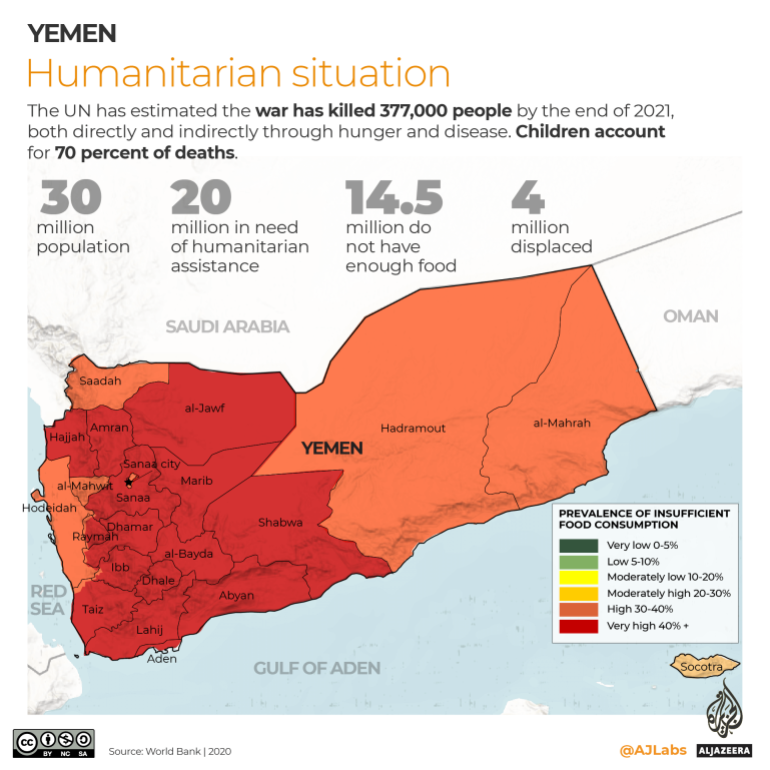
At the beginning of the year, the UN’s World Food Programme (WFP) was forced to reduce food rations for eight million people due to a funding shortage, with households receiving barely half of the WFP standard daily minimum food basket. Now the shortage of funds is putting five million more at risk of slipping into famine-like conditions
Griffiths, the former UN special envoy to Yemen, said the dire humanitarian situation in Yemen may get worse, as wheat imports from Ukraine, which supplies some 40 percent of Yemen’s grains, may come to a halt.
“Ukraine is a breadbasket for many countries and needs to remain so,” said Griffiths, warning of the knock-on effects the Russian war on Ukraine may bear on other conflict areas that depend on the country’s wheat production.
Food assistance: 19 million in need
The fighting pits Iran-allied Houthi rebels, who control many of the country’s most populated regions including the capital Sanaa, against the internationally-recognised Yemeni government. A Saudi-led coalition backs the Yemeni government, and has led an air campaign against the Houthis since March 2015. . .
“Peace is required to end the decline,” said UN Resident and Humanitarian Coordinator for Yemen David Gressly in a statement on Tuesday. “The parties to the conflict should lift all restrictions on trade and investment for non-sanctioned commodities. This will help lower food prices and unleash the economy.”
Yemen’s economy has collapsed amid a Saudi-led coalition blockade of its main ports, which is limiting access to food and fuel, as well as non-essential commodities entering the country. Parties to the conflict, including the Houthis and the Yemeni government, have also restricted the transfer of fuel and goods across the country.
At the beginning of the year, the UN’s World Food Programme (WFP) was forced to reduce food rations for eight million people due to a funding shortage, with households receiving barely half of the WFP standard daily minimum food basket. Now the shortage of funds is putting five million more at risk of slipping into famine-like conditions
Griffiths, the former UN special envoy to Yemen, said the dire humanitarian situation in Yemen may get worse, as wheat imports from Ukraine, which supplies some 40 percent of Yemen’s grains, may come to a halt.
“Ukraine is a breadbasket for many countries and needs to remain so,” said Griffiths, warning of the knock-on effects the Russian war on Ukraine may bear on other conflict areas that depend on the country’s wheat production.
Food assistance: 19 million in need
In a report published on Monday, the UN’s WFP, its Food and Agriculture Organization (FAO) and its United Nations Children’s Fund (UNICEF) warned that the humanitarian situation in Yemen is poised to get worse between June and December 2022.
Some 19 million people are projected to be in need of food assistance, an increase from the current 17.4 million. Of these, 7.3 million people will be facing emergency levels of hunger.
The report also shows a persistently high level of acute malnutrition among children under the age of five. Across the country, some 2.2 million children are acutely malnourished, including more than half a million children facing severe acute malnutrition, a life-threatening condition.
In addition, around 1.3 million pregnant or nursing mothers are acutely malnourished. New data also shows that the number of people experiencing famine conditions is projected to increase fivefold, from the current 31,000 to 161,000 in the second half of 2022.
“Peace is required to end the decline,” said UN Resident and Humanitarian Coordinator for Yemen David Gressly in a statement on Tuesday. “The parties to the conflict should lift all restrictions on trade and investment for non-sanctioned commodities. This will help lower food prices and unleash the economy.”
. . .Food prices have more than doubled in 2021, while during the same period many salaries have not been paid and remittances have stagnated due to COVID-19.
“We need to inject liquidity, lift restrictions on imports and remove the blockade of the main ports as well as resume flights into the country,” said Griffiths. “While I understand there is a UN Security Council arms embargo and shipments need to be checked and inspected, we have to let in food and fuel.”
UN mismanagement
Answering questions about accusations of aid diversion by the Houthi rebels in Sanaa, and mounting criticism of UN funds mismanagement, officials acknowledged that they faced problems, but that they had to negotiate with authorities on the ground.
“There are obstacles and we are pushing to improve the operating environment,” said Deputy Director-General at the Swedish Ministry for Foreign Affairs Carl Skau, one of the organisers of the pledging conference. “However, humanitarian assistance is a lifeline and makes all the difference … the obstacles cannot be used as an excuse not to deliver aid.”
The UN response system has faced criticism, including from the UN Panel of Experts on Yemen, and former UN workers. This criticism has highlighted incidents where aid has allegedly been diverted by the Houthis in areas under their control, and did not reach the most vulnerable.
“We are aware of nine instances which are being investigated,” admitted Griffiths. “Delivering assistance is hard because of the detailed negotiations with all kinds of actors on the ground. But I don’t see a single crisis where this is not happening.”
So far only 60.9 percent of Yemen’s 2021 response plan, amounting to $3.9bn, has been funded, leaving a funding gap of $1.5bn. Amongst the top donors in 2021 were the United States, Saudi Arabia, Germany, the United Arab Emirates, and the European Union.
TONIGHT 8-11PM: Live Music Angel Robles
ANGEL ROBLES is k nown for an eclectic set list that spans multiple genres, . . He utilizes loop pedals, acoustic guitars, and backing...

-
 Flash News: Ukraine Intercepts Russian Kh-59 Cruise Missile Using US VAMPIRE Air Defense System Mounted on Boat. Ukrainian forces have made ...
 -
A nor’easter is about to hit the Northeast in May. That’s very unusual.

