Wednesday, April 20, 2022

"GUNS-AND-BUTTER"

STATEMENT: A foundational element for any successful economy is peace and stability, giving firms the confidence to invest and people the space to flourish
Here's the usual case for counter argument: When governments spend more on soldiers and arms, they have less available for other things.
A common assumption, therefore, is that extra spending on armies is harmful to growth and development.
But the relationship is not so straightforward.
In some cases bigger defense budgets may in fact yield substantial economic benefits.

What bigger military budgets mean for the economy

"IN THE WAKE of the war in Ukraine, military budgets around the world are about to get bigger. This is most notable in Europe, where the threat of Russian aggression looms largest. Germany, Italy and Norway, among others, have already decided to spend more on defence. America and China, the world’s two biggest military spenders, are also ramping up their allocations. Pressure on smaller countries to do likewise seems inevitable. . .

Listen to this story.
Enjoy more audio and podcasts on iOS or Android.

That there is a trade-off between spending on the army and on, say, roads or hospitals is a lesson that students of economics internalise early on. The classic model for illustrating the concept of opportunity costs is guns versus butter: the more you produce of one, the less you can of the other. In any given year, that simple model holds true. Governments have finite budgets, which can only be pulled in so many different directions.

It is thus easy to see how spending on defence, taken to an extreme, could be corrosive for an economy. If a government shortchanges the education system in order to buy shiny new weapons, the long-run impact on productivity and, ultimately, growth would be baleful. Some economists think America is nearing that danger zone. The RAND Corporation, an influential think-tank supported by the Air Force, not exactly known as a peacenik outfit, published a report in 2021 laying out two risks. First, when the government allocates money to defence at the expense of infrastructure, that may undermine long-run growth prospects, since America has a pressing need for better roads, ports and more. Second, defence spending contributes to the public-debt load. In both cases, the analysts conclude, anything that erodes America’s economic strength will ultimately hurt the armed forces.

A sprawling body of research has come to a similar, albeit more nuanced, conclusion.

. . .Effects are generally quite small, but they found two distinct categories: military expenditure in poorer countries is often detrimental to growth, whereas in wealthier countries it is more likely to be beneficial.

One possible reason, they suggest, is weaker governance in developing countries; a big military budget is a juicy target for corrupt officials.

Another possibility relates to the gun-versus-butter framework. The potential returns on civilian investments, from health care to education, are so great in poor countries that military spending has a particularly high opportunity cost. In rich countries with good schools and hospitals, the opportunity costs ought to be lower.

 

Federal District Judge Kathryn Kimball Mizelle: Trump appointee considered unqualified for the job by the American Bar Association

Intro: A 'sanitized' selection of headline news stories from many different sources, including the first snippet from Bloomberg Politics

Trump-Appointed Judge Becomes Hero on Right for Mask Ruling

Video player cover image
Mask Mandates Dropped by Most Major U.S. Airlines on Court Ruling
Updated on
 

TOP STORIES:


RELATED CONTENT

Federal Judicial Service District Judge, United States District Court for the Middle District of Florida Nominated by Donald J. Trump (link is external) on ...
10 hours ago · US District Judge Kathryn Kimball Mizelle has been serving as a federal judge in Florida for more than a year. Notably, the Senate vote ...
10 hours ago · Kathryn Kimball Mizelle (born 1987) is an American attorney and jurist serving as a United States District Judge of the United ...
14 hours ago · U.S. District Judge Kathryn Kimball Mizelle struck down the federal mask mandate for airplanes and other modes of public transportation ...


LOCKED SHIELDS: Protecting Numerous Cyber-Physical Systems: NATO holds Major Three-Day ‘Live-Fire' Cyber Exercise

A cyber organization accredited by the North Atlantic Treaty Organization will conduct what it bills as the largest and most complex “live-fire” cyber defense exercises in the world beginning on Tuesday.
The NATO Cooperative Cyber Defense Center of Excellence, which is based in Estonia, said the annual event, called Locked Shields, is intended to boost the skills of cybersecurity experts defending national IT systems and critical infrastructure under real-time attacks.
> For the first time the exercise includes the simulation of a reserve management and financial messaging systems of a central bank.
> Additionally, a 5G Standalone mobile communication platform is deployed as part of a critical infrastructure to give the first experience to cyber defenders about upcoming technology change.
In total there are more than 2000 participants from 32 nations expected to be involved in Locked Shields 2022. The exercise is organised by CCDCOE in cooperation with NATO, Siemens; TalTech; Clarified Security; Arctic Security; CR14. The Centre also acknowledges the unique elements added to Locked Shields 2022 by Microsoft, the Financial Service Information Sharing and Analysis Center (FS ISAC), SpaceIT, Fortinet.

Additional information: media@ccdcoe.org

OFFICIAL NOTICE:

Over 2000 Cyber Experts from 32 nations at the Locked Shields Exercise

<div class=__reading__mode__extracted__imagecaption>Over 2000 Cyber Experts from 32 nations at the Locked Shields Exercise

During two days more than 2000 participants from 32 nations practise the protection of national IT systems and critical infrastructure under the pressure of a large-scale cyberattack at the annual live-fire cyber defence exercise Locked Shields. In addition to protecting numerous cyber-physical systems the participating teams practice tactical and strategic decision making, cooperation and the chain of command in a crisis situation where they also have to tackle forensic and legal issues and respond to information operations challenges.

The annual real-time network defence exercise is a unique opportunity for cyber defenders to practise protection of national IT systems and critical infrastructure under the pressure of a severe cyberattack.


19 Apr, 2022 16:25 

Tuesday, April 19, 2022

“It’s a symbol, a message. It reflects our inner patriotism"

Crude and vulgar it is but at the same time when a shortlist of 50 designs were put to a vote, with the warship the triumphant winner. “It was democratic, just like Ukraine,”
“People are in love with it. It reflects the mood around the world towards Russia,” said Igor Smelyansky, Ukrposhta’s director general.
Smelyansky has also produced a “Russian warship, go fuck yourself” T-shirt, which will soon go on general sale

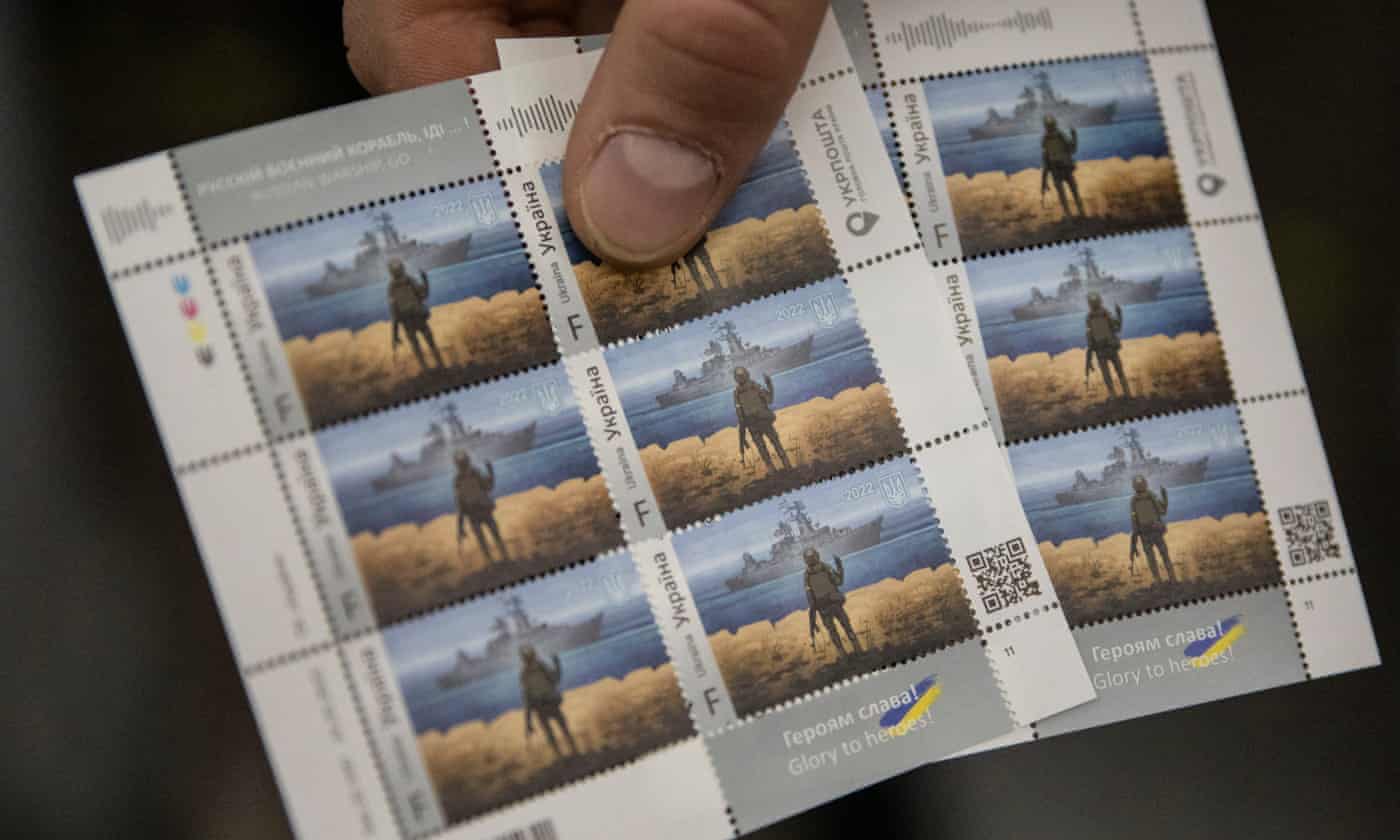
‘Russian warship, go …!’: Ukrainians queue for stamp celebrating act of defiance

<div class=__reading__mode__extracted__imagecaption>The stamp was published the day before Ukrainian missiles took down the Moskva. Photograph: Alessio Mamo/The Guardian<br>The stamp was published the day before Ukrainian missiles took down the Moskva. Photograph: Alessio Mamo/The Guardian</div>

Country takes pride in limited-edition design featuring soldier giving middle-finger salute

"After spending four hours in a queue, Viktor Fyodorovich showed off his shiny new purchase. “I’m 63 years old. I’ve never felt so much pride before in our nation. It’s a symbol of our courage and steadfastness,” he said. . .

(Kyiv’s independence square.)

Fyodorovich was the proud owner of two sheets of stamps, 16 in total. Available from Kyiv’s central post office, the stamps show a Ukrainian soldier giving the finger to the flagship Russian cruiser Moskva. On the sheet’s perforated margin is the phrase that has become a rallying slogan for Ukrainians in their underdog battle against Moscow: “Russian warship, go …!” The “fuck yourself” is tactfully omitted.

The words were spoken by Roman Hrybov when the warship’s crew asked him and his fellow border guards on Snake Island, south of the port of Odesa, to surrender in the early hours of Vladimir Putin’s invasion. The phrase has since gone global. Last week the national postal service, Ukrposhta, released the design as a special commemorative stamp. . ."

Reference: https://www.theguardian.com/world/2022/apr/19/russian-warship-go-ukrainians-queue-for-stamp-celebrating-act-of-defiance

BEANSTALK SECURITY BREACH...Latest Articles TODAY | Bleeping Computer

A post-mortem analysis of the attack from smart contract auditors and developers at Omniscia explains that the hacker managed to steal the assets via a malicious proposal. . .
What happens now 
Beanstalk hasn't shared its plans moving forward, so reimbursing the investors remains an uncertain action.
"We believe there is a need to educate and inform non-technical market participants about the status, scope and limitations of technical audits. Our team is currently working on multiple initiatives aimed at demystifying audits," reads the analysis.
> The platform is still investigating the incident and has openly called the DeFi community and blockchain analytics experts to help them salvage what they can. At the same time, it has also invited the exploiter to negotiate.
. . .Interestingly, PeckShield blockchain analytics reports that the hacker has donated $250,000 of the stolen amount to Ukraine.
 

Beanstalk DeFi platform loses $182 million in flash-loan attack

"The decentralized, credit-based finance system Beanstalk disclosed on Sunday that it suffered a security breach that resulted in financial losses of $182 million, the attacker stealing $80 million in crypto assets.

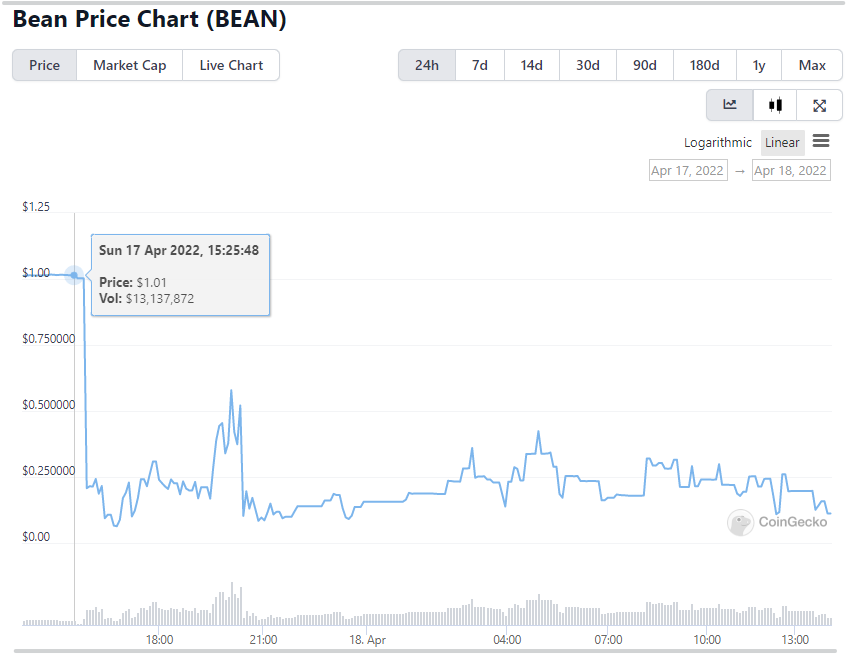
As a result of this attack, trust in Beanstalk's market has been compromised, and the value of its decentralized credit-based BEAN stablecoin has collapsed from a little over $1 on Sunday to $0.11 right now.

The drop in BEAN's value within a day(CoinGecko)

. . .

Essentially, the attacker allowed themselves to drain all of the protocol's funds to a private Ethereum wallet in an instance, having the power to vote in favor of the action.

A flash loan allows users to borrow a large amount of stablecoins from other traders without offering a collateral (unsecured) and the process of approving a loan and returning it happens in a single transaction on the blockchain, within seconds.

DeFi platforms under fire

A Chainalysis report from last week indicates that DeFi platforms are the primary focus of crypto-heists in 2022, and the Beanstalk incident is yet another confirmation of this trend.

Typically, these hacks occur either via a security breach or an exploit in the code, so flash-loan attacks are likely to became less frequent.

LATEST ARTICLES https://www.bleepingcomputer.com/

Drones, hackers and mercenaries - The future of war | DW Documentary

MERCENARIES EMBEDDED WITH UKRAINIAN NATIONALISTS IN AZOVSTAL METALLURGICAL PLANT

An estimated 6,824 foreign mercenaries from 63 countries have come to Ukraine to fight for Volodymyr Zelensky’s government, the Russian Defense Ministry stated on Sunday.
Of these, 1,035 have been “destroyed,” while several thousand remain.
Four hundred foreign fighters are holed up in Mariupol, where nationalist forces, including the neo-Nazi fighters, have refused to surrender.
18 Apr, 2022 03:07

Russia publishes data on foreign mercenaries in Ukraine

400 foreign fighters remain trapped in Mariupol, where Kiev forces have refused an offer to surrender

Russia publishes data on foreign mercenaries in Ukraine

Source: https://www.rt.com/russia/554029-foreign-mercenaries-ukraine-mariupol/

". . .The most numerous group of foreign fighters (1,717) arrived from Poland, while around 1,500 came from the US, Canada and Romania. Up to 300 people each came from the UK and Georgia, while 193 arrived from the Turkish-controlled areas of Syria. 

These figures were announced on Sunday by Defense Ministry spokesman Major General Igor Konashenkov. According to the general, 1,035 foreign mercenaries have been killed by Russian forces and 912 fled Ukraine, leaving 4,877 active in the cities of Kiev, Kharkov, Odessa, Nikolaev and Mariupol.

Roughly 400 of these foreign fighters remain embedded with Ukrainian nationalist battalions in the besieged port city of Mariupol, Konashenkov stated. With most of the city under Russian control, these forces have dug in at the sprawling Azovstal metallurgical plant, a gargantuan Soviet-built factory complex spread over 11 square kilometers.

“Most of them are citizens of European countries, as well as Canada,” Konashenkov stated, adding that Russian forces have intercepted radio communications from the plant in six foreign languages. After the surrender of more than 1,000 members of Ukraine’s 36th Marines Brigade at the Ilyich Steel and Iron Works in Mariupol earlier this week, which Ukraine denies, the Russian military offered the defenders at Azovstal a final chance to lay down their arms and surrender on Sunday morning, promising that “all who lay down their weapons are guaranteed the preservation of life.”

No such surrender took place, and the pounding of heavy guns could be heard near the plant on Sunday afternoon. “In case of further resistance, all of them will be destroyed,” Konashenkov said.

“Let me remind you that foreign mercenaries do not have the status of ‘combatants’ under International Humanitarian Law,” Konashenkov said. “They came to Ukraine to earn money by killing Slavs. Therefore, the best that awaits them is criminal liability and long prison terms.”

Within days of Russia’s military assault on Ukraine, the government in Kiev promised visa-free entry for foreigners willing to take up arms against Moscow’s forces. Potential recruits visited Ukrainian embassies across the West and signed up to fight – often with the blessing of their own governments – and made their way to the battlefield.

Russia says it’s struck another mercenary base in Ukraine                 
                  READ MORE: Russia says it’s struck another mercenary base in Ukraine

However, recruitment was narrowed in March to those with military experience, and paused entirely at the beginning of April. A spokesman for Ukraine’s so-called “International Legion” told Canadian media that sending untrained volunteers to the front was becoming more of a hindrance than a help, and supplies of firearms and ammunition were running low.

Some of those who made the journey shared horror stories online of being sent to the front lines with inadequate weapons and ammo, while recruitment suffered after a Russian missile strike leveled a training center for these foreigners near the Western Ukrainian city of Lvov. “Up to 180 foreign mercenaries and a large quantity of foreign weapons were destroyed,” Konashenkov said at the time."


NO CAPTAIN ONBOARD