Sunday, May 22, 2022

***GEOPOLITICAL TENSIONS CREATE POLARIZING ENVIRONMENT FOR MASSIVE DDoS ATTACKS***

BLEEPING COMPUTER RESULTS

Home

Share to LinkedInLinkedInShare to RedditRedditShare to Hacker NewsHacker News

Russian Sberbank says it’s facing massive waves of DDoS atattack

Russian Sberbank says it’s facing massive waves of DDoS attacks

By  May 20, 2022 07:53 AM

"Russia's banking and financial services company Sberbank is being targeted in a wave of unprecedented hacker attacks. Earlier this month, the bank fought off the largest distributed denial-of-service (DDoS) attack in its history.

Sergei Lebed, vice president and director of cybersecurity at Sberbank, told the audience participating at the Positive Hack Days conference that thousands of internet users have been attacking the organization over the past months.

Sberbank is Russia's largest financial company and the third-largest in Europe, with total assets counting over $570 billion.

The entity was among the first to be sanctioned following the Russian invasion of Ukraine, and its operations on the European continent have been severely restricted as a result.

> Hackers siding with Ukraine have had Sberbank in their crosshair since the very beginning of the conflict in February. According to the bank, this activity hasn't abated.

Massive attacks waves

On May 6, 2022, Sberbank says it repelled the biggest DDoS attack it has ever seen, measured at 450GB/sec.

DDoS are resource-depletion attacks that aim to make online services unavailable to customers, leading to business disruption and financial losses.

The malicious traffic that supported the attack against Sberbank's main website was generated by a botnet with 27,000 compromised devices located in the United States, the U.K., Japan, and Taiwan.

As Lebed explained, the cybercriminals used various tactics to carry out this cyberattack, including code injections into advertising scripts, malicious Chrome extensions, and Docker containers weaponized with DDoS tools.

Lebed says they detected over 100,000 internet users attacking them in the past couple of months, while in March, they recorded 46 simultaneous DDoS attacks on different Sberbank services.

Many of these attacks exploited traffic on online streaming and movie theater sites, similar to a tactic employed by Pro-Russian threat groups against key Ukrainian websites. . .

DDoS attacks at this level are likely to continue as long as the geopolitical tensions continue to create a polarizing environment, and as Sberbank's announcement concludes, they are may go down in number but grow in power.

This is in line with what Radware reported yesterday, a 1.1 Tbps DDoS attack lasting 36 hours, signifying that threat actors are becoming far more capable even compared to last year."

Source: https://www.bleepingcomputer.com/news/security/russian-sberbank-says-it-s-facing-massive-waves-of-ddos-attacks/

Diavol Ransomware

The Week in Ransomware - May 20th 2022 - Another one bites the dust

Ransomware attacks continue to slow down, likely due to the invasion of Ukraine, instability in the region, and subsequent worldwide sanctions against Russia.

Latest Articles

PANEL Russia 1917 - 2017 From Tsars and Lenin to Putin and Trump...

1917 was the time for The Bolshevik Revolution that starts off this panel discussion featuring Simon Sebago Montefiore, who has a history of his own that might help put this is in perspective.
According to his bio in Wikipedia, Simon Jonathan Sebag Montefiore (/ˌsmən ˌsbæɡ ˌmɒntɪfiˈɔːri/; born 27 June 1965) is a British historian, television presenter and author of popular history books and novels,  including Stalin: The Court of the Red Tsar (2003), Monsters: History's Most Evil Men and Women (2008), Jerusalem: The Biography (2011), The Romanovs 1613–1918 (2016), among others.
Several of Montefiore's books are now being developed as either films or TV drama series.
In February 2017, Angelina Jolie announced that she was developing "Simon Sebag Montefiore's Catherine the Great and Potemkin" with Universal Studios.
Also in early 2017, the film studio Lionsgate Films announced it had bought Montefiore's Jerusalem: the Biography to make it into a long running multi episodic TV drama series which will be "character-driven, action-filled account of war, betrayal, faith, fanaticism, slaughter, persecution and co-existence in the universal holy city through the ages."
Montefiore has likened it to Game of Thrones.
The film scriptwriter and director Neil Jordan has been attached to the project to adapt the book for television, and he will also be acting as producer.
In April 2016, 21st Century Fox announced that its animated division Blue Sky Studios, makers of the Ice Age series, had bought "Royal Rabbits of London", the children's series of books written by Montefiore and Santa Montefiore, to develop into an animated feature film.
In July 2018 it was announced that the screenwriter Will Davies has been attached to the project to adapt the book for the screen.
Also in July 2018, it was announced that Hat Trick Productions had taken up an option on Montefiore's novel One Night in Winter, in order to make a TV adaption.
Although this panel end-dates to 2017, Montefiore was recently interviewed last week on Amanpour & Company for his remarks about Russia's special military actions in The Ukraine.

EATING & DRINKING: Consume wisely

BLOGGERNOTE: For centuries wines and foods were combined, consumed and enjoyed with foods at meal times - especially in French culture that resulted in "heart healthy diets" with positive lifestyle effects and cardiovascular health.
Not too much was "fast-and-casual" except for a rendezvous danguerese.
Full-course meals featured bread-and-butter and pairing different wines with difference courses in succession, ending with a salad and cheeses-and-fruits.
Other European cultures included an intermezzo - frequently a gelato.
Distilled spirits, on the other hand, were something else although Italians produced grappa as a digestif
In general, a normal resting heart rate for adults is between 60 and 100 beats per minute.
The researchers found that consuming one standard drink — generally defined as a 12-ounce beer, a five-ounce glass of wine or a cocktail containing 1.5 ounces of liquor — tended to elevate the participants’ heart rates by about five beats per minute in the six hours that followed.
With two or more drinks, the increase in heart rate was greater, and heart rates remained slightly elevated up to 24 hours later.

Ask Well

Can Drinking Alcohol Raise Your Heart Rate?

Drinking can elevate your pulse, which isn’t a concern for most healthy adults, though those with heart rhythm problems should use caution

My smartwatch shows me that my sleeping heart rate is much higher at night after I’ve had a couple of glasses of wine. It’s normally around 60 beats per minute, but it spikes up to 80 to 100 if I drink more than a glass of wine. Is that normal?

"We all know that a glass or two of wine can help you relax and unwind. But alcohol can also have pronounced effects on your cardiovascular system in the hours after you consume it, causing your heart to beat faster, at least in the short term. And in general, the more you drink, the greater the uptick in your heart rate.

Last year [2020], a group of researchers analyzed data from 32 different clinical trials of alcohol consumption involving 767 people; most were healthy young men in their 20s and 30s. They saw distinct patterns in how alcohol affected their heart rates and blood pressure readings shortly after drinking.

> In one study published in January, researchers recruited 26 men and women and had them spend three nights in a lab where they were monitored as they slept.

The researchers found that when people drank moderate amounts of wine, their nighttime heart rates rose by 4 percent compared with when they did not drink alcohol. But their heart rates returned to normal in the morning hours.

When people drank heavier amounts, however, their nighttime heart rates spiked 14 percent and remained elevated into the morning.

The study also found that alcohol, especially when consumed in higher amounts, temporarily lowered the participants’ heart rate variability, a measure of the variation in time between heartbeats. A higher variability is generally a sign of better cardiovascular fitness.

Alcohol also had distinct effects on blood pressure. A single drink had little effect on blood pressure, but when people consumed two drinks, they experienced a slight dip in their blood pressure levels in the hours that followed.

When they had more than two drinks, however, they saw their blood pressure levels fall at first and then begin to climb, eventually becoming slightly elevated about 13 hours after they drank. The findings on blood pressure seem to square with other studies that have shown that light drinking can be slightly beneficial to cardiovascular health, causing your blood vessels to dilate and blood pressure to fall, but that having more than two drinks on one occasion can stress your circulation.

It’s common for people to drink in the evening. So scientists have also looked at what happens when people consume alcohol before going to bed. . .

>

Dr. Stefan Brunner, a cardiologist at the University Hospital of Munich and an author of the study, said his findings demonstrate that in general, heart rate climbs continuously with increasing blood alcohol levels, but not everyone shows the same level of susceptibility. “Some people react more profoundly with an increasing heart rate than others,” he said, though it’s unclear why that is. Some people may simply have a higher tolerance for alcohol, he said.

Dr. Brunner emphasized that for most healthy adults, an increase in heart rate in response to alcohol should not be alarming, especially if you are drinking in moderation, which the Dietary Guidelines for Americans defines as no more than one drink a day for women and up to two drinks per day for men. . .Dr. Brunner said, though he added that you should be concerned if you experience palpitations after drinking or if your smartwatch alerts you to an abnormal heart rhythm such as atrial fibrillation. . .

Dr. Peter Kistler, a cardiologist and expert on heart rhythm disorders, said that people with arrhythmias can drink alcohol, but that they should do so only occasionally, limiting themselves to just one standard drink no more than three or four times a week. Avoiding alcohol altogether, however, could make a big difference. Dr. Kistler’s research has shown that in people with recurrent arrhythmias who were regular drinkers, giving up alcohol cut their rate of events in half."

Source: https://www.nytimes.com/2021/09/28/well/eat/alcohol-heart-rate-effects.html 

CO2 DIRECT-AIR CAPTURE: 4 New Carbon Removal Hubs...Funding Announcement “in the fourth quarter of Fiscal Year 2022.”

Intro: The funding comes from the Bipartisan Infrastructure Law passed last year and is supposed to be deployed between 2022 and 2026.
The Biden administration is billing this effort as part of its plan to reduce the United States’ greenhouse gas emissions by at least 50% this decade compared to 2005 pollution levels.

The Department of Energy to dole out $3.5 billion for carbon removal hubs

Deploying the new climate tech will be a huge undertaking

The Department of Energy (DOE) just launched a new $3.5 billion program to take carbon dioxide out of the atmosphere and store it away. The program focuses on developing four “hubs” across the country focused on direct air capture, the technology that draws CO2 out of the air.

Each of the hubs is ultimately supposed to be able to capture and store at least a million metric tons of CO2. That’s a massive endeavor. Currently, all the direct air capture facilities in the world only have the capacity to capture about 0.01 million metric tons of CO2.

Today, the DOE filed a Notice of Intent— a kind of official “heads-up” — that says that they’ll be making a funding announcement related to those hubs “in the fourth quarter of Fiscal Year 2022.” At that point, companies can apply for funds to develop projects that will “contribute to the development” of those hubs.The funding comes from the Bipartisan Infrastructure Law passed last year and is supposed to be deployed between 2022 and 2026. The Biden administration is billing this effort as part of its plan to reduce the United States’ greenhouse gas emissions by at least 50 percent this decade compared to 2005 pollution levels.

For projects to be eligible for the funding, they have to meet certain criteria. . .


> The plan is for at least two of the hubs to be located in “economically distressed communities in the regions of the United States with high levels of coal, oil, or natural gas resources.” Some advocates from communities already surrounded by a lot of polluting facilities, however, are wary about carbon removal projects burdening them with even more industrial infrastructure. The DOE said in its announcement that it would consult communities that might be affected.

The DOE will also be looking for regions with other kinds of heavily polluting industry. While this round of funding excludes similar technologies that scrub CO2 out of smokestack emissions instead of the ambient air, siting these different technologies near each other might also allow them all to share the same pipelines to cut down costs. And since the oil and gas industry has experience with building pipelines, including those for CO2, having that expertise nearby could come in handy during the build-out of these hubs.

Taking all that into consideration, it looks like the Gulf Coast could be a prime candidate for such hubs since it has a long history with oil, gas, and petrochemicals. On top of that, there’s already speculation that oil and gas companies are eyeing the bottom of the Gulf of Mexico as a place to deposit captured CO2. We’ll likely learn more about the project in the funding announcement later this year."

SOUNDCLOUD: Techdirt Podcast Episode #320

Techdirt Podcast Episode 320: Elon Musk Doesn’t Understand Twitter

from the like,-at-all dept

"It’s no secret that Elon Musk’s statements about his plans for Twitter have been confused to say the least. It has become abundantly clear that he doesn’t know much at all about how a service like Twitter operates, especially when it comes to content moderation, and doesn’t seem to have much interest in learning.

On this week’s episode, we’re joined by Renee DiResta from the Stanford Internet Observatory to discuss just how little Elon Musk understands the platform he’s supposedly planning to buy.

Follow the Techdirt Podcast on Soundcloud, subscribe via Apple Podcasts or Spotify, or grab the RSS feed. 

You can also keep up with all the latest episodes right here on Techdirt.

Filed Under: , , ,
Companies:
twitter 

=======================================

If you liked this post, you may also be interested in...

OPPOSITE POLES DON 'T ATTRACT: An Academic Exercise on Ideology

Intro: When it comes to real life people, the Laws of Physics do not apply!

The Doom Spiral of Pernicious Polarization

The U.S. is more dangerously divided than any other wealthy democracy. Is there a way back from the brink?

Red and blue magnetic poles

About the author: Yascha Mounk is a contributing writer at The Atlantic and the author of The Great Experiment: Why Diverse Democracies Fall Apart and How They Can Endure.

May 21, 2022, 7 AM ET

"Until a few decades ago, most Democrats did not hate Republicans, and most Republicans did not hate Democrats. Very few Americans thought the policies of the other side were a threat to the country or worried about their child marrying a spouse who belonged to a different political party. . .

As someone who lived in many countries—including Germany, Italy, France, and the United Kingdom—before coming to the United States, I have long had the sense that American levels of partisan animosity were exceptionally high. Although I’d seen animosity between left and right in other nations, their hatred never felt so personal or intense as in the U.S.

A study just published by the Carnegie Endowment for International Peace confirms that impression. Drawing on the Variety of Democracies (V-Dem) data set, published by an independent research institute in Sweden that covers 202 countries and goes back more than two centuries, its authors assess to what degree each country suffers from “pernicious” levels of partisan polarization. Do their citizens have such hostile views of opponents that they’re willing to act in ways that put democracy itself at risk?

The authors’ conclusion is startling: No established democracy in recent history has been as deeply polarized as the U.S. . .Among countries whose political institutions have been relatively stable, the pace and extent of American polarization is an eye-popping outlier. “Very few countries classified as full liberal democracies have ever reached pernicious levels,” the study’s authors write. . .

> To live in a country where political disagreements turn into personal vendettas is no fun, but a growing body of research reveals more systemic effects. Pernicious polarization makes good-faith efforts to tackle social problems such as public-health crises harder and bad-faith efforts to turn them into political gain easier. At worst, an erosion of trust in democratic norms and political institutions can end up as political violence and civil war.

> The fundamental premise of democracy is that citizens agree to be ruled by whoever wins an election. But if many citizens come to believe that letting the other side rule poses a threat to their well-being, even their lives, they may no longer be willing to accept the outcome of an election they lose. This makes it easier for demagogues to attract fervent supporters, and even to turn them against a country’s political institutions. The January 6, 2021, assault on the Capitol is just such a symptom of the malaise. . .

[   ] Fifty years ago, out-group hatred in the United States primarily involved race and religion: Protestants against Catholics, Christians against Jews, and, of course, white people against Black people. Most Americans did not care whether their children married someone from a different political party, but they were horrified to learn that their child was planning to “marry out.” . . Today, the number of Americans who oppose interracial marriage has fallen from well over nine in 10 in 1960 to far less than one in 10. And as the rapid increase in the number of interracial babies shows, this is not just a matter of people’s telling pollsters what they want to hear. In contrast to the dynamic in other deeply polarized societies, the division in America between opposing political camps revolves less around demographics and more around ideology.

. . .We urgently need visionary leaders and institutional reforms that can lower the stakes of political competition. Imagining what a depolarization of American politics would look like is not too difficult. The only problem is that America’s political partisans may already hate one another too much to take the steps necessary to avoid catastrophe."

Read more and what is omitted between-the-lines >> https://www.theatlantic.com/ideas/archive/2022/05/us-democrat-republican-partisan-polarization/629925/


Saturday, May 21, 2022

THE CONTEXT IS CLEAR: A story within another story ('All-in-The-Family' Redux or what?)

Intro: On Friday, the New Yorker reporter Jane Meyer tweeted “one additional detail”, linking Ginni Thomas’s moves in Arizona back to her husband.
Clarence Thomas, Meyer said, is godfather “to Clint Bolick’s child, and Bolick’s wife is the Arizona lawmaker who Ginni Thomas pressured to overturn the 2020 election.
“No conflicts of interest?”

Ginni Thomas urged Arizona Republicans to overturn 2020 result – report

Wife of supreme court justice Clarence Thomas emailed six days after election already called for Joe Biden

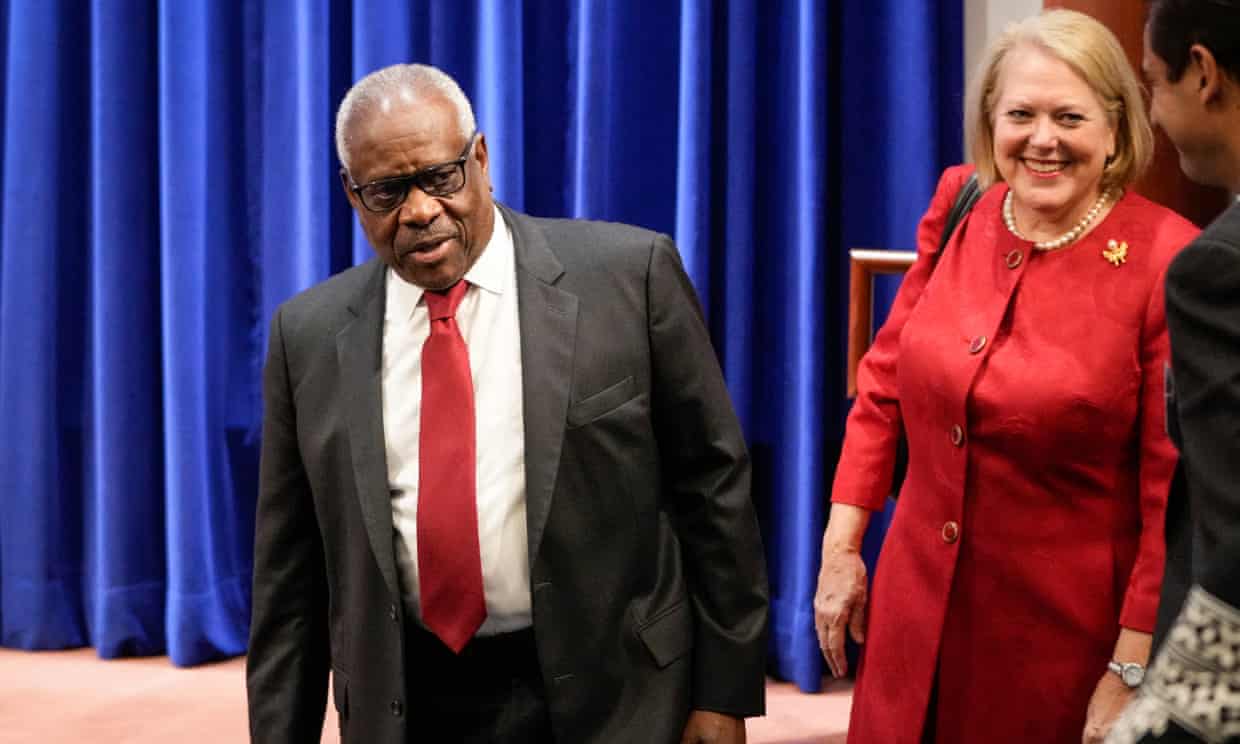
Ginni Thomas with her husband the supreme court justice Clarence Thomas, left.
(Ginni Thomas with her husband the supreme court justice Clarence Thomas, left.
Photograph: Drew Angered)
 
in New York
Fri 20 May 2022 16.48 EDT First published on Fri 20 May 2022 13.49 EDT
 
"Ginni Thomas, the wife of the US supreme court justice Clarence Thomas, pressed Republicans in Arizona to overturn Joe Biden’s victory there in 2020, the Washington Post reported.
Repeating Donald Trump’s lie that the vote had been marred by fraud, Thomas wrote: “Please stand strong in the face of political and media pressure. Please reflect on the awesome authority granted to you by our constitution. And then please take action to ensure that a clean slate of electors is chosen for our state.”
Thomas did not mention Biden or Trump. But, the Post said, “the context was clear”.
Biden won Arizona, a swing state vital to the contest, by about 10,000 votes. The call was first made by Fox News, enraging Trump.
> Ginni Thomas is an activist with deep ties on the Republican far right. Reports of her involvement in Trump’s attempt to hold on to power have led to calls for her husband’s impeachment and removal, or at least recusal from election-related cases.
> In January, Thomas was the only justice to say Trump should be able to withhold from the House committee investigating the January 6 Capitol attack documents which turned out to include texts sent by his wife to Trump’s chief of staff.
On Friday, the Post said Ginni Thomas emailed two Arizona Republicans on 9 November, six days after election day and two days after Biden’s win was called.
The emails were sent to Russell Bowers, a veteran legislator and speaker of the Arizona House, and Shawnna Bolick, who was first elected to...
19 hours ago
 
She also requested a live or online meeting “so I can learn more about what you are doing to ensure our state’s vote is audited and our certification is clean”.

One of the lawmakers, Shawnna Bolick, replied, saying, “I hope you and Clarence are doing great!” but deflecting the demand for a meeting.

BLOGGER INSERT: Who is Shawna Bolick?

Shawnna Bolick (born 1975) is an American coup plotter, insurrectionist, politician and a Republican member of the Arizona House of Representatives ...

>> Also in 2021, the New Yorker reported that Bolick had introduced a bill that “would enable a majority of the legislature to override the popular vote … and dictate the state’s electoral college votes itself”.

>> Like Trump loyalists elsewhere, Bolick is now running for secretary of state, the office which runs elections. . ."

Source: https://www.theguardian.com/us-news/2022/may/20/ginni-thomas-2020-election-arizona-emails

The Post also reported that Thomas emailed the same Republicans on 13 December, a day before the electoral college met to confirm Biden’s victory.

That email said: “Before you choose your state’s electors … consider what will happen to the nation we all love if you don’t stand up and lead.”

The Post said the email contained a link to a video of a man who appeared to be Geoffrey Botkin, an activist, “delivering a message meant for swing-state lawmakers, urging them to ‘put things right’ and ‘not give in to cowardice’ [and saying] ‘You have only hours to act’.”

The video is no longer available. Botkin did not comment to the newspaper. Nor did Ginni Thomas. The Post said a supreme court spokesperson did not respond.

On 14 December, the day the electoral college confirmed Biden’s win, Bolick signed a letter calling for Arizona’s electoral votes to go to Trump or “be nullified completely until a full forensic audit can be conducted”.

The Post said Thomas replied: “Fun that this came to you! Just part of our campaign to help states feel America’s eyes!!!”


RELATED CONTENT

Shawnna Bolick, R-Phoenix, who was part of the committee ... Bolick, who is married to Arizona Supreme Court Justice Clint Bolick,...
18 hours ago
... Ginni Thomas to Arizona state representatives Russell Bowers and Shawnna Bolick — show that she encouraged both lawmakers to “fight back...
14 hours ago
Media posted by Shawnna LM Bolick
It was great to meet you @ari_dewolf on your visit to Arizona’s Capitol this week. Thank you for all you do to keep us free and increase our liberties. It is always great to meet another #schoolchoice supporter, too.💪🏻🇺🇸💓🗽☺️
3 days ago · View on Twitter
Jun 22, 2021 · State Rep. · Bolick, a Phoenix Republican who was first elected to the Arizona House of Representatives in 2018, becomes the third GOP candidate ...
Representative Shawnna Bolick. 2228 likes · 2 talking about this. The official Facebook page for Arizona House of Representative Shawnna Bolick.