Saturday, May 28, 2022

EDUCATION IN ARIZONA...and Audits

Intro: A new Census Bureau report says Arizona invested less in the education of our children than all but two other states (Utah and Idaho) in fiscal 2020.
Even Mississippi spent more on its children and isn’t that saying something?...Money alone won’t improve our schools.But a systemic lack of money is guaranteed to result in overcrowded classrooms, fleeing teachers and a depressingly high number of kids who can’t read. . ."
 

Arizona Is Dead Last (#51) In Classroom Instruction Funding When The State Has A $5.3 Billion Surplus

By |2022-05-27T10:30:06-07:00May 27th, 2022|AZ Government, AZ Politics, Education, Tax Policy 


Audit: Ducey’s office misused COVID-19 relief funds

Auditors noted that the governor’s office has replaced the misspent funds


UNDERSTAND THIS: Lessons from History

Intro:

27 May, 2022 13:48

Egor Kholmogorov: The intertwined roots of history explain why Russia can't let go of Ukraine

Centuries of shared history mean that the fate of Kiev will always remain Moscow's core interest
Egor Kholmogorov: The intertwined roots of history explain why Russia can't let go of Ukraine

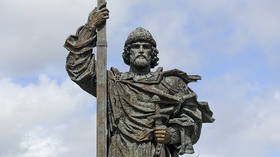
(Monument of Prince Vladimir in Moscow, Russia. © Andrew Surma / NurPhoto)

"In August 1948, the US National Security Council issued memorandum (NSC 20/1 1948), requested by then Defense Secretary James Forrestal. The document described American objectives with respect to the Soviet Union.

A significant part of the memorandum focused on Ukraine. American analysts were convinced that the territory was an integral part of greater Russia, and it was highly unlikely that Ukrainians could exist as an independent nation. Most importantly, it noted, any support given to separatists would be met with a strong negative reaction by Russians. 

“The economy of the Ukraine is inextricably intertwined with that of Russia as a whole … To attempt to carve it out of the Russian economy and to set it up as something separate would be as artificial and as destructive as an attempt to separate the Corn Belt, including the Great Lakes industrial area, from the economy of the United States…

Finally, we cannot be indifferent to the feelings of the Great Russians themselves … They will continue to be the strongest national element in that general area, under any status … The Ukrainian territory is as much a part of their national heritage as the Middle West is of ours, and they are conscious of that fact. A solution which attempts to separate the Ukraine entirely from the rest of Russia is bound to incur their resentment and opposition, and can be maintained, in the last analysis, only by force,” read the report.

It seems like today’s American establishment and media have forgotten something that was obvious to US analysts and politicians at a time when America was the only superpower with nuclear weapons. It would appear that the White House and EU now believe they can make Russians think of Ukraine as a different country through force and sanctions threats.

If the West is successful in its attempts to “deter” Russia, it will get its reward – long-lasting resentment from Russians, who will view the US-led West as a force that prevents them from managing a big chunk of their historic land. 

Why do Russians think of Ukraine as part of Russia?

>

Russians see it as the land of their forefathers – quite literally, as they can show you the graves of their ancestors and the land where their houses stood. 

When the administrative boundaries between the republics of the USSR turned into real borders in 1991, eight million ethnic Russians became ‘Ukrainians’ on paper. Kharkov in Ukraine and Belgorod in Russia, for example, are essentially twin cities that were founded by Russian tsars as frontier fortresses against the Crimean Tatars in the mid-17th century. After the Soviet Union’s collapse, they ended up on the opposite sides of the border. . .

> Many Russians not only lived but also worked in Ukraine, which was a key industrial area in Russia. Its industrial development can’t be attributed to Ukrainian national character – it was the tsars and then the Soviet authorities that focused on this region’s growth. The industrial density of eastern Ukraine could only compare to that of Germany’s Ruhr. . .

>

The Ukrainian leaders’ attitude towards the powerful gas transportation system that had been left to them by the USSR was characteristic – they perceived it as a tool for blackmail. Unable to create or improve the system, they threatened to block or destroy it if they did not receive more money for the right to pump gas through ‘their’ territory.

Hence the hysterical reaction of the Ukrainian elites to the construction of the Nord Stream 2 gas pipeline, linking Russia directly to Germany. The fact that the Western powers have supported this view has led to the largest gas crisis in European history. . .

> Russians living in Russia, as well as those living in Ukraine, cannot understand why Ukrainian land should be used by NATO. In Russia, Ukraine’s possible accession to the US-led military bloc is not construed as a free choice made by the country in its own security interests, but as a means for the West to build advance bases for launching a direct attack on Moscow.

> Do the Russians have historical grounds for considering this land their own, and for seeing the Kiev regime and NATO as the actual occupiers of this land? Definitely, in my view. 

Kiev in modern Ukraine, Polatsk in contemporary Belarus, and Novgorod, Smolensk, and Rostov in today's Russia were one state in ancient times – Rus.

Though Kiev, the ‘Mother of Russian cities,’ was the capital of this state, Novgorod, which is now part of Russia, played no lesser a role. Amazingly, anthropologists in northern Russia’s Arkhangelsk Region have recorded epic ballads about Prince Vladimir and his warriors, who baptized Rus, which are similar in many ways to legends about King Arthur and the knights of the round table. It is therefore obvious that the local population retained a direct cultural connection with the population of ancient Kiev and Russia. At the same time, no similar ballads have been preserved in modern Ukraine.

> Kiev was almost destroyed as the result of the Mongol invasion by Genghis Khan’s grandson, Batu Khan, in 1240, and the fate of the inhabitants in different parts of Rus was divided after that. The eastern regions became vassals of the Mongols (Tatars) but continued to be ruled by direct male descendants of Prince Vladimir. The city of Moscow, with princes from this house, gradually gained hegemony and created a state that managed to gain independence.

A different fate awaited the inhabitants of Western Russia. The cities there lost the power of Prince Vladimir’s descendants, as well as their historical connection to ancient Kiev. They were conquered by Lithuania, which soon merged with Poland to form a single state – the Polish-Lithuanian Commonwealth. Since these lands were cut in half by the practically impassable Polesie Marshes, two different groups of Russian origin emerged there during the Middle Ages: Belarusians to the north of the marshes, and ‘Little Russians’ to the south.

The Muscovite princes, who became tsars in 1549, always proclaimed their right to these lands and demanded their return from Poland, leading a slow kind of ‘Reconquista’. Poland lost the support of its Little Russian and Belarusian subjects in this struggle after it announced the religious Union of Brest in 1596 and began persecuting the Orthodox Church and its adherents. An Orthodox resistance movement emerged in the territories of Little Russia shortly thereafter.

The resistance’s strike force was the Cossacks – a community of free warriors that assembled in the steppe for battles with the Tatars and Turks. A Cossack could be a native of any country who professed Orthodox Christianity and was ready to fight for it. As Poland progressively persecuted the Orthodox religion, the Cossacks increasingly raised their sabers against it. . .

>

Tsar Aleksey Mikhaylovich was declared ‘Tsar of All Great, Little, and White Russia’ and began a grueling 13-year war with Poland, which ended with a partial victory – the lands on the left bank of the Dnieper were ceded to Russia, and the Russian Tsardom bought Kiev, the ancient capital of Rus on the right, for 146,000 silver rubles and seven tons of silver, which the richest Polish families divided among themselves.

Subsequently, many Little Russians from the territory of modern Ukraine moved north and settled throughout the vast reaches of Russia, making careers both in the church and at court. The word ‘Ukraine’ was not used as a place name at all during this period – in both Russian and Polish it meant ‘borderland’ or ‘frontier’. Its use as a name referring to the territories around Kiev only began in the 18th century, when these lands really did become a borderland during the constant wars between Russia and Turkey.

The integration of Little Russians into Russia was not even disrupted by the adventure of Hetman Mazepa, who betrayed Peter the Great out of personal interests and sided with the Russian leader’s enemy King Charles XII of Sweden. Mazepa was abandoned by everyone except his personal guards, and a fierce guerrilla war began against the Swedish troops that entered the territory of modern Ukraine. The first attempt to exploit the concept of ‘Ukrainian separatism’ ended in disaster for the party that tried to employ it.

By the middle of the 18th century, the integration of Little Russians and Russia was extremely tight. . . ____________________________________________________________________

__________________________________________________________________________

__________________________________________________________________________

__________More Details >> https://www.rt.com/russia/556073-russians-never-let-go-ukraine/

[      ] The Russian Federation had been experiencing a long crisis with respect to national identity and consciousness, and it was Ukraine that pulled it out of this muddle. As predicted in 1948 by US National Security Council analysts, the Russians became enraged on learning that propaganda was being used to make some Russians see themselves as ‘non-Russian’. 

The first wound to Russian pride was inflicted back in Soviet times, when Malenkov and Khrushchev transferred Crimea from the RSFSR (Russia) to the Ukrainian SSR (Ukraine) in 1954. Russians considered this peninsula to be their own land, steeped in the blood of two heroic defenses of Sevastopol (1854-55 and 1941-42). Though the outward manifestation of this transfer was limited to changing the color of Crimea on maps from pink to green, it was perceived as an ethnic insult by Russians in the USSR. Sevastopol was the ‘city of Russian sailors’ (as was sung in a famous song) and no one dared argue with this. Russian indignation reached a boiling point after the peninsula became part of an independent Ukraine in 1991, and the government began to ban the Russian language there. The phrase “You will still answer for Sevastopol” from the popular movie ‘Brat 2’ became a nationwide meme.

Several waves of forced Ukrainization in the 20th century have convinced Russians that Ukrainian identity is not something stemming from ancient history and culture, but something that is instilled by propaganda. Like it or not, Russians in Russia see modern Ukraine’s hostility towards the Russian part of its population not as a free choice of ethnic identity, but as a disease that has arisen under the influence of propaganda that must be cured. The more assertively some Ukrainians declare that they are not brothers to Russians, but enemies, that they want to be with NATO, and not Russia, the greater the desire on the other side is to save and cure them, whatever that means.

The trick of the West – to appeal to the population of modern Ukraine’s sense of unique identity – is even more dangerous in terms of provoking conflict. The reaction of Russians to these appeals is similar to that of the parents of a kidnapped child who has been turned against them. It’s better not to get in their way.

To sum up: Russians have many vital and historical reasons to consider Ukraine their land, and to see Ukrainians, even those most hostile to Russia, as their own people, who are in need of protection (including from brainwashing). The West’s claims that it has a right to exercise hegemony over Ukraine because ‘Ukraine is not Russia’ is seen by Russians in Russia as false and predatory."

Friday, May 27, 2022

SONIC EXCELLENCE: New Digital Conversion

INTRO: Dylan won the Nobel prize in literature in 2016.
Peter Klarnet, a senior specialist at Christie’s, called Blowin’ in the Wind “one of the most important songs written in the last century … I very much share T Bone Burnett’s passion for the sonic excellence of analog sound.” Bob Dylan has rerecorded his classic protest song Blowin’ in the Wind for the first time since it was tracked in July 1962 ---- Although it has been described as a protest song, it poses a series of rhetorical questions about peace, war and freedom.

Bob Dylan rerecords Blowin’ in the Wind for Christie’s auction

<div class=__reading__mode__extracted__imagecaption>Bob Dylan pictured in 1962. Photograph: John Cohen/Getty Images<br>Bob Dylan pictured in 1962. Photograph: John Cohen/Getty Images</div>

THE APOCALYPTIC REALITY OF RUSSIA'S SPECIAL MILITARY OPERATIONS IN THE UKRAINE

Former Reality TV-Star and now Performative Politician Ukrainian President Volodymyr Zelenskyy has accused Western countries of lacking “unity” over the war, citing differing positions on weapons supplies to Kyiv and disagreements within the NATO military alliance.
>> Here are snippets from an Aljazeera report https://www.aljazeera.com/news/2022/5/26/nato-general-putin-has-8-9-months-to-win-the-war  yesterday:

Former NATO general says Putin has 9-month window to win war

Russia gains ground as it focuses its military offensive and Moscow’s vast resources of men and material exact a toll.

Armies cannot turn on a dime

Ukraine has fought valiantly and driven the Russians back from the northern cities of Kyiv, Chernihiv, Sumy and Kharkiv in recent weeks, but its counteroffensive has not been sustained because Ukrainian forces need time to assimilate Western military equipment, a retired NATO commander said. . .

“Tanks and armoured vehicles need an initial stage of personal training and team training for the driver, gunner, reloader and commander,” said Lt-Gen Konstantinos Loukopoulos, who has taught tank warfare at military academies in Kyiv and Moscow.

“They need tactical training, including test firing and exercises, which cannot be done in a few weeks. The training cycle is at least six months, and that doesn’t change in wartime,” he said.

“After [Russian President Vladimir] Putin’s illusions about winning the war in 96 hours, the illusions began on the Western side,” he added.

The United States, United Kingdom, Canada, France, Germany and the Czech Republic are among those who have pledged various types of armour and artillery, and that complicates matters, Loukopoulos said.

For instance, out of 90 howitzer M777 artillery pieces sent by the US to Ukraine, about 18 have been absorbed, he said, adding that it is unknown how many of the 12 or 14 César self-propelled howitzers sent by France are in use.

“For Ukraine to absorb the weapons from the West and make them operational, form the right units, and train them, it needs eight, nine months. It can’t pull active units from the front to train them,” Loukopoulos said.

That is the timeframe, he believes, within which Putin must win the war on the ground and reach a negotiated settlement.

“Under the present balance of forces, the general trend is in favour of the Russians. Right now nothing can change that,” he said. . .

Can the Ukrainians create a fact on the ground to counter Russian gains? Right now they cannot,” he said.

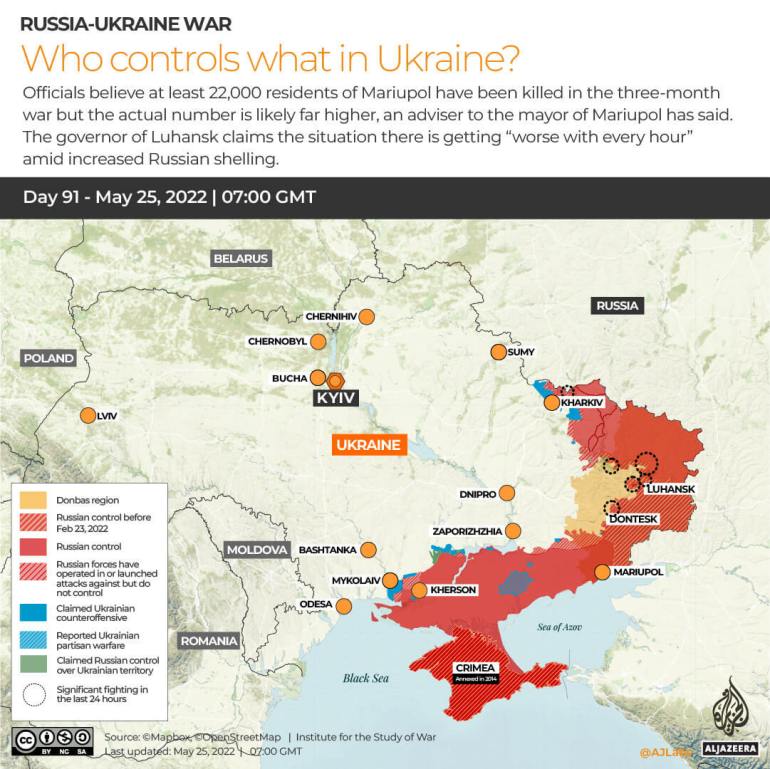
“Whether we like it or not, Russia has the political and military initiative. The West is reacting to what Putin is doing. . [   ] The apocalyptic reality of the Russian victory at Mariupol may drive Ukrainian determination to fight along the eastern front. The question is whether Ukrainian material shortages will be insurmountable."


INTERACTIVE Russia Ukraine War Who controls what Day 910


Thursday, May 26, 2022

A 2-DAY TREND...Now really is that a nice Rubber Band Snap Back in the Stock Market??

Hmmm...Despite seven straight weeks of losses pushing the S&P 500 briefly into bear market territory last Friday, stocks are on track to post a strong rebound this week: The Dow and S&P 500 are up over 4% and the Nasdaq more than 3%.

Dow Jumps 500 Points, Market Rebounds As Strong Earnings Alleviate ‘Dire Recession Headlines’

"The stock market rebounded for a second day in a row on Thursday, on track to snap a 7-week losing streak, as recession fears cooled amid a slew of strong quarterly earnings reports that boosted investor sentiment.

Stocks moved higher as investors continued to assess the minutes from the Federal Reserve’s latest policy meeting: The Dow Jones Industrial Average rose 1.6%, over 500 points, while the S&P 500 gained 2% and the Nasdaq Composite 2.7%. . .

“Last week’s doom and gloom about the all-important U.S. consumer may have been overdone, along with the dire recession headlines,” says Quincy Krosby, chief equity strategist for LPL Financial, about the recent market rally.

Retail stocks, which were initially hard-hit during earnings season after profit warning from major companies like Walmart and Target, continued to rebound on Thursday amid strong showings from the likes of Macy’s and Williams Sonoma, shares of which rose over 10% each.

Discount retailers Dollar Tree and Dollar General jumped 20% and 14%, respectively, after similarly solid quarterly results, which also helped boost sentiment and reverse some of the steep selloffs in the retail sector last week.

Solid earnings results in recent days, especially from retailers, have helped “quell some of the deafening ‘recession’ talk that permeated the market these last few weeks,” says Vital Knowledge founder Adam Crisafulli."

Crucial Quote:

“Markets continue to be volatile, with close attention being paid to fundamentals, including consumer spending and corporate earnings,” says Nationwide chief of investment research Mark Hackett. “The durability of those factors will determine if we are close to a bottom or can expect continued volatility.”

Key Background:

The latest Fed minutes released Wednesday show that central bank officials agree on the need for aggressively tighter monetary policy, with most in favor of raising interest rates by 0.50% intervals at the upcoming policy meetings in June and July. Stocks have undergone a relentless selloff this year as investors remain fearful about surging inflation and the prospect of rising rates leading to a possible recession. The S&P 500 is down over 15% in 2022, while the Dow has fallen over 10% and the Nasdaq over 25%.

What To Watch For:

“Down 16.5% after 100 days for the S&P 500 is the worst start to a year since 1970 and one of the worst starts ever,” says LPL Financial chief market strategist Ryan Detrick. “But the good news is previous bad starts have seen some nice rubber band snap-backs and 2022 could be in line to do it once again.”

Reference: https://www.forbes.com/sites/sergeiklebnikov/2022/05/26/dow-jumps-500-points-market-rebounds-as-strong-earnings-alleviate-dire-recession-headlines/ 

Information You Can Use >> Multiple Vulnerabilities and Guidance for Security Fixes

Intro: No stopping anytime soon: Here's one report and then another and another taken from Bleeping Computer https://www.bleepingcomputer.com/

OAS platform vulnerable to critical RCE and API access flaws

plc

  • May 26, 2022
  • 03:11 PM

"Threat analysts have disclosed vulnerabilities affecting the Open Automation Software (OAS) platform, leading to device access, denial of service, and remote code execution.

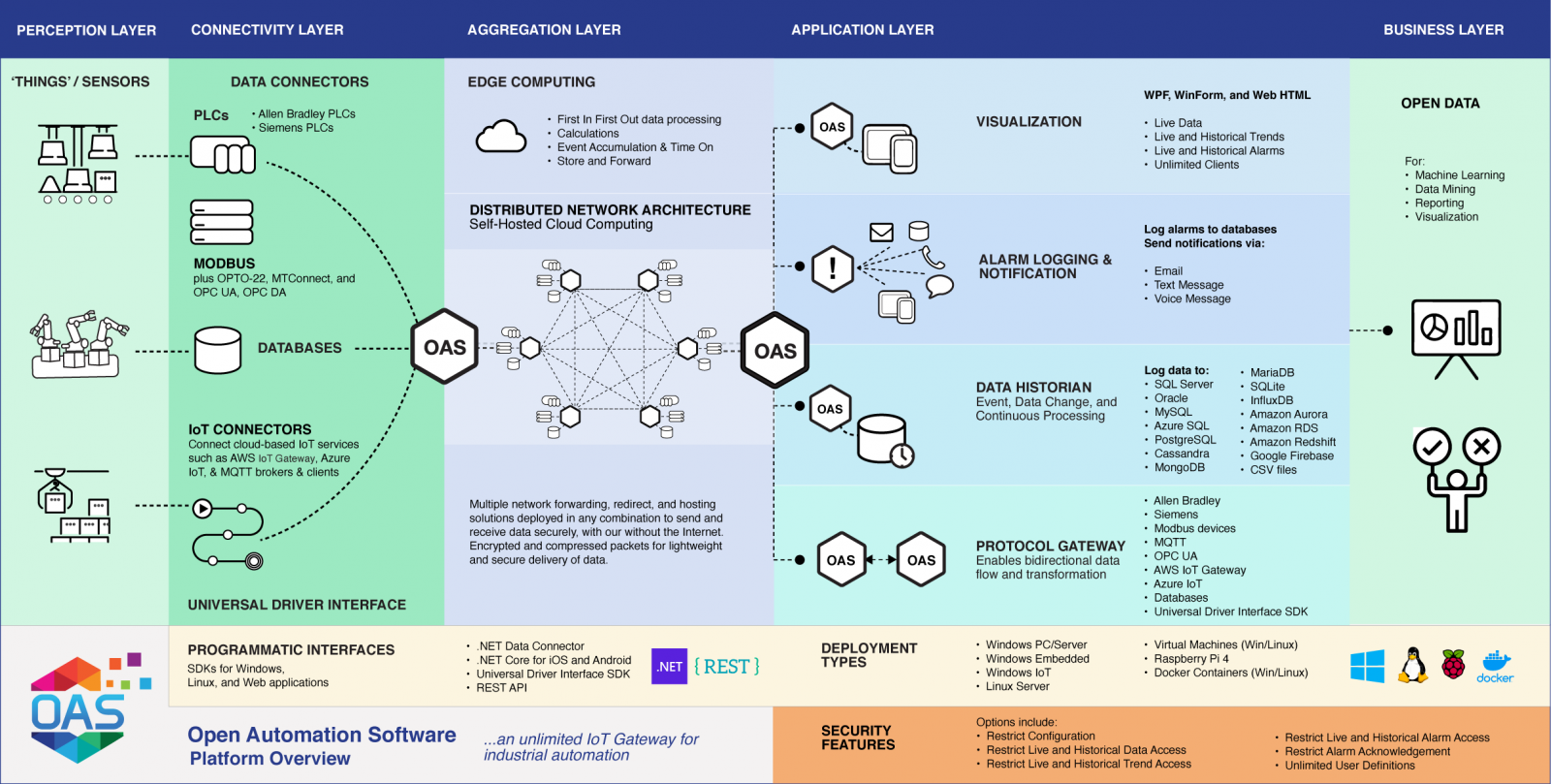
The OAS platform is a widely used data connectivity solution that unites industrial devices (PLCs, OPCs, Modbus), SCADA systems, IoTs, network points, custom applications, custom APIs, and databases under a holistic system.

It is a versatile and flexible hardware and software connectivity solution that facilitates data transfers between proprietary devices and apps from multiple vendors and connects them to firm-specific products, custom software, etc.

Overview of the OAS platform

OAS is used by Michelin, Volvo, Intel, JBT AeroTech, the U.S. Navy, Dart Oil and Gas, General Dynamics, AES Wind Generation, and several other high-profile industrial entities.

As such, vulnerabilities in the platform can put crucial industrial sectors at risk of disruption and confidential information disclosure.

Critical flaws

According to a report by Cisco Talos, OAS platform version 16.00.0112 and below is vulnerable to a range of high and critical severity bugs that create the potential for damaging attacks.

Starting with the most critical of the bunch, CVE-2022-26833 has a CVSS severity rating of 9.4 out of 10 and concerns the unauthenticated access and use of the REST API functionality in OAS.

An attacker could trigger the exploitation of this flaw by sending a series of specially crafted HTTP requests to the vulnerable endpoints.

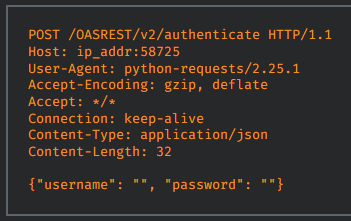
As Cisco explains, the REST API is designed to give programmatic access for configuration changes and data viewing to the “Default” user, which Talos researchers were able to authenticate by sending a request with a blank username and password.

Authenticating without using any credentials
​​​​​​
​(Cisco)

The second critical flaw is CVE-2022-26082, rated at 9.1, which is a file write vulnerability in the OAS Engine SecureTransferFiles module.

According to Cisco, a specially-crafted series of network requests sent to the vulnerable endpoint may lead to arbitrary remote code execution.

“By sending a series of properly-formatted configuration messages to the OAS Platform, it is possible to upload an arbitrary file to any location permissible by the underlying user. By default, these messages can be sent to TCP/58727 and, if successful, will be processed by the user oasuser with normal user permissions.” - Cisco Talos

This enables a remote threat actor to upload new authorized_keys files to the oasuser’s .ssh directory, making it possible to access the system via ssh commands.

The other flaws discovered by Cisco Talos are all categorized as high-severity (CVSS: 7.5) and are the following:

  • CVE-2022-27169: obtain directory listing via network requests
  • CVE-2022-26077: information disclosure targeting account credentials
  • CVE-2022-26026: denial of service and loss of data links
  • CVE-2022-26303 and CVE-2022-26043: external configuration changes and creation of new users and security groups

Cisco provides mitigation advice for each of the above vulnerabilities, which involves disabling services and closing communication ports, so if upgrading to a newer version of OAS is impossible, there might be a solution with some functionality or convenience trade-offs.

Otherwise, upgrading to a more recent version of the OAS platform would be advisable. The security fixes for the two critical flaws described above landed in version 16.00.0.113, which was released as a security update on May 22, 2022.

Upgrade lags are to be expected in industrial environments that operate intricate and complicated data connectivity systems, but in this case, due to the severity of the disclosed flaws, it is crucial to take immediate action."

Related Articles:

Stay on the cutting edge of IT with this lifetime subscription bundle deal

Is 100% Cybersecurity Readiness Possible? Medical Device Pros Weigh In

Build your white hat hacking skills with this ethical hacking bundle deal

Get certified in cybersecurity with this advanced exam prep bundle

Kali Linux 2022.2 released with 10 new tools, WSL improvements, and more 

LATEST ARTICLES____________________________________________________________

Windows 11

Microsoft shares mitigation for Windows KrbRelayUp LPE attacks

Microsoft has shared guidance to help admins defend their Windows enterprise environments against KrbRelayUp attacks that enable attackers to gain SYSTEM privileges on Windows systems with default configurations.

  • Zyxel USG FLEX

    Zyxel warns of flaws impacting firewalls, APs, and controllers

    Zyxel has published a security advisory to warn admins about multiple vulnerabilities affecting a wide range of firewall, AP, and AP controller products.

  • server

    Google shut down caching servers at two Russian ISPs

    Two Russian internet service providers (ISPs) have received notices from Google that the global caching servers on their network have been disabled.

  • Data theft data breach hacker cyberattack

    Industrial Spy data extortion market gets into the ransomware game

    The Industrial Spy data extortion marketplace has now launched its own ransomware operation, where they now also encrypt victim's devices.

  • MASS KILLINGS IN AMERICA

    Outrage and inaction: how the push for gun control rises and falls with each school shooting

    Map of US with circles where there have been school shootings.
    Map of US with circles where there have been school shootings. Composite: Getty Images
    Map of US with circles where there have been school shootings. Composite: Getty Images

    The country experiences a mass shooting nearly every day while federal gun control legislation remains a distant dream

    NO CAPTAIN ONBOARD