Wednesday, June 01, 2022

TODAY'S LEXICON: "Thinkwashing"

Ooooof!
People thinkwash whenever they magnify the complexity of the problem and undermine real possibilities. Whatever the issue, entrenched interests have perfected their response: It’s complicated. . . while organizations may tell the public they’ve got the “brightest minds” working on a given issue to no avail, the roadblock is often not intellectual but political, says Marianne Jennings, a professor of legal and ethical studies at Arizona State University.
Meaningful action is possible—but when companies are unwilling to address root issues, it’s often because doing so would threaten their revenue stream.
Instead, they demand more research amid dire circumstances and promote distracting alternatives...
"Thinkwashing" is a way of obscuring the basic fact that “complicated” intellectual questions can often be answered, at least in part, by straightforward moral imperatives and a pragmatic approach to the future. . .
 

‘Thinkwashing’ Keeps People From Taking Action in Times of Crisis

When it comes to issues like climate change, too many let the perfect become the enemy of the good, while the world burns.
 See original image

"Less than a decade ago, “wait and see” arguments about climate change still circulated. “We often hear that there is a ‘scientific consensus’ about climate change,” physicist Steven E. Koonin wrote in The Wall Street Journal in 2014. “But as far as the computer models go, there isn't a useful consensus at the level of detail relevant to assessing human influences.” The idea was that the world needed more data before it could respond to the threat posed by global warming—assuming such research indicated a response was even necessary.

Today, outright denialism is dormant, but delay tactics have never been more in vogue. Many of them fall under the banner of what I’d call thinkwashing, a combination of willful ignorance of existing knowledge, policy perfectionism, and an all-or-nothing position on the role of technology in society. It’s not limited to climate change, either. People thinkwash whenever they magnify the complexity of the problem and undermine real possibilities. Whatever the issue, entrenched interests have perfected their response: It’s complicated.

It’s easy enough to empathize with these arguments; 21st-century challenges like artificial intelligence, climate change, and the threat social media poses to democracy are astounding in their legal, social, and economic complexity. But while organizations may tell the public they’ve got the “brightest minds” working on a given issue to no avail, the roadblock is often not intellectual but political, says Marianne Jennings, a professor of legal and ethical studies at Arizona State University. Meaningful action is possible—but when companies are unwilling to address root issues, it’s often because doing so would threaten their revenue stream. Instead, they demand more research amid dire circumstances and promote distracting alternatives.

Thinkwashing is not thoughtfulness. It is not a helpful contribution to the discourse or an essential injection of skepticism. It’s a way of obscuring the basic fact that “complicated” intellectual questions can often be answered, at least in part, by straightforward moral imperatives and a pragmatic approach to the future.

Over time, thinkwashing has trickled down from corporate PR campaigns to the general public—typically in the form of a profound techno-pessimism that is also an obstacle to action...

Take direct-air carbon capture. Tech billionaires like Bill Gates, an investor in these plants, have suggested that they will one day be able to extract emissions out of the sky at scale, passively decarbonizing an electrified but otherwise largely unchanged world. Already, Microsoft has purchased one such facility, thereby helping to bring its business down to sub-zero emissions by 2030—without necessarily disentangling itself from the fossil fuel economy (though it’s promising to do some of that work too).

These plants are unlikely to keep pace with accelerating emissions, or to have significant impacts on atmospheric carbon in time to avert catastrophe, as article after article has laid out. While Microsoft may have found its silver bullet, negating the emissions of the current global economy would require a huge leap in extraction technology, the establishment of a vast new industry, the construction of plants around the world, and incredible amounts of energy to operate. Even then, if our consumption of fossil fuels continues to grow, we would still fail to neutralize the threat of carbon.

These make for some serious shortcomings to this imagined techno-utopia. But that doesn’t make these direct-air carbon capture efforts entirely useless. While these machines cannot decarbonize on our behalf, they could be helpful in a plan to draw down past emissions. Yet because some are overestimating the potential of carbon removal, cynics can seem to prematurely discard the premise altogether.

Such is the cycle of techo-pessimist thinkwashing: the oversimplified idea, the hype, a wave of debunks.

The galaxy brain is quickly exhausted, and people turn to a new topic, at least until some outlandish new claim pulls them back again.

 See original image

A similar false dichotomy—between savior and despair—has played out with numerous other technologies, including the clean-tech boom and bust of the early 2010s, hydrogen engines, and even the Covid-19 vaccine. In each case, the problem begins when the terms of the conversation are set by the techno-optimists. “The techno-optimist doesn’t have a vision for the future at all,” says Colin Koopman, head of the Philosophy Department and director of new media and culture at the University of Oregon. “They take the present and project it into the future.” That leaves the techno-pessimists to respond with equal certainty—decrying what won’t work, what’s insufficiently radical, what’s a “distraction.”

These critiques can be vitally important. Yet technology is, in fact, changing the world every day, for worse but also for better. . .

While certainty is comforting, both optimism and pessimism gamble with the nuance necessary for progress. Allowing the uninformed, unqualified speculations of billionaires to set the stage for such urgent discussions keeps concerned citizens on a hyperreal hamster wheel, far removed from the real action.

Deliberation is important in both public and private sector leadership. But action remains the goal. “For all the words, for all the targets, for all the, you know, moral entanglements” of the climate crisis, says Stuart Capstick, a senior research fellow in psychology at Cardiff University, there is still a bottom line. To avoid mass death and destruction, we must decarbonize. A similar line exists for threats to democracy, human rights, and other core values; complicate them all you want, we must do something and we know at least a little bit about how.

Unlike thoughtfulness, which helps people make the trade-offs necessary in the real world, thinkwashing causes a perverse kind of analysis paralysis. “The status quo with all its embedded imperfections and the harms,” Capstick says, somehow tasks progressives with “making the world a sort of perfect place.” But perfect isn’t the goal; better would be enough.

So how, exactly, are people to push back against thinkwashing, especially when it’s so hard to distinguish from virtues like healthy skepticism and due diligence? The answer lies in techno-pragmatism, a merging of the philosophy of pragmatism (which states that the reason we think is not merely to describe but ultimately to predict, test, and act) with the churn of technological innovation.

The first step is to set the terms of the discussion, instead of merely reacting to hype. . .

This means asking whether the core problem is really being addressed in any conversation about change. “In climate spaces, there's an obsession with gas cars as the problem. So EVs are a ‘natural’ solution,” climate journalist Kendra Pierre-Louis recently tweeted. “But the actual issue is mobility/transit.” From there, solutions that speak to the core problem are more easily identified—in this case, more infrastructural support for walking, biking, and other ways of getting around—and aggressively pursued.

That doesn't mean that tangential problems (and solutions) get short shrift, only that their place in the larger ecosystem is properly qualified. For example, vehicles will remain important for essential services, including fire trucks and ambulances. Finding ways to replace gas engines with electric or hydrogen alternatives still holds immense value, but it’s still a few steps down the triaged to-do list.

Against this backdrop, it is important to quantify the risks of each problem—and proposed solutions. If the techno-optimist is 99 percent sure their technology will improve the world but the remaining 1 percent is the chance of an existential threat like climate change worsening, that risk is still too big to stomach. This has been the logic of the millions poured into “killer AI” prevention, but by only investing in emerging threats, we continue to expose ourselves to the risks of history, including nuclear energy production, nuclear weapons deployment, greenhouse gas emissions, and the ever present threat of pandemics.

Techno-pessimists rightly claim that emerging technologies will inevitably have big and unpredictable side effects once scaled. But given that risks are inherent, but action is essential, the world would benefit from carefully studying new technologies in small trials or specific communities, instead of needing every new device to prove itself on a global scale. Pilot programs would allow us to learn more about the pros and cons of the machinery or software itself—and to identify the specific places it could have the most impact, or wouldn’t work at all.

Entrenched positions about technology are failing to get us where we need to go. But techno-pragmatism advocates for a grounded, scientific approach to whatever comes next. It says “we must do whatever we can to ameliorate damaging possibilities without ever thinking we can get to zero,” Koopman says. We must think before we act, and we must act even when it is hard."


Tuesday, May 31, 2022

SECURITY UPDATES: Releasing patches to fix serious vulnerabilities | Wired

Heads up!

You Need to Update iOS, Chrome, Windows, and Zoom ASAP

Plus: Google patches 36 Android vulnerabilities, Cisco fixes three high-severity issues, and VMWare closes two “serious” flaws.

<div class=__reading__mode__extracted__imagecaption>Illustration: Elena Lacey

"May has been another busy month of security updates, with Google’s Chrome browser and Android operating system, Zoom, and Apple’s iOS releasing patches to fix serious vulnerabilities.

Meanwhile, things have not run smoothly for Microsoft, which was forced to issue an out-of-band update after a disastrous Patch Tuesday during the month. And Cisco, Nvidia, Zoom, and VMWare all issued patches for pressing flaws.

Here’s what you need to know.

Apple iOS and iPadOS 15.5, macOS Big Sur 11.6.6, tvOS 15.5, watchOS 8.6

With Apple due to announce iOS 16 at its Worldwide Developers Conference in June, the iPhone maker released probably its last major iOS 15-point update in May. It came with new features, but iOS and iPadOS 15.5 also fixed 34 security vulnerabilities, some of which are serious.

Security issues fixed in iOS 15.5 include flaws in the Kernel, as well as in the WebKit browser engine, according to Apple’s support page. Thankfully, none of the issued patches in iOS and iPad 15.5 are being used in attacks, according to the company, but that doesn’t mean they won’t be if you don’t update now.

Meanwhile, users of macOS, tvOS, and the Apple Watch should update their devices ASAP, as Apple also issued an emergency update to patch an issue it believes is already being used in attacks. The flaw in Apple AVD, labeled CVE-2022-22675, could allow an app to execute code with Kernel privileges. Issues in the Kernel are as bad as it gets, so it’s worth checking and updating your devices right away.
 
Microsoft’s Flubbed May Patch Tuesday

Microsoft’s May Patch Tuesday was something of a disaster for the diligent businesses that installed it straight away.

On May 10, the firm issued security updates to fix 75 vulnerabilities, eight labeled as serious and three that were being exploited by attackers. The issues fixed in May’s Patch Tuesday were important, but there were soon problems for some Microsoft users, who reported authentication failures after installing the latest updates. It impacted people using the client and server Windows platforms and systems running all Windows versions, including Windows 11 and Windows Server 2022.

Firefox 100.0.2

In early May, Mozilla released Firefox 100, including nine security fixes for its Firefox browser, of which seven were rated as high severity. But later in May, ethical hackers at the Pwn20wn competition in Vancouver were able to demonstrate how attackers could execute JavaScript code on devices running the latest Mozilla software. Mozilla fixed the issues in another updateFirefox 100.0.2, Firefox ESR 91.9.1, Firefox for Android 100.3, and Thunderbird 91.9.1. Click those update buttons.

Android

May’s Android security update is a big one, patching 36 vulnerabilities, including an issue already being exploited by attackers. This exploited flaw is a privilege escalation bug in the Linux Kernel known as “The Dirty Pipe.”

The flaw, which impacts newer Android devices running Android 12 and later, was disclosed by Google in February, but it has taken a while to reach devices.

Google Pixel and Samsung users, in particular, should look out for the May update, as additional vulnerabilities have been fixed on these devices. The update has so far reached Android devices, including the Samsung Galaxy S22, Galaxy S22+, and Galaxy S22 Ultra, as well as the Galaxy Tab S8 series, the Galaxy Watch 4 series, and the Galaxy S21 series.
Chrome 102

Another month, another major Google Chrome security update, this time for 32 issues, of which one is rated as critical and eight are deemed high severity. The critical issue, CVE-2022-1853, impacts the IndexedDB feature, while the high-rated flaws affect areas that include DevTools, UI foundations, and the user education function.

None of the flaws fixed in Chrome 102 have been exploited, Google says. This is in contrast to April, when the company issue emergency updates to fix several already exploited vulnerabilities in its Chromium-based browser.

Earlier in May, Google released 13 fixes in Chrome v101.0.4951.61 for Android, with eight of these rated as having a high-severity impact.

Cisco

Cisco has fixed multiple vulnerabilities in Cisco Enterprise NFV Infrastructure Software that could allow an attacker to escape from the guest virtual machine to the host machine, inject commands that execute at the root level, or leak system data from the host to the virtual machine.

It goes without saying that these high-severity issues—tracked as CVE-2022-20777, CVE-2022-20779, and CVE-2022-20780—are serious, so it’s a good idea to update as soon as possible.

Nvidia

Chip manufacturer Nvidia issued a security update in mid-May for its Nvidia GPU display driver to fix flaws that could allow denial of service, information disclosure, or data tampering. The list of 10 vulnerabilities includes issues in the Kernel mode layer on Windows and Linux devices. The updates themselves can be found on Nvidia’s downloads website.

Zoom

Video conferencing app Zoom has released version 5.10.0 to fix an issue found by security researchers at Google’s Project Zero in February. The flaw in messaging protocol XMPP doesn’t require any interaction from the user in order to execute the attack. “User interaction is not required for a successful attack. The only ability an attacker needs is to be able to send messages to the victim over Zoom chat over XMPP protocol,” says security researcher Ivan Fratric, who describes how the attacker can force the victim client to connect to a malicious server, resulting in arbitrary code execution.

VMWare

Cloud provider VMWare has released patches to fix multiple issues, including a privilege escalation vulnerability (CVE-2022-22973) and an authentication bypass flaw (CVE-2022-22972), the latter of which it says must be applied immediately as “the ramifications are serious.”

UKRAINE CALCULATES FINANCIAL AID FROM THE WEST

Intro: The country’s GDP last year was estimated at around $165 billion, and Kiev authorities say it has already dropped by between 30% and 50% during Russia’s military operation.

29 May, 2022 12:06

Ukraine calculates financial aid from West

Its central bank says the country has received over $6 billion so far, but needs more help
Ukraine calculates financial aid from West

"Ukraine has received $6.5 billion in aid from Western countries since the start of Russia’s military operation in late February, said Kateryna Rozhkova, the first deputy head of the National Bank of Ukraine.

Since the beginning of the war, Ukraine has received almost $6.5 billion from partner countries to support the economy,” Rozhkova stated on Sunday, adding that all funds have been directed to the country’s budget.

The total includes both grants and loans, she explained, but did not specify how much Kiev would have to pay back. The official added that the interest rate on loans to Ukraine is “low,” without providing further details.

Rozhkova noted that Kiev cannot address its budget deficit on its own due to declining export earnings, while the recent downgrade of the country’s credit rating to pre-default is also a problem, as money cannot be borrowed on international markets due to the high cost of such loans.

According to the official, Ukraine needs at least $5 billion in aid each month to cover the state budget deficit amid the current crisis. She reiterated previous calls from President Volodymyr Zelensky for this aid to be provided by Kiev’s Western partners.

Last month, Zelensky addressed the World Bank and the IMF, saying his country has already suffered more than half-a-trillion dollars’ worth of damage and needs around $7 billion in aid every month to stay afloat. The country’s GDP last year was estimated at around $165 billion, and Kiev authorities say it has already dropped by between 30% and 50% during Russia’s military operation."

For more stories on economy & finance visit RT's business section

TAIWAN JET SCRAMBLES: Top Gun Political Theater by China on Memorial Day

Intro: In recent months, the US has accused China of ratcheting up tensions across the Taiwan Strait, with Secretary of State Antony Blinken singling out aircraft incursions as an example of “increasingly provocative rhetoric and activity”.
Three reports from different sources - and another instance of state National Guard used for training.

1

China sends 30 planes into Taiwan air defence zone

The US has accused China of ratcheting up tensions across the strait with ‘provocative’ incursions.

China has made its second-largest incursion into Taiwan’s air defence zone this year, as Taipei signalled it planned to deepen security ties with the United States.

Taiwan’s defence ministry said that 30 Chinese military aircraft, two-thirds of them fighter jets, entered the southwestern part of its air defence identification zone (ADIZ) on Monday and that it had scrambled its own air force and deployed air defence missile systems in response.

The incursion was the biggest since January when Beijing sent 39 aircraft into the ADIZ. Earlier this month, it sent 18 warplanes into the area.

Beijing claims self-ruled Taiwan as its own and has not ruled out the use of force to take control of the island. . .

> Although the US has no formal diplomatic ties with Taiwan, it is the island’s most prominent international supporter and supplier of weapons, and follows what it calls a policy of “strategic ambiguity“.

> Following the latest incursion, Taiwan President Tsai Ing-wen on Tuesday said there were plans for “cooperation” between the Taiwan military and the US National Guard. . .

> Taiwanese media has previously reported that Taiwan could partner with Hawaii’s National Guard for the programme. . .

--- Last year, Taiwan recorded 969 incursions by Chinese warplanes into its ADIZ, according to an AFP news agency database, more than double the roughly 380 carried out in 2020.

--- So far in 2022, Taiwan has reported 465 incursions, a near 50 percent increase from the same period last year, AFP said.

The increasing activity is adding to pressure on Taiwan’s air force, which on Tuesday suspended flight training of new pilots after reporting its second fatal accident this year.

The defence ministry said the AT-3 jet crashed during a training mission from the southern Gangshan airbase, and the body of the 23-year-old pilot had already been found."

2

Top Gun's Maverick Risks China's Anger With Taiwan Flag on Jacket

  • Tom Cruise’s character wears jacket featuring Taiwan flag
  • Chinese tech giant Tencent withdrew to avoid angering Beijing
Tom Cruise in “Top Gun: Maverick.” 
Tom Cruise in “Top Gun: Maverick.” Source: Paramount Pictures
Updated on

Tom Cruise isn’t simply taking on what appears to be Russian-made fighter jets in his remake of the 1986 classic “Top Gun”: He’s also angering China.    

The sequel “Top Gun: Maverick” features Cruise’s character wearing a bomber jacket with the Taiwanese flag, something considered an independence symbol by authorities in Beijing, who view the island as part of its territory. The government of President Tsai Ing-wen asserts Taiwan is already a de facto independent nation in need of wider international recognition.

3

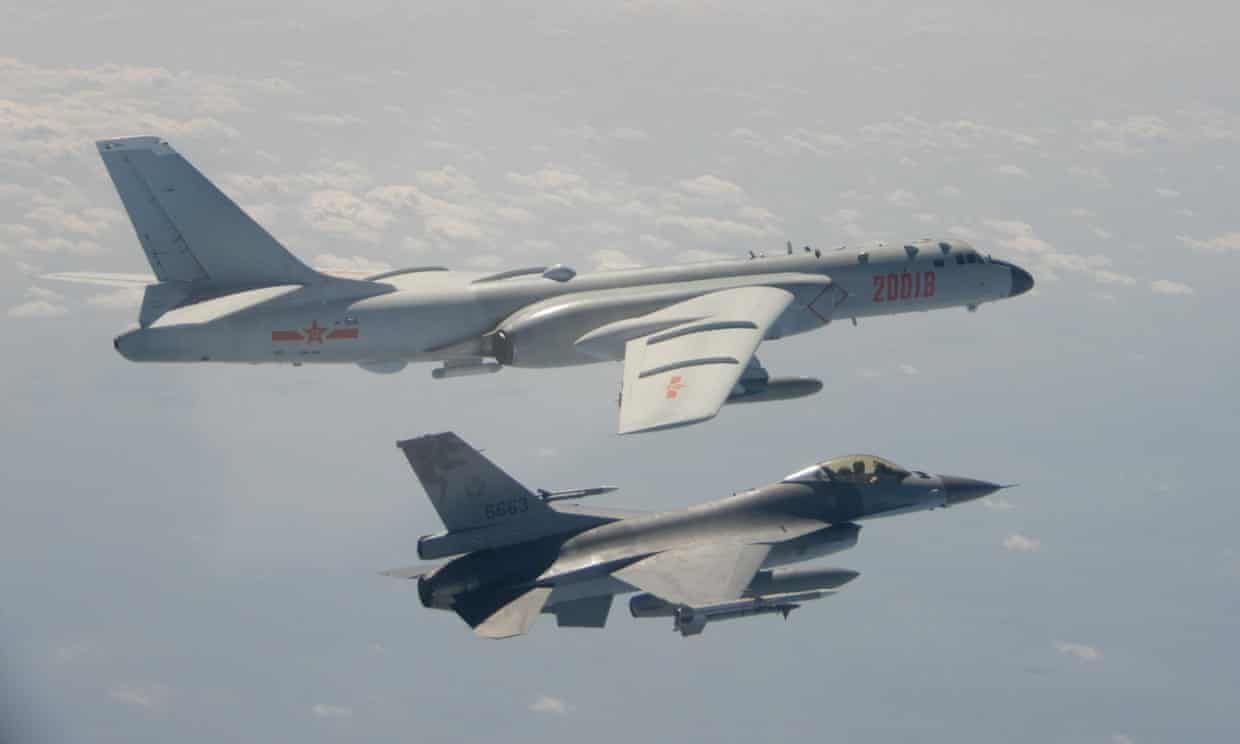
Taiwan scrambles jets after China makes largest incursion into air defence zone since January

<div class=__reading__mode__extracted__imagecaption>A Taiwanese fighter jet flying next to a Chinese bomber (top) off the coast of Taiwan in February 2020. China has almost doubled its incursions this year. Photograph: Taiwan's Defence Ministry/AFP/Getty Images<br>A Taiwanese fighter jet flying next to a Chinese bomber (top) off the coast of Taiwan in February 2020. China has almost doubled its incursions this year. Photograph: Taiwan's Defence Ministry/AFP/Getty Images</div>

China has almost doubled its incursions this year, as it attempts to keep island under pressure

China has made the second largest incursion into Taiwan’s air defence zone this year with Taipei reporting 30 jets entering the area, including more than 20 fighters.

Taiwan’s defence ministry said late on Monday it had scrambled its own aircraft and deployed air defence missile systems to monitor the latest Chinese activity.

In recent years, Beijing has begun sending large sorties into Taiwan’s defence zone to signal dissatisfaction, and to keep Taipei’s ageing fighter fleet regularly stressed.

Self-ruled democratic Taiwan lives under the constant threat of invasion by China, which views the island as its territory and has vowed to one day seize it, by force if necessary.

The US last week accused Beijing of raising tensions over the island, with secretary of state Antony Blinken specifically mentioning aircraft incursions as an example of “increasingly provocative rhetoric and activity”.

Blinken’s remarks came after US president Joe Biden appeared to break decades of US policy when in response to a question on a visit to Japan he said Washington would defend Taiwan militarily if it was attacked by China. . .

> The ADIZ is not the same as Taiwan’s territorial airspace but includes a far greater area that overlaps with part of China’s own air defence identification zone and even includes some of the mainland. A flight map provided by the Taiwanese defence ministry showed the planes entered the south-western corner of the ADIZ before they looping back out again. . .

So far in 2022 Taiwan has reported 465 incursions, a near 50% increase on the same period last year. The sheer number of sorties has put the air force under immense pressure, and it has suffered a string of fatal accidents in recent years.

On Tuesday local media reported that a pilot had died after crashing a trainer jet in southern Kaohsiung. It is not the first deadly crash this year – in January one of Taiwan’s most advanced fighter jets, an F-16V, plunged into the sea.

Last March, Taiwan grounded all military aircraft after a pilot was killed and another went missing when their fighters collided mid-air in the third fatal crash in less than six months."


Monday, May 30, 2022

BUMPY UNCERTAIN DESTABILIZING PHASE: Growing Worries About Global Growth + Corporate Earnings

Intro:

Private equity cannot avoid the reckoning in markets

Both the real economy and the financial system are in a destabilising phase for both public and private investors

The writer is president of Queens’ College, Cambridge, and an adviser to Allianz and Gramercy

"At a conference of investment professionals I recently attended, several private equity funds argued with considerable vigour that this year’s large losses in public markets would drive even more investors their way.

They were confident that their asset class would avoid the reckoning that stocks and bonds have been exposed to this year because they were structurally immunised against disruptive changes in the investment landscape.

I fear that this may prove to be too much bravado and misplaced self-confidence. Both the real economy and the financial system have entered a phase that is uncertain and destabilising for private as well as public market investors.

As noted recently in the Financial Times by Katie Martin, “adherents to the classic portfolio split — 60 per cent stocks and 40 per cent bonds — have not had it so bad in half a century”. Both equities, usually dubbed as risk assets, and the “risk free” alternatives of government bonds have experienced large losses this year.

In the traditional correlation between such assets, if stocks sold off, government bonds rose. That correlation has broken down as all these assets (understandably) suffered from worries about higher interest rates and tightening financial conditions.

While the last couple of weeks have seen some reversion to the more traditional correlation, that is not without its own problems. The reason is growing worries about global growth and corporate earnings. They point to further volatility for equities which constitute the largest part of most public market portfolios.

> In contrast to this year’s brutal sell-off in stocks and bonds, private equity valuations have remained robust. As often pointed out by their marketers, the conventionally longer holding period reduces the disruptive influence of speculative money looking to get out quickly. As does the fact that private equity investments are usually focused on single assets as opposed to indices, limiting the scope for contagion.

Such factors fuel expectations of an acceleration of what already has been a considerable multiyear increase in the strategic allocation of investment flows, and not just from public pension funds, foundations, endowments and sovereign wealth institutions. Private equity fans also expect the asset class to get a boost from ongoing efforts to make private equity more accessible for retail money.

Such optimism about the robustness of the asset class may, however, be excessive. Private equity valuations are updated much less regularly than for public investments. Indeed, historically, revaluations have tended to lag behind public markets by a minimum of six to nine months. Moreover, several of the factors that have recently undermined the public markets are also worrisome for private equity.

Higher interest rates and tightening financial conditions will complicate the refinancing of leveraged take-private transactions. They make the paths back into the public markets less secure and the exit valuation less certain. They also curtail new investors’ enthusiasm for buying private equity stakes in the secondary market, putting pressure both on prices and volumes.

The worsening global economic outlook is also a problem. Downturns rob companies of actual and prospective revenues, leading to faster burning of cash reserves, increased debt burdens relative to equity and capital erosion.

There are two additional risks that are specific to private equity in the period ahead. First, that one of its often-cited structural strengths — that of illiquidity that damps unfavourable price volatility — turns into a weakness; and second, that financial regulators and supervisors pay a lot more attention to conduct in private markets.

Private equity is just as likely to experience a shift in operating paradigm this year as the public markets have been undergoing — from a seller’s to a buyer’s market. Indeed, both are in the process of exiting from a world of massive and predictable central bank liquidity injections that over-facilitated a seemingly endless flow of money into a smaller set of investment opportunities. What lies ahead is a world in which the cost of money will be higher and financial flows more selective as they become less ample.

With time, genuinely attractive value will be restored to private and public markets. The process of doing so, however, is likely to be as bumpy."

Video for mohamed el erian
3 days ago · Mohamed El-Erian, Bloomberg Opinion Columnist and President of Queens' College ...
Duration: 9:00
Posted: 3 days ago

 Media posted by Mohamed A. El-Erian

> RELATED CONTENT...............................................................................