O YAY!! The first teaser for the new “Pinocchio” was unveiled Tuesday and faithfully re-creates some of the most beloved scenes from the 1940 animated feature. Tom Hanks stars as Geppetto, the humble woodcarver who yearns for his marionette, Pinocchio (Benjamin Evan Ainsworth), to become a real boy.
Tom Hanks as Geppetto in Disney's live-action reimagining of "Pinocchio."
Disney
Disney is giving yet another of its animated classics the live-action treatment with the release of a reimagined “Pinocchio” later this year.
As the Blue Fairy, Cynthia Erivo puts a chilling spin on “When You Wish Upon a Star” ― arguably the most beloved Disney song of all time ― and brings Pinocchio to life.
Catch the teaser for “Pinocchio” below.
The new “Pinocchio,” which hits Disney+ on Sept. 8, is directed by Robert Zemeckis
previously worked with Hanks on “Forrest Gump” and “Cast Away.”
The film’s starry cast also features Joseph Gordon-Levitt as Jiminy Cricket, Luke Evans as the villainous Coachman, and Lorraine Bracco as Sofia the Seagull, a newly written character.
Appearing on the “D23 Inside Disney” podcast last year, Evans said his character was among those that had been “dramatically enhanced” for the 2022 version of “Pinocchio
Intro: Randolph Solar Park LLC, a subsidiary of EDP Renewables North America, LLC (EDP Renewables), after discussions with Salt River Project Agricultural and Power District (SRP), is seeking two Certificates of Environmental Compatibility (CECs) from the Arizona Corporation Commission (ACC) for the Randolph Solar Project, a proposed 230 kV gen-tie line and associated substation facilities (Project).
About EDP: EDP Renewables works hard to balance the energy needs of our customers while protecting the environment and existing features of the area.
The Project is proposed in a heavily disturbed area with several existing industrial and utility land uses including multiple high-voltage transmission lines and the existing SRP Coolidge gas facility. The gen-tie transmission line structures will consist of double-circuit 230kV steel monopoles and are anticipated to be approximately 105 feet in height and would generally blend in with many of the existing landscape features.
Project Planning
In early 2021, EDP Renewables hired SWCA, an environmental consulting firm, to assist in evaluating the project site, to assess potential environmental impacts, and to support the public outreach process for the project. Baseline information about land use, visual, biological, cultural, and recreational resources for the area has been collected. Early in the project process, EDP Renewables began coordination with project area stakeholders including other utility partners and Pinal County in order to share project information and to collect input from them.
Project Description
Randolph Solar Park LLC, a subsidiary of EDP Renewables North America, LLC (EDP Renewables), after discussions with Salt River Project Agricultural and Power District (SRP), is seeking two Certificates of Environmental Compatibility (CECs) from the Arizona Corporation Commission (ACC) for the Randolph Solar Project, a proposed 230 kV gen-tie line and associated substation facilities (Project). This Project would connect the future 1,290 acre 200 MW Randolph Solar Park project to the regional electric grid via the existing SRP Randolph Substation. The Project would be under two separate ownerships, the first portion would include approximately 0.18-mile owned and operated by Randolph Solar Park, LLC (CEC-1). The second portion would include the remaining approximate 0.22-mile portion and would be owned and operated by SRP (CEC-2). Please see the maps for further description of the CECs.
The proposed gen-tie line would be approximately 0.4 mile or 2,112 feet long and would originate at a proposed new substation within the Randolph Solar Project site and terminate at SRP’s Randolph switchyard located immediately adjacent to the proposed solar facility approximately 0.5 mile southeast of the intersection of State Route 287 and Randolph Road. The new line would be constructed within a 200-foot-wide right of way and the supporting structures for the line’s conductors would be no more than 105 feet tall.
The Project need is to provide a new 230 kV gen-tie transmission line to interconnect the proposed Randolph Solar Park 200 MW photovoltaic facility and SRP's ...
Dec 13, 2021 · Randolph Solar PV Park I is a 200MW solar PV power project. It is planned in Arizona, the US. The project is currently in permitting stage.
Aug 12, 2021 · “Randolph will be EDP Renewables' largest solar project in Arizona, and we look forward to continuing to expand our portfolio in the state.”.
Aug 12, 2021 · EDP Renewables North America LLC and Salt River Project (SRP) have executed a 25-year power purchase agreement for 200 MW at the Randolph ...
AGENDA
Randolph Solar Park, LLC (L-21183A-22-0069-00200) – Application in Conformance with the Requirements of A.R.S. § 40-360, et seq., for Certificates of Environmental Compatibility (CEC-1) Authorizing the 230 kV Randolph Solar Gen-Tie Project Including Construction of a New 230kV Transmission Line and Associated Facilities Originating in Coolidge, Arizona and Interconnecting with the Existing SRP Randolph Substation.
Randolph Solar Park, LLC (L-21183A-22-0069-00200) – Application in Conformance with the Requirements of A.R.S. § 40-360, et seq., for Certificates of Environmental Compatibility (CEC-2) Authorizing the 230 kV Randolph Solar Gen-Tie Project Including Construction of a New 230kV Transmission Line and Associated Facilities Originating in Coolidge, Arizona and Interconnecting with the Existing SRP Randolph Substation.
HV Sunrise, LLC. (L-21185A-22-0072-00201) – Application in Conformance with the Requirements of Arizona Revised Statutes §§ 40-360, et seq., for a Certificate of Environmental Compatibility Authorizing Construction of a 500-KV Transmission Intertie Connecting a New Photo-voltaic Solar Power Plant to the APS Delaney Substation in Maricopa County, Arizona.
Arizona Corporation Commission (E-00000A-21-0010) – Staff’s Request for Modification of Procedural Schedule in Decision Nos. 78498 and 78582 Pursuant to A.R.S. § 40-252, with Notice and Opportunity to be Heard, to Allow the Policy Task Force to Docket Final Recommendations and Staff to Hold a Second Substantive Workshop After All Town Halls have Concluded. (ITEM ADDED)
ARIZONA CORPORATION COMMISSION
EXECUTIVE DIRECTOR Matthew J. Neubert
SECRETARY Carolyn D. Buck Phone: 602-542-3931 CDBuck@azcc.gov
COMMISSIONERS Chairwoman Lea Márquez Peterson Sandra D. Kennedy Justin Olson Anna Tovar Jim O'Connor
REVISED N O T I C E
Special Open Meeting of the Arizona Corporation Commission
This shall serve as notice of an open meeting at the above location for consideration, discussion, and possible vote of the items on the agenda and other matters related thereto. Commissioners may attend the proceedings in person, or by telephone, video, or internet conferencing, and may use this open meeting to ask questions about the matters on the agenda. Because of the guidance issued by state and federal officials regarding the Covid-19 pandemic, the number of persons admitted to the hearing room will be limited to 50, to allow for appropriate social distancing. Admission will be allowed on a first-come basis. An overflow room with a capacity of 25 and facilities for watching the proceeding will be made available if the main hearing room reaches capacity. Parties to the matters to be discussed or their legal representatives may attend remotely or in person. The Commissioners may move to executive session, which will not be open to the public, for the purpose of legal advice pursuant to A.R.S. § 38-431.03 (A) (3) and (4) on the matters noticed herein.
In addition to attending in-person, the public will be able to participate by either watching and listening to the meeting online or listening to the meeting via telephone. For those not attending in-person and wishing to enter an appearance or provide public comment for a particular item please use the dial in phone numbers. Once the item for which you are appearing or providing public comment is concluded, please hang up and watch the live stream.
Each party to and stakeholder interested in an Open Meeting agenda item will be permitted to appear in-person, by videoconference or telephone during the Commission’s consideration of the item at Open Meeting. To participate by videoconference for an agenda item, a person must have an ACC Portal Account (create an account for free at https://efiling.azcc.gov/cases ) and must, by no later than 8:00 a.m. on the day of Open Meeting, complete the process on the ACC Portal to “Request to Speak at Open Meetings” for the item. A person who has completed the Request to Speak process for an agenda item will, at approximately 8:30 a.m. on Open Meeting Day, receive an email with a WebEx link and instructions to participate in the Open Meeting. Parties and stakeholders may also opt to participate via telephone, using the phone number and code to speak shown below.
Persons with a disability may request reasonable accommodations by contacting the Commission Secretary listed above at least 48 hours before the scheduled commencement of the Open Meeting.
Dial-in Phone Number: 1-866-705-2554 Passcode to Speak: 241497#
1-866-705-2554 Passcode to Listen Only: 2414978#
Members of the public may watch a livestream/broadcast of the meeting online at: http://www.azcc.gov/live(Please note there is an approximate 30 second delay in the livestream and it is for listen-only. Individuals making comment must register/sign-on to speak using the telephone number above.)
NOTE: The Commission may choose to take testimony under oath.
RELATED CONTENT................................................................................
EDP Renewables developing 200-MW Arizona solar project powering Facebook data center
DP Renewables and utility company Salt River Project (SRP) have executed a 25-year power purchase agreement for 200 MW at the Randolph Solar Park in Pinal County, located in south-central Arizona.
The entire capacity of the Randolph Solar Park will be dedicated to supporting Facebook’s newly announced data center in Mesa, Arizona
“We enjoy working with partners who share our sustainability vision, and we are happy to work with EDP Renewables to support Facebook’s new data center with renewable solar energy,” said Kelly Barr, SRP’s chief strategy, corporate services and sustainability executive. “All organizations involved in this effort are jointly reducing carbon emissions in Arizona and setting a precedent for a green energy future.”
The Randolph Solar Park is expected to be operational in 2023, generating enough electricity to annually power more than 49,000 average Arizona homes
SRP’s investment in the Randolph Solar Park is part of the utility’s expanded commitment to add 2,025 MW of utility-scale solar resources to its power system by 2025 and serve customer energy needs with renewable energy.
“We are excited to partner with SRP and EDP Renewables to bring new solar energy resources to the Arizona grid. Access to renewable energy and a strong grid were an important part of our decision to build in Mesa,” said Urvi Parekh, Facebook’s head of renewable energy. “Facebook is committed to having a positive impact on local communities, and we’re excited to help bring this additional investment and jobs to the area.”
Randolph is EDP Renewables’ first greenfield development project to execute a PPA in the state, and the company will continue its efforts to add more to its portfolio in Arizona in the coming years.
“Arizona has an abundance of opportunities in the solar space, and this transaction allows EDP Renewables to expand our presence in this growing market,” said Miguel Prado, EDP Renewables North America CEO. “We are eager to break ground next year on this project, which will provide an economic boost to the local economy and sustainable, reliable energy to Arizonians.”
Intro: Ya know, dear readers, your MesaZona is really throwing one more RANT today about our Air Quality ....Ooops!! Here's another one, but this time here are some links so that YOU, dear readers, CAN FOLLOW THROUGH to get yourown daily updates . . . ask for more accountability. Maricopa County consistently VIOLATES federal Clean Air Standards Whose job is it anyway to ensure that Federal Clean Air Standards do not get consistently violated here? It doesn't look like they are "Doing Their Job"! Here's another Advisory for tomorrow: WHAT DO YOU WANT TO DO ABOUT IT???????? It's just NOT a Particulate Matter > Do you take it personally? It's time to hold ADEQ accountable.
Health Impacts
People most vulnerable to the impacts of air pollution include children, older adults, adults exercising outdoors and people with heart or lung disease and those suffering from asthma and bronchitis. Exposure can increase the number and severity of asthma attacks, cause or aggravate bronchitis or other lung disease and reduce the body’s ability to fight infection. Symptoms may include itchy eyes, nose, and throat, wheezing, coughing, shortness of breath, chest pain and upper respiratory issues. Long-term exposure is linked to premature death in people with heart or lung disease, nonfatal heart attacks, irregular heartbeat and decreased lung function.
Particulate Matter:
State and county agencies measure levels of particulate matter (PM) in the air.
PM is extremely small solid particles and liquid droplets that circulate in air.
PM comes from combustion (cars, industry, wood burning) or dust stirred up into the air. High levels of PM occur when air is especially stagnant or windy.
Two types of PM are measured:
PM-10, commonly called dust
PM-2.5, commonly called soot or smoke.
PM-10 is 10 microns or less in size
PM-2.5 is 2.5 microns or less in size.
(For perspective, one strand of human hair is 70-100 microns in size.)
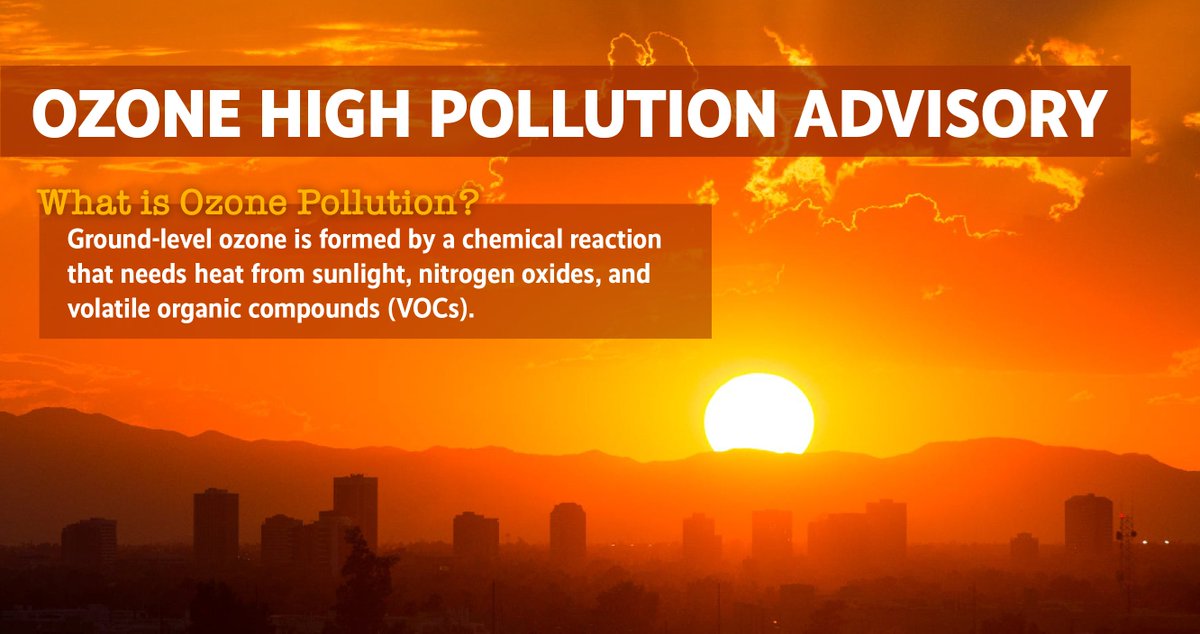
The previously issued Ozone High Pollution Advisory for today will remain in effect and be extended for Tuesday, May 26th. Friday, high pressure’s grip on the Desert Southwest bolsters and another Ozone High Pollution Advisory is possible. Please keep in mind that although ozone fluctuates daily, the week in Phoenix is going to get progressively hotter! Eventually, the 110 degree realm is likely.
The National Weather Service is covering that aspect in detail. They have issued a host of heat related warnings
Ozone GPA: High Pollution Advisory (HPA)
Notifies the public that the level of an air pollutant is forecast to exceed the federal health standard.
HEALTH IMPACTS: People most vulnerable to the impacts of air pollution include children, older adults, adults exercising outdoors, people with heart or lung disease, and those suffering from asthma and bronchitis.
Exposure can increase the number and severity of asthma attacks, cause or aggravate bronchitis or other lung disease, and reduce the body’s ability to fight infection.
Symptoms may include itchy eyes, nose and throat, wheezing, coughing, shortness of breath, chest pain and upper respiratory issues.
Ground-level ozone forms when two types of pollutants — volatile organic compounds (VOCs) and nitrogen oxides (NOx) — react in sunlight.
These pollutants come primarily from automobiles, but also from other sources, including industries, power plants and products, such as solvents and paints. Generally, the highest levels of ozone occur in the afternoon.
There are only 'alerts' and 'warnings' for what to avoid doing, qualifiers with qualifiers like sensitive-groups may be affected.
Five major pollutants
EPA establishes an AQI for five major air pollutants regulated by the Clean Air Act. Each of these pollutants has a national air quality standard set by EPA to protect public health:
ground-level ozone
particle pollution (also known as particulate matter, including PM2.5 and PM10)
Technical Assistance Document for the Reporting of Daily Air Quality
This guidance is designed to aid local agencies in reporting the air quality using the AQI as required in the Code of Federal Regulations (CFR). For more information contact David Mintz at (mintz.david@epa.gov). Updated 2018
You may need a PDF reader to view files on this page. See EPA’s About PDF page to learn more.
Not too many - very few in fact - picked up on Arizona Governor Doug Ducey's 5-day trip to the nation of Israel in the Middle East - it was the third visit by the governor in Israel.
Hello Tim,
Governor Doug Ducey is wrapping up his trip to Israel with a series of back-to-back meetings with industry leaders and government officials, as well as visiting heritage sites in Nazareth.
See some of the highlights below followed by a story from the Jewish News Syndicate about the governor’s trip.
Governor Ducey Meets with Israeli Ministry of Foreign Affairs Officials
Governor Ducey Visits The Church of Annunciation
Governor Ducey Receives Commemorative Drip Irrigation Device From N-Drip
Arizona Gov. Doug Ducey Brings Economic Trade Mission To Israel
He and his delegation also visited biblical and historical sites, attended a U.S. Memorial Day service and celebrated Jerusalem Day in the capital.
Arizona Gov. Doug Ducey is in Israel this week on a five-day trade mission with a delegation from Arizona focused on business development, water technology and border security. The delegation includes Danny Seiden, the head of Arizona’s Chamber of Commerce, and Sandra Wilson, the president and CEO of the Arizona Commerce Authority.
While the trip is geared towards increasing trade and investment between Israel and Arizona, the governor also had the opportunity to visit some key religious, historical and cultural sites, including the Western Wall, the Tomb of the Patriarchs in Hebron, Menachem Begin Heritage Center, and City of David excavations. Ducey’s visit to the burial site of Abraham, Isaac, Jacob, Sarah, Rebecca and Leah in Hebron followed recent visits to Judaism’s second holiest site by Former Vice President Mike Pence and former Secretary of State Mike Pompeo.
During his stop in Hebron, Ducey told JNS, “It’s great to be back in Israel.” Arizona, he said, has a “wonderful” relationship with the Jewish state. “In the first year of my administration [2015] we came here and learned a lot about water and border security, about building a start-up state, and we have tried to apply that to Arizona. So this is an economic mission that we are on. We are in search of solutions to future water issues and Israel is always cutting-edge.”
In addition, Arizona is reportedly the only U.S. state to have a full-time, dedicated Trade and Investment Office in Israel, which was established in 2019 under Ducey’s leadership and is led by Tel Aviv-based American-Israeli entrepreneur David Yaari. Arizona has a growing tech scene, with many Israeli companies choosing to establish bases in the Grand Canyon state as opposed to elsewhere on the West Coast.
With an arid climate much like that of Israel, the governor is particularly interested in Israeli agri-tech, with an eye toward reproducing Israel’s work in the fields of water preservation and desalination.
The governor also led a U.S. Memorial Day Ceremony at Israel’s 9/11 Living Memorial Plaza, the only monument outside of the United States that bears all the names of those killed during the September 11 attacks. The ceremony was attended by U.S. Ambassador to Israel Thomas Nides, U.S. Military Attaché to Israel Brig. Gen. Shawn Harris and Consul General of Israel to the Pacific Southwest Hillel Newman.
“To be in Israel on Memorial Day at the only memorial in the world [outside the U.S.] with all the names of everyone who perished that day listed, it certainly feels like Memorial Day here,” said Ducey.
“To be among our greatest allies, and all the support they show for our nation is something really special. [Israel] is one of the nations that represents light in the world, alongside the United States,” he added.
Ducey was in Jerusalem on Sunday as Israel celebrated Jerusalem Day. He tweeted: “Proud to be in Israel on Jerusalem Day marking the 55th anniversary of the reunification of Jerusalem during the Six-Day War in 1967. Jerusalem is the eternal and indivisible capital of Israel.”
He added: “It was very special to be here on Jerusalem Day. There was a real energy, patriotism and spirit, especially among the young people.”
Consul General Newman, who was a key facilitator of Ducey’s visit, told JNS, “The Consulate General of Israel in Los Angeles was delighted to work with the governor and his team on realizing this visit of the governor, the third visit by the governor in Israel.”
Ducey, added Newman, “is one of the greatest friends of the State of Israel and the people of Israel, as demonstrated by his many actions. Among them are his opening of an office of trade in Israel, divesting from Ben & Jerry’s, his many statements of support and his solidarity with Jerusalem Day.”
In addition, under Ducey’s tenure, Arizona has adopted the International Holocaust Remembrance Alliance (IHRA) definition of anti-Semitism and has mandated Holocaust education in the state’s schools for students from grades seven through 12.
During his time in the Jewish state, Ducey also met with Israeli President Isaac Herzog, Prime Minister Naftali Bennett, and former Prime Minister Benjamin Netanyahu. He was also recognized as a “Defender of Israel” by the Menachem Begin Heritage Center.
1 THORNY CONSTITUTIONAL QUESTIONS: Privacy advocates say the revelation that police are actively using AV footage is cause for alarm.
San Francisco Police Are Using Driverless Cars as Mobile Surveillance Cameras
“Autonomous vehicles are recording their surroundings continuously and have the potential to help with investigative leads,” an internal training document states.
“As companies continue to make public roadways their testing grounds for these vehicles, everyone should understand them for what they are—rolling surveillance devices that expand existing widespread spying technologies,” said Chris Gilliard, Visiting Research Fellow at Harvard Kennedy School Shorenstein Center. “Law enforcement agencies already have access to automated license plate readers, geofence warrants, Ring Doorbell footage, as well as the ability to purchase location data. This practice will extend the reach of an already pervasive web of surveillance.”
SFPD’s use of AVs as mobile surveillance cameras follows the practices of the Chandler Police Department in Arizona, where Waymo has been testing AVs since 2017. But previous reports indicated these were rare instances involving traffic crimes like hit and runs. SPFD did not respond to a Motherboard email asking for more details on when and how often it sought footage from AVs.
Privacy advocates and researchers have long warned about the implications of increasingly sophisticated cars, but many of these warnings are essentially extensions of the privacy concerns of smartphones, where consumer technology tracks your movements and behavior, anonymizes it, and sells it to third parties in a manner that can be reverse-engineered to identify individuals. They rarely imagine a scenario where cars on the road are constantly recording the world around them for later use by police departments.
It is the combination of using fixed location camera networks with rolling networks of autonomous vehicle cameras and data that scares privacy advocates most. “The holistic outcome of these combined moving and fixed networks is a threat that is greater than the sum of its parts,” Schwartz said. “Working together, [they can] more effectively turn our lives into open books.”
At some point, evidence gathered by autonomous vehicles may be challenged in court. If and when that happens, we may get even more answers. But it seems like this isn’t a problem capable of being quantified with this minimum amount of information. That doesn’t mean it should be ignored. It just means more data is needed to draw any solid conclusions.
San Francisco Cops Are Accessing Autonomous Vehicle Recordings To Collect Evidence
For the last five years, driverless car companies have been testing their vehicles on public roads. These vehicles constantly roam neighborhoods while laden with a variety of sensors including video cameras capturing everything going on around them in order to operate safely and analyze instances where they don’t.
While the companies themselves, such as Alphabet’s Waymo and General Motors’ Cruise, tout the potential transportation benefits their services may one day offer, they don’t publicize another use case, one that is far less hypothetical: Mobile surveillance cameras for police departments.
It’s not quite as cut-and-dried as that last sentence. As far as we know, police departments do not have unfettered, real-time access to the recordings created constantly by autonomous vehicles. But they do have access to the recordings. That much is clear from the public records obtained by Motherboard.
The San Francisco PD has been using this footage to aid in investigations, apparently frequently. The training document says two things, neither of which address the particularly thorny constitutional questions they raise:
Autonomous vehicles are recording their surroundings continuously and have the potential to help with investigative leads.
There’s nothing untrue about this assertion and yet it says nothing about the processes used to obtain these recordings. That might have been a hypothetical if not for the following bullet point:
Information will be sent in how to access this potential evidence (Investigations has already done this several times)
Yikes.
That is problematic, as an EFF rep points out:
“This is very concerning,” Electronic Frontier Foundation (EFF) senior staff attorney Adam Schwartz told Motherboard. He said cars in general are troves of personal consumer data, but autonomous vehicles will have even more of that data from capturing the details of the world around them. “So when we see any police department identify AVs as a new source of evidence, that’s very concerning.”
So many questions
An AV will not have a human driver, which lowers the expectation of privacy. That expectation reverts to the company deploying it, which makes it somewhat comparable to a third-party record: data obtained by an automatic process that belongs to the company deploying the data-gathering device (in this case, a car).
Since there’s no driver to challenge searches, the responsibility lies with the company deploying the vehicle. And, since the recordings presumably cover public areas where the privacy expectation is further lowered, it might be possible to obtain recordings with nothing more than a subpoena (or a friendly sounding email!)
That’s where things get even thornier, in terms of the Fourth Amendment. The document does not describe the process the SFPD investigations team uses to obtain recordings.
>First of all, how does the SFPD even know if AV recordings might be useful in ongoing investigations? ...
> Moving on from there, how does the PD approach these companies? Private searches (which may be how these recordings are viewed by courts) are legal provided law enforcement does nothing to encourage searches companies (or their employees) may not otherwise engage in...
AV testing is AV testing. It really doesn’t matter much where it’s happening, so some companies may engage in test runs in neighborhoods investigators think might provide more evidence or intel. If this is happening, that’s a real problem.
Unfortunately, we only know what the SFPD has released so far: a training document that says AV cars capture footage and that investigators have utilized that footage in the past. Future public records requests may shed more light on the matter, but for now, this is all we have.
National Security Implications of Leadership in Autonomous Vehicles
June 28, 2021
". . .The Military Applications of Autonomous Vehicles
As much of the innovation and work on AVs is now happening in the private sector, it is reasonable to ask how much carryover there will be from commercial to military uses. In the early stages of developing AV technology, there was considerable overlap. As development progressed, there has been divergence, and the direct application of commercial autonomy will be smaller (the same way a combat aircraft and a passenger aircraft that share certain technologies can jointly benefit from research and development but are ultimately designed for fundamentally different purposes and requirements).
Autonomous devices that operate without human control are deeply attractive to militaries and are already deployed in aerospace and undersea vehicles by leading military powers. Autonomous ground vehicles are more challenging to develop, given the much more complex and varied terrain in which operations take place, but innovation in the commercial self-driving sector could improve military vehicles’ operations. This will be seen first in logistics and support vehicles (e.g., autonomous trucks), where the transition from commercial to military is simpler, and perhaps later in combat vehicles.
It is not an accident that the Defense Advanced Research Projects Agency (DARPA) was the government agency that began work on autonomous driving in 1984 with its Autonomous Land Vehicle program. . ."
Whenever cops discover a new means or method of tracking people that seems to run afoul of the letter (if not the spirit) of the Fourth Amendment, they’re quick to defend these actions by claiming they’re necessary to hunt down the most dangerous of criminals: terrorists, sexual exploiters of children, kidnappers, homicide suspects, etc.
When pressed for details, it usually turns out Fourth Amendment eluding by law enforcement tends to focus on the same sort of bog standard crime cops could be using regular stuff to handle, rather than seeking “national security” exceptions for their rights violations.
Cops are terrible at tracking down and punishing the worst criminals. And, like anyone employed pretty much anywhere, they’re far more interested in easy wins and easy busywork. So, when cops started acquiring designed-for-the-military phone tracking gear (Stingrays, etc.), they claimed these purchases that they kept hidden from the public were essential to ensure the annual Mule Day parade remained free of terrorist activity. The heinous criminal acts cited in acquisition forms materialized as the deployment of cell site simulators to track down threats to the fabric of society like… fast food thieves.
Cops are frequently turning to Google to shortcut the investigative work of criminal investigations. When cops can’t find a suspect, they send subpoenas (or “reverse” warrants) to Google, demanding information on every device found in the area of a crime scene during the time the crime occurred. Depending on the size of the geofence erected around the request, hundreds to thousands of innocent people are subjected to searches while cops figured out who might actually be a likely suspect.
Again, cops (and their published advocates) argue the use of reverse warrants is a net good for society — something that allows cops to track down suspects without troubling the rights of people who don’t care about their rights.
Few assurances have been offered about the use of reverse warrants. The lack of “but serious crimes” assurances may have factored into the handful of court rejections of these warrants. But cops continue to run to Google for location data. And they rely on the (sometimes unspoken) implication that serious criminal investigations would dead end without this information, further separating probable cause from its expected definition to engage in dragnet acquisitions of cell location data and identifying info that can link devices to people.
A review of warrants by KUTV found Layton Police are routinely obtaining geo-fence warrants to investigate property crimes. Court records show that since last fall, Layton Police have used geo-fence warrants for cases including a stolen wallet at Layton Hospital, a theft at Layton Hills Mall, a car break-in at a gym, and a stolen vehicle from a car dealership, among other crimes.
These are the sorts of crimes people expect cops to solve without a bunch of fancy technical tools. This are small-time property crimes — the sort that make up the bulk of police work. Why a geofence warrant was considered necessary is unclear. The most obvious explanation is “because it’s there.” If it’s an option that will see little pushback from third parties and courts, then why bother doing any actual police work using means and methods that have proven capable of handling low-level crap like this for years?
Until the pushback arrives, we can expect Utah cops to keep using a questionable tool to investigate regular property crimes they often couldn’t be bothered to investigate otherwise. When time is of the essence, cops are always available to write things down and shrug about the possibility of property recovery. But when Google can be made to do cops’ work for them, then Google it is.
And, of course, certain residents are cool with cops lazily turning dozens or hundreds of people into criminal suspects because someone else is doing most of the work. KUTV interviewed Randy Lavine, one of several residents living in the area where multiple cars were broken into and thieves made off with [rereads news report] $350 in property. Lavine indicated some discomfort at being (however briefly) considered a suspect due to his residence in the neighborhood where the thefts took place, but otherwise gave his blessing to the dragnet surveillance.
“I would like to have a heads up to say ‘hey, this is what we’re going to do,’ and I would have said ‘fine, hey, knock yourself out’,” Lavine said.
This is a pretty easy thing to say when you haven’t been hauled out of your home, dragged down to the precinct, and aggressively questioned about a crime you didn’t commit. That didn’t happen to Lavine, so that probably explains his blase attitude towards this use of reverse warrants.
Then again, Lavine was never going to “fit the description,” even if the theft had been committed by someone described as a “white, mustachioed, hat-wearing, AARP member.” Here’s Lavine, as captured by KUTV’s cameras:
Lavine isn’t the sort of person who’s going to get picked up and threatened by detectives who’ve done nothing more than run a proxy Google search before searching for suspects. That’s not how the system works anywhere in this country, least of all primarily white states like Utah. Lavine can shrug this off because even if the cops are wrong, it’s never going to affect him personally. This is not to condemn Lavine for his reaction. This is just to point out how easy it is to not be too bothered by apparent Fourth Amendment violations when they have little chance of affecting you personally.
The courts are pretty much the only thing pushing back against law enforcement overreach when it comes to methods and means that haven’t been subjected to a lot of precedent or judicial examination. The court will always trail tech advances because that’s the way the system operates: nothing is an issue until somebody raises it in court. The problem is courts are often hesitant to weigh in on these issues. The (irrational) fear that limiting cops might give criminals an advantage is only one of the problems. The other is the deference shown by courts to law enforcement officers who have somehow maintained their reputation as good people despite years of constitutional violations, lying, and inexplicably violent reactions to everyday occurrences.
Cops may have legitimate uses for geofence warrants. But those uses should be the exception, not the rule. But what’s shown here is that cops are using new tools that have not been fully examined by courts to track down the most petty of criminals, even when less intrusive options would accomplish the same ends. This needs to stop. And it’s up to the courts to stop it."