Wednesday, July 06, 2022

MICRO-MOBILITY: Electric Cargo Bikes...or even Walking!

O Yeah!

Amazon is using electric cargo bikes that look like mini-trucks to make deliveries in the UK

Amazon has launched its first “micromobility hub” in the UK with the aim to swap “thousands” of polluting delivery trucks with electric cargo bikes — and, in some cases, walking. The project is intended to help Amazon achieve its climate goals to have 50 percent of its deliveries be carbon neutral by 2030.

Starting in the London borough of Hackney, the company says that it will deliver 1 million packages a year using walking and electric cargo bikes, in addition to deliveries that are made with electric vans. Delivery workers on foot and e-bikes will help displace “thousands” of traditional van trips, Amazon said.

The carbon neutral trips will take place within a tenth of London’s ultra low emissions zone, in which vehicles are charged a fee based on the amount of emissions they produce. E-bikes and electric vehicles are exempt from the charge.

Amazon said it plans on opening additional hubs in the coming months. The company already operates 1,000 electric delivery vans in the UK, and has plans to introduce a new Rivian-made lineup of van in the US later this year (depending on Rivian’s ability to fill those orders).

Electric cargo bikes, especially those designed to look like mini-trucks, have been growing increasingly popular among delivery companies looking to burnish their environmental credentials. FedEx also uses e-bikes in London (that emissions charge!), while Domino’s partnered with Rad Power Bikes to deliver pizza in a couple of cities. UPS is used cargo bikes in Seattle. German delivery company DPD wants to use these mini-trucks that are actually e-bikes in disguise. In New York City, e-bikes are almost exclusively used by food delivery workers.

Amazon didn’t release any details about what they are calling their “e-assisted vehicles,” though they appear to be much different than most of the traditional cargo bikes that are out there. If anything, they look like the mini-trucks first proposed by DPD, which were designed by a startup called Eav, or the four-wheeled “eQuad” delivery vehicles used by UPS.

But we have yet to see a deployment of cargo e-bikes at scale by any delivery company. If Amazon sticks with it and actually fulfills on its promise, then the company’s micromobility efforts in the UK could be the first."


WORLD'S MOST LIVE-ABLE CITY: Vienna (for the third time in the last five years)

Must be that "Old World Charm" when Europe boasted six out of the top 10 cities.

After slipping to 12th place last year due to COVID-19 related closures, Vienna once again topped the Economist Intelligence Unit’s annual ranking of the world’s most livable cities following the reopening of Austria’s borders as well as the city’s museums and restaurants

Vienna reclaims title of the world’s most liveable city

"Annual rankings return Austria’s capital to first place, as former title-holder Auckland tumbles to 34th and Ukraine war sees eastern cities slump

The Austrian capital, Vienna, has made a comeback as the world’s most liveable city, according to an annual report from the Economist.

Vienna snatched the top spot from New Zealand city Auckland, which tumbled down to 34th place due to coronavirus pandemic restrictions, according to the report by the Economist intelligence unit published on Thursday.

“Vienna, which slipped to 12th place in our rankings in early 2021 as its museums and restaurants were closed, has since rebounded to first place, the position it held in 2018 and 2019,” the report said.

“Stability and good infrastructure are the city’s main charms for its inhabitants, supported by good healthcare and plenty of opportunities for culture and entertainment.”

The Austrian capital was followed by the Danish capital, Copenhagen, and Switzerland’s Zurich. Fellow Swiss city Geneva came sixth, Germany’s Frankfurt seventh, and the Netherlands’ Amsterdam ninth.

Canada also did well. Calgary came in joint third position, followed by Vancouver in fifth place and Toronto in eighth.

Japan’s Osaka and Australia’s Melbourne shared 10th place. France’s capital, Paris, came 19th, 23 places up from last year. The Belgian capital, Brussels, was 24th, just behind Canada’s Montreal. . .

In this year’s rankings, the UK’s capital, London, was the world’s 33rd most liveable city, five places behind Manchester in 28. Spain’s Barcelona and Madrid came 35th and 43rd respectively. Italy’s Milan ranked number 49, the US city of New York 51, and China’s Beijing came 71st.

Lebanon’s capital, Beirut, which was ravaged by a 2020 port explosion and is battling a crippling financial crisis, was not included in the ranking of business destinations.

Neither was Kyiv, after the Russian invasion on 24 February forced the Economist to abort its survey of the city. Russia’s capital, Moscow, saw its liveability ranking fall by 15 places, while St Petersburg slipped by 13 places. . .

The capital of war-torn Syria, Damascus, retained its place as least liveable city on the planet."

Agence France-Presse contributed to this report

JOINT ADVISORY TODAY: The FBI, CISA, and the U.S. Treasury Department

The three U.S. federal agencies also provide indicators of compromise (IOCs) obtained by the FBI while responding to Maui ransomware attacks since May 2021.
They also urge HPH Sector organizations to implement mitigation and apply a set of measures shared in the joint advisory to prepare for, prevent, and respond to ransomware incidents.

US govt warns of Maui ransomware attacks against healthcare orgs

"The FBI, CISA, and the U.S. Treasury Department issued today a joint advisory warning of North-Korean-backed threat actors using Maui ransomware in attacks against Healthcare and Public Health (HPH) organizations.

Starting in May 2021, the FBI has responded to and detected multiple Maui ransomware attacks impacting HPH Sector orgs across the U.S.

"North Korean state-sponsored cyber actors used Maui ransomware in these incidents to encrypt servers responsible for healthcare services—including electronic health records services, diagnostics services, imaging services, and intranet services," the federal agencies revealed.

"In some cases, these incidents disrupted the services provided by the targeted HPH Sector organizations for prolonged periods. The initial access vector(s) for these incidents is unknown."

Based on previous reports (including one authored by Stairwell principal reverse engineer Silas Cutler), Maui ransomware is manually deployed across compromised victims' networks, with the remote operators targeting specific files they want to encrypt.

While Stairwell collected the first Maui sample in early April 2022, all Maui ransomware samples share the same compilation timestamp of April 15, 2021.

Maui also stands out compared to other ransomware strains by not dropping a ransom note on encrypted systems to provide victims with data recovery instructions.

DPRK hackers will likely continue targeting HPH sector

The three U.S. federal agencies also provide indicators of compromise (IOCs) obtained by the FBI while responding to Maui ransomware attacks since May 2021.

They also urge HPH Sector organizations to implement mitigation and apply a set of measures shared in the joint advisory to prepare for, prevent, and respond to ransomware incidents.

At the very least, network defenders are advised to train users to spot and report phishing attempts, enable and enforce multi-factor authentication across their orgs, and keep antivirus and antimalware software up to date on all hosts. 

"The FBI assesses North Korean state-sponsored cyber actors have deployed Maui ransomware against Healthcare and Public Health Sector organizations," the joint advisory adds.

"The North Korean state-sponsored cyber actors likely assume healthcare organizations are willing to pay ransoms because these organizations provide services that are critical to human life and health.

"Because of this assumption, the FBI, CISA, and Treasury assess North Korean state-sponsored actors are likely to continue targeting HPH Sector organizations."

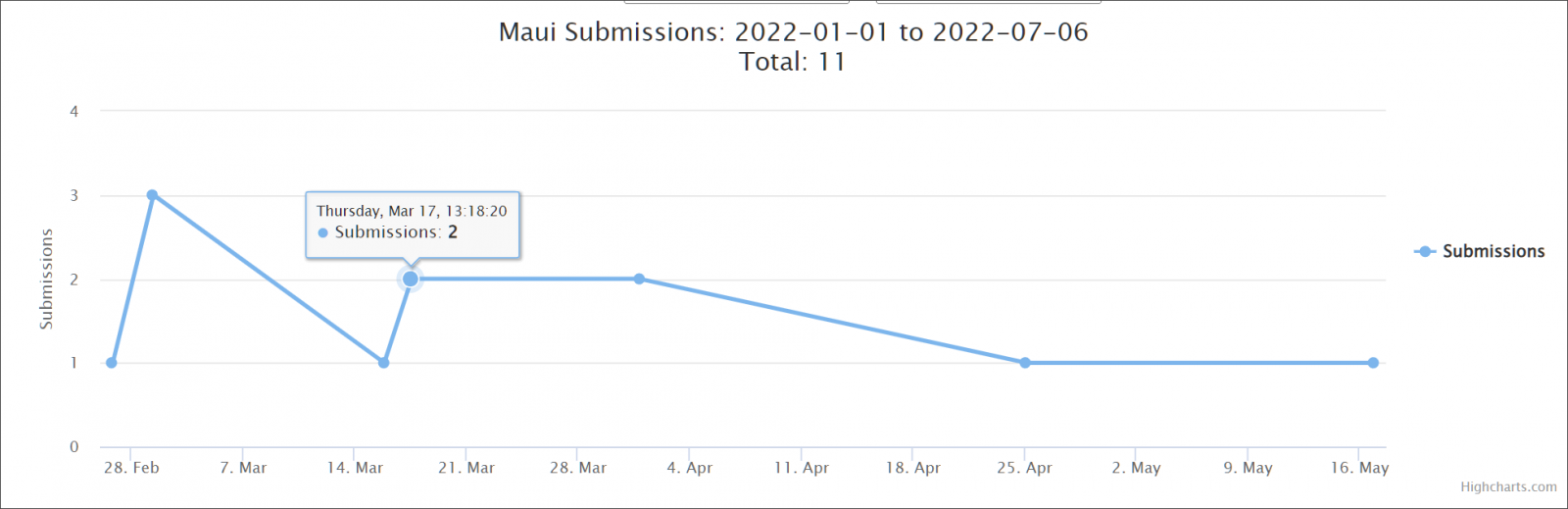
Maui ransomware activity (ID-Ransomware)

Cheerio BoJo! ...Things have gone from bad to worse in the Prime Minister's 3-year tenure

The events of the past week are just the latest to tarnish Mr Johnson’s three-year tenure. The most dangerous to his hold on office, until now, was “Partygate".
Only one thing is sure: having craved the prime ministership all his life, Mr Johnson will not go willingly. . .
Hmmm, sounds familiar doesn't it? But there's a difference in the timelines:

Two senior ministers resign, weakening Boris Johnson’s hold on office

"WHEN BORIS JOHNSON survived a vote of no confidence among Conservative MPs just under a month ago, he laid on the superlatives. More than 40% of his colleagues had voted to remove him as their leader and hence as Britain’s prime minister. Yet he called the result “extremely good, positive, conclusive, decisive”. Mr Johnson may have felt safe—and party rules say he cannot be challenged again for a year—but murmurs of rebellion continued nonetheless. Now, after the resignations of two senior ministers, Mr Johnson’s hold on his job looks as tenuous as ever.

On July 5th Rishi Sunak, the chancellor of the exchequer, or finance minister—the most powerful job bar the top one—and Sajid Javid, the health secretary, departed within minutes of each other. Several junior figures followed, among them Alex Chalk, the solicitor-general, and Bim Afolami, a vice-chair of the party, who in almost satirical spirit quit during an interview on TalkTV, a little-watched political television channel.

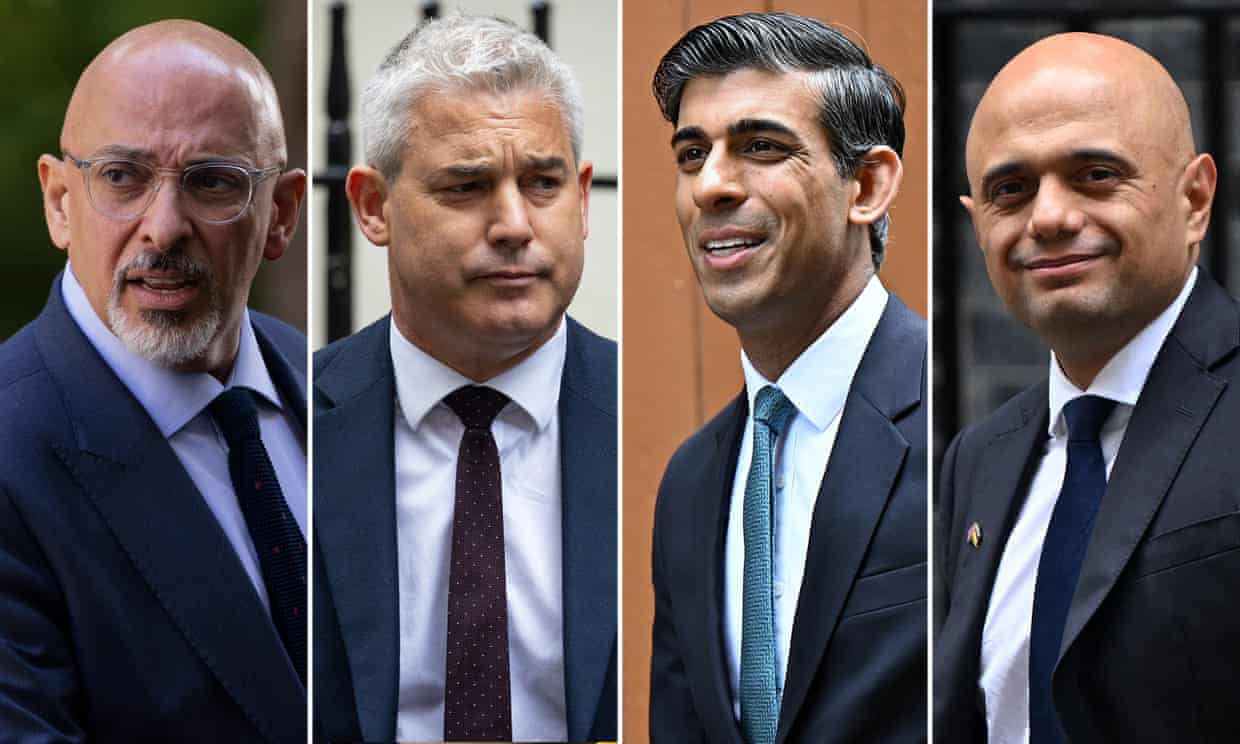
Mr Johnson quickly replaced Mr Sunak with Nadhim Zahawi, the education secretary, and Mr Javid with Steve Barclay, a peripatetic loyalist who in his previous post was the prime minister’s chief of staff. Even so, few prime ministers would survive such a double blow, especially after the battering Mr Johnson has taken in recent months. How long he will be in office, no one knows. But his authority is chronically weakened.

UK Prime Minister Boris Johnson Clings On After Resignations

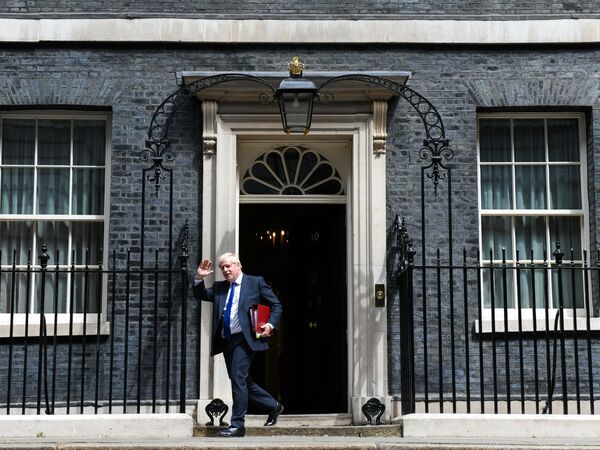
Boris Johnson departs 10 Downing Street ahead of PMQs, on July 6.

Johnson Warns Tory Rebels Planning Fresh Challenge He’s Staying

  • Premier says he has ‘colossal mandate’ and will continue
  • Tory MPs plot to change rules to allow fresh confidence vote
Photographer: Chris J. Ratcliffe/Bloomberg
Updated on

Boris Johnson made clear he’ll contest any new attempt by rebels in his ruling Conservative Party to oust him, ahead of a meeting later on Wednesday where rank-and-file Tories will discuss holding a fresh confidence vote on the UK prime minister’s leadership

His latest troubles began on June 30th, when the Sun reported the sudden resignation of Chris Pincher, the Tories’ deputy chief whip—an enforcer of party discipline. He confessed to “having drunk far too much” and “embarrassed myself”, after accusations that he had groped two men at a Conservative club. Asked whether Mr Johnson knew of any concerns about Mr Pincher’s behaviour when appointing him in February, a Downing Street spokesman said no. That was later modified: the prime minister knew of no “specific” allegations.

After the Sunday papers reported more claims of groping (denied by Mr Pincher), Downing Street said that Mr Johnson had in fact been aware of some allegations, but these had been “resolved” or had led nowhere. Only on July 5th—after the official account had been flatly contradicted by a former senior civil servant—did Mr Johnson admit that he had been told, in person, about a claim against Mr Pincher in 2019, when Mr Johnson was foreign secretary and Mr Pincher a junior minister in the Foreign Office. In hindsight, the prime minister said, he “bitterly regretted” having given Mr Pincher the whip’s job.

For Messrs Javid and Sunak, that was apparently the last straw, even if neither mentioned the Pincher affair in their resignation letters. “The tone you set as a leader, and the values you represent, reflect on your colleagues, your party and ultimately the country,” Mr Javid wrote. Mr Sunak was similarly stinging: “[T]he public rightly expect government to be conducted properly, competently and seriously.” Mr Sunak also hinted at differences over fiscal policy. . .

Lack of candour, even about a tawdry sexual scandal, should not by itself prompt the resignations of uninvolved senior ministers, let alone endanger a prime minister. But the events of the past week are just the latest to tarnish Mr Johnson’s three-year tenure. The most dangerous to his hold on office, until now, was “Partygate”—claims that officials in Downing Street, including Mr Johnson, repeatedly broke the government’s lockdown rules imposed during the covid-19 pandemic.

Mr Johnson was fined, as were Mr Sunak and dozens of civil servants, after a police inquiry. A report by a senior civil servant, Sue Gray, described shameful scenes, including vomiting after officials held a late-night party and rudeness to cleaning staff. As in the Pincher affair, Downing Street officials and the prime minister changed their stories time and again about what went on and what he knew when. Mr. Johnson is still to face a parliamentary inquiry into whether he knowingly misled the House of Commons—by the usual standards of British political honour, a resignation offence. . ."

Reference: https://www.economist.com/britain/2022/07/06/two-ministers-resign-weakening-boris-johnsons-hold-on-office 

RELATED CONTENT YESTERDAY

Nadhim Zahawi becomes chancellor and Steve Barclay health secretary, replacing Rishi Sunak and Sajid Javid – as it happened

<div class=__reading__mode__extracted__imagecaption>Nadhim Zahawi and Steve Barclay are appointed chancellor and health secretary respectively, replacing Rishi Sunak and Sajid Javid who have resigned from their roles.  Composite: Getty Images/AFP/EPA<br>Nadhim Zahawi and Steve Barclay are appointed chancellor and health secretary respectively, replacing Rishi Sunak and Sajid Javid who have resigned from their roles.  Composite: Getty Images/AFP/EPA</div>

From 20h ago

Javid/Sunak resignations - snap analysis

It could all be over for Boris Johnson - although quite how long it will take his enemies to finish him off is not at all clear and his defenestration does not look immediate. The two byelection defeats almost two weeks ago prompted calls for cabinet ministers to mount a coup against Boris Johnson, and it finally it seems to be happening.

We have not had confirmation yet, but it is impossible to believe that the resignations of Sajid Javid and Rishi Sunak were not coordinated. Perhaps there are more to come.

The Sunak resignation is the most serious of the two. Since the spring statement, the chancellor has not been the obvious heir apparent he once was. But he is still a powerful figure in the party. The resignation of Nigel Lawson helped to bring down Margaret Thatcher, although it took just over a year for that to eventually play out.

Even if there are no more resignations, the mood in the Conservative party has already turned against Johnson – perhaps decisively.

Under current rules Johnson is safe from another leadership challenge until next summer. But the executive of the 1922 Committee can change the rules whenever it wants. A new anti-Johnson executive is expected to be elected next week, but even the current executive – more evently split between loyalists and critics – could act now if it felt there was a consensus in the party.

Johnson is famously stubborn, and he is unlikely to quit just because two ministers have decided to go. But increasingly Conservative MPs believe they have no chance of winning the next election under his leadership. Ultimately that assessment should prove decisive."

PRESS RELEASE: Kaspersky

Kaspersky, one of the cybersecurity industry's most popular anti-virus software makers, operated by a holding company in the United Kingdom, is headquartered in Moscow and was founded in 1997 by Eugene Kaspersky, who U.S. officials describe as a former Russian intelligence officer.

Kaspersky lab releases world’s first IoT secure gateway

<div class=__reading__mode__extracted__imagecaption>© Sergey Bobylev/TASS

Hmmm...Now that the Supreme Court has given states the freedom to police women’s bodies, it only makes sense that police are out there literally policing women’s bodies

/ Your Tax Dollars At Work: Cops Busting People For Crop Tops, Twerking

from the on-the-other-hand,-all-real-crime-is-no-longer-a-problem dept

"Now that the Supreme Court has given states the freedom to police women’s bodies, it only makes sense that police are out there literally policing women’s bodies.

It’s summer. Temperatures are high pretty much everywhere. And when temps go up, the amount of clothing people are willing to put on goes down. For some reason, that completely expected turn of events resulted in some ridiculous enforcement of law by local law enforcement. (h/t Peter Bonilla)

Casey LaCaze-Lachney of Winnfield, Lousiana went to a festival in town June 11 dressed like this (screenshot via Lachney’s TikTok account):

For that, she was cited for indecent exposure by a Winnfield PD officer:

A Winnfield, LA woman’s TikTok video has gone viral after she took to the app to complain about an indecent exposure citation she received at a festival on Saturday, June 11. 

Casey LaCaze-Lachney, known on the app by her username @kazzi112, posted about the incident where it has received more than 2.6 million views. LaCaze-Lachney captioned the video “make it make sense” before showing viewers the outfit in question. 

LaCaze-Lachney is shown wearing a black t-shirt that covered her shoulders and was cropped just above the belly button, paired with cutoff denim shorts and a studded belt. 

The video went viral but this was no stunt. This actually happened. According to the Winnfield PD’s pathetic, incredibly defensive Facebook post, an officer actually believed this totally normal summer outfit violated the law:

Winnfield’s 6th Annual Dugdemona Festival held on Main Street was an amazing success. However, recent posts to social media have had a negative impact on the service of our police officers during this family fun-filled festival.

An unnamed citizen was cited for a city ordinance and has since taken to a popular social media site, blasting police officers. However, 3 female officers responded to various complaints about the person’s attire and the person of interest was issued a citation under the city ordinance.

Um, the only thing having a “negative impact on the service” of the PD’s officers is the service of the PD’s officers. If “various complaints” are made about someone who isn’t breaking the law, the officers (female or not) should ignore those complaints and concern themselves with actual lawbreaking.

But that didn’t happen. Instead, a citation was issued for violating city ordinance 14-76. This ordinance is quoted by the PD in its “stop being mad at us for being assholes” post. Here it is. See if you can’t spot the lawbreaking!

“It shall be unlawful for any person to wear pants, trousers, shorts, skirts, dresses, or skorts in any public place or places open to the public which either intentionally exposes undergarments or intentionally exposes any portion of the pubic hair, cleft of buttocks, or genitals.” Fines range from $25.00 for a first offense to a maximum of $300, and the person may be ordered to perform up to 40 hours of community service.

Even if the shorts/crop top managed to inadvertently expose, say, the “cleft of the buttocks” (perhaps when bending over), it would not be an intentional exposure. And I have no idea how this law applies to swimming pools, where the clothing worn is indistinguishable from “undergarments” in many cases.

To conclude this stupidity, the PD offered this statement, which says the PD will not lower itself to engaging with irate citizens for lowering the department to its current level by citing a person for wearing clothes.

“We, as public servants, will not engage in a social media war with any one or any organization, as it is improper and brings discredit upon this department. We also cannot comment on details of any case under investigation or pending court action.”

It’s a bit late for most of this. The department has already done the “improper” and succeeded in “bringing discredit” on itself. It was a stupid, unlawful move by local law enforcement. And it’s definitely going to end in some court action.

Speaking of court action, here’s our second bit of literal policing of women’s bodies. This one occurred quite a bit earlier than the Winnfield debacle, but is back in the news because the victim of body policing is getting a payout from the city of Portland over the actions of some similarly stupid officers.

I’m going to dole out this lead sentence in chunks for maximum impact:

The city will pay $75,000 to settle a federal lawsuit filed by a woman arrested by Portland police in 2019 after she was seen twerking in a bike lane downtown…

I’m not sure what part of this is more laughable: that officers believed twerking was a crime or that doing it in a bike lane was the part that triggered enforcement. Either way, it gets stupider:

…and had flipped off officers during a protest.

Definitely not a crime. In fact, it’s the opposite: it’s constitutionally protected expression. . ."

Homeland: The Verge’s ongoing series about how government surveillance, bureaucracy, and technology have rewired American lives.

Nearly 20 years later, the Department of Homeland Security is one of the largest agencies in the federal government. It employs over a quarter-million people. Through shifting regimes, the DHS reflects changing priorities for what it considers threats against the “homeland”: some real (climate change, the pandemic), others imagined (activists, voter fraud).
Its 2022 budget is $52.2 billion — nearly three times what it was in 2002

A special series exploring two decades of American life under the Department of Homeland Security.

Video
Video

See original image

The Verge’s “Homeland” project is a series of stories about surveillance, immigration, and technology that attempt to unmask the policies that have shaped the US in the 20 years since. For the next three months, we will be publishing investigative features, interviews, and profiles that will capture the breadth of DHS’s influence and power — and how that sprawl has diffused accountability and allowed the agency to operate in total opacity. . .

The great challenge of conceiving “Homeland” has not been identifying the myriad overreaches and abuses by the DHS but trying to understand the long trail of incentives and violations it has caused. Often, the reasons were unintentional. But repeatedly, the reporting comes to the same conclusion: that the Department of Homeland Security has been a 20-year boondoggle.

— Sarah Jeong and Kevin Nguyen, Editors

"When George W. Bush outlined his national strategy for homeland security, the pitch was simple: America was under attack by a “terrorist threat,” and the country needed to protect itself from an enemy that “takes many forms, has many places to hide, and is often invisible.”

It was in direct response to the 9/11 attack, and yet, the specifics of that terrorist threat were surprisingly vague. The imprecision could be read as paranoia. Or, more insidiously, you could see it as a way to broaden the definition of enemy to include any and all foreigners. Suddenly, immigrants were a threat to the “homeland.” And anyone else who would voice a dissenting opinion was a danger to national security. Rereading the strategic initiatives that underpin the Department of Homeland Security’s founding today, an irony in its logic becomes clear: the threat is there, and also, the threat is here.

And so, the Department of Homeland Security (DHS) was swiftly established as a new umbrella agency to oversee nearly two dozen existing ones. Domestically, the government’s great response to 9/11 would come to resemble a dramatic corporate reshuffling to keep Americans safe by updating an org chart. Whereas the US enforces its power abroad through military and economic strength, it enacts violence on its people domestically through a much more surreptitious form: bureaucracy. . .

Just as 9/11 gave the US government cover to start two wars abroad, it became the justification to permanently undermine the civil rights of its people — an undermining of civil freedoms disguised as a big knee-jerk reaction. . ."

CONTINUE >> https://www.theverge.com/c/23055922/homeland-security-series 

6.29.22The Afghan refugee crisis collides with California’s housing disaster


Nobody enjoys waiting in the airport security line. But you can make that wait a little bit shorter — and also keep your shoes on — if you pay for a program rolled out by the TSA called “PreCheck.” In a post-9/11 world, this is the great innovation of the department.

At least according to Dan McCoy. This is a guy who should know innovation, as the TSA’s chief innovation officer. In my interview with him, he called PreCheck ---- “a hallmark government innovation program.”

But what do programs like PreCheck and the larger surveillance apparatus that theoretically keep us safe mean for the choices we make? What do we give up to get into the shorter security line, and how comfortable should we be with that?

BLOGGER NOTE: Dan McCoy also mentions "Clear"... here's what that is ICE Signs $274,000 Contract With Clearview

Shitbirds Of A Feather Flock Together:

ICE Signs $274,000 Contract With Clearview

from the voted-Most-Hateable-for-two-years-running! dept

"ICE continues to not care what anyone thinks of it. Its tactics over the past few years have turned it into one of the federal government's most infamous monsters, thanks to its separation of families, caging of children, unfettered surveillance of undocumented immigrants, its fake university sting created to punish students trying to remain in the country legally, its sudden rescinding of COVID-related distance learning guidelines solely for the purpose of punishing students trying to remain in the country legally… well, you get the picture.
Perhaps it's fitting ICE is buying tech from a company that appears unconcerned that most of the public hates it. Clearview -- the facial recognition software that matches uploaded facial images with billions of images scraped from the open web -- is one of the latest additions to ICE's surveillance tech arsenal.

Immigration and Customs Enforcement (ICE) signed a contract with facial recognition company Clearview AI this week for “mission support,” government contracting records show (as first spotted by the tech accountability nonprofit Tech Inquiry). The purchase order for $224,000 describes “clearview licenses” and lists “ICE mission support dallas” as the contracting office. . .

Either way, we can safely conclude both partners here suck. ICE is bad and keeps getting worse, and Clearview isn't ever going to improve and is presumably still scraping sites for "content" it can sell to its customers.

26 June 2021

Clearview In View (One More Time Again!) on Techdirt Over "Scraping"

"Clearview continues to dominate the "Most Hated" category in the facial recognition tech games. And with Amazon tossing aside its "Rekognition" program for the time being (it's spelled with a K because the AI tried to spell "recognition" correctly and failed), Clearview has opened up what could be an insurmountable lead.
 
. . .Clearview has been sued, investigated, banned by law enforcement agencies, and suffered numerous self-inflicted wounds.
Underneath Clearview's untried and untested AI lies an underbedding composed of the internet. The ~4 billion images in Clearview's database have been scraped from public posts and accounts hosted by thousands of websites and dozens of social media platforms.
There's nothing inherently wrong with scraping sites to make use of information hosted there. In fact, this often controversial power can sometimes be used for good.
The last thing we need is Clearview's questionable tech convincing legislators, prosecutors, and courts that scraping sites is something only criminals do.
Clearview hack fuels debate over facial recognition
Clearview called out Google's apparent hypocrisy on the subject of site scraping when Google sent a cease-and-desist demanding it stop harvesting images and data from Google's online possessions. But Clearview is apparently unable to recognize its own hypocrisy. While it's cool with site scraping when it can benefit from it, it frowns upon others perpetrating this "harm" on its own databases. . .
The Real Dangers of Surveillance - The New York Times
Its user agreement [PDF] with the Evansville, Indiana police department (obtained by MuckRock user J Ader) contains this paragraph:
 

The use of automated systems or software to extract the whole or any part of the Service or Website, the Information or data on or within the Service or the Website, including image search results or source code, for any purposes (including uses commonly known as “scraping”) is strictly prohibited.

Pretty sure a bunch of the sites scraped by Clearview have similar clauses in their terms of use. And if Clearview doesn't believe those terms should be honored, it shouldn't expect others to give it the respect it refuses to extend to others. I don't think anyone else should necessarily be in possession of everything in Clearview's facial recognition database but I do think someone needs to scrape the shit out of it on sheer principle. . ."