Wednesday, July 06, 2022

FIRST RESPONDER MISCONDUCT

This isn’t the kind of response one expects from a firefighter arriving at the scene of a fire. (via Courthouse News Service)

Court Says Homeless Man Beaten By Firefighter Can Continue To Sue City For Ignoring First Responder Misconduct   

from the only-[kick]-you-[kick]-can-[kick]-prevent-[kick] dept

Tue, Jul 5th 2022 03:46pm -

In August 2019 [Brad] Cox and other DFD [Dallas Fire Rescue Department] personnel were called to extinguish a grass fire. When Cox and other DFD personnel arrived, [Kyle] Vess, who is mentally ill, was walking near the fire. Due to Vess’s proximity to the fire, Cox thought Vess was responsible for starting it.

Cox and other DFD personnel attempted to detain Vess. Meanwhile, other DFD personnel called the Dallas Police Department (“DPD”) for assistance. Cox confronted Vess in an effort to detain him. Something provoked Vess, however, and he errantly swung at Cox, who swung back at Vess and hit him. According to the second amended complaint (“SAC”), Cox then beat Vess “senselessly” and subdued him. After subduing Vess, Cox continued to beat him, kicking him six times while he was on the ground. It was necessary for another firefighter to restrain Cox.

That’s from the recent federal court decision [PDF] allowing Vess’ lawsuit to move forward. The beating involved one more kick, delivered to the head of the “clearly subdued” Vess by Cox: one that resulted in a fractured orbital socket. The entire beating delivered more injuries, including a fractured sinus, cracked teeth, and facial paralysis to the right side of Vess’ face.

There’s body cam footage of the beating so neither Brad Cox nor the DFD could deny it happened.

They could, however, choose to do nothing about it.

DFD did not conduct an internal affairs investigation, and the Dallas Public Integrity Unit (“DPIU”) cleared Cox of any wrongdoing.

> Both entities “worked to ensure that no further or deeper investigation was done” because both had a practice of concealing internal disciplinary measures from the public.

> The office of the Dallas County District Attorney did not pursue an indictment of Cox, later “indicated remorse” for not having done so, and “admitted that a thorough investigation was not undertaken.”

And it had never bothered to seriously discipline Brad Cox, who has apparently been a problem for the DFD for nearly two decades when this incident took place: According to the SAC, Cox was arrested in 2002 for suspected assault at a birthday party; was reprimanded three times for refusing to provide medical treatment to patients; was counseled in writing in 2011 for “unacceptable conduct” related to a patient; pleaded guilty to falsifying a government report; and is currently being sued in a case where he allegedly laughed at, and refused to give care to, a homeless man, who ultimately died.

Cox isn’t an anomaly.

[W]hen DFD personnel do engage in inappropriate behavior (whether in poor communities or elsewhere), DFD has refused to terminate any of these personnel in the last 30 to 40 years. This is so despite numerous examples of such inappropriate behavior—not punished by termination—including refusing to render care because of the person’s sexual orientation; refusing to transport a child to the hospital because the paramedic thought the mother was lying about the seriousness of her child’s illness; refusing to treat a man with a terminal condition because the paramedic believed the man was already dead; and refusing to follow standard procedures for a gunshot wound.

Brad Cox asked for qualified immunity, claiming the beating he handed out was unrelated to any “seizure” of Vess by law enforcement and, therefore, did not violate his Fourth Amendment rights. Wrong, says the court. A seizure takes place when an officer (or first responder, as in this case) uses physical force or a show of authority to restrain someone’s liberty. Cox may have felt he was just handing out a beating, but he did so as a government employee while in the presence of officers called to the scene. No immunity.

> The city of Dallas tried to dismiss the lawsuit as well, arguing that the allegations did not sufficiently tie the city to Cox’s beating or the DFD’s unwillingness to terminate employees over severe misconduct. The court says that Vess has actually alleged all he needs to at this point. With the DFD making a four-decade run at never terminating an employee over severe misconduct, the city is at least partially responsible for this accountability vacuum

[T]he court holds that Vess has alleged sufficient facts for the court to draw the reasonable inference that the City has a “de facto policy and/or custom of protection for previously disciplined personnel by refusing to terminate or separate from employment individuals unfit to serve as members of the Dallas Fire Department despite good cause for termination and the risk these individuals pose to the public.” And the court concludes that Vess has plausibly pleaded that this policy was the moving force behind Cox’s actions.

That’s enough to keep the lawsuit alive. And now the city of Dallas will have to confront its failure to oversee an agency that was created to fight fires and save lives but has ended up housing people like Brad Cox — a firefighter who assaults citizens, falsifies reports, and refuses to help the people he’s paid to help."

Filed Under: , , ,  


VOX MEDIA NETWORK TEASER: The first episode of "Land of the Giants: The Facebook / Meta Disruption" comes out on July 13th.

This transition is happening while criticisms from users, regulators, and even its own former employees are at an all-time high

The inside story at Meta as it moves beyond Facebook

Land of the Giants explores the social media juggernaut in a moment of transformation

Land of the Giants: The Facebook/Meta Disruption podcast artwork showing the series title and a hand giving a thumbs up in Facebook-like colors.

The new season of Vox Media Podcast Network’s award-winning narrative podcast Land of the Giants is debuting next week, on July 13th. This time, Recode senior correspondent Shirin Ghaffary and The Verge deputy editor Alex Heath team up to tell the story of Meta, formerly known as Facebook, at a pivotal moment — both for the tech giant and for the billions of people who use its products.

Under the leadership of CEO Mark Zuckerberg, the same man who co-founded Facebook from his college dorm room in 2004, Meta is trying to transition away from its complicated legacy as a social media company to a futuristic metaverse vision that aims to reshape the future of the internet. This transition is happening while criticisms from users, regulators, and even its own former employees are at an all-time high. They are worried the company and its products — Facebook, Instagram, WhatsApp, and others — are harming society, from how global democracy functions to the mental health of teenagers. They think Meta is too powerful and perhaps needs to be broken up.

Meanwhile, Zuckerberg’s business is under pressure like never before. Both Facebook and Instagram are quickly losing ground to TikTok, forcing Meta to rethink its approach to social media entirely.

The new season of Land of the Giants will bring you original reporting on Meta’s current challenges and the future it’s building. The show will also explore critical moments from its origin as a scrappy startup to a tech behemoth. Co-hosts Ghaffary and Heath will take you inside the company by talking to current and former executives, including Meta’s top policy executive Nick Clegg and head of WhatsApp Will Cathcart, as well as preeminent critics and leaders outside the company like whistleblower Frances Haugen and Zynga founder Mark Pincus.

The first episode of Land of the Giants: The Facebook / Meta Disruption comes out on July 13th. You can find it on Apple Podcasts, Google Podcasts, Spotify, or wherever you get your podcasts. Listen to the trailer above.


Next Up In Tech

EXCLUSIVE LIVE (The Guardian)

Ordinarily, Boris Johnson relishes days like today. . .

Cabinet ministers at No 10 after Boris Johnson told delegation is waiting to tell him to go – live

<div class=__reading__mode__extracted__imagecaption>Boris Johnson in Downing Street earlier on Wednesday. Photograph: Wiktor Szymanowicz/REX/Shutterstock<br>Boris Johnson in Downing Street earlier on Wednesday. Photograph: Wiktor Szymanowicz/REX/Shutterstock</div>

Anne-Marie Trevelyan arriving at No 10 earlier this afternoon. Photograph: Phil Noble/Reuters

"Priti Patel, the home secretary, is backing those cabinet ministers saying Boris Johnson should go, the Times’ Matt Dathan reports. Patel used to be one of his strongest supporters. He defied expectations when he made her home secretary, and he backed her when his ethics adviser produced a report saying she broke the ministerial code by bullying staff. But recently their relationship has been more frayed, with No 10 sometimes apparently briefing criticism of her handling of the Channel small boats problem.

EXCLUSIVE:

Priti Patel has sided with the group of Cabinet ministers calling for PM to go

The home secretary - one of Johnson's most loyal supporters - believes there's no way he can continue to govern without the support of his party


She's joined Shapps and Gove NOT Dorries

— Matt Dathan (@matt_dathan) July 6, 2022

Grant Shapps, the transport secretary, has just come out of No 10, Sky News reports. But he did not say anything on his way out.

Nadine Dories arriving at No 10 this afternoon. Photograph: Daniel Leal/AFP

The night before she resigned, Margaret Thatcher met members of her cabinet one by one to ask if she could rely on their support in the second ballot of the leadership contest. She won the first round, but not by the threshold then required. If Thatcher thought that not allowing them to confront her as a group would lessen their courage and weaken their resolve to tell her to go, it did not work. Most of them told her that her time was up.

According to Harry Cole from the Sun, Boris Johnson is deploying the same tactic.

NEW: Sources say PM is seeing Cabinet ministers one at a time rather than a being greeted by the whole delegation.

Number of them told Chief they would resign last night or today without movement.

When they did they were invited to No10 by CHH to tell the PM to his face.

— Harry Cole (@MrHarryCole) July 6, 2022


PPS resignations continue

The Tory resignations keep coming. Here are some of the latest from MPs.

David Duguid has resigned as a trade envoy for Angola and Zambia. In a statement, he said: “In light of recent events, I believe the prime minister’s position is now untenable.”

Peter Gibson has resigned as a PPS to the international trade department. In his resignation letter he said:

On Saturday last week I marched with LGBT+ Conservatives at London Pride.

As a gay MP, that should have been a liberating, enjoyable experience, instead due to the damage our party has inflicted on itself over the failure to include trans people in the ban on conversion therapy, it was a humiliating experience and signalled to me the immense damage that has been so needlessly inflicted after years of hard work by many to rebuild the damage of Section 28.

— Peter Gibson MP (@Gibbo4Darlo) July 6, 2022

Sara Britcliffe has resigned as PPS to Nadhim Zahawi (although she was PPS to him as education secretary, and so it was not inevitable that she would move over to the Treasury).

It is with a heavy heart that I’ve given my resignation as PPS in a Department I love, Education. This Government has achieved so much start delivering on levelling up in Hyndburn and Haslingden. But, this self-inflicted crisis risks undoing all of that. It’s time to draw a line. pic.twitter.com/DQLosYplJf

— Sara Britcliffe MP (@SarBritcliffeMP) July 6, 2022

Mark Fletcher has resigned as PPS to Kwasi Kwarteng, the business secretary. Fletcher was at the Carlton Club when Chris Pincher got drunk there last week and he said he was offended by the PM’s suggestion that MPs like him were at fault. He said:

As you are aware, early last Thursday morning I had to intervene in a very serious situation at the Carlton Club involving the former deputy chief whip.

I reported the events immediately to the chief whip, who took appropriate action and handled the situation with superb levels of seriousness and care. On Friday, upon my raising concerns around Mr Pincher still having the whip, you and I spoke about the events that had happened on Thursday morning.

I was reassured that shortly after our call you did the right thing and suspended the whip for Mr Pincher. However, in our conversation in the tearoom yesterday, you suggested that the events of that night were the fault of the colleagues who were present for allowing him to drink so much.

Such a view seems to me an attempt to absolve Mr Pincher of his actions and, in so doing, to be an apologist for someone who has committed sexual assault. I am unable to accept such a crass and insensitive interpretation of what happened that night.

I have reached the conclusion that any person who suggests that anyone other than Mr Pincher is solely responsible for what happened that night is unfit to lead our country.

Conservative MP for Bolsover Mark Fletcher resigns as BEIS PPS pic.twitter.com/SSa7PHJfpF

— Georgia Roberts (@GeorgiaZemoreyR) July 6, 2022

Labour says committee hearings for legislation being cancelled because too many ministers have resigned

In the Commons earlier Conor McGinn, a shadow Cabinet Office minister, used a point of order to say he understood the government had adjourned or “effectively cancelled” committee hearings organised for tomorrow to consider legislation before parliament as they are “unable to provide ministers”. He said:

It seems very much to me that this is a government that has ceased in its ability to govern.


My colleague Aubrey Allegretti says Sir Graham Brady, the chairman of the 1922 Committee, has been spotted heading towards Downing Street.

Graham Brady spotted walking out of parliament by the Red Lion. May only be headed to one place… pic.twitter.com/YHxW0a7gq4

— Aubrey Allegretti (@breeallegretti) July 6, 2022

Brady is the ultimate embodiment of the fabled “men in grey suits”, but today he’s wearing blue.

Allegra Stratton resigned as a spokesperson for Boris Johnson after footage was released of her joking about No 10 holding a lockdown busting party in a rehearsal for a televised briefing. She was the first person from No 10 to resign over Partygate, and now works for Bloomberg where she writes a daily email. In tonight’s edition she says watching Sajid Javid in the Commons explain why he felt he could not longer continue to serve Johnson reminded her of her own experience. She says:

Even as they were preparing the prime minister for today’s public ordeals, members of his team told me they believed the game was up.

Others were more bullish: “He’s not going voluntarily,” one said, “regardless of how many people tell him to.”

Ordinarily, Boris Johnson relishes days like today. When I worked for him, in Downing Street, he would flex his arm muscles and gurn like a wrestler in moments of strife. While I maintain he is frequently humble, sweet and kind, he thinks people who resign are, essentially, not political enough.

Listening to Sajid Javid speak after PMQs was tough for a lot of people. The journey that the now-former health secretary described was one that the prime minister has put many of us through.

STARK SHADES OF SLEAZY: Arizona Attorney General Mark Brnovich

Who Wants to be a U.S. Senator

Trump cracks down on deceptive fundraising by others using his name

While being known for his own false and misleading emails, Trump faces armies of unaffiliated fundraisers who ape his message and sometimes threaten Republicans in Trump’s name

This fundraising plea makes it clear that it's time for Attorney General Mark Brnovich to resign his day job.

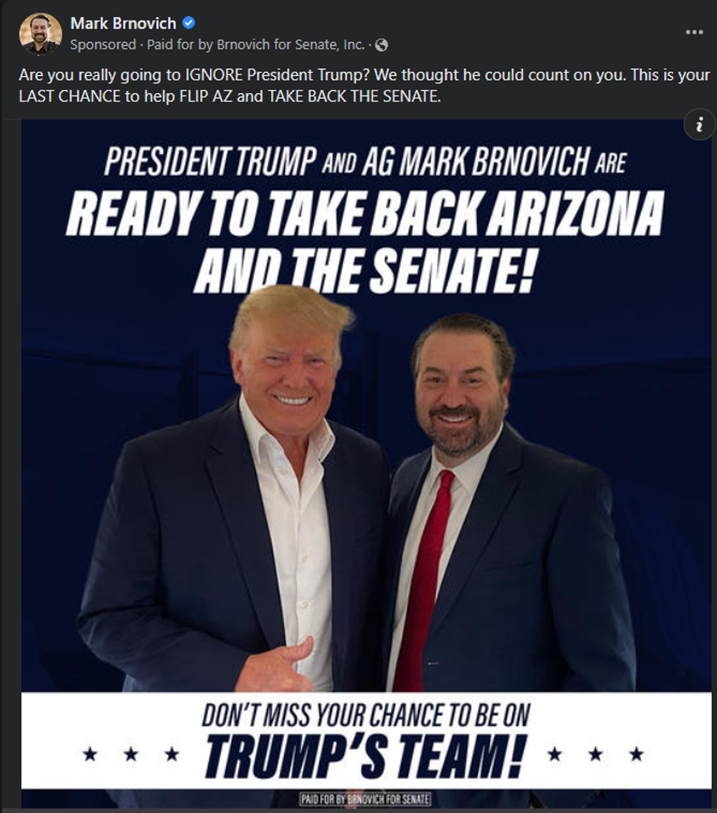
Arizona Attorney General Mark Brnovich has spent months groundlessly telling Republicans that they can be on “Trump’s Team” or “Endorse Trump for President in 2024” by giving to his U.S. Senate campaign.

“Are you turning your back on Pres. Trump?” one Brnovich fundraising ad asked last year. “Renew your 2022 membership before it is too late.”

Such appeals pushed the actual team of advisers around Trump to a breaking point in June, after Trump endorsed Brnovich’s rival, Blake Masters, for the Senate seat in Arizona. In a cease-and-desist letter obtained by The Washington Post, an attorney for Save America, Trump’s political action committee, threatened legal action if Brnovich did not stop using Trump’s image and name in misleading ways.

Trump’s lawyer pointed to a recent email with the subject line “ACCOUNT TERMINATION NOTICE” that threatened potential donors with losing “[a]ny chance of continuing to receive our Trump polls, Trump rally alerts, and 2024 Endorsement opportunities” if they did not give money to Brnovich.

“Your use of President Trump’s name, image, and/or likeness is likely to deceive individuals into believing President Trump supports, endorses, or otherwise promotes your candidacy for U.S. Senate in Arizona — he does not,” the attorney wrote, while adding that the wording of the email could confuse people into thinking they were giving to Trump.

The letter was one of dozens of demands that Trump’s attorneys and aides have sent in recent years. But those efforts have not stopped the deceptive solicitations that flood Republican phones and inboxes daily. Eighteen months after leaving office, Trump remains the biggest draw for GOP donors, especially those who give small contributions. While he continues to rake in money, he also faces armies of unaffiliated fundraisers who ape or mimic Trump appeals and sometimes threaten or bully Republicans in Trump’s name to get money

Kentucky Supreme Court Says Warrants Are Needed For Real-Time Cell Location Pings...

Thus and so forth -- in Kentucky the court suppressed real-time location info law enforcement obtained without a warrant from a cell service provider. . .And, again, the Kentucky court system holds officers in the state to a higher “good faith” standard — one that says cops don’t get to play fast and loose with unsettled law unless they like seeing their evidence tossed. More courts should do the same.

An animated image showing location pins dropping onto a street map from above, tracing several paths

Kentucky Supreme Court Says Warrants Are Needed For Real-Time Cell Location Pings

from the get-a-warrant dept

In 2018, the Supreme Court declared warrantless access to historical cell site location information unconstitutional, given the privacy implications of being able to track someone’s movements over days or weeks without bothering to secure a warrant. Prior to this decision, cell site location info (CSLI) was treated as a third party record, requiring neither a warrant nor probable cause to obtain.

It did not extend this coverage to real-time access to CSLI, tower dumps, or ping requests made to service providers to engage in quasi-real time tracking. However, other courts in the nation have been willing to extend the coverage of the Carpenter decision, applying it to other third party records, including real-time acquisition of cell location info. . .

Key to the court’s findings here is how this information is obtained. Rather than being a third party record created by someone simply having their phone on while near cell towers, the location data obtained here required the interference of the cell service provider.

Real-time CSLI is not a passive location record but data generated by an affirmative action—a “ping” taken by the cell-service provider at the behest of a law enforcement officer. By “pinging” an individual’s cell phone, the cell service provider is able to determine, instantaneously, the cell phone’s location in relation to the available cell sites and to communicate that location information to law enforcement.

And that’s where the search moves from “reasonable” to “unreasonable,” says the court.

In obtaining an individual’s cell phone’s real-time CSLI, police commandeer the cell phone and its transmissions for the purpose of locating that individual. We find this usurpation of an individual’s private property profoundly invasive, and we liken it to a technological trespass. Such an appropriation of an individual’s cell phone is precisely the sort of invasion that we find the average citizen unwilling to accept.

Historic CSLI is intrusive because it allows law enforcement to track someone’s movements after the fact, providing officers with plenty of information about a person’s life, habits, contacts, and other activities. Prospective (“real-time”) CSLI is intrusive because it forces someone’s phone to, in essence, “answer” to law enforcement by providing its current location.

The government tried to argue that real-time pings were no different than observing a driver on a public road… apparently because law enforcement performed the stop on a public road. The court finds this argument ridiculous.

We do not disagree that an individual has no reasonable expectation of privacy in his movements on a public road and, thus, law enforcement may constitutionally observe those movements. But at issue in this case is not the observation of Reed’s movements on a roadway or the traffic stop performed on Reed’s vehicle but the acquisition of Reed’s CSLI that enabled officers to conduct a dragnet to intercept Reed’s vehicle. At the time police pinged Reed’s cell phone, Reed was not under visual police surveillance. Instead, the only reason police were able to locate and surveil Reed on a roadway was as a result of their acquisition of Reed’s CSLI. It is the constitutionality of the acquisition of Reed’s CSLI, not of his traffic stop, that we consider today. As such, we regard Knotts as inapplicable in this case. We find that a person’s reasonable expectation of privacy in his CSLI is unaffected by his or his cell phone’s physical location at the time the CSLI is generated or acquired by police.

Furthermore, the court says, giving the government’s other argument (that the third party doctrine is engaged just because a cell user has granted permission for third parties to gather data) credence would allow widespread abuse of third parties to bypass the Fourth Amendment.

Permitting application of the third-party doctrine to real-time CSLI would drastically alter the landscape of digital privacy. By the same logic offered by the Commonwealth, law enforcement could contact application developers whose applications are authorized to use the camera and microphone on a cell phone. Law enforcement could then, via those application developers, commandeer the cell phone as a photo, video, and audio surveillance device, simply because the cell phone’s owner granted authorization to those applications.

The government loses its evidence (again) and the case returns to the trial court where prosecutors can try to put the suspect behind bars, but without the benefit of the CSLI info or evidence derived from the traffic stop that followed the warrantless pings. . ."

Filed Under: , , , , , , ,  

==============================================

RELATED

How the Federal Government Buys Our Cell Phone Location Data

An animated image showing location pins dropping onto a street map from above, tracing several paths

DEEPLINKS BLOG
June 13, 2022

"Over the past few years, data brokers and federal military, intelligence, and law enforcement agencies have formed a vast, secretive partnership to surveil the movements of millions of people. Many of the mobile apps on our cell phones track our movements with great precision and frequency. Data brokers harvest our location data from the app developers, and then sell it to these agencies. Once in government hands, the data is used by the military to spy on people overseas, by ICE to monitor people in and around the U.S., and by criminal investigators like the FBI and Secret Service. This post will draw on recent research and reporting to explain how this surveillance partnership works, why is it alarming, and what can we do about it.

Where does the data come from?

Weather apps, navigation apps, coupon apps, and “family safety” apps often request location access in order to enable key features. But once an app has location access, it typically has free rein to share that access with just about anyone.

That’s where the location data broker industry comes in. Data brokers entice app developers with cash-for-data deals, often paying per user for direct access to their device. Developers can add bits of code called “software development kits,” or SDKs, from location brokers into their apps. Once installed, a broker’s SDK is able to gather data whenever the app itself has access to it: sometimes, that means access to location data whenever the app is open. In other cases, it means “background” access to data whenever the phone is on, even if the app is closed...


[    ]

Who sells location data? 

Dozens of companies make billions of dollars selling location data on the private market. Most of the clients are the usual suspects in the data trade—marketing firms, hedge funds, real estate companies, and other data brokers. Thanks to lackluster regulation, both the ways personal data flows between private companies and the ways it’s used there are exceedingly difficult to trace. The companies involved usually insist that the data about where people live, sleep, gather, worship, and protest is used for strictly benign purposes, like deciding where to build a Starbucks or serving targeted ads. 

But a handful of companies sell to a more action-oriented clientele: federal law enforcement, the military, intelligence agencies, and defense contractors. Over the past few years, a cadre of journalists have gradually uncovered details about the clandestine purchase of location data by agencies with the power to imprison or kill, and the intensely secretive companies who sell it.

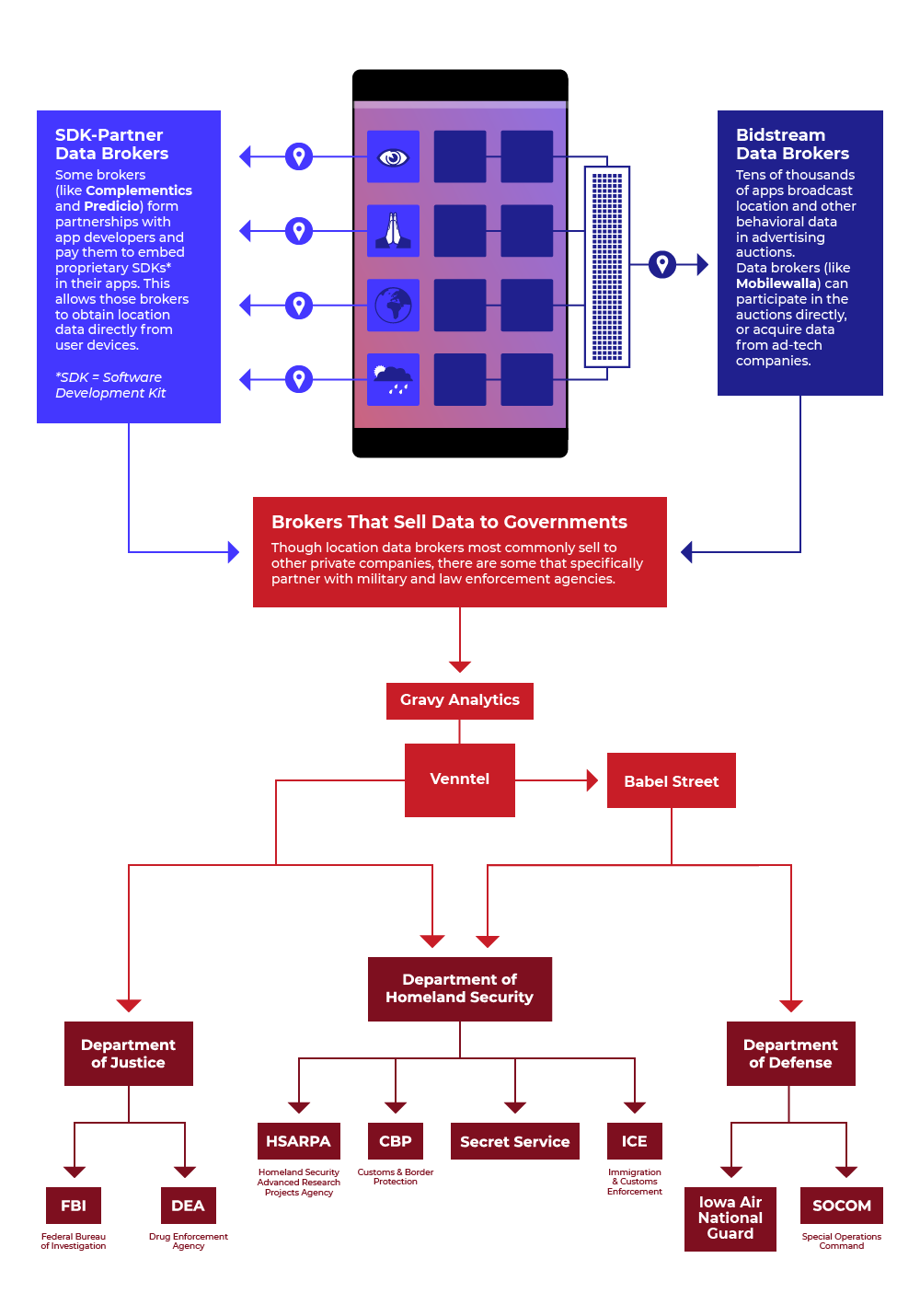
A flow chart showing how location data travels from a person's phone to federal government agencies. It summarizes the information in the next section about how Venntel and Babel Street sell to federal agencies.

This chart illustrates the flow of location data from apps to agencies via two of the most prominent government-facing brokers: Venntel and Babel Street.

The vendor we know the most about is Venntel, a subsidiary of the commercial agency Gravy Analytics. Its current and former clients in the US government include, at a minimum, the IRS, the DHS and its subsidiaries ICE and CBP, the DEA, and the FBI. Gravy Analytics does not embed SDKs directly into apps; rather, it acquires all of its data indirectly through other data brokers. 


Continue reading >> https://www.eff.org/deeplinks/2022/06/how-federal-government-buys-our-cell-phone-location-data


If you liked this post, you may also be interested in...

LIKE TO TINKER? Try Raspberry Pi Pico...The most notable, the Raspberry Pi Pico W, adds built-in Wi-Fi connectivity to the board while increasing the price from $4 to $6.

Other releases to follow!

The tiniest Raspberry Pi gets a new version with built-in Wi-Fi

Bluetooth is not enabled at launch but may be "in the future."

<div class=__reading__mode__extracted__imagecaption>Enlarge/ The Raspberry Pi Pico W adds Wi-Fi to the $4 Pico board for an additional $2. Raspberry Pi Foundation

The Raspberry Pi Zero series is the smallest version of the popular single-board computer that most people have experience with, but there's one Pi that's even smaller: the Raspberry Pi Pico. Launched in January of 2021 for just $4, the Pico's RP2040 microcontroller incorporates a pair of 133MHz Arm Cortex-M0+ CPU cores and 264 kilobytes (not megabytes) of memory. The low specs and low price make it well-suited for single-purpose devices that don't need much processing power instead of running general-purpose software like the larger Pi boards.

To help support companies who want to use the Pico as a basis for Internet-connected smart devices, the Raspberry Pi Foundation is introducing a few new variants of the Pico today. The most notable, the Raspberry Pi Pico W, adds built-in Wi-Fi connectivity to the board while increasing the price from $4 to $6.

Raspberry Pi founder Eben Upton writes that the Infineon CYW43439 Wi-Fi chip being used for the Pi Pico uses the old 2.4 GHz-only 802.11n (or Wi-Fi 4) protocol. That chipset also includes built-in Bluetooth support, like most other wireless Pi products, but Bluetooth support is currently disabled. Adding Bluetooth to devices typically requires another layer of Federal Communications Commission certification in the US, and other territories have their own rules, which could explain the omission. Upton says that Bluetooth support could be enabled "in the future."

There will be two additional versions of the Pico that add pre-installed header pins and a three-pin debug connector to the basic Pico board. Called the "Pico H," a version without Wi-Fi will cost $5 instead of $4, and a Pico WH version with Wi-Fi will run $7 instead of $6."

Tsk Tsk: Not-So-Righteous Indignation when Russia Federation Does It as Blatantly as United States

Wow!

Russian astronauts use space station to promote anti-Ukraine propaganda

"The space station is supposed to be a symbol of peace and cooperation."

<div class=__reading__mode__extracted__imagecaption>Enlarge/ Cosmonauts Oleg Artemyev, Denis Matveyev, and Sergey Korsakov pose with a flag of the Luhansk People's Republic on the International Space Station.

The Russian state space corporation responsible for spaceflight activities, Roscosmos, on Monday posted images to its official Telegram channel showing three cosmonauts with the tri-color flags of the Luhansk People's Republic and the Donetsk People's Republic.

The photos were taken recently on board the International Space Station and show smiling cosmonauts Oleg Artemyev, Denis Matveyev, and Sergey Korsakov posing with the flags.

"This is a long-awaited day that residents of the occupied areas of the Luhansk region have been waiting for eight years," the Roscosmos message stated. "We are confident that July 3, 2022, will forever go down in the history of the republic."

The images and social media posting represent the most blatant use of the International Space Station—which is operated by the United States, Russia, Japan, Canada, and the European Space Agency—for Russian propaganda purposes since the invasion of Ukraine.

Luhansk and Donetsk are two breakaway "quasi-states" in the eastern region of Ukraine known as the Donbas. Ukraine and Russia have battled over the two regions since 2014, as Russia has agitated separatists in the Ukrainian territory. The United Nations does not recognize the two "republics," and Ukraine has designated them as "temporarily occupied territories." Fighting has heated up since the Russian invasion of Ukraine in February 2022. This past weekend, Russian forces claimed to have established control over the entire Luhansk region.

A professional relationship

NASA and Roscosmos, as well as other space agencies, have continued cooperating on the International Space Station since the invasion began. Some US officials have suggested that NASA should consider breaking ties with Russia in space due to the atrocities in Ukraine. However, the space agency's administrator has defended the partnership on the basis that the station flies above geopolitical tensions on Earth. NASA also wants to keep flying the station, as breaking the US segment from the Russian segment would be difficult and potentially fatal to the operation of the orbital facility.

In an interview published Monday in the German publication Der Spiegel, NASA Administrator Bill Nelson reiterated this stance.

"In the midst of the Cold War, when the Soviet Union and the United States were mortal enemies and their nuclear weapons could be used at any time, a US and a Soviet spacecraft met in space in 1975," Nelson said. "Peaceful cooperation continued even after the collapse of the Soviet Union. Our space shuttle docked with the Russian space station Mir. And then we decided to build the International Space Station together. Both countries are needed for operations, the Russians for propulsion, the Americans for power. We will continue to have a very professional relationship between cosmonauts and astronauts to keep this station alive."

Nevertheless, the provocative actions this weekend by Roscosmos, with its cosmonauts celebrating the so-called liberation of Ukrainian territory, bring the bloody conflict on Earth into space. . .

Seat swap

NASA's cooperation with Russia may come into greater public focus in a couple of months. At present, NASA astronaut Frank Rubio is scheduled to fly on a Russian Soyuz spacecraft to the station in September. Around the same time, Russian cosmonaut Anna Kikina is due to fly on a SpaceX Crew Dragon vehicle to the station as part of the seat swap. The arrangement has not been formally agreed to by the US and Russian governments.

In his German interview, Nelson defended the swap, saying, "It makes a lot of sense for us. You need both Russians and Americans to operate the space station. What happens if something is wrong with one of our spacecraft? We need the other vehicle as a backup. And that's why we will continue to have crew exchanges."

Such an argument may soon ring hollow, however. Boeing's Starliner spacecraft may make its first crewed test flight before the end of this year, and if it is successful NASA will have two US spacecraft capable of reaching the station."