Training materials reviewed
by The Intercept confirm that Google is offering advanced artificial
intelligence and machine-learning capabilities to the Israeli government
through its controversial “Project Nimbus” contract. The Israeli
Finance Ministry announced the contract
in April 2021 for a $1.2 billion cloud computing system jointly built
by Google and Amazon. “The project is intended to provide the
government, the defense establishment and others with an
all-encompassing cloud solution,” the ministry said in its announcement.
Google engineers have spent the time since worrying whether their
efforts would inadvertently bolster the ongoing Israeli military
occupation of Palestine. In 2021, both Human Rights Watch and Amnesty International
formally accused Israel of committing crimes against humanity by
maintaining an apartheid system against Palestinians. While the Israeli
military and security services already rely on a sophisticated system of computerized surveillance, the sophistication of Google’s data analysis offerings could worsen the increasingly data-driven military occupation.
According to a trove of training documents
and videos obtained by The Intercept through a publicly accessible
educational portal intended for Nimbus users, Google is providing the
Israeli government with the full suite of machine-learning and AI tools
available through Google Cloud Platform. While they provide no specifics
as to how Nimbus will be used, the documents indicate that the new
cloud would give Israel capabilities for facial detection, automated
image categorization, object tracking, and even sentiment analysis that
claims to assess the emotional content of pictures, speech, and writing.
The Nimbus materials referenced agency-specific trainings available to
government personnel through the online learning service Coursera,
citing the Ministry of Defense as an example.
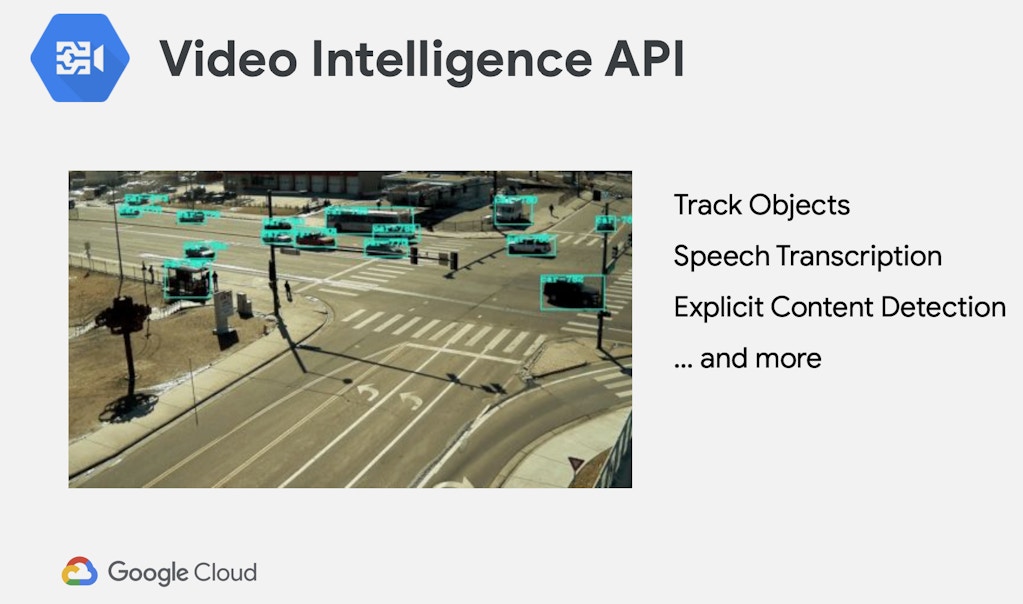
A slide presented to Nimbus users illustrating Google image recognition technology.
Credit: Google
Jack Poulson, director of the watchdog group Tech Inquiry, shared the
portal’s address with The Intercept after finding it cited in Israeli
contracting documents.
“The former head of Security for Google Enterprise — who now heads
Oracle’s Israel branch — has publicly argued that one of the goals of
Nimbus is preventing the German government from requesting data relating
on the Israel Defence Forces for the International Criminal Court,”
said Poulson, who resigned in protest from his job as a research
scientist at Google in 2018, in a message. “Given Human Rights Watch’s
conclusion that the Israeli government is committing ‘crimes against
humanity of apartheid and persecution’ against Palestinians, it is
critical that Google and Amazon’s AI surveillance support to the IDF be
documented to the fullest.”
Though
some of the documents bear a hybridized symbol of the Google logo and
Israeli flag, for the most part they are not unique to Nimbus. Rather,
the documents appear to be standard educational materials distributed to
Google Cloud customers and presented in prior training contexts
elsewhere.
Google did not respond to a request for comment.
The documents obtained by The Intercept detail for the first time the
Google Cloud features provided through the Nimbus contract. With
virtually nothing publicly disclosed about Nimbus beyond its existence,
the system’s specific functionality had remained a mystery even to most
of those working at the company that built it. In 2020, citing the same
AI tools, U.S Customs and Border Protection tapped Google Cloud to process imagery from its network of border surveillance towers.
Many of the capabilities outlined in the documents obtained by The
Intercept could easily augment Israel’s ability to surveil people and
process vast stores of data — already prominent features of the Israeli
occupation.
“Data collection over the entire Palestinian population was and is an
integral part of the occupation,” Ori Givati of Breaking the Silence,
an anti-occupation advocacy group of Israeli military veterans, told The
Intercept in an email. “Generally, the different
technological developments we are seeing in the Occupied Territories all
direct to one central element which is more control.”
The Israeli security state has for decades benefited from the country’s thriving research and development sector, and its interest in using AI to police and control Palestinians isn’t hypothetical. In 2021, the Washington Post reported on the existence of Blue Wolf,
a secret military program aimed at monitoring Palestinians through a
network of facial recognition-enabled smartphones and cameras.
“Living under a surveillance state for years taught us that all the
collected information in the Israeli/Palestinian context could be
securitized and militarized,” said Mona Shtaya, a Palestinian digital
rights advocate at 7amleh-The Arab Center for Social Media Advancement,
in a message. “Image recognition, facial recognition, emotional
analysis, among other things will increase the power of the surveillance
state to violate Palestinian right to privacy and to serve their main
goal, which is to create the panopticon feeling among Palestinians that
we are being watched all the time, which would make the Palestinian
population control easier.”
The educational materials obtained by The Intercept show that Google
briefed the Israeli government on using what’s known as sentiment
detection, an increasingly controversial and discredited form of machine
learning. Google claims that its systems can discern inner feelings
from one’s face and statements, a technique commonly rejected as
invasive and pseudoscientific, regarded as being little better than phrenology. In June, Microsoft announced that it would no longer offer
emotion-detection features through its Azure cloud computing platform —
a technology suite comparable to what Google provides with Nimbus —
citing the lack of scientific basis.
Google does not appear to share Microsoft’s concerns. One Nimbus presentation touted
the “Faces, facial landmarks, emotions”-detection capabilities of
Google’s Cloud Vision API, an image analysis toolset. The presentation
then offered a demonstration using the enormous grinning face sculpture
at the entrance of Sydney’s Luna Park. An included screenshot of the
feature ostensibly in action indicates that the massive smiling grin is
“very unlikely” to exhibit any of the example emotions. And Google was
only able to assess that the famous amusement park is an amusement park
with 64 percent certainty, while it guessed that the landmark was a
“place of worship” or “Hindu Temple” with 83 percent and 74 percent
confidence, respectively.

A slide presented to Nimbus users illustrating Google AI’s ability to detect image traits.
Credit: Google
Google workers who reviewed the documents said they were concerned by
their employer’s sale of these technologies to Israel, fearing both
their inaccuracy and how they might be used for surveillance or other
militarized purposes.
“Vision API is a primary concern to me because it’s so useful for
surveillance,” said one worker, who explained that the image analysis
would be a natural fit for military and security applications. “Object
recognition is useful for targeting, it’s useful for data analysis and
data labeling. An AI can comb through collected surveillance feeds in a
way a human cannot to find specific people and to identify people, with
some error, who look like someone. That’s why these systems are really
dangerous.”
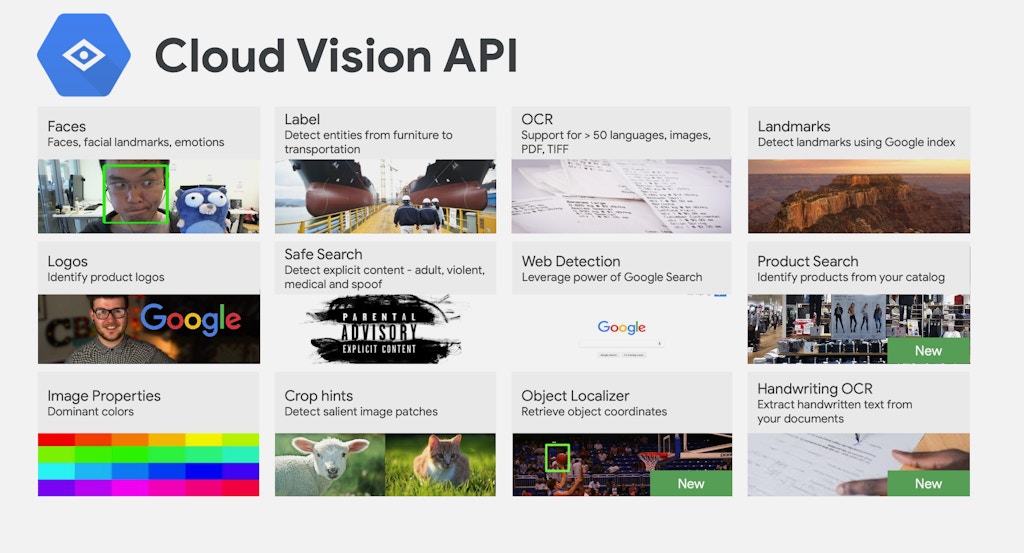
A slide presented to Nimbus users outlining various AI features through the company’s Cloud Vision API.
Credit: Google
The employee — who, like other Google workers who spoke to The
Intercept, requested anonymity to avoid workplace reprisals — added that
they were further alarmed by potential surveillance or other
militarized applications of AutoML, another Google AI tool offered
through Nimbus. Machine learning is largely the function of training
software to recognize patterns in order to make predictions about future
observations, for instance by analyzing millions of images of kittens
today in order to confidently claim that it’s looking at a photo of a
kitten tomorrow. This training process yields what’s known as a “model” —
a body of computerized education that can be applied to automatically
recognize certain objects and traits in future data.
Training an effective model from scratch is often resource intensive,
both financially and computationally. This is not so much of a problem
for a world-spanning company like Google, with an unfathomable volume of
both money and computing hardware at the ready. Part of Google’s appeal
to customers is the option of using a pre-trained model, essentially
getting this prediction-making education out of the way and letting
customers access a well-trained program that’s benefited from the
company’s limitless resources.
“An
AI can comb through collected surveillance feeds in a way a human
cannot to find specific people and to identify people, with some error,
who look like someone. That’s why these systems are really dangerous.”
Cloud Vision is one such pre-trained model, allowing clients to
immediately implement a sophisticated prediction system. AutoML, on the
other hand, streamlines the process of training a custom-tailored model,
using a customer’s own data for a customer’s own designs. Google has
placed some limits on Vision — for instance limiting it to
face detection, or whether it sees a face, rather than recognition that
would identify a person. AutoML, however, would allow Israel to leverage
Google’s computing capacity to train new models with its own government
data for virtually any purpose it wishes. “Google’s machine learning
capabilities along with the Israeli state’s surveillance infrastructure
poses a real threat to the human rights of Palestinians,” said Damini
Satija, who leads Amnesty International’s Algorithmic Accountability
Lab. “The option to use the vast volumes of surveillance data already
held by the Israeli government to train the systems only exacerbates
these risks.”
Custom models generated through AutoML, one presentation noted, can
be downloaded for offline “edge” use — unplugged from the cloud and
deployed in the field.
That Nimbus lets Google clients use advanced data analysis and
prediction in places and ways that Google has no visibility into
creates a risk of abuse, according to Liz O’Sullivan, CEO of the AI
auditing startup Parity and a member of the U.S. National Artificial
Intelligence Advisory Committee. “Countries can absolutely use AutoML to
deploy shoddy surveillance systems that only seem like they work,”
O’Sullivan said in a message. “On edge, it’s even worse — think
bodycams, traffic cameras, even a handheld device like a phone can
become a surveillance machine and Google may not even know it’s
happening.”
In one Nimbus webinar reviewed by The Intercept, the potential use
and misuse of AutoML was exemplified in a Q&A session following a
presentation. An unnamed member of the audience asked the Google Cloud
engineers present on the call if it would be possible to process data
through Nimbus in order to determine if someone is lying.
“I’m a bit scared to answer that question,” said the engineer
conducting the seminar, in an apparent joke. “In principle: Yes. I will
expand on it, but the short answer is yes.” Another Google
representative then jumped in: “It is possible, assuming that you have
the right data, to use the Google infrastructure to train a model to
identify how likely it is that a certain person is lying, given the
sound of their own voice.” Noting that such a capability would take a
tremendous amount of data for the model, the second presenter added that
one of the advantages of Nimbus is the ability to tap into Google’s
vast computing power to train such a model.
“I’d be very skeptical for the citizens it is meant to protect that these systems can do what is claimed.”
A
broad body of research, however, has shown that the very notion of a
“lie detector,” whether the simple polygraph or “AI”-based analysis of
vocal changes or facial cues, is junk science. While Google’s reps
appeared confident that the company could make such a thing possible
through sheer computing power, experts in the field say that any
attempts to use computers to assess things as profound and intangible as
truth and emotion are faulty to the point of danger.
One Google worker who reviewed the documents said they were concerned
that the company would even hint at such a scientifically dubious
technique. “The answer should have been ‘no,’ because that does not
exist,” the worker said. “It seems like it was meant to promote Google
technology as powerful, and it’s ultimately really irresponsible to say
that when it’s not possible.”
Andrew McStay, a professor of digital media at Bangor University in Wales and head of the Emotional AI Lab,
told The Intercept that the lie detector Q&A exchange was
“disturbing,” as is Google’s willingness to pitch pseudoscientific AI
tools to a national government. “It is [a] wildly divergent field, so
any technology built on this is going to automate unreliability,” he
said. “Again, those subjected to them will suffer, but I’d be very
skeptical for the citizens it is meant to protect that these systems can
do what is claimed.”
According to some critics, whether these tools work might be of
secondary importance to a company like Google that is eager to tap the
ever-lucrative flow of military contract money. Governmental customers
too may be willing to suspend disbelief when it comes to promises of
vast new techno-powers. “It’s extremely telling that in the webinar PDF
that they constantly referred to this as ‘magical AI goodness,’” said
Jathan Sadowski, a scholar of automation technologies and research
fellow at Monash University, in an interview with The Intercept. “It
shows that they’re bullshitting.”
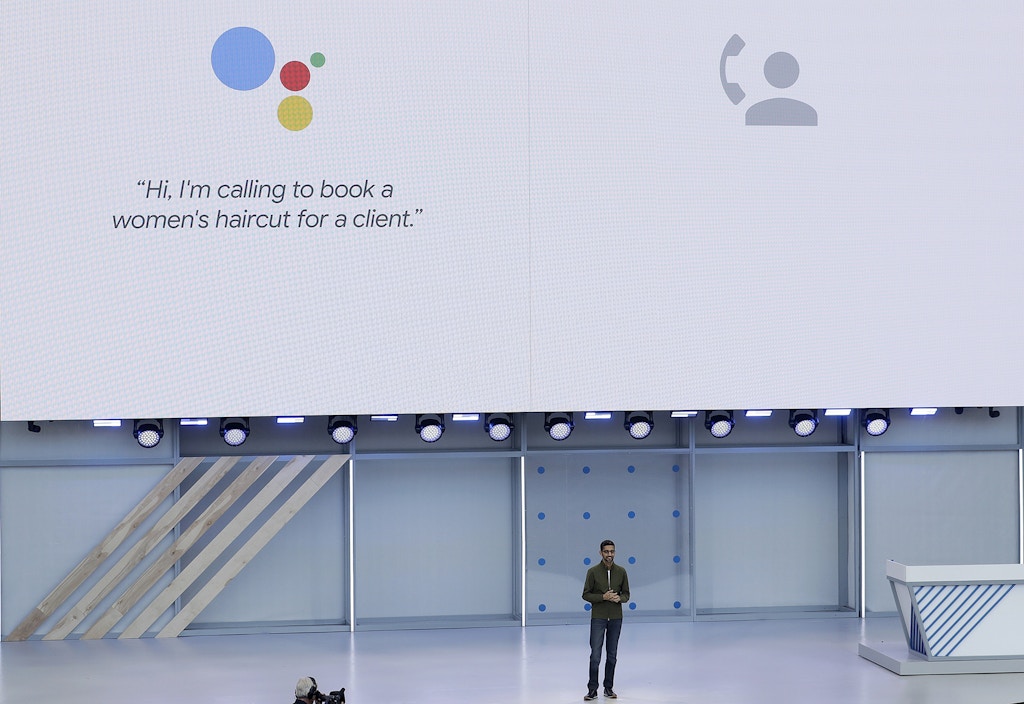
Google CEO Sundar Pichai speaks at the
Google I/O conference in Mountain View, Calif. Google pledges that it
will not use artificial intelligence in applications related to weapons
or surveillance, part of a new set of principles designed to govern how
it uses AI. Those principles, released by Pichai, commit Google to
building AI applications that are “socially beneficial,” that avoid
creating or reinforcing bias and that are accountable to people.
Photo: Jeff Chiu/AP
Google, like Microsoft, has its own public list of “
AI principles,”
a document the company says is an “ethical charter that guides the
development and use of artificial intelligence in our research and
products.” Among these purported principles is a commitment to not
“deploy AI … that cause or are likely to cause overall harm,” including
weapons, surveillance, or any application “whose purpose contravenes
widely accepted principles of international law and human rights.”
Israel, though, has set up its relationship with Google to shield it
from both the company’s principles and any outside scrutiny. Perhaps
fearing the fate of the Pentagon’s Project Maven,
a Google AI contract felled by intense employee protests, the data
centers that power Nimbus will reside on Israeli territory, subject to Israeli law and insulated from political pressures. Last year, the Times of Israel reported
that Google would be contractually barred from shutting down Nimbus
services or denying access to a particular government office even in
response to boycott campaigns.
Google employees interviewed by The Intercept lamented that the
company’s AI principles are at best a superficial gesture. “I don’t
believe it’s hugely meaningful,” one employee told The Intercept,
explaining that the company has interpreted its AI charter so narrowly
that it doesn’t apply to companies or governments that buy Google Cloud
services. Asked how the AI principles are compatible with the company’s
Pentagon work, a Google spokesperson told Defense One, “It means that our technology can be used fairly broadly by the military.”
“Google
is backsliding on its commitments to protect people from this kind of
misuse of our technology. I am truly afraid for the future of Google and
the world.”
Moreover, this
employee added that Google lacks both the ability to tell if its
principles are being violated and any means of thwarting violations.
“Once Google offers these services, we have no technical capacity to
monitor what our customers are doing with these services,” the employee
said. “They could be doing anything.” Another Google worker told The
Intercept, “At a time when already vulnerable populations are facing
unprecedented and escalating levels of repression, Google is backsliding
on its commitments to protect people from this kind of misuse of our
technology. I am truly afraid for the future of Google and the world.”
Ariel Koren, a Google employee who claimed earlier this year that she faced retaliation
for raising concerns about Nimbus, said the company’s internal silence
on the program continues. “I am deeply concerned that Google has not
provided us with any details at all about the scope of the Project
Nimbus contract, let alone assuage my concerns of how Google can provide
technology to the Israeli government and military (both committing
grave human rights abuses against Palestinians daily) while upholding
the ethical commitments the company has made to its employees and the
public,” she told The Intercept in an email. “I joined Google to promote
technology that brings communities together and improves people’s
lives, not service a government accused of the crime of apartheid by the
world’s two leading human rights organizations.”
Sprawling tech companies have published ethical AI charters to rebut
critics who say that their increasingly powerful products are sold
unchecked and unsupervised. The same critics often counter that the
documents are a form of “ethicswashing” — essentially toothless
self-regulatory pledges that provide only the appearance of scruples,
pointing to examples like the provisions in Israel’s contract with
Google that prevent the company from shutting down its products. “The
way that Israel is locking in their service providers through this
tender and this contract,” said Sadowski, the Monash University scholar,
“I do feel like that is a real innovation in technology procurement.”
To Sadowski, it matters little whether Google believes what it
peddles about AI or any other technology. What the company is selling,
ultimately, isn’t just software, but power. And whether it’s Israel and
the U.S. today or another government tomorrow, Sadowski says that some
technologies amplify the exercise of power to such an extent that even
their use by a country with a spotless human rights record would provide
little reassurance. “Give them these technologies, and see if they
don’t get tempted to use them in really evil and awful ways,” he said.
“These are not technologies that are just neutral intelligence systems,
these are technologies that are ultimately about surveillance, analysis,
and control.”
.jpg)