Monday, August 01, 2022

Got Milk?...The Benefits of Breast-Feeding | Aljazeera


Infographic: Which countries have the lowest breastfeeding rates?

Less than half of all newborns around the world are exclusively breastfed during their first five months

World Breastfeeding Week is celebrated from August 1 to 7 every year. Coordinated by the World Alliance for Breastfeeding Action (WABA), it highlights the importance of breastfeeding in tackling malnutrition, understanding inequality and the challenges mothers face across the globe.

According to the United Nations Children’s Fund (UNICEF), less than half of all newborns around the world (44 percent) are exclusively breastfed during the first five months of their lives.

However, despite the numerous health benefits for both babies and mothers, breastfeeding isn’t always easy. In the following infographic series, Al Jazeera looks at why breast milk is important and where breastfeeding is most prevalent.

Why is breast milk important?

Breast milk is packed with essential nutrients, proteins, vitamins, minerals and antibodies uniquely adapted to a baby’s needs.

Consisting of about 87 percent water, breast milk keeps the infant hydrated, manages body temperature, lubricates joints, and protects organs. It also consists of about 7 percent lactose – a sugar that provides the baby with energy, 4 percent fats (lipids) and the remaining 2 percent proteins and other bioactive components, which cannot be found in formula.
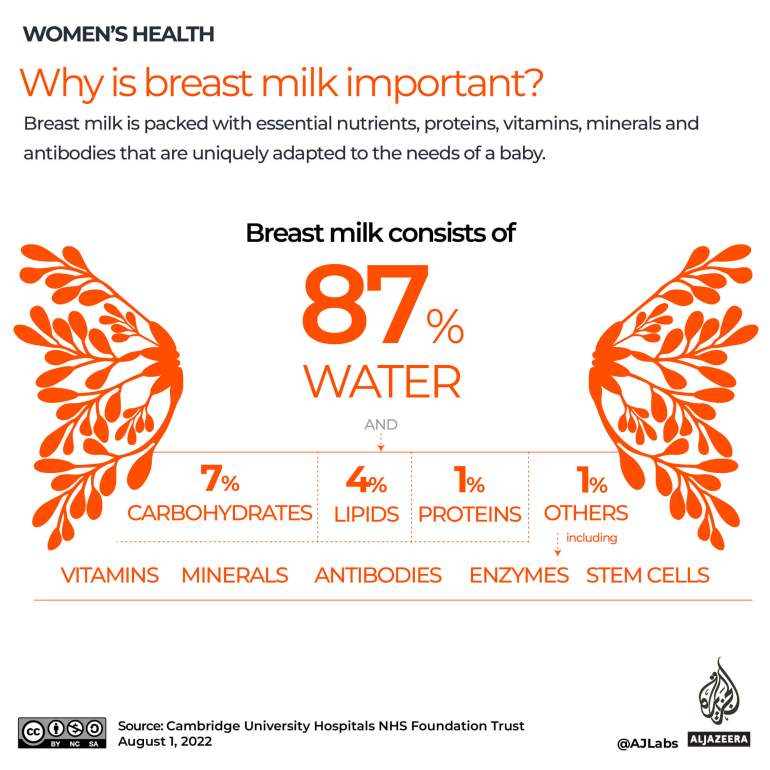
WHY IS BREAST MILK IMPORTANT

The production of milk by the mammary glands is stimulated by hormones. As the pregnancy comes to term, a woman’s body begins to produce the first breast milk, called colostrum, in the initial days after birth.

Colostrum is known as “liquid gold” because of its colour and benefits to newborns: it is packed with protein, vitamins, minerals and immunoglobulins (antibodies) that are essential to the growth and protection of a newborn.
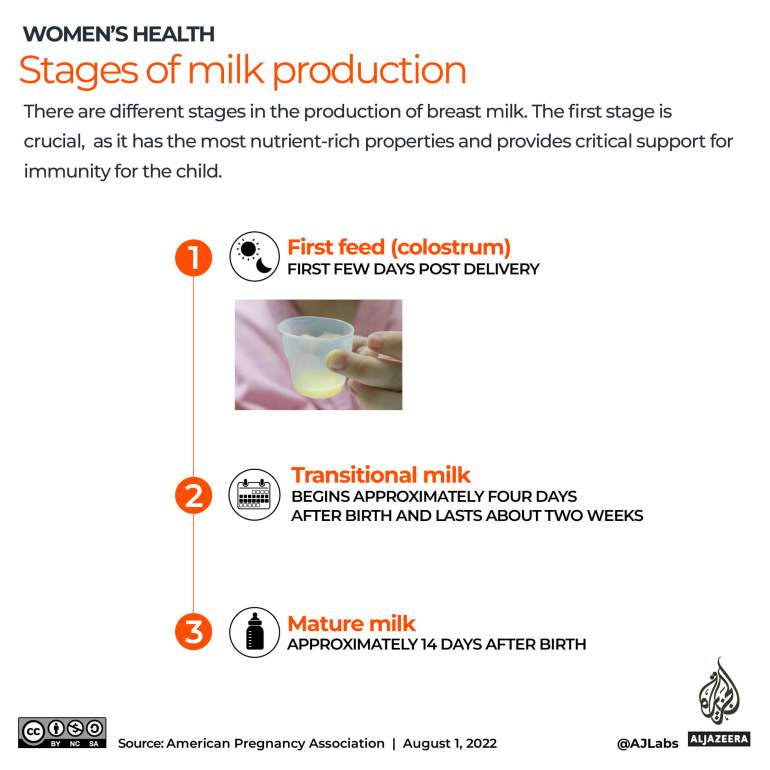
INTERACTIVE_BREASTFEEDING AWARENESS WEEK - STAGES OF MILK PRODUCTION

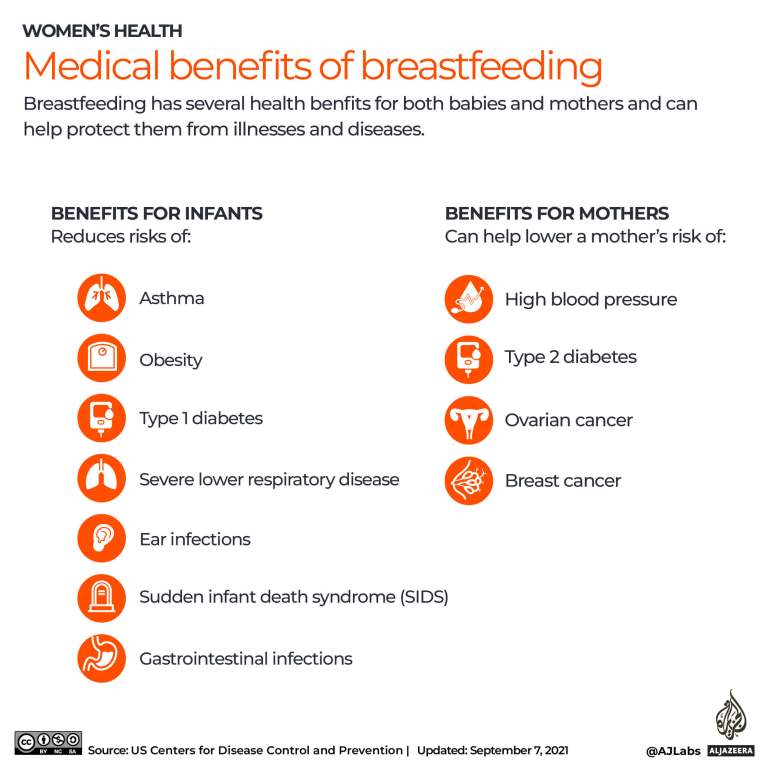
According to the United States Centers for Disease Control and Prevention (CDC), breastfeeding has several health benefits for babies and mothers and can help protect them from illnesses and diseases.

Privacy Policy

For babies, breastfeeding can reduce the risk of:

  • Asthma
  • Obesity
  • Type 1 diabetes
  • Severe lower respiratory disease
  • Ear infections
  • Sudden infant death syndrome (SIDS)
  • Gastrointestinal infections

For mothers, breastfeeding can lower the risk of:

  • High blood pressure
  • Type 2 diabetes
  • Ovarian cancer
  • Breast cancer

INTERACTIVE_BREASTFEEDING AWARENESS WEEK - MEDICAL BENEFITS

Common problems breastfeeding mothers face 

Breastfeeding is not always an option.

Amna Riaz is a young mother from Karachi, Pakistan who had a challenging pregnancy and now has a one-year-old daughter. Amna has Hashimoto’s disease, an autoimmune disorder affecting the thyroid gland. She is clinically obese and had irregular menstruation cycles. For her, even the pregnancy was a miracle.

“I lost 12kg (26.4 pounds) during my pregnancy and ended up giving birth via caesarean section because I was surviving via drips, not solid food, with compromised kidneys,” she said.

With some help post-delivery, lactation counselling and family support, Amna’s milk supply was good.

“After one month of amazing [feeding] … I had to go through another whole new challenge to feed my baby,” she said.

After being told her baby wasn’t growing properly, Amna had to supplement her breast milk with a lactose-free formula (the baby was diagnosed as lactose-intolerant). Her own supply wasn’t enough.

“She wasn’t gaining weight at all [with] the formula milk … [combined] with breast milk,” she says.

The baby eventually had trouble latching onto her mother’s breast, Amna said, adding: “I completely weaned her off breast milk in six months.”
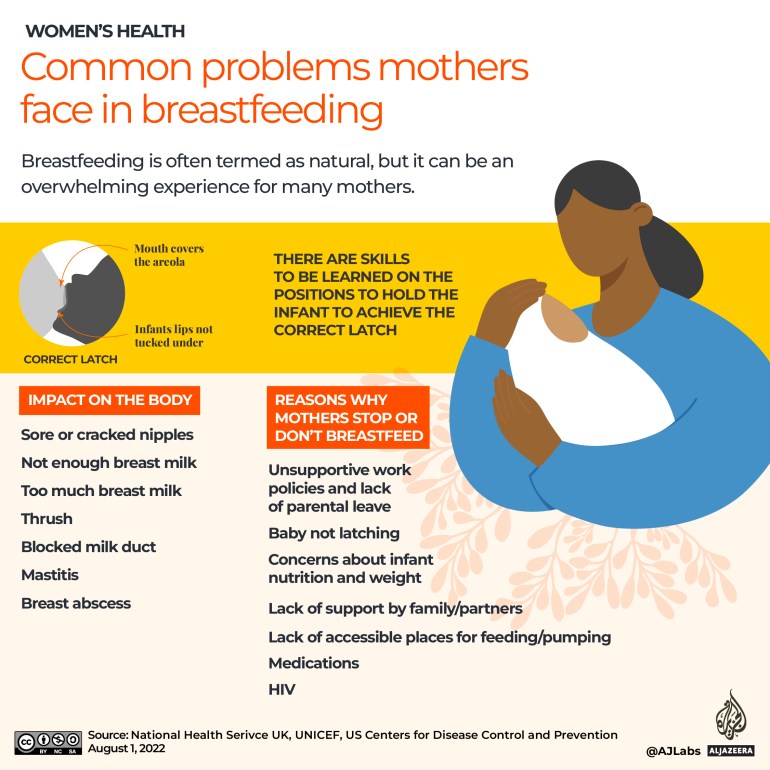
REVISED INTERACTIVE_COMMON PROBLEM3

Yasmin, not her real name, a 29-year-old mother also based in Karachi, told Al Jazeera that breastfeeding was difficult for her and nothing felt normal after she gave birth.

“When my baby was brought to me six hours after [birth] a nurse tried to help me breastfeed,” she said. “With hardly any energy and feeling overwhelmed, I wasn’t able to feed her much at the hospital due to my physical and mental health at that time. But when I came home, I started to pump manually. It was taking so much of my energy. I could barely sit or walk properly in the first few days.”

In the weeks that followed, despite lactation counselling and medications to help boost her supply, Yasmin opted for formula instead of her own milk because her mental health was suffering and she felt switching to formula was her only option – in spite of pressure from her husband to feed “naturally”. She chose to put her mental health first, knowing she was slipping into postpartum depression.

Hareem Sumbul, a certified lactation counsellor, said breastfeeding stimulates the production of oxytocin, a happiness hormone that helps calm mothers.

But, “in case breastfeeding does not go as planned or if there are any hurdles in breastfeeding which cause stress, it can even contribute to kicking off postpartum depression”, she said.

Breastfeeding rates around the globe

According to data collected by UNICEF, South Asian countries have the highest exclusive breastfeeding rates for babies up to five months old: 57 percent.

At 55 percent, Eastern and Southern Africa have the second-highest breastfeeding rates followed by Eastern Europe and Central Asia (41 percent), Latin America and the Caribbean (37 percent) and West and Central Africa (37 percent).

One in three newborns (33 percent) in the Middle East and North Africa are exclusively breastfed.

A retired gynaecologist, who worked in Saudi Arabia for more than a decade and requested not to be named, told Al Jazeera most Saudi mothers tend to be young and have hired help to take care of the infant.

“In private hospitals, there used to be ready-made formula for children that was given freely,” she said. “Once the child is put on the formula in the bottle, there are lesser chances the child will take to suckling.”

INTERACTIVE_BREASTFEEDING AWARENESS WEEK - RATES AROUND THE WORLD

Globally, North America has the lowest rate of exclusive breastfeeding for babies within the first five months of their lives, with just over 26 percent.

Christina Tenorio, a doula and certified lactation specialist from the Pasadena Breastfeeding Center in California in the US, said parents tend to switch to formula mainly because breastfeeding becomes difficult.

“There are also parents who choose to formula feed or supplement because they have to return to work or they do not have the ability to exclusively breastfeed,” she said. “They may have other children or have other responsibilities that don’t allow for exclusive breastfeeding.”

“We definitely see a divide and the discrepancies and disparities in women of colour and the ability to pay. Many parents have to have two-income households, and many moms return to work in six to eight weeks. This will definitely decrease the longevity of breastfeeding.”

Source: Al Jazeera

This won't be Trump's Last Tango by Any Means

 In just one day...


Kari Lake is embraced by Donald Trump at a rally in Prescott last week. Lake has falsely said Biden did not win in Arizona, and called the election ‘corrupt’.
Kari Lake is embraced by Donald Trump at a rally in Prescott last week. Lake has falsely said Biden did not win in Arizona, and called the election ‘corrupt’. Photograph: Ross D Franklin/AP

Kari Lake and Mark Finchem running for governor and secretary of state in primary contests that could have serious consequences

in New York, in Phoenix, and in Washington
Mon 1 Aug 2022 03.00 EDTLast modified on Mon 1 Aug 2022 03.01 EDT

Arizona Republicans are on the verge of nominating two of America’s most prominent election deniers for governor and secretary of state, the latest in a series of primary contests with serious consequences for America’s democracy.

Kari Lake, a former news anchor, and Mark Finchem, a state lawmaker, are running for governor and secretary of state, respectively. Both have built their campaigns around the lie that the 2020 election was stolen. Both are frontrunners in their races and if elected, would take over roles with considerable power over how elections are run and certified in a key battleground state.

The Arizona primary on Tuesday is the latest in a series of contests where candidates who have questioned the election results stand a strong chance of winning the GOP nomination for statewide office. It’s a trend that is deeply alarming, experts say, and could pave the way for Republicans to reject the result of a future election

  • Kari Lake is embraced by Donald Trump at a rally in Prescott last week. Lake has falsely said Biden did not win in Arizona, and called the election ‘corrupt’.
    Kari Lake is embraced by Donald Trump at a rally in Prescott last week. Lake has falsely said Biden did not win in Arizona, and called the election ‘corrupt’. Photograph: Ross D Franklin/AP

    Kari Lake and Mark Finchem running for governor and secretary of state in primary contests that could have serious consequences

    in New York, in Phoenix, and in Washington
    Mon 1 Aug 2022 03.00 EDTLast modified on Mon 1 Aug 2022 03.01 EDT

    Arizona Republicans are on the verge of nominating two of America’s most prominent election deniers for governor and secretary of state, the latest in a series of primary contests with serious consequences for America’s democracy.

    Kari Lake, a former news anchor, and Mark Finchem, a state lawmaker, are running for governor and secretary of state, respectively. Both have built their campaigns around the lie that the 2020 election was stolen. Both are frontrunners in their races and if elected, would take over roles with considerable power over how elections are run and certified in a key battleground state.

    The Arizona primary on Tuesday is the latest in a series of contests where candidates who have questioned the election results stand a strong chance of winning the GOP nomination for statewide office. It’s a trend that is deeply alarming, experts say, and could pave the way for Republicans to reject the result of a future election

  • Sunday, July 31, 2022

    Official news or not...


    Ukraine war: Mighty force of patriotism whipped up by Putin overwhelms doubts about Russia's power

    Putin has promised more big guns. The long touted Tsirkon hypersonic missile will be delivered to Russia's armed forces in the coming months. According to Putin, the Tsirkon missile systems will have "no equal in the world".


    Sunday 31 July 2022 16:22, UK

    Think back to April though and the loss of the Moskva - the flagship warship of Russia's Black Sea fleet.

    A direct hit Ukraine's defence ministry said; a fire onboard according to Russia.

    A significant blow both to Russia's prestige and its Black Sea capabilities. Nor is it the only loss for the Black Sea fleet, against a Ukrainian navy massively diminished since the annexation of Crimea and largely barricaded inside its ports, just like its commercial shipping.

    The Black Sea blockade has been a major strategic win for Russia, forcing Ukraine to mine itself in.

    Stasis at Ukraine's ports has left huge swathes of the world without grain, most significantly, but also fertiliser, sunflower oil and a host of other exports which would have brought much needed cash into the Ukrainian economy.

    tsirkon missile from thebarentsobserver.com
    Duration: 0:51
    Posted: Feb 23, 2022
    tass.com from mobile.twitter.com
    Duration: 0:01
    Posted: Jun 3, 2022

    Ukraine Latest: Putin Flaunts Naval Power; Chubais Hospitalized

    Updated on

    President Vladimir Putin said Russia’s navy would soon be fitted with powerful Zircon hypersonic cruise missiles, which can fly at five times the speed of sound. He signed an expansive new naval doctrine and vowed to respond “with lightning speed to anyone who decides to encroach on our sovereignty and freedom.”

    Anatoly Chubais, who quit as Russia’s climate envoy in opposition to the war in Ukraine, said he’s hospitalized in Europe with a diagnosis of Guillain-Barre syndrome. Russian shelling killed a Ukrainian grain magnate and President Volodymyr Zelenskiy urged civilians in the Donetsk region to evacuate in the face of a lengthy ground battle.

    Russia’s defense ministry said it had invited experts from the United Nations and the Red Cross to investigate the deaths of Ukrainian POWs in the Olenivka detention center in occupied Donetsk. 

    relates to Ukraine Latest: Putin Flaunts Naval Power; Chubais Hospitalized
    Vladimir Putin attends the military parade during Navy Day celebrations in St. Petersburg, Russia. 
    Photographer: Dmitri Lovetsky/AP

    (See RSAN on the Bloomberg Terminal for the Russian Sanctions Dashboard.)

    Key Developments

    Russia’s new Maritime Doctrine identifies mounting NATO activity as major security threat

    HahHeeHeee Everything old is new again | New York Post (Don't worry about the 'Great Deceleration')

     What's this a form of rationing?????? HUH...from my old Hometown Tabloid News!!!!

    SPAM goes on lockdown due to inflation in NYC


    It’s the nation’s crises in a can. 

    Inflation and crime have gotten so bad in Gotham that even cheap meat like Spam has to be locked up.

    At Duane Reade’s store in the Port Authority bus depot, the shelf-stable product — only $3.99 a can — is now being stocked in plastic, anti-theft cases.

    “I’ve never seen that before!” one cashier laughed while using a magnet to remove a can of Spam from its cage. 

    The cashier was among the employees, to

    Almost-All-In-One: Vox.com is one voice among many

     Explanatory Journalism at its own best.      

    Top Stories

    Free speech is essential for democracy. Could it also be democracy’s downfall?

    Margaret Sullivan and I talk about my new book, The Paradox of Democracy.

    Georgia’s big Trump election investigation, explained

    A grand jury investigation in Georgia intensified this summer, and could be a greater legal threat to Trump than the Justice Department.

    The key to universal Covid-19 vaccines lies in your bones

    Scientists are designing vaccines that could potentially cover all Covid-19 variants.

    The smallpox vaccine stockpile isn’t the monkeypox solution we need — yet

    Public health leaders are weighing significant trade-offs to ACAM2000, including the vaccine’s side effects.

    You still need to tell your friends if you get Covid

    The virus is surging again. Here’s how to be your own contact tracer if you get sick.

    Exclusive: Inside Amazon’s plan to “neutralize” powerful unions by hiring ex-inmates and “vulnerable students”

    Leaked memo reveals the tech giant’s plans to combat the Teamsters in California.

    Understand the news with

    Today, Explained

    Listen now in app or on public radio

    The Island of Explained: Plant-based party

    An invitation to a vegan party sends producers Kiarra and Izii to the Island of Explained, where a giant who once ate people explains why he switched to a plant-based diet — and why that diet might be beneficial for humans, too.

    This high-speed rail project is a warning for the US

    How America is screwing up its response to monkeypox

    This summer’s movies are all about love

    What we mean when we say Beyoncé is “saving” house music

    Living with roommates doesn’t have to suck

    Vox’s audience support program, explained

    From Vox Media

    We're building great things, and we need your talent.

    Take a mental break with the newest Vox crossword

    What think tank drama tells us about the US response to Russia’s war

    Why the Inflation Reduction Act isn’t a sure thing

    NYT Columnist Thomas Friedman: “The World Will Push Back” Against Trump ...

        Jan 27, 2026 #amanpourpbs From ICE's violent crackdown in Minneapolis to President ...