Saturday, August 20, 2022

BRAVEHEART: The Browser

 Safe

Stop being followed online

By default, Brave blocks the trackers & creepy ads on every website you visit. And that thing where ads follow you across the Web? We block that, too


Online privacy made simple

All the good of ad-blocking, incognito windows, private search, even VPN. All in a single download.

Online Privacy Illustration

Switch in 60 seconds

Quickly import bookmarks, extensions, even saved passwords. It’s the best of your old browser, only safer. And it only takes a minute to switch.

Switch to Private Browsing Illustration

The new super app

Brave brings truly independent search, free video calls, offline playlists, even a customizable news feed. All fully private. All right to your browser super app.

Private Browser App Illustration

Privacy you can see

No creepy ads & trackers means less stuff (visible or hidden) on the sites you visit. And that means faster page load, better battery life, even mobile data savings.

Fastest Browser Illustration

Online privacy by default: Brave vs. other browsers

www.mozilla.org

Firefox vs. Brave: Which is the better browser for you?

8 - 10 minutes

Just like the Firefox browser, the Brave browser is free, open source and focused on protecting users’ privacy. Brave is a relative newcomer to the world of browsers: its maker, Brave Software, first debuted the browser in January 2016. In this article we’ll compare our Firefox browser with the Brave browser in three categories: privacy, utility and portability.
Security and Privacy Firefox Brave
Private Browsing mode Yes Yes
Blocks third-party tracking cookies by default Yes Yes
Blocks cryptomining scripts Yes Yes
Blocks social trackers Yes Yes

The Brave browser, like so many others, is built on the open-source Chromium code by Google. Open-source means anyone can use the source code and piggy-back on top of it to build whatever they want — like the Opera and Edge browsers. But it doesn’t mean that all Chromium-based browsers are equal or are themselves open source.

Brave differentiates itself from the other Chromium browsers by focusing on user privacy — specifically by blocking trackers, scripts, and ads by default. So when you use the Brave browser, the areas of a website that would normally display ads appear as blank spaces. In some instances, pages don’t load properly, which will require you to either choose a different browser or flip the ‘Shields Up’ setting to ‘Shields Down’ which turns off the privacy and security protection.

The Internet as a whole is largely paid for by display advertisements, which keeps the actual content you want to view free. Brave has attempted to upend this model by encouraging its users to opt into Brave’s own reward system, which in reality, is its own ad platform. Once a user has opted-in, Brave will display what they call “privacy-respecting ads” for which you can view and earn what they call a Basic Attention Token a.k.a. a BAT. From this point Brave users can choose to spend their BATs on supporting the sites or individual contributors they love, who in turn can convert the BATs into actual currency.

Whether this sounds complicated or like a great idea, probably depends on your level of contempt for the display advertising on the Internet. Most Internet users understand that good content costs money, and are okay with the fact that the money comes from advertising.

On the other side of the coin, with the Firefox browser, we prefer to keep things simple. Firefox blocks many third party trackers, cryptominers and fingerprinting trackers from following you by default. However, Firefox, outside of Private Browsing Mode, chooses not to block display ads from appearing. That is, unless you install one of the extensions specifically designed for that purpose.

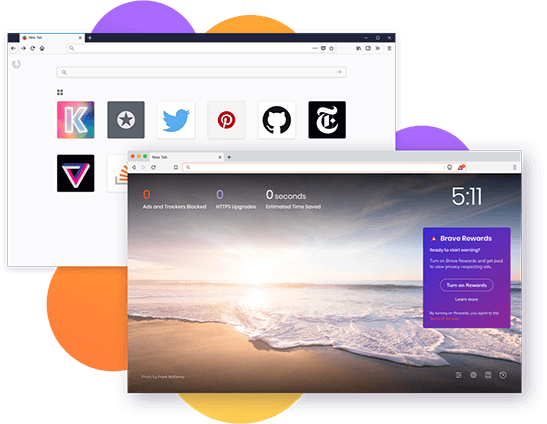
There are a few security features in Brave worth highlighting, such as its automatic HTTPS connection upgrades (which Firefox also offers by extension). Brave and Firefox both offer users a native password manager and the ability to check their security statistics anytime. Brave displays stats like the number of trackers it has blocked whenever you open a new tab. Firefox displays similar information when you view your privacy report which can be accessed anytime by clicking the shield in the address bar.

The bottom line is that even though Brave’s revenue model with the Basic Attention Tokens may be too complex for a lot of users, overall both Brave and Firefox browsers offer a variety of ways to enjoy a safe and private browsing experience.

Utility Firefox Brave
Autoplay blocking Yes Yes
Tab browsing Yes Yes
Bookmark manager Yes Yes
Automatically fills out forms Yes Yes
Search engine options Yes Yes
Text to speech Yes No
Reader mode Yes Yes
Spell checking Yes Yes
Web extensions/Add-ons Yes Yes
In-browser screenshot tool Yes No

What might surprise some new Brave users is just how fast pages tend to load in the browser. The reason for these speedy load times is that pages load much quicker when you block all of the advertising on them. There’s simply less to load so it takes less time.

In terms of actual precious RAM usage, the Brave browser is much heavier than Firefox. Brave comes pre-loaded with various features and “add-ons” which can be attributed to its usage of more RAM. Firefox, on the other hand, lets you decide which add-ons and extensions you want to bolt on.

Customization of UI elements and themes have been a favorite feature of Firefox users for years and our avid community of developers have created a vast library of open source add-ons and extensions allowing for even more personalization and functionality. Features that come with Firefox when you download include our powerful screenshots tool, accessibility features and integration with Pocket — a resource that lets users quickly save an article for later reading on any device.

Brave also supports the huge library of extensions available in the Google Chrome web store and offers a variety of in-browser features like the aforementioned Brave Rewards program, and support for downloading torrents in the browser.

Portability Firefox Brave
OS availability Yes Yes
Mobile OS availability Yes Yes
Syncs with mobile Yes Yes
Password management Yes Yes
Primary password Yes No

The ability to sync your passwords, extensions, form data, add-ons and other preferences across all your devices and operating systems is a feature that’s been available for years with Firefox. The synced data is also encrypted, which means no one can access it from the outside.

The Firefox browser also gives users the ability to sign up for a free Firefox Account. Having a Firefox account is the key to unlocking syncing across devices, plus you get the added benefit of products like Firefox Monitor which monitors your email addresses and alerts you if any of your information has been involved in any known data breaches.

Brave also recently gained the ability to sync data across most popular operating systems and devices as well with the added capability of syncing your Basic Attention Tokens.

When comparing the two browsers, both Firefox and Brave offer a sophisticated level of privacy and security by default, available automatically from the very first time you open them.

Brave’s advertising replacement idea is a twist on the current model of paid ad placement and paid search. But again, some busy Internet users will probably not want to get too involved with the management of micro payments to sites in exchange for their time and attention.

Overall, Brave is a fast and secure browser that will have particular appeal to cryptocurrency users. But for the vast majority of internet citizens, Firefox remains a better and simpler solution.

The comparisons made here were done so with default settings and across browser release versions as follows:
Firefox (81) | Brave (1.14.81)
This page is updated semi-quarterly to reflect latest versioning and may not always reflect latest updates.

Related 


Apr 8, 2021 · Brave is a more-or-less standard browser that lets users navigate to websites, run web apps, and display online content. Like other browsers, it ...
Missing: braveheart | Must include:braveheart
Brave is a free and open-source web browser developed by Brave Software, Inc. based on the Chromium web browser. Brave is a privacy-focused browser, ...
Developer(s): Brave Software, Inc.
Initial release: 13 November 2019 (Version 1.0)
Written in: JavaScript, Swift, C++
Operating system: Windows; macOS; Linux; Android; iOS
Missing: braveheart | Must include:braveheart
Rating (249,919) · Free · iOS
With over 50 million users, Brave Browser is a lightning fast, safe and private web browser that prevents you from being tracked by ads.

MIT: Technology Review


Who we are

Founded at the Massachusetts Institute of Technology in 1899, MIT Technology Review is a world-renowned, independent media company whose insight, analysis, reviews, interviews and live events explain the newest technologies and their commercial, social and political impacts.

MIT Technology Review derives authority from its relationship to the world's foremost technology institution and from its editors' deep technical knowledge, capacity to see technologies in their broadest context, and unequaled access to leading innovators and researchers.

www.technologyreview.com

Social media is polluting society. Moderation alone won’t fix the problem 


Nathaniel Lubin
9 - 11 minutes

We all want to be able to speak our minds online—to be heard by our friends and talk (back) to our opponents. At the same time, we don’t want to be exposed to speech that is inappropriate or crosses a line. Technology companies address this conundrum by setting standards for free speech, a practice protected under federal law. They hire in-house moderators to examine individual pieces of content and remove them if posts violate predefined rules set by the platforms.

The approach clearly has problems: harassment, misinformation about topics like public health, and false descriptions of legitimate elections run rampant. But even if content moderation were implemented perfectly, it would still miss a whole host of issues that are often portrayed  as moderation problems but really are not. To address those non-speech issues, we need a new strategy: treat social media companies as potential polluters of the social fabric, and directly measure and mitigate the effects their choices have on human populations. That means establishing a policy framework—perhaps through something akin to an Environmental Protection Agency or Food and Drug Administration for social media—that can be used to identify and evaluate the societal harms generated by these platforms. If those harms persist, that group could be endowed with the ability to enforce those policies. But to transcend the limitations of content moderation, such regulation would have to be motivated by clear evidence and be able to have a demonstrable impact on the problems it purports to solve.

Moderation (whether automated or human) can potentially work for what we call “acute” harms: those caused directly by individual pieces of content. But we need this new approach because there are also a host of “structural” problems—issues such as discrimination, reductions in mental health, and declining civic trust—that manifest in broad ways across the product rather than through any individual piece of content. A famous example of this kind of structural issue is Facebook’s 2012 “emotional contagion” experiment, which showed that users’ affect (their mood as measured by their behavior on the platform) shifted measurably depending on which version of the product they were exposed to. 

In the blowback that ensued after the results became public, Facebook (now Meta) ended this type of deliberate experimentation. But just because they stopped measuring such effects does not mean product decisions don’t continue to have them.

Structural problems are direct outcomes of product choices. Product managers at technology companies like Facebook, YouTube, and TikTok are incentivized to focus overwhelmingly on maximizing time and engagement on the platforms. And experimentation is still very much alive there: almost every product change is deployed to small test audiences via randomized controlled trials. To assess progress, companies implement rigorous management processes to foster their central missions (known as Objectives and Key Results, or OKRs), even using these outcomes to determine bonuses and promotions. The responsibility for addressing the consequences of product decisions is often placed on other teams that are usually downstream and have less authority to address root causes. Those teams are generally capable of responding to acute harms—but often cannot address problems caused by the products themselves.

With attention and focus, this same product development structure could be turned to the question of societal harms. Consider Frances Haugen’s congressional testimony last year, along with media revelations about Facebook’s alleged impact on the mental health of teens. Facebook responded to criticism by explaining that it had studied whether teens felt that the product had a negative effect on their mental health and whether that perception caused them to use the product less, and not whether the product actually had a detrimental effect. While the response may have addressed that particular controversy, it illustrated that a study aiming directly at the question of mental health—rather than its impact on user engagement—would not be a big stretch. 

Incorporating evaluations of systemic harm won’t be easy. We would have to sort out what we can actually measure rigorously and systematically, what we would require of companies, and what issues to prioritize in any such assessments. 

Companies could implement protocols themselves, but their financial interests too often run counter to meaningful limitations on product development and growth. That reality is a standard case for regulation that operates on behalf of the public. Whether through a new legal mandate from the Federal Trade Commission or harm mitigation guidelines from a new governmental agency, the regulator’s job would be to work with technology companies’ product development teams to design implementable protocols measurable during the course of product development to assess meaningful signals of harm. 

That approach may sound cumbersome, but adding these types of protocols should be straightforward for the largest companies (the only ones to which regulation should apply), because they have already built randomized controlled trials into their development process to measure their efficacy. The more time-consuming and complex part would be defining the standards; the actual execution of the testing would not require regulatory participation at all. It would only require asking diagnostic questions alongside normal growth-related questions and then making that data accessible to external reviewers. Our forthcoming paper at the 2022 ACM Conference on Equity and Access in Algorithms, Mechanisms, and Optimization will explain this procedure in more detail and outline how it could effectively be established.

When products that reach tens of millions are tested for their ability to boost engagement, companies would need to ensure that those products—at least in aggregate—also abide by a “don’t make the problem worse” principle. Over time, more aggressive standards could be established to roll back existing effects of already-approved products.

There are many methods that might be suitable for this type of process. These include protocols like the photographic affect meter, which has been used diagnostically to assess how exposure to products and services affects mood. Technology platforms are already using surveys to assess product changes; according to reporters Cecilia Kang and Sheera Frankel, Mark Zuckerberg looks at survey-based growth metrics for most every product decision, the results of which were part of his choice to roll back the “nicer” version of Facebook’s news feed algorithm after the 2020 election. 

It would be reasonable to ask whether the technology industry sees this approach as feasible and whether companies would fight against it. While any potential regulation might engender such a response, we have received positive feedback from early conversations about this framework—perhaps because under our approach, most product decisions would pass muster. (Causing measureable harms of the sort described here is a very high bar, one that most product choices would clear.) And unlike other proposals, this strategy sidesteps direct regulation of speech, at least outside the most extreme cases.

At the same time, we don’t have to wait for regulators to take action. Companies could readily implement these procedures on their own. Establishing the case for change, however, is difficult without first starting to collect the sort of high-quality data we’re describing here. That is because one cannot prove the existence of these types of harms without real-time measurement, creating a chicken-and-egg challenge. Proactively monitoring structural harms won’t resolve platforms’ content issues. But it could allow us to meaningfully and continuously verify whether the public interest is being subverted. 

The US Environmental Protection Agency is an apt analogy. The original purpose of the agency was not to legislate environmental policy, but to enact standards and protocols so that policies with actionable outcomes could be made. From that point of view, the EPA’s lasting impact was not to resolve environmental policy debates (it hasn’t), but to make them possible. Likewise, the first step for fixing social media is to create the infrastructure that we’ll need in order to examine outcomes in speech, mental well-being, and civic trust in real time. Without that, we will be prevented from addressing many of the most pressing problems these platforms create.

Nathaniel Lubin is a fellow at the Digital Life Initiative at Cornell Tech and the former director of the Office of Digital Strategy at the White House under President Barack Obama. Thomas Krendl Gilbert is a postdoctoral fellow at Cornell Tech and received an interdisciplinary PhD in machine ethics and epistemology at UC Berkeley.

RECESSION WATCH:

 Like they say, "Stay calm. Don't panic." We'll get through this just like every time before.  Consumers are 'resilient:.  

HUH 


The Fed

The Fed raised interest rates by another 75 basis points at its latest policy meeting in July, as officials discussed "unacceptably high inflation" and acknowledged economic growth will be “noticeably weaker" than they believed one month ago. Thus far, the central bank has hiked interest rates by 2.25 percentage points this year. Goldman says the majority of hikes are behind us in this tightening cycle and predicts only a 50-basis-point rate hike in September and 25-basis-point increases in November and December. However, that's contingent on inflation coming down.

The Atlanta Fed cut its projections for third-quarter economic growth from 2.5% to 1.8% on Tuesday after data showing housing starts unexpectedly plunged 9.6% last month to the lowest level in more than a year, with experts blaming the worsening sentiment on rising mortgage rates.

Economists at Goldman Sachs are also worried it will be difficult to avoid a recession as the Fed works to combat inflation, saying on Tuesday that officials are "off to a good start but [have] a long way to go"; on Monday, Moody's Analytics put the odds of a recession over the next year at 50%.

Stock Market

Stocks have struggled to find direction after rallying more than 15% since the Fed's rate hike in June when many investors concluded the worst of the increases may be over. However, the S&P 500 is still down 12% this year, compared to a 21% gain in 2021. Bank of America has warned slower-than-expected economic growth could tank stocks further, and if inflation isn't tamed, more aggressive Fed policy would surely rock markets again.

Housing Market

Higher interest rates are having a brutal effect on the housing market, driving u

p the cost of home-buying by hundreds of dollars each month and pummeling demand as a result. Existing home sales have plunged nearly 30% from a January high. Meanwhile, home prices are still skyrocketing and making affordability even worse. "We're witnessing a housing recession in terms of declining home sales and home building; however, it's not a recession in home prices," National Association of Realtors economist Lawrence Yun said Thursday, noting the median existing home price has fallen to $403,800 from a record high in June but is still up nearly 11% from one year ago.

www.forbes.com

Recession Watch: It Doesn’t Seem Imminent—But The Housing Market Collapse Deepens As Fed Officials Warn 'Economy Will Slow'

Jonathan Ponciano
8 - 10 minutes
Forbes Staff

✓ 

✓ 

✓ 

,✓ 


WHATEVER IT TAKES? ? ? ? ? ? ? ? ? ? ? ? ? ? ? ? ? ? ? ?

 UNCERTAINTY in these troubled times. . .


Jul 26, 2022 · The world's three largest economies are stalling, with important consequences for the global outlook. Inflation is a major concern

Higher-than-expected inflation, especially in the United States and major European economies, is triggering a tightening of global financial conditions. China’s slowdown has been worse than anticipated amid COVID-19 outbreaks and lockdowns, and there have been further negative spillovers from the war in Ukraine. As a result, global output contracted in the second quarter of this year.

Under our baseline forecast, growth slows from last year’s 6.1 percent to 3.2 percent this year and 2.9 percent next year, downgrades of 0.4 and 0.7 percentage points from April. This reflects stalling growth in the world’s three largest economies—the United States, China and the euro area—with important consequences for the global outlook.


In the United States, reduced household purchasing power and tighter monetary policy will drive growth down to 2.3 percent this year and 1 percent next year. In China, further lockdowns, and the deepening real estate crisis pushed growth down to 3.3 percent this year—the slowest in more than four decades, excluding the pandemic. And in the euro area, growth is revised down to 2.6 percent this year and 1.2 percent in 2023, reflecting spillovers from the war in Ukraine and tighter monetary policy.

✓ There is a chance some economic data could be revised, making it more challenging for officials to set policy. 


www.bnnbloomberg.ca

Fed’s Barkin Says Central Bank ‘Will Do What It Takes’ to Curb Inflation - BNN Bloomberg

Jonnelle Marte

(Bloomberg) -- Federal Reserve Bank of Richmond President Thomas Barkin said the central bank was resolved to curb red-hot inflation, even if that meant risking a US economic recession.

“We’re committed to returning inflation to our 2% target and we’ll do what it takes to get there,” Barkin said Friday during an event in Ocean City, Maryland. He said that this could be achieved without a “tremendous decline in activity” but acknowledged that there were risks.

“There’s a path to getting inflation under control but a recession could happen in the process,” he said.

The US central bank hiked interest rates by 75 basis points in July for the second straight month as policy makers tackle inflation that’s running near 40-year highs. Fed officials speaking in recent days have said more rate increases are needed, but they are still deciding how big to move at their next policy meeting. 

St. Louis Fed President James Bullard, one of the most hawkish policy makers, on Thursday urged another 75 basis-point move while Kansas City’s Esther George struck a more cautious tone.

“We have a lot of time still before September,” Barkin told reporters after his remarks, noting that there are eight weeks between the July and September meetings. He said his decision on the size of the rate hike needed next month will be based on what economic data shows about the strength of the US economy and whether inflation is starting to fade.

A Labor Department report for July showed that the US economy added 528,000 jobs that month, more than double what forecasters were projecting, and the unemployment rate ticked down to 3.5%, matching the pre-pandemic low.

But a separate report on Aug. 10 showed that consumer prices rose 8.5% in the 12 months through July, down from the 9.1% increase in the year to June that had marked the highest inflation rate since 1981. Officials will be able to review another jobs report and one more reading on consumer inflation before they meet next month. The Fed official said there is a chance some economic data could be revised, making it more challenging for officials to set policy. 


Barkin, who does not have a vote in monetary policy decisions this year, said it is important for the Fed to get rates into “restrictive” territory, where they are putting downward pressure on inflation. The policy maker said he’s “been supportive of front-loading” rate increases, but said there is uncertainty over what level of rates are considered neutral, meaning that they neither slow down nor stimulate the US economy. 

“Getting inflation under control is going to be necessary to set up what we have the potential to do in the economy,” he said. “I’ve convinced myself that not getting inflation under control is inconsistent with a thriving economy.”


NO CAPTAIN ONBOARD