November 16, 2022 at 12:56 pm
"Today the City of Mesa partnered with several water agencies and
providers throughout the West in a joint Memorandum of Understanding to
protect the Colorado River system. Mesa has pledged continued commitment
to water conservation, reducing water.
Mesa has pledged continued commitment to water conservation, reducing
water demands and maximizing the beneficial reuse of recycled water.
In May of this year, the City of Mesa declared Stage I of its Water
Shortage Management Plan. In response, drought messaging and outreach
were intensified, and City Departments are working toward water use
reduction across City facilities."
The City of Mesa recognizes
the shared role in continuing to reduce demands on the Colorado River
and will continue to build on current efforts to ensure a sustainable
water future.
Their common-ground approach seems to be resonating with readers across the
globe and brands that seek to connect with them. It is an important
mission . . .
Kevin Gentzel: On Elon Musk, Jeff Bezos and Joining Newsweek
Kevin Gentzel
3 - 4 minutes
To our Readers
Newsweek
A consistent thread throughout my career
has been my commitment to helping iconic, important media brands
survive and grow. I don't think that work has ever been more important.
If, five years from now, everyone is getting their news from TikTok,
we're all in trouble.
Media disruption continues to be dramatic. Like many Twitter users across the world, I have been watching Elon Musk's
takeover with deep interest. The saga has involved famous board
members, billionaire founders, executive departures, and employees
sharing the drama from their perspective in real time on their own
platform.
As advertisers and their agencies began pausing their
ad-spend on Twitter in order to suss things out as the Musk era unfolds,
it brought back fond memories of my time leading advertising sales at The Washington Post (as chief revenue officer) as the Jeff Bezos era began. As you might imagine, when the Washington Post leadership team learned that Bezos had acquired the Post, the sentiment was a mix of sheer excitement and nervous chatter—a lot of, "what does this mean?"
"Jeff doesn't like advertising" was one much-repeated line, though I quickly pointed out that Amazon
was in fact building a burgeoning ads business. In anticipation of the
upheaval, we started a book club (if memory serves we kicked it off with
"The Innovator's Dilemma"). We discussed frugality and innovation and
putting engineering principles into our workflows. We weaned off of
Powerpoint.
But there was a specific element of the Jeff Bezos era
that I was unprepared for: local retail advertisers who wanted to pause
or pull ad spend due to the Amazon Effect on their business. This
caught us by surprise at first, but after hearing the feedback multiple
times we knew we needed to respond.
We discussed and debated, and
ultimately our response to advertisers was: wouldn't you like to work
with us to experience what his impact might be like? We developed
marketing partnerships by incorporating technology into the ideation
process. We tinkered with how products were built, created small
features that compelled a user to engage, developed innovation layers to
more typical sponsorship opportunities with businesses that helped them
stand out and reach customers in new ways.
My reasons for joining Newsweek as its first Global Chief Commercial Officer are many (and coincidentally Newsweek was owned by The Washington Post's
Graham family for close to 50 years). But our mission to bring diverse
voices onto our platform, to engage with viewpoints across the political
and cultural spectrum, is the most important to me.
Two
third-party media watchdogs, AllSides and NewsGuard, rate Newsweek as
centrist—significant endorsements for a polarized industry. Our reach is
now over 50 million users every month and has grown tenfold over the
past four years. Our common-ground approach seems to be resonating with
readers across the globe and brands that seek to connect with them. It
is an important mission we are on, and thank you greatly for spending
time with us.
NATO has supported Ukraine throughout the conflict, sending economic
and military assistance. The U.S., for its part, has provided around $54
billion in aid since the war began in February and the White House has
asked Congress to green-light some $38 billion more in the aftermath of the incident across the Polish border.
"In comments shared with Newsweek, Moscow's envoy in Washington has accused Kyiv of trying to bring NATO
directly into the war after it was determined by allied leaders that a
deadly blast across the Polish border was most likely triggered by
Ukrainian defense systems attempting to intercept a Russian missile
strike.
A number of Western officials initially attributed the
cause of the incident Tuesday, which resulted in the deaths of two
Polish citizens near the border village of Przewodów, to Russian
missiles, sparking fears of a new escalation in the war.
U.S. President Joe Biden
and Polish President Andrzej Duda have since acknowledged that it was
likely a Ukrainian missile behind the incident, but allied officials
including NATO Secretary-General Jens Stoltenberg have cast blame on
Moscow's actions for what occurred due to Russia's ongoing attacks on
Ukraine.
And in Ukraine, President Volodymyr Zelensky has continued to deny it was his forces' projectile that struck the neighboring NATO state.
In the midst of the fallout, Russian Ambassador to the United States Anatoly Antonov told Newsweek
that "we have noted that Ukrainian missiles landing on Polish territory
continues to evoke a significant response in the United States."
"U.S.
officials, media and non-governmental organizations continue to voice a
mantra 'Russia is to blame for everything,'" Antonov said. "The
American side resorts to such a method in any difficult situation. Even
when the U.S. publicly acknowledges the fact that Kiev is responsible
for the deaths of Polish civilians."
Some
Western officials such as Latvian Defense Minister and Deputy Prime
Minister Artis Pabriks initially called for invoking NATO Article 4 over
the strike, a measure that would see allies gather to discuss their
concerns and potentially consider increasing assistance to Ukraine,
which has sought more advanced air and missile defense systems. Another
NATO clause, Article 5, asks nations to respond collectively to any
attack on a member state.
Kiev seeks to trigger direct Russia-NATO standoff — Russian ambassador to US
"West’s
absurd attempts to shift responsibility for everything on Russia "can
only provoke the Kiev regime, which already feels permissiveness,"
Anatoly Antonov said
NEW YORK, November 19. /TASS/. The Ukrainian government is
trying to trigger a direct confrontation between Russia and NATO,
Russian Ambassador to the US Anatoly Antonov said in a comment to Newsweek.
"The Ukrainian authorities are not only begging Washington to provide
more military assistance, but are also trying to provoke a direct
military clash between the Russian Federation and NATO," the embassy’s
press service quoted the diplomat as saying.
Antonov went on to say that West’s absurd attempts to shift
responsibility for everything on Russia "can only provoke the Kiev
regime, which already feels permissiveness."
A missile crashed in the village of Przewodow in eastern Poland’s
Lublin Voivodeship close to the border with Ukraine on November 15,
killing two people. Polish President Andrzej Duda said on Wednesday the
missile was part of the Ukrainian air defense system. The US State
Department said the US has full confidence in the accuracy of
conclusions made by Poland. The Russian Foreign Ministry called
statements by Kiev with respect to the incident a "gross provocation."
According to the Russian Defense Ministry, the missile was fired by a
Ukrainian S-300 air defense system."
The futility of U.S. military aid and NATO aspirations for Ukraine — Defense Priorities
23 - 29 minutes
Key points
Since the 2014
Russian annexation of Crimea, the U.S. has provided $2.5 billion in
military aid to Ukraine. Continued security assistance prolongs the
conflict and heightens U.S.-Russia tensions.
Russia
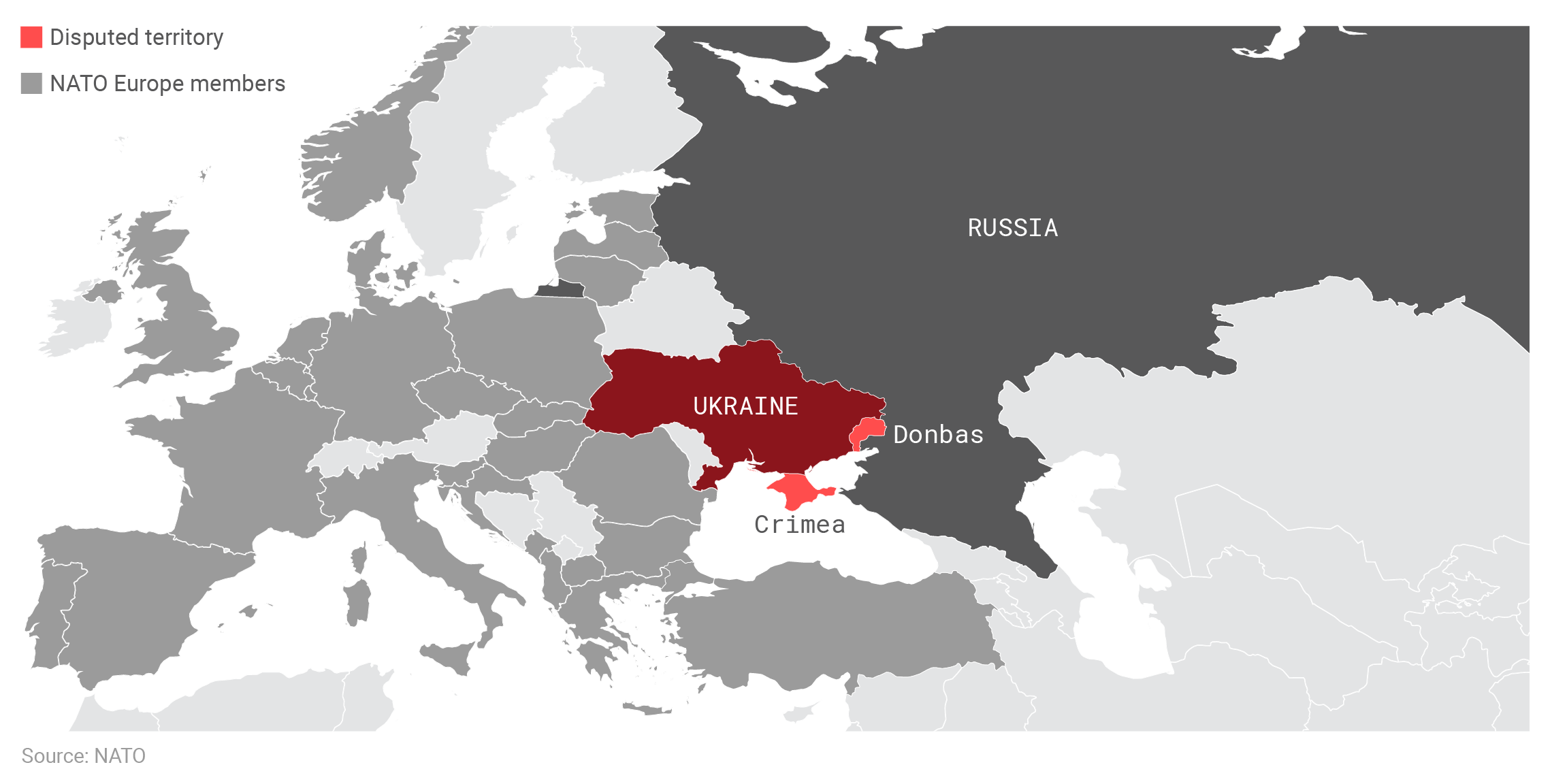
shares a 1,200-mile border with Ukraine and views the prospect of Kyiv
joining NATO and basing U.S. and allied forces there as a threat. Russia
will absorb significant costs—monetary and human—to prevent this
outcome.
A resolution in Ukraine that does not account
for Russia’s concerns is unrealistic; therefore, U.S. and European
leaders should account for them, starting with ruling out Ukrainian
accession to NATO.
Because of the risk of escalation,
potentially to nuclear war, the U.S. should seek détente with Russia and
support the establishment of a neutral, non-aligned Ukraine that serves
as a buffer state between Russia and the West.
Repeating the same mistakes in Ukraine
President Biden met with Ukrainian President Volodymyr Zelensky at
the White House in September 2021 and reiterated the U.S. commitment to
Ukraine’s territorial sovereignty. The meeting suggests the Biden
administration intends to continue the failed policy of his two
predecessors: providing piecemeal security assistance to Ukraine and
supporting its eventual accession to NATO.
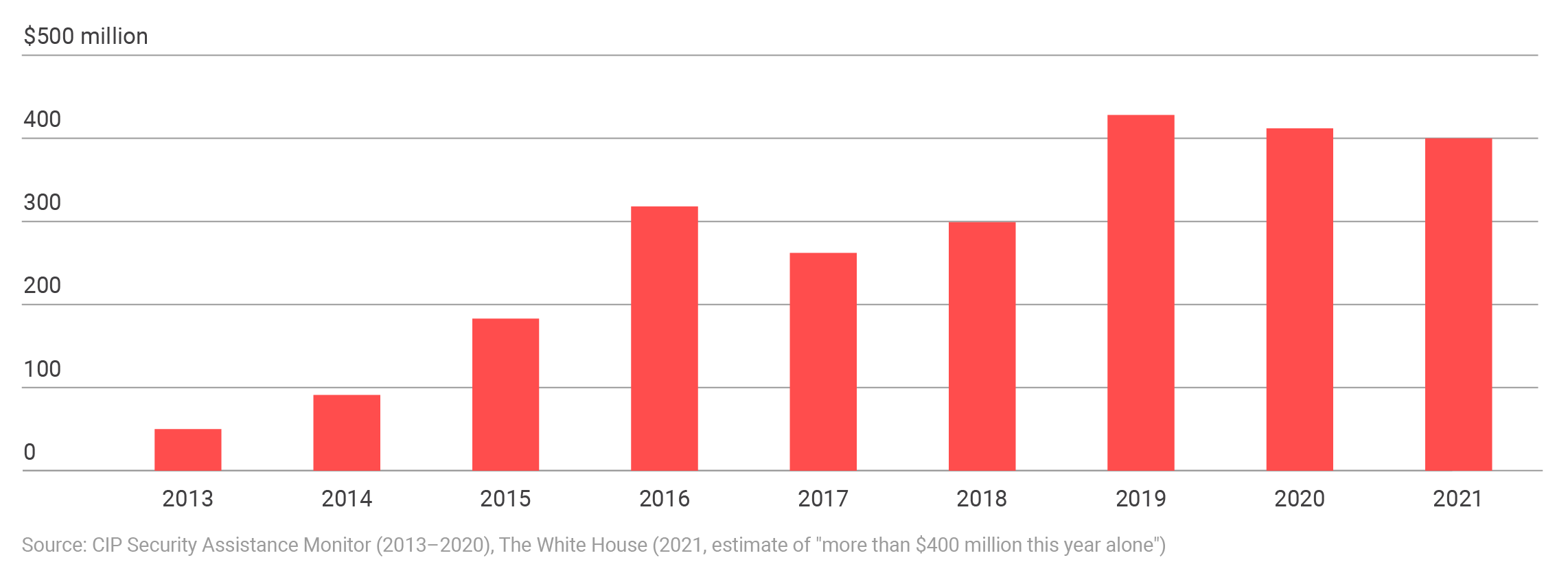
Annual U.S. military aid to Ukraine
The U.S. has provided $2.5 billion in military support to Ukraine since 2014, including more than $400 million in 2021 alone.
U.S. military aid to Ukraine
Ahead
of the meeting, President Biden presented a $60 million military aid
package to Ukraine, which included Javelin anti-tank missiles, small
arms, and ammunition.1 Since
hostilities broke out between Ukraine and Russia in 2014, the United
States has provided $2.5 billion in security aid to Kyiv, with more than
$400 million in the last year alone.2
U.S. security assistance has come in the form of training, equipment,
and weaponry, including tactical unmanned aerial vehicles, night vision
devices, sniper rifles, small arms, Javelin anti-tank missiles,
high-mobility multipurpose wheeled vehicles, and Mark VI patrol boats.
The United States has also provided secure communications, satellite
imagery and analysis support, counter-battery radars, and equipment to
support military medical treatment and combat evacuation procedures.3
While these weapon systems and equipment increased the warfighting
capabilities of Ukraine’s security forces, they failed to meaningfully
alter the balance of power between Ukraine and the Russian-backed
separatists or bring an end to hostilities. They also failed to stop
Russian interference in Ukraine, ranging from direct military aid to
influence operations and cyber-attacks.
Despite these continued military transfers from the United States,
the conflict continues into its seventh year because the underlying
causes of the war have not been sufficiently addressed—particularly
Russia’s concern Ukraine will become a western bulwark by allowing U.S.
and NATO forces to station there.
Holding out prospects for Ukrainian membership in NATO
The
Biden administration continues to rhetorically support Ukraine’s
aspirations to join NATO. A joint statement released after the White
House meeting in September declared “the United States supports
Ukraine’s right to decide its own future foreign policy course free from
outside interference, including with respect to Ukraine’s aspirations
to join NATO.”4 Secretary of Defense Lloyd Austin reinforced this message during a visit to Kyiv in October.5
Yet even as the administration voiced its support, it has, wisely, not
formally extended membership. President Zelensky previously discussed
his annoyance at the reluctance of western leaders to admit Ukraine into
NATO, and the lack of a firm commitment by Biden likely exacerbates
Zelensky’s frustrations.6
The reasons for the administration’s apparent hesitancy to extend
outright NATO membership likely reflect an understanding of the dangers
of admitting Ukraine into the alliance. Rather than decrease the
possibility of war, offering Ukraine NATO membership risks provoking a
Russian military response which has the potential to instigate a larger
war between the United States and a nuclear-armed Russia. Not only would
such a scenario be devastating for Ukrainians, but it also could
escalate to the nuclear level; therefore, avoiding this outcome should
be a top policy priority. Even short of war, protracted hostility
between the United States and Russia over Ukraine could spill over into
other areas, costing the United States time and resources better devoted
to higher priorities. Nevertheless, the United States and NATO continue
to play to the edge of offering full membership, recognizing Ukraine as
an Enhanced Opportunities Partner in 2020 and conducting joint military
exercises as recently as September 2021 to increase Ukraine’s
interoperability with NATO forces.7
Continued U.S. security assistance to Ukraine and dangling false
hopes of NATO membership prolong the conflict in Ukraine and increase
the risk of counterproductive war between the United States and Russia.
The Biden administration’s current policy draws out the suffering of
Ukrainians and prevents the possibility of establishing stable and
constructive relations between the world’s two greatest nuclear powers.
An overview of the conflict
Hostilities in Ukraine began in November 2013 when, under heavy
pressure from Moscow, Ukrainian President Viktor Yanukovych rejected an
association agreement that would have led to greater economic
integration with the European Union.8
This decision sparked large protests in Kyiv against Yanukovych, which
escalated tensions throughout Ukraine between citizens who preferred
closer ties with Europe and those who preferred closer ties with Russia.
As protests intensified and became more violent, Yanukovych fled to
Russia in February 2014. The following month, Russian forces seized, and
ultimately annexed, the Crimean Peninsula.9
Pro-Russian separatists, with Russian backing, fought Ukrainian
security forces in the eastern Ukrainian regions of Donetsk and Luhansk.
These two regions declared themselves independent from Ukraine
following disputed local referendums in May 2014.10
As a result of a long-intertwined history, eastern Ukraine has strong
cultural, economic, and political ties with Russia. These factors
intensified the conflict, igniting a civil war between pro-Russian
separatists and pro-Ukrainian security forces. A national census
conducted in 2001 found that while 77 percent of Ukrainian citizens
identify as ethnic Ukrainians, a sizable minority (17 percent) identify
as ethnic Russians.11 The
majority of those claiming Russian ethnicity reside in eastern and
southern Ukraine. Indeed, ethnic Russians make up the majority of
Crimea.12 The Russian language
is used extensively throughout the eastern and southern regions of the
country, and 29 percent of Ukrainians consider Russian to be their first
language.13 Survey data
illuminates this geographical divide further: Ukrainians living in
central and western Ukraine prefer closer relations with Europe while
those residing in the south and east prefer closer relations with
Russia.14
Diplomatic efforts so far have failed to end the violence. In
September 2014, Ukrainian, Russian, and separatist leadership signed the
Minsk Protocol, seeking to achieve a ceasefire and create the
conditions necessary to resolve the conflict. The implementation of the
agreement quickly broke down with both sides accusing the other of
ceasefire violations.
In February 2015, a renewed effort in the form of Minsk II between
the leaders of Ukraine, Russia, Germany, and France was agreed upon.
Minsk II called for several conflict management measures, including a
ceasefire and the pullback of heavy weaponry from the front line;
amnesty for fighters; an exchange of hostages; humanitarian assistance;
Ukraine resuming socio-economic ties with the Donbas region; the
disarmament of all illegal groups; and the withdrawal of all foreign
armed formations, mercenaries, and military equipment from the country.
The agreement also attempted to address key political issues and called
for Ukrainian authorities to reestablish full control over the
Ukraine-Russia border, a dialogue on local elections in the Donbas
region in accordance with Ukrainian law, and constitutional reform that
would provide greater autonomy for the Donbas region.15
Like its predecessor, Minsk II failed to end the conflict—ceasefire
violations and sporadic heavy fighting have continued since 2015.16
Geography is destiny for Ukraine
Ukraine must live within the politics of its geography.
Kyiv’s ability to manage its foreign affairs is largely dictated by the
country’s location.
The
conflict remains frozen with neither side claiming new territory for
several years. The 260-mile-long contact line runs across the Donbas
region, effectively splitting the country into east and west. Both sides
implement restrictions on civilian movement, and the overall security
situation remains volatile. While the intensity of the fighting has died
down from the initial stages of the conflict, the possibility of
further escalation remains high with 250 ceasefire violations (mostly
small arms fire and shelling) per day observed in September 2021.17
So far, the war has killed more than 14,000 people and wounded more
than 30,000. More than 1.6 million Ukrainians were internally displaced
because of the fighting.18
Why current U.S. policy is not working
Given the significant power disparity between Ukraine and Russia,
U.S. military aid does little but prolong a civil war and heighten
U.S.-Russia tensions. Modestly increasing the capabilities of Ukraine’s
military forces by providing high-tech equipment and lethal weaponry
provides a minuscule benefit at the expense of a vast risk.
Providing military aid risks a tit-for-tat escalation with Russia as
Moscow can assist its proxies in kind, essentially canceling out any
U.S. efforts. Security aid that provides Ukraine an opportunity to
retake contested territory could escalate the conflict to the point
where Moscow may commit overt conventional military forces in support of
the separatists. Moscow has periodically moved tens of thousands of
troops to the Ukrainian border, reminding Kyiv that it is outmatched
militarily. In Spring 2021, Russia stationed close to 80,000 troops near
Ukraine’s border at the same time as major NATO exercises were being
conducted in eastern Europe.19 In November 2021, Russia stationed 90,000 troops near Ukraine’s borders, signaling again its military superiority.20 A direct conflict with Russia would surely prove devastating for Ukraine.
Supporters of providing U.S. security aid might argue Ukraine need
not defeat Russia in the event of a full-scale invasion. Rather, the
goal should be to deter further Russian aggression by inflicting
significant damage to Russian military forces. The United States
provided Javelin missiles and Mark VI patrol boats explicitly with the
intention of deterring Russian armor and naval threats.21
Besides being dismissive of the brutal consequences to Ukrainians, this
line of thinking omits the reality that Moscow views the prevention of a
pro-western Ukraine as a core strategic interest.22
Russia will therefore go to great lengths to prevent that outcome.
Despite years of tough economic sanctions from the United States and
Europe, Russia’s primary aims and its resolve in Ukraine remain
unchanged. The historical record also suggests Russia will tolerate
great military costs in pursuit of national security, as evident by
World War II, the Soviet-Afghan War, and the Chechen Wars. More
recently, Moscow demonstrated its resolve to use military force in
Georgia, Syria, and parts of Ukraine. As many as 500 Russian personnel
died in Ukraine in the first year after the annexation of Crimea,
according to the U.S. State Department.23
Given Russia’s view of Ukraine’s significance to its security, one can
reasonably expect Russian forces will bear a substantial burden to
prevent a western-oriented Ukraine.
Moreover, U.S. and European leaders have naively strung along Ukraine with the notion it may one day join NATO.24
This would be a tremendous miscalculation—Russia has made it clear it
views accession as a “red line” the West should not cross.25
Failing to rule out Ukrainian membership in NATO risks a sudden Russian
attack on Ukraine, with the potential of igniting a major NATO-Russia
conflict. With Russia already at war in eastern Ukraine, acceptance into
the alliance could immediately trigger NATO’s Article 5 and bring the
United States and all other NATO allies to militarily defend Ukraine.
Such a scenario could quickly escalate to the nuclear level, making it
imperative western policy makers honestly assess the devastating
consequences that could follow such a misguided policy.
Reaching a realistic resolution in the U.S. interest
Unlike Russia, the United States does not have a strong security
interest in Ukraine that would provide an impetus for U.S. service
members to fight and die over it. The United States does, however, have a
strong incentive to lower the risk of war with Russia and work toward
improved U.S.-Russia relations. On humanitarian grounds, it would also
be good to avoid prolonging the suffering of Ukrainians.
Ending the conflict requires a political settlement that accounts for
the geopolitical anxiety of Russia. One need not agree with Russia’s
concerns, but accounting for them is necessary to ensure a prudent
Ukraine policy. U.S. and European leaders should pursue a policy that
would see Ukraine become a neutral buffer state, neither aligned with
Russia nor the West.26 A
neutral Ukraine would not seek integration with western or Russian
security institutions, nor would it allow either side to utilize its
territory for military purposes. Rather, it would tactfully reflect its
precarious geographical reality—being a large but relatively weak state
situated on the border of a great nuclear power. The United States has
two main levers to incentivize Russia and Ukraine to bring about this
resolution: Ending the possibility of Ukraine becoming a NATO member and
halting direct security aid to Ukraine.
A neutral status would not preclude Ukraine from establishing
stronger trade ties with the United States, other European countries,
and Russia; however, it would require taking NATO expansion off the
table.27 Preventing Ukraine
from joining NATO enhances U.S. security by reducing the risk of war
with nuclear-armed Russia over a territory with little geopolitical
significance to the United States—keeping Ukraine out of NATO also
happens to be Russia’s primary objective. Even without a formal
membership action plan for Ukraine to join NATO, rhetoric of potential
membership from U.S. and European leaders counterproductively
incentivizes Russia to continue its interference in Ukraine. Such
rhetoric should stop, otherwise Russia will seek to keep Ukraine divided
to prevent NATO accession and will maintain the possibility of further
escalation, if needed, to do so.
The United States should cease direct security aid, and in particular
lethal aid, as it has protracted the conflict, can be equally matched
by Russia, and risks further escalation. Given the imbalance of power
between Russia and Ukraine, the United States cannot realistically
provide enough security aid to tip the scale in Ukraine’s favor at an
acceptable level of cost and risk. Security aid may also have unintended
escalatory consequences should Ukrainian forces gain an acute military
advantage over the separatists. Moscow may commit overt military forces
should it believe Ukraine will attempt to retake contested territory.
Moreover, U.S. security aid makes Ukraine more dependent on the
wherewithal of the United States to continue the conflict, shifting
Ukraine’s security burden to American taxpayers.
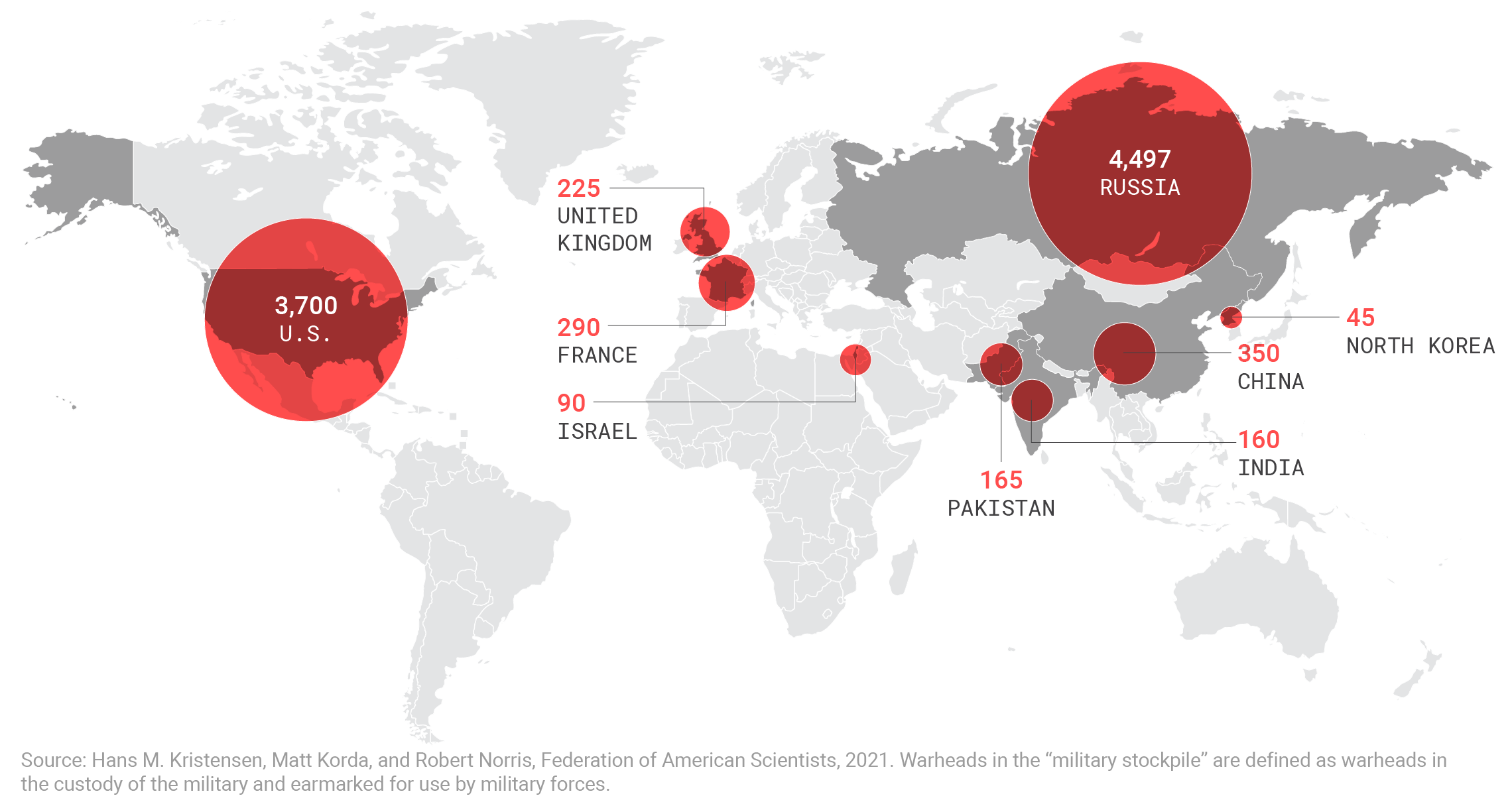
Number of nuclear weapons in each country’s military stockpile
The U.S. and Russia hold nearly nine of every 10 deployed
and stored nuclear warheads in the world. Avoiding a nuclear conflict
remains the highest U.S. national security priority with respect to
Russia.
Providing
hope to Ukraine that NATO will come to its defense, including by
continuing U.S. security aid, allows Kyiv to avoid making difficult
political accommodations necessary to end the war.28
A political settlement will likely necessitate that Ukraine accepts its
unique role as a neutral buffer state in Eastern Europe. The prospect
of being protected forever by the United States lets Ukrainian leaders
avoid pressing for a resolution to the conflict.
A settlement could result in Russia ending its support for separatist
groups in the Donbas region, allowing Ukraine to work toward national
reconciliation. Russia and European countries should take responsibility
for providing significant humanitarian and economic aid to help those
affected by the conflict. War-torn areas will need assistance rebuilding
vital infrastructure to allow displaced citizens to return home and
normal economic activity to resume. Since the civil strife has been
partly fueled by ethnic and cultural tensions, a neutral Ukraine should
also be encouraged to protect minority rights and increase local
autonomy for the Donbas region.
The Ukraine crisis has poisoned U.S.-Russia relations for the last
seven years, a dangerous status quo given the importance of avoiding
conflict between nuclear weapons states. Sympathy for Ukraine’s
unfortunate geopolitical circumstances is natural; however, current
policy undermines U.S. security and exacerbates the suffering of
Ukrainians. Working toward a realistic resolution in the form of a
neutral, non-aligned Ukraine could provide an avenue for the United
States and Russia to form a constructive and predictable relationship.
As the United States shifts its focus to the greater threat of China,
détente with Russia should guide U.S. policy.29
25 Tom Balforth, “Kremlin Says NATO Expansion in Ukraine Is a ‘Red Line’ for Putin.”
26 Mike Sweeney, “Saying ‘No’ to NATO-Options for Ukrainian Neutrality.”
27 While Russia opposes
Ukraine’s European Union aspirations, it is unlikely that their
interests would be threatened by trade that does not come with
institutional ties.
Elon Musk reinstates some high-profile Twitter accounts
3 minutes
"Twitter’s new owner reinstated on Friday several of the accounts “permanently suspended”
earlier this year, including Canadian psychologist Jordan Peterson,
liberal comedian Kathy Griffin, and satire site The Babylon Bee, whose
suspension triggered Elon Musk’s interest in the social media platform.
Former US president Donald Trump remains banned for now, and Musk
refused to reinstate InfoWars host Alex Jones.
“Kathie [sic] Griffin, Jorden [sic] Peterson & Babylon Bee have been reinstated,” Musk announced on Friday, adding that the “Trump decision has not yet been made.”
Musk also said that Twitter’s new policy will be “freedom of speech, but not freedom of reach,” explaining that “negative/hate” tweets will be demonetized and “deboosted.” He clarified that this will apply to individual posts, rather than the account of the person who made them, however.
. . . As part of what he dubbed “Freedom Fridays,” Musk has solicited advice from users on “What should Twitter do next?”
Among more than 150,000 replies was a request to reinstate Jones. The
InfoWars host was banned in September 2018, after getting deplatformed
for alleged “abusive behavior” by Apple, Facebook, Spotify and YouTube.
That appeared to be a step too far for Musk, however. His only response to the request was “No.”
Vittoria Elliot and Chris Stokel-Walker, wired.com
3 - 4 minutes
After Elon Musk’s staff cuts, there are hardly any moderators left to talk to.
by
- Nov 18, 2022 1:00 pm UTC
"Even before Twitter cut some 4,400 contract workers on November 12, the platform was showing signs of strain. After Elon Musk bought the company and laid off half of its 7,500 full time employees,
disinformation researchers and activists say, the team that took down
toxic and fake content vanished. Now, after years of developing
relationships within those teams, researchers say no one is responding
to their reports of disinformation on the site, even as data suggests
Twitter is becoming more toxic. . .The issue is particularly acute in Brazil, where a runoff presidential
election between right-wing incumbent Jair Bolsonaro and Luiz Inácio
Lula da Silva took place just days after Musk’s takeover. . .
Disinformation also flooded Twitter during the US midterms, particularly around the race in Maricopa County, Arizona, the state’s largest county and a consistent target
of right-wing election deniers. Bouzy, who was monitoring thousands of
right-wing accounts, says he had “no idea who to contact” at the company
to get tweets containing disinformation taken down. “Twitter is a shit
show,” he says. . .
Intro: Russia said the refusal by the EU nations to allow it to be involved in the investigation of the blasts raises the question of whether they want the truth about it to come out. . .The three countries - Germany, Sweden, and Denmark are conducting their own probe and rejected the idea of forming a joint team, citing 'national security grounds.' (there are 158 comments)
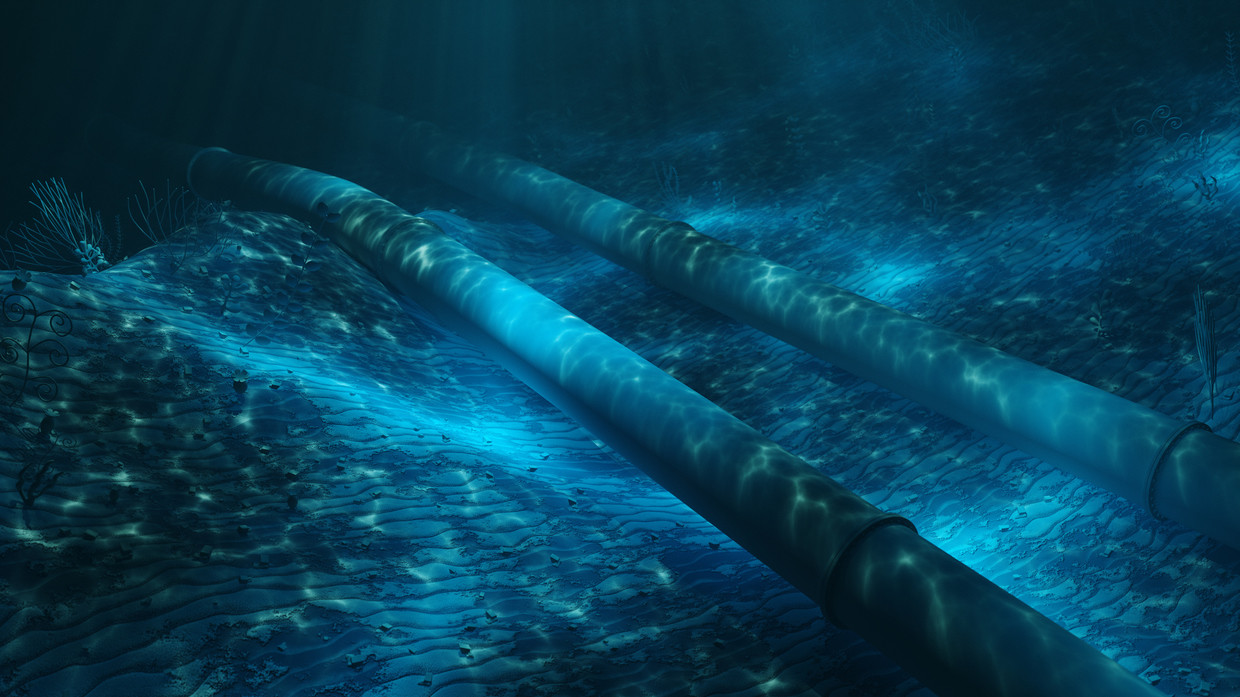
✓ Three of the four strings of Russia’s Nord Stream 1 and Nord Stream 2
gas pipelines, which run under the Baltic Sea from Russia to Germany,
were damaged in late September. Swedish seismologists said at the time
they registered two explosions on the gas routes.
Russia initiated a probe into the incident, condemning it as an “act of international terrorism.”
After their own investigations, Sweden and Denmark both found that the
leaks on the pipelines were caused by explosions, but have not said who
might be responsible. Russia's Defense Ministry said it suspects the
British Navy, an accusation that London has denied.
"Swedish investigators have found traces of explosives on fragments of “foreign objects”
recovered from the blast sites of the Nord Stream undersea pipelines,
the nation’s security service SAPO said on Friday. The new evidence
confirms that the energy links were targeted in an act of sabotage, it
said.
“The advanced analysis work is still in progress – the
aim is to draw more definitive conclusions about the Nord Stream
incidents,” the agency said. “The investigation is extensive
and complex and will eventually show whether anyone can be suspected of,
and later prosecuted for this.”
The explosions that
breached three of the four strings of the pipelines, and damaged the
fourth, took place in late September. The Nord Stream infrastructure
linked Russia directly to Germany but was not fully operational at the
time of the attack due to the rift between Russia and Western nations
over the crisis in Ukraine.
The incident happened as the German
public was becoming increasingly unsettled by rising energy prices, a
trend partially attributable to the EU’s decision to break off trade
with Moscow in retaliation for its military operation in Ukraine. The
Nord Stream incident made it physically impossible to resume direct
supplies under the Baltic Sea.
NOTE: “As of November 2, 2022, Nord Stream AG has completed the initial
data collection at the site of the damage to the first string of the
pipeline in Sweden's exclusive economic zone. According to the
preliminary results of the inspection of the damaged area, technogenic
craters of 3 to 5 meters in depth were found on the seabed at a distance
of about 248 meters from each other,” the company said in a statement.
Officials in Moscow saw the US as the biggest beneficiary of the
situation. Washington has long pressured Germany to reduce energy
cooperation with Russia and offered its more expensive liquefied natural
gas (LNG) as an alternative.
The Russian military claimed that
the UK may have been involved in the plot, a suggestion that its British
counterparts ridiculed.
Russia said the refusal by the EU
nations to allow it to be involved in the investigation of the blasts
raises the question of whether they want the truth about it to come out.
Germany, Sweden, and Denmark are each conducting its own probe. The two
Nordic nations have a jurisdiction claim because the pipelines run
through their exclusive economic zone. The three countries rejected the
idea of forming a joint team, citing national security grounds."
FCC unveils big update to broadband map—and wants you to help correct errors
by
Jon Brodkin
- Nov 18, 2022 6:54 pm UTC
3 - 4 minutes
Map is better but not perfect—look up your address to see if there are mistakes.
"The Federal Communications Commission took two significant steps
toward providing US broadband users with more accurate availability and
pricing information.
Today, the FCC released the long-awaited National Broadband Map update based on the most detailed data
the commission has ever collected from ISPs. There's still plenty of
work to do, as this first version will undergo a challenge process to
correct errors, and there are indications it will have many inaccuracies.
"The map will display specific location-level information about
broadband services available throughout the country—a significant step
forward from the census block level data previously collected," an FCC press release
said. "This release of the draft map kicks off the public challenge
processes that will play a critical role in improving the accuracy of
the map."
You can go to the newly updated map site here
to search for your home or other addresses and see a list of fixed and
mobile providers with the offered speeds. You can use that page to
submit challenges of both address or availability information. The FCC
also updated its speed test app with an option to use test results to challenge the accuracy of mobile coverage data.
Broadband “nutrition” labels
The other step taken by the FCC came yesterday when the commission adopted rules
requiring broadband providers to "display easy-to-understand labels to
allow consumers to comparison shop for broadband services." The
disclosures are modeled on nutrition labels and look like this:
The label requirements don't take effect yet. The FCC said it "will
announce the effective date of the label after it has completed
necessary next steps, including requirements under the Paperwork
Reduction Act."
These labels have been in the works for years. Under then-Chairman
Tom Wheeler, the FCC approved rules requiring the use of the labels in 2016. The labels and related rules requiring greater transparency were eliminated under former FCC Chairman Ajit Pai, but the Infrastructure Investment and Jobs Act approved by Congress in November 2021 required the FCC to issue new rules mandating the display of the consumer labels.
.gif)

.gif)
.gif)





.png)
.jpg)
.png)
.jpg)
.jpg)


.jpg)
.jpg)
.jpg)

.jpg)
.jpg)