Sign up for Meridian’s Free Newsletter, please CLICK HERE
On Dec. 23, we remember the birth of Joseph Smith, coming
right at a time when in our northern hemisphere the light begins to
return to the earth.
In August of 1894, while on one of his many trips, Junius Wells, a
Latter-day Saint leader, took a detour through Vermont looking for
something that mattered to him—the birthplace of Joseph Smith.

Junius Wells.
At the Sharon Town Clerk’s office, he met Harvey Black, a long-time
resident of the area, who led him across a field to an old cellar hole.
The site consisted of crumbling walls, a few foundation stones and
overgrown shrubbery. This was the physical and largely-forgotten remains
of the Smith home where the Prophet Joseph Smith was born.
As he rode away from the birthplace, Wells said to himself, “sometime we ought to mark this place with a monument of the faith of our people in Joseph Smith the Prophet.”
Then in March, 1905, Wells found himself again in New England. This
time he was contracting for a piece of Vermont granite for his father’s
headstone in Salt Lake City. The monument contractor was Riley C. Bowers
from Montpelier. In the course of this exchange, Wells mentioned the
idea of a monument to Joseph Smith in Sharon, to commemorate the
centennial anniversary of his birth in 1805. Bowers thought the idea was
certainly workable, so with this endorsement, Wells returned to Salt
Lake to share his idea with the First Presidency of the Church of Jesus
Christ of Latter-day Saints.
Consider this timing. The centennial was only a few months away, and
Wells would be erecting a 38-1/2 foot obelisk of granite weighing
thousands of pounds. He would not only be looking for the perfect stone,
but having to transport it, at least part of the way, on a wagon across
a muddy track. This was all but impossible. Wells would need a
miracle—in fact many miracles—to make this happen.
In a letter dated April 1, 1905, Wells made his pitch to President
Joseph F. Smith and his counselors. Although the letter has not
survived, Wells offered to supervise the project and took the liberty of
proposing a monument for the site recommending dimensions, inscription
and even included a sketch of the proposal.
The First Presidency was a little more guarded, and instructed Wells
that he first needed to verify the location of the Prophet’s birth and
then attempt to purchase the land. Only then would they consider the
proposal for building a monument. The clock was ticking.
On May 10, 1905, Wells left for Vermont, determined to erect a
monument in six months that would typically take ten to twelve months to
accomplish.
He was going to need some help.

The Easy Part
Wells settled into the South Royalton House. This would now become
his headquarters. The local newspapers soon picked up on his presence in
town. They reported that “he made no secret of his purpose which
was to settle indubitably the exact spot where Joseph Smith was born and
to acquire the premises and to erect a monument thereon.”
Wells recalled that with the help of Daniel E. Parkhurst, a
shoemaker, town clerk and Treasurer for Sharon, records were found
tracing the Solomon Mack property back to King George III and New
Hampshire Governor Benning Wentworth in 1761. Next, visiting William
Skinner, town clerk of Royalton, he found out that the Mack property lay
both in Sharon and in Royalton townships.
Wells identified that C.H. Robinson presently owned the land in both
townships. On May 19, 1905, Wells visited the site with Benjamin Cole
Latham who gave testimony to it being the birthplace site. Others like
Maria Griffith and Harvey Smith went on record with their own
testimonials. The help Wells had hoped for was pouring in….
Wells bargained with C.H. Robinson for the purchase of 68 acres as
well as a narrow strip of land connecting the birthplace site with Dairy
Hill Road. The transaction also included two springs, the Solomon Mack
foundation site, the White Brook and the “Old Sharon Road”.
Junius Wells then returned to Salt Lake City to attend to the
dedication of a headstone he was having erected for his father, built by
the R.C. Bowers granite company of Montpelier, Vermont. It was a
15-foot tall obelisk. His father, Daniel Wells, had died in 1891, and
Junius was just now finally having the stone put in place. This
headstone’s size and shape were all indicative of the life of his
father. This would be a “typecast” of what Junius would eventually do at
the Joseph Smith monument site.
During the first week of June 1905, Wells prepared for the First
Presidency, a report of his activities in Vermont and a detailed sketch
of the monument he envisioned. He suggested it would be a 38-1/2 foot
shaft of gray “Barre granite”. He also proposed the tribute that would
appear on the Inscription Die and the cap stone.
After some deliberation, the First Presidency approved the project
with only one minor inscription change. By July 1, 1905, the
announcement of the project was made public. On July 6th
Wells was given full power of attorney to “erect a granite monument in
memory of the Prophet Joseph Smith and Patriarch Hyrum Smith”. Wells now
had a carte blanche to carry out the project.
This was the easy part, now the fun would begin.
How Do You Find the Perfect Stone?
By July 13th, Wells was back in Vermont, a state built on a
granite bedrock. He went immediately to Barre, where over one-hundred
quarry firms were located. On the 24th of July, Wells awarded the general contract to his friend, the owner of the R.C. Bowers Granite Company of Montpelier.

Barre Quarry Workers
Wells moved his residence to Montpelier so he could personally
supervise the work. He had five months to complete the project and every
day was a day closer to the December 23rd dedication. Wells felt that his job was to “continually be pushing the project along”.
Bowers sub-contracted the quarrying to the Marr-Gordon Quarry in Barre. Wells reported; “The
first success came when a piece of granite suitable for the die and
capstone was found. Quarrymen soon found a piece sufficient for the
first and second base (the monument has two base stones, Inscription Die, cap stone and pillar).
But, after removing a large piece for the first base, they found that
one corner was cut off, rendering the piece insufficient for the second
base. This was very disappointing”. However, a suitable piece was soon discovered for the second base on the opposite side of the quarry.
With work slowly progressing at the quarry, Wells focused his attention to South Royalton.
Wells contracted with surveyors Walker and Gallison to start
preparations for the birthplace park, roads, walks and building lots. By
mid-August Wells had fifteen Italian laborers working at the site.
Wells also contracted with Joseph Perkins to build a Memorial Cottage
directly over the old cellar hole, and to incorporate the hearthstone in
its original position, into the cottage fireplace. Wells was very
conscious of the importance of the hearthstone. He said’ “if Joseph
had any association with the hearthstone it was as a child, perhaps it
was there that he was washed and dressed as a babe.”
But, all was not well in paradise. There were pressing issues north
in Barre. Workers at the Marr-Gordon Quarry had found four pieces of
stone, but the most difficult, the forty-foot shaft still remained to be
located. Time was running out. Wells was searching for a “perfect
shaft that would be typical of a perfect man. Joseph died at age 38 and a
half years, the visible portion of the shaft needs to be 38 and a half
feet tall.”
Wells was starting to get concerned and discouraged. Mr. Blakeney,
the foreman tried numerous stones and various locations throughout the
quarry to no avail. Wells said, “It was now a hopeless hope to me. I
had not the faith in me. I had not the impression. I had been going by
impressions all the way through. Somehow when I had the right impression
it has come out all-right. But I have had no impressions”. With no
impressions, no feelings and no revelation there would be no
assurances. Wells began to wonder if his dream would ever come to pass.
Wells needed a little miracle and one was on the way.
It seems that while Junius Wells was searching for his pillar stone,
the Marr-Gordon Quarry was being purchased. The buyer, Mr. James M.
Boutwell, of the Boutwell, Milne & Varnum Company owned an adjoining
quarry. Wells recalled that this “company took over his contract with great skill”.
Two days later in the adjoining quarry “a partly disclosed stone was found that showed great promise”. Mr. Farnsworth, the foreman said it would be a week before they could be sure if it was big enough, however, Wells said, “I believed at once we were on the right track”.
It was a happy day for Wells when Farnsworth announced that the shaft
was forty-six feet long, sufficient for the monument. The rough stone
weighed sixty ton and it took “the ingenuity of both Mr. Boutwell and Mr. Varnum combined to raise it out of the quarry”. A
temporary railroad spur was constructed to transport the stone to the
main line. It took two days to load the stone on the railroad car
because the derrick could only load one end at a time.

Moving the uncut stone from the quarry.
The rough stone was sent six miles by train to the Barclay Brothers
cutting and polishing shed. Upon arrival, powerful steam cranes and
chains lifted the shaft off the railroad car, inverted it, and lowered
it into the cutting blocks, where it was cut in just sixteen minutes.
Wells marveled at “the difference when knowing how and having the mechanical means and power and not having it”. The stones were cut with remarkable skill and clarity.
It was now the first part of October, the dedication date of December 23rd
was drawing near. Wells worried about the weather. The previous year
two feet of snow had already fallen by the first of November.
As October drew to a close the polishing phase was completed. Wells
was now faced with the prospect of transporting 100 tons of stone in a
world without trucks. The 40-ton pillar seemed especially daunting.
Wells recalled that no one before had moved polished stone this far and
the time was tight. Fortunately for Wells a railroad line ran from Barre
to Royalton. The issue was the six difficult miles from Royalton to the
monument site.
Wells awarded the transportation contract to Mr. M.F. Howland of
Barre. Mr. Howland recommended that a special wagon he had built for the
removal of the stones at St. John’s Cathedral in New York be used to
move the stones from Royalton to the monument site. The wagon had 20inch
wide tires, axles eight feet long and eight inches in diameter and
weighed eight tons.
With anticipation everyone waited at Royalton Village for the arrival
of the stones. The base pieces would be the first to arrive. What
Wells was about to learn, was his greatest challenges lay ahead. If it
had taken enormous faith to hope that a 40-foot granite stone would
appear in the short time frame he had, his faith would be taxed even
further when it came to moving this behemoth.
The Greatest Challenge
Unloading in Royalton meant the bridge over the First Branch of the
White River in South Royalton would need to be firmed up. This task
required “much scavenging all over the state for the right timbers.”
The first load to leave Royalton contained the two base pieces of the
monument. Mr. Ellis of Bethel quarries sent twenty horses to pull the
load. Two other horses were picked up in Royalton. Once the horses had
moved the load to the main road they stopped. Twenty-two horses could
not move the 31 ton Base pieces up the simple rises on the White River
Road.
A discouraged Mr. Wells returned to the South Royalton Inn and
drafted a telegram to President Joseph F. Smith. He asked to ship the
stones, to Salt Lake City to have them erected on the Temple Block. He
kept the telegram in his pocket, but did not send it.
It was decided that block and tackle would be used, horses pulling in
the opposite direction of each other using the largest trees as the
hinged point. The winding White River Road was slow going, even with
twenty-inch wheels the wagon would sink into the mud. The crew resorted
to placing 10”x3” hardwood planks under the wheels. After one week the
wagon had traveled two miles to the town of South Royalton.

Slowly the wagon and crew arrived at the base of Dairy Hill Road. Two
miles left, unfortunately they had an 800 foot climb in front of them.
The crew inched up the narrow, winding, muddy unpaved country road,
using block and tackle and trees to serve as the support points.
The road behind was “strewn with trees, some large ones, that
were pulled up by the roots, it looked as though a hurricane came down
Dairy Hill Road”. A week later the bases arrived at the monument site.
The bases had landed in late October, but the original plan was to have had the entire monument completed by this time.

The next stone up was the 19 ton, six foot inscription die. They
traveled without incident until arriving at the recently reinforced
covered bridge over the Tunbridge Branch. The combined height of the
wagon and die was 12’2”, but the opening in the covered bridge was
11’4”. H.C. Leonard of Barre brought down a special low-to-the-ground
wagon. The low wagon would enable the die stone to pass under the
covered bridge and sit lower to ground so it would not become unstable
as they traveled up Dairy Hill road. This was a minor miracle that such a
wagon even existed and was nearby. The large wagon then returned to
Royalton to prepare to move the 40 ton shaft.
At this point Wells had four teams of local men working on the
project. One team was preparing to move the shaft, one was transporting
the die, one was preparing the monument and one was building the first
visitors center or “Cottage” over the birthplace site. The crews were being paid well, two dollars a day with dinner furnished.
On November 7, now only a few weeks out from the centennial day when
all had to be completed, Wells began to haul the shaft. It was forty
feet long and weighed 80,000 pounds (40 ton). It would take thirty-three
days to move the shaft to the monument location. They traveled only the
length of a football field a day. Wells recalls the day they arrived at
the foot of Haynes Hill. It rained all that day. In front of them lay
Mr. Buttons bog or mud-hole. A neighbor was seen hurrying his empty hay
wagon through the bog, “The wheels sunk deeper and deeper into the miserable little swamp”. With
great difficulty four horses were required to remove the hay wagon.
Wells dismissed the crew. Was it finally time to send the telegram he
had been carrying? When alone, he knelt in prayer asking for a miracle.
He returned to his hotel.
Late that night, a miracle happened. From out of Quebec a strong
Canadian Clipper formed, a very cold nor-eastern wind blowing south.
As it picked up speed through the notched valleys of Vermont, it
began to snow. The temperature dropped 35 degrees in three hours.
The crew reassembled, Mr. Buttons bog seemed to be frozen. The crew
decided because of the weight of the stone and the uncertainty of the
frozen ground they would lay the hard wood planks under the wheels, 9
inches thick under each wheel. As the horses heaved the weight of the
load split the planks into kindling. The ground was frozen as hard as
steel. The crew moved the shaft over the frozen mud hole and up the hill
so quickly that it arrived a day before the inscription die. Wells
asked one of the men riding with him if he believed in miracles, the man
replied, “I almost believe it”.
The 10-ton molded cap was the last stone to arrive. It was the
lightest of the stones but required a drawn of 14 horses. This was due
to the small 6-inch wide wheels. If they stopped at all they would
probably not get started again. The stone made the trek in just 6 hours.
It was now November 26, all stones were at the site. It was time to
stand the stones. A large derrick had been sent for from Pennsylvania.
It arrived the day before. To place the 40-foot shaft, it would have to
be lifted 13 feet into the air, turned perpendicular and set into place.
This process would take place December 8.

When the signal was given, the assembled crowd started cheering. They
were suddenly stopped as they heard wells shouting Stop! Stop! Wells
then dropped to his knees at the foot of the monument and offered a
prayer of thanks.
He then jumped to his feet and yelled, “All right boys now I am with you, let her go.”
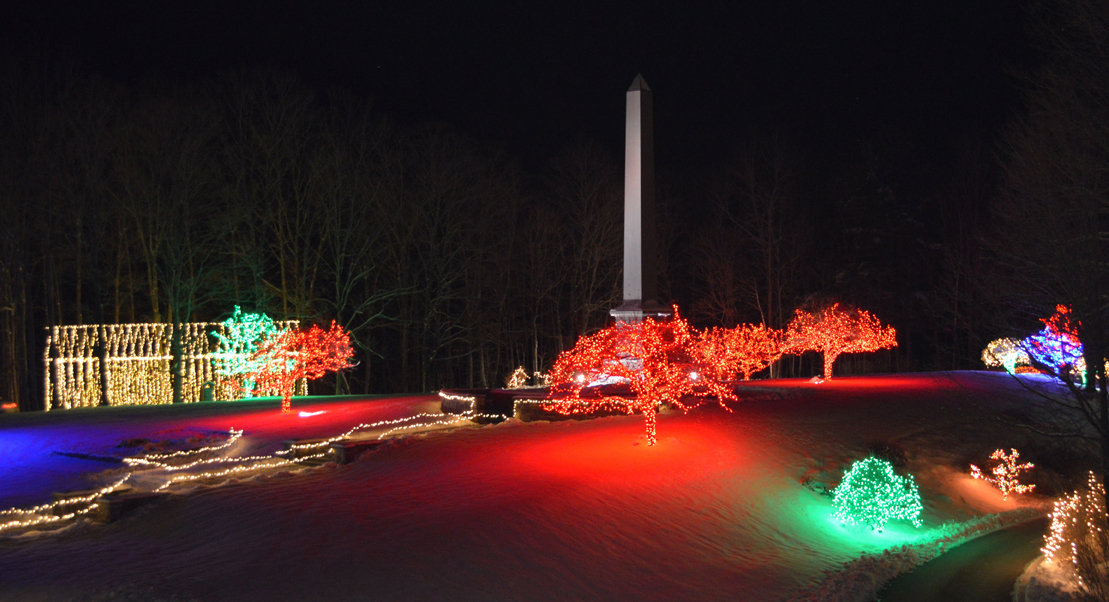
After 137 days of anxious work and miracle after miracle, the Joseph
Smith Birthplace Monument was completed, and one man’s quest for the
perfect stone was over.
.jpg)
.jpg) I'm
I'm
.jpg)


.jpg)

.jpg)