". . .Alexa has been around for 10 years and has been a trailblazing voice
assistant that was copied quite a bit by Google and Apple. Alexa never
managed to create an ongoing revenue stream, though, so Alexa doesn't
really make any money. The Alexa division is part of the "Worldwide
Digital" group along with Amazon Prime video, and Business Insider says
that division lost $3 billion in just the first quarter of 2022, with
"the vast majority" of the losses blamed on Alexa.
That is apparently
double the losses of any other division, and the report says the
hardware team is on pace to lose $10 billion this year. It sounds like
Amazon is tired of burning through all that cash. . .By 2018, the division was already a money pit. That year, The New York Times reported
that it lost roughly $5 billion. This year, an employee familiar with
the hardware team said, the company is on pace to lose about $10 billion
on Alexa and other devices.
Amazon Alexa is a “colossal failure,” on pace to lose $10 billion this year
by
Ron Amadeo
- Nov 21, 2022 7:32 pm UTC
6 - 7 minutes
Layoffs reportedly hit the Alexa team hard as the company's biggest money loser.
The fourth-generation Echo device is a
cloth-covered sphere with a halo at the base, contrasting with the squat
plastic cylinders of earlier-generation Echoes.
Amazon
Amazon is going through the biggest layoffs in the company's history right now, with a plan to eliminate some 10,000 jobs.
One of the areas hit hardest is the Amazon Alexa voice assistant unit,
which is apparently falling out of favor at the e-commerce giant. That's
according to a report from Business Insider, which details "the swift downfall of the voice assistant and Amazon's larger hardware division."
. . .
A division in crisis
The BI report spoke with "a dozen current and former employees on the
company's hardware team," who described "a division in crisis." Just
about every plan to monetize Alexa has failed, with one former employee
calling Alexa "a colossal failure of imagination," and "a wasted
opportunity." This month's layoffs are the end result of years of trying
to turn things around. Alexa was given a huge runway at the company,
back when it was reportedly the "pet project" of former CEO Jeff Bezos.
An all-hands crisis meeting took place in 2019 to try to turn the
monetization problem around, but that was fruitless. By late 2019, Alexa
saw a hiring freeze, and Bezos started to lose interest in the project
around 2020. Of course, Amazon now has an entirely new CEO, Andy Jassy,
who apparently isn't as interested in protecting Alexa.
The report says that while Alexa's Echo line is among the
"best-selling items on Amazon, most of the devices sold at cost." One
internal document described the business model by saying, "We want to
make money when people use our devices, not when they buy our devices."
That plan never really materialized, though. It's not like Alexa
plays ad breaks after you use it, so the hope was that people would buy
things on Amazon via their voice. Not many people want to trust an AI
with spending their money or buying an item without seeing a picture or
reading reviews. The report says that by year four of the Alexa
experiment, "Alexa was getting a billion interactions a week, but most
of those conversations were trivial commands to play music or ask about
the weather." Those questions aren't monetizable.
Amazon also tried to partner with companies for Alexa skills, so a
voice command could buy a Domino's pizza or call an Uber, and Amazon
could get a kickback. The report says: "By 2020, the team stopped
posting sales targets because of the lack of use." The team also tried
to paint Alexa as a halo product with users who are more likely to spend
at Amazon, even if they aren't shopping by voice, but studies of that
theory found that the "financial contribution" of those users "often
fell short of expectations."
In a public note
to employees, Jassy said the company still has "conviction in pursuing"
Alexa, but that's after making huge cuts to the Alexa team.. .
Business Insider's
tracking now puts Alexa in third place in the US voice-assistant wars,
with the Google Assistant at 81.5 million users, Apple's Siri at 77.6
million, and Alexa at 71.6 million.
Are all voice assistants doomed?
We have to wonder: Is time running out for Big Tech voice assistants?
Everyone seems to be struggling with them. Google expressed basically identical problems
with the Google Assistant business model last month. There's an
inability to monetize the simple voice commands most consumers actually
want to make, and all of Google's attempts to monetize assistants with display ads
and company partnerships haven't worked. With the product sucking up
server time and being a big money loser, Google responded just like
Amazon by cutting resources to the division.
While Google and Amazon hurt each other with an at-cost pricing war,
Apple's smart speaker plans focused more on the bottom line. The
original HomePod's $350 price was a lot more expensive than the
competition, but that was probably a more sustainable business model.
Apple's model didn't land with consumers,
though, and the OG HomePod was killed in 2021. There's still a $99
"mini" version floating around, and Apple isn't giving up on the idea of
a big speaker, with a comeback supposedly in the works. Siri can at least be a loss leader for iPhone sales, but Apple is also hunting around for more continual revenue from ads."
Ron Amadeo /
Ron is the Reviews Editor at Ars Technica, where he specializes in
Android OS and Google products. He is always on the hunt for a new
gadget and loves to rip things apart to see how they work.
Amazon is gutting its voice assistant, Alexa. Employees describe a division in crisis and huge losses on 'a wasted opportunity.'
Eugene Kim
13 - 16 minutes
Alexa is on life support.
When the voice assistant first launched in November 2014, publications called it the "computer of the future." CNET described it as something out of the sci-fi series "Star Trek." Computerworld heralded the product as the "future of every home."
Nearly 10 years since, the voice assistant hasn't lived up to Amazon's expectations.
During
the first quarter of this year, Amazon's "Worldwide Digital" unit,
which includes everything from the Echo smart speakers and Alexa voice
technology to the Prime Video streaming service, had an operating loss
of over $3 billion, according to internal data obtained by Insider.
The
vast majority of Worldwide Digital's losses were tied to Amazon's Alexa
and other devices, a person familiar with the division told Insider.
The loss was by far the largest among all of Amazon's business units and
slightly double the losses from its still nascent physical stores and
grocery business.
While Amazon's business model has traditionally
tolerated this kind of poor financial performance from its hardware
businesses, that's no longer true. . . READ MORE
Internal reports and layoffs suggest Amazon doesn’t believe in its hardware plans anymore
Amazon was forced to lay off the biggest portion of its workforce in
its history this year. One of the divisions to be hit the hardest was
the devices and Alexa team, building some of the best Echo displays around.
It’s becoming increasingly clear why, as it looks like the “Worldwide
Digital” division at Amazon is suffering from huge losses, which
includes Echo devices and Prime Video, with the future of the Alexa
division uncertain.
As reported by internal sources talking to Business Insider,
the operating loss of the division lies at about $3 billion in the
first quarter of 2022. It’s the most any division within the company is
losing. With this data in mind, it looks like Amazon’s usual playbook of
subsidizing hardware sales by selling services and other products
through them doesn’t play out as well as it was always thought it would.
Sources within the division also told Business Insider that "Alexa is
a colossal failure of imagination” and that “it was a wasted
opportunity." . . READ MORE
One chapter of my Walled Culture book (free download available in various formats) looks at how the bad ideas embodied in the EU’s appalling Copyright Directive –
the worst copyright law so far – are being taken up elsewhere. One I
didn’t include, because its story is still unfolding, is Canada’s Bill C-18:
“An Act respecting online communications platforms that make news
content available to persons in Canada”. Here’s the key idea, which will
be familiar enough to readers of this blog: READ MORE
There are a variety of myths about how the world works that get
people really screwed up when they make big bets on trying to “fix”
things. I think Elon Musk has fallen prey to a few of them in how he’s
trying to run Twitter. First, he falsely believes (as was the widespread
myth among many, especially in right wing circles) that Twitter’s
content moderation/trust & safety efforts were driven mainly by
extreme “woke” employees who were seeking to silence opinions and
viewpoints they disagreed with. As we’ve discussed repeatedly, that’s never been the case.
Twitter had a far more free speech-supporting position than any other
site, and the trust & safety decisions were made based on what they
believed was actually best for the site, which means trying to minimize
hate and harassment as that drives both users and advertisers away.
A second big myth that Musk seems to have bought into is the idea
that this is all a technical, rather than human, problem. And that he
can just “hardcore” nerd harder his way through these challenges. But,
that’s not true either. Yes, Twitter actually had some pretty
sophisticated technology, which was mainly around scaling a massive
many-to-many messaging system. But the real “product” innovation at
Twitter was the human element, and the community that built up around it. . . READ MORE
Florida governor Ron DeSantis appears to believe he’s the successor
to Donald Trump’s short-lived throne. While Trump was president,
DeSantis did everything he could to appeal the same voter base. Trump rather listlessly announced he’ll run again in 2024, but it’s a fair bet DeSantis will try to become Trump 2.0 if it appears the Republican base isn’t ready to ride Trump’s presidential Vomit Comet for another four years.
DeSantis has pushed through laws that violate the First Amendment in hopes of bypassing Section 230 immunity, targeting social media companies
over perceived “anti-conservative” bias. He’s also decided the First
Amendment shouldn’t apply to certain people and companies if they choose
to espouse views that don’t align with his. That’s the gist of the Stop
W.O.K.E. Act (since rechristened the “Individual Freedom Act” in an
attempt to divorce itself from the rights-crushing it’s intended to
inflict), which forbids speech if the speech is anything other than an echoing of the DeSantis party line.
This law has already been blocked twice by a federal court. . . READ MORE
We’ve noted for decades how, despite all the political lip service paid toward “bridging the digital divide,” the U.S. doesn’t actually have any idea where broadband is or isn’t available.
The FCC’s past broadband maps, which cost $350 million to develop, have
long been accused of all but hallucinating competitors, making up
available speeds, and excluding a key metric of competitiveness: price.
You only need to spend a few minutes plugging your address into the FCC’s old map
to notice how the agency comically overstates broadband competition and
available speeds. After being mandated by Congress in 2020 by the
Broadband DATA Act, the FCC struck a new, $44 million contract with a
company named Costquest to develop a new map, just unveiled for the first time.
According to the FCC,
this new map is the first step in a long process to accurately identify
where broadband is (or isn’t), kind of important for people making
broad policy decisions:
“Our pre-production draft maps are a first step in a long-term
effort to continuously improve our data as consumers, providers and
others share information with us,” FCC chairwoman Jessica Rosenworcel
said in a statement. “By painting a more accurate picture of where
broadband is and is not, local, state, and federal partners can better
work together to ensure no one is left on the wrong side of the digital
divide.”
A first glimpse at the map shows many of the same problems we saw
with the last map. It still doesn’t bother to mention price, a key
metric in determining broadband accessibility.
And it still claims service availability in a lot of locations that
don’t have service. For example, I live a few miles from the center of
Seattle under a Comcast monopoly, and the map still claims I can get
Lumen (Centurylink) fiber:
Still, there’s several useful improvements this time around. For one,
the FCC promises it will do a better job of holding ISPs accountable
for false coverage claims. Two, the agency says it will stop using
flawed methodology that declared an entire census block “served” with
broadband if ISPs claimed that just one home in that census block could receive broadband.
That it took thirty years to get here tells you just how influential
broadband industry lobbying has been. Telecom monopolies have spent decades lobbying against better maps
and a more modern definition of broadband (currently 25 Mbps down, 3
Mbps up), knowing full well that a more accurate picture of
competitiveness might give somebody in the federal government the crazy
idea to try and fix it.
I’ve spent most of 2022 talking to states and city leaders trying to deliver better broadband, and most of them are very concerned about the challenge process the FCC is implementing to let third parties challenge industry claims. . . READ MORE
Of particular concern is that many under-resourced, under-staffed, under-funded small ISPs, states, and municipalities won’t be able to afford to challenge industry claims,
causing them to lose out on a once in a lifetime broadband funding
opportunity made possible via the $50 billion in broadband subsidies
created by COVID relief and infrastructure legislation:
On National Security | It’s no secret: Keeping space allies in the dark hurts the U.S. - SpaceNews
Sandra Erwin
5 - 6 minutes
Kirsten
Bingley, orbital analyst for the Joint Task Force-Space Defense
Commercial Operations cell (JCO), participates July 28 in a Dragon Army
Ops day in Colorado Springs, Colorado. Credit: U.S. Space Force Photo by
Lekendrick Stallworth
Secrecy is innate to military space, and it’s been that way
since the start. But officials are increasingly expressing frustration
with a classification system that at times appears to be doing more harm
than good.
The culture of secrecy emerged in the opening decades of the space
age when only two superpowers owned the domain. Space has since gone
global, with 90 countries belonging to the once highly exclusive club,
including many U.S. allies.
Today’s U.S. military space leaders frequently trumpet the importance
of international partnerships. They point out that the security
challenges in outer space are global and the United States can’t do it
all. The Space Force, for example, talks about creating hybrid networks —
and has advocated for joint programs with other nations.
But the rhetoric rings hollow if information cannot be shared, said
Maj. Gen. Doug Schiess, who runs U.S. Space Command’s Combined Force
Space Component Command.
Schiess’ organization, responsible for monitoring and analyzing
objects and activities in orbit, brings in officers from allied
countries to work side-by-side with U.S. space operators. He said it is
becoming more difficult to share information, even with close partners,
because documents routinely are labeled NOFORN, meaning they cannot be
shared with foreign nationals.
“All too often we slap a ‘NOFORN’ control on a sensitive document,” Schiess said at a recent industry conference.
“There are times, of course, when the NOFORN label is required, but
lately it’s become too universal,” he said. “If we’re going to be truly
integrated by design, we need to ensure our allies and our partners have
access to the information they need to accomplish the mission,” he
added. “I can assure you our senior leaders are paying attention to
this.”
Facilitating work with allies also is a priority of Air Force
Secretary Frank Kendall who recently sent new guidance to Department of
the Air Force employees on the use of the NOFORN label. He is asking
managers to be more selective in what gets billed as “no foreign” and
make sure it doesn’t unnecessarily undermine efforts to work more
closely with allies.
Kendall’s guidance is reflected in a recent memo that assistant
secretary of the Air Force for space acquisitions Frank Calvelli sent to
procurement agencies. One of the directives in the memo is to “avoid
SAPs and over-classifying.”
SAP, or Special Access Programs, is a specific category that imposes
much tighter access restrictions than normally required for information
at the same classification level.
Putting programs in the SAP category “hinders our ability to
integrate space capabilities across other domains … and can hinder
getting ideas from a broader pool of industry, and future sharing with
allies,” Calvelli wrote. “Protect capabilities, if necessary, through
normal security classification guidelines such as SECRET and TOP SECRET
but avoid creating stovepipes with SAPs.”
Space Force officials also have suggested that talking more openly
about U.S. military capabilities would make enemies think twice before
attacking the United States. “If you have everything classified, that
really erodes your ability to deter conflict. You have to be able to
talk about your capabilities,” Gen. John “Jay” Raymond, the first chief
of the Space Force, said last year.
This mindset appears to have influenced Kendall’s decision to reveal
the Air Force’s B-21 stealth bomber at a Dec. 2 event at Northrop
Grumman’s facilities in Palmdale, California. The Air Force to date has
only shown renderings.
Charles Beames, a space industry executive who once worked on
classified space programs at the Pentagon, has been a longtime critic of
overclassification.
“People are rewarded for saying declassification is a good thing, but they’re not rewarded for actually doing it,” said Beames.
The defense secretary, the director of national intelligence and
others in the executive branch of the U.S. government have the authority
to declassify. “It isn’t hard to do at all. It can be done in a memo,”
Beames said. “But there’s no reward for them to do it. It takes a lot of
courage and people can risk their careers.”
Of course, there are always things that should be kept secret, but
the space business takes it to the extreme compared to other sectors of
the military, he said. “It’s a weird cultural thing.”
Sandra Erwin covers military space for SpaceNews. She is a
veteran national security journalist and former editor of National
Defense magazine.
“On National Security” appears in every issue of SpaceNews magazine. This column ran in the November 2022 issue.
The Space Force is
researching industry interest in the follow-on to the $94 million Launch
Manifest Systems Integration contract that Parsons Corp. won in 2019
SpaceX to launch last new cargo Dragon spacecraft - SpaceNews
Jeff Foust
4 - 5 minutes
A
SpaceX cargo Dragon mission being prepared for launch on the CRS-25
mission earlier in the year. The upcoming CRS-26 launch will be the
first flight of the third and final cargo Dragon spacecraft the company
expects to build. Credit: SpaceX
WASHINGTON — A SpaceX Dragon launching soon to the International
Space Station is the last cargo version of the spacecraft the company
expects to build, with one more crewed spacecraft under construction.
At an Nov. 18 briefing about the upcoming SpaceX CRS-26 cargo mission
to the station, NASA and SpaceX announced the launch, previously
scheduled for Nov. 21 from the Kennedy Space Center, had slipped a day
to Nov. 22 at 3:54 p.m. Eastern. A launch that day would allow the
Dragon to dock with the station Nov. 23 at 5:57 a.m. Eastern. . . READ MORE
Azure Orbital Space unveils software tools for space applications - SpaceNews
Debra Werner
3 minutes
Xplore
is the latest addition to the Azure Orbital Ecosystem. The a
Seattle-area startup is preparing to launch an Earth-observation
satellite to gather hyperspectral data and high-resolution video
imagery. Credit: Xplore
SAN FRANCISCO – Microsoft announced the private preview Nov. 17
of a new product, the Azure Orbital Space Software Development Kit
(SDK).
With the spacecraft-agnostic SDK, Azure Orbital intends to make it
easy for developers to create space-related applications in the cloud
and deploy them on spacecraft operated by Azure Orbital partners,
Stephen Kitay, Azure Space senior director, told SpaceNews.
“Microsoft has a vision to lower the barrier of entry for space
developers and to reduce the need for custom solutions,” Kitay said.
Space applications development is a highly specialized field. A lack
of standards makes it time-consuming and difficult to write applications
and reuse code across satellites and missions, Kitay said.
On-orbit computers are become increasingly capable. Still, demands
for rapid data processing are surging as Earth observation,
communications and space domain awareness missions turn to artificial
intelligence and machine learning to speed up operations and increase
spacecraft autonomy.
Instead of launching its own satellites, Azure Orbital created an
intelligent hosting platform, software, that runs on spacecraft operated
by its partners Ball Aerospace, Loft Orbital, Thales Alenia Space and
Xplore.
The hosting platform is designed to help applications communicate
with spacecraft hardware in a secure way, meaning developers can test
code in space. . . READ MORE
The futility of U.S. military aid and NATO aspirations for Ukraine — Defense Priorities
23 - 29 minutes
Key points
Since the 2014
Russian annexation of Crimea, the U.S. has provided $2.5 billion in
military aid to Ukraine. Continued security assistance prolongs the
conflict and heightens U.S.-Russia tensions.
Russia
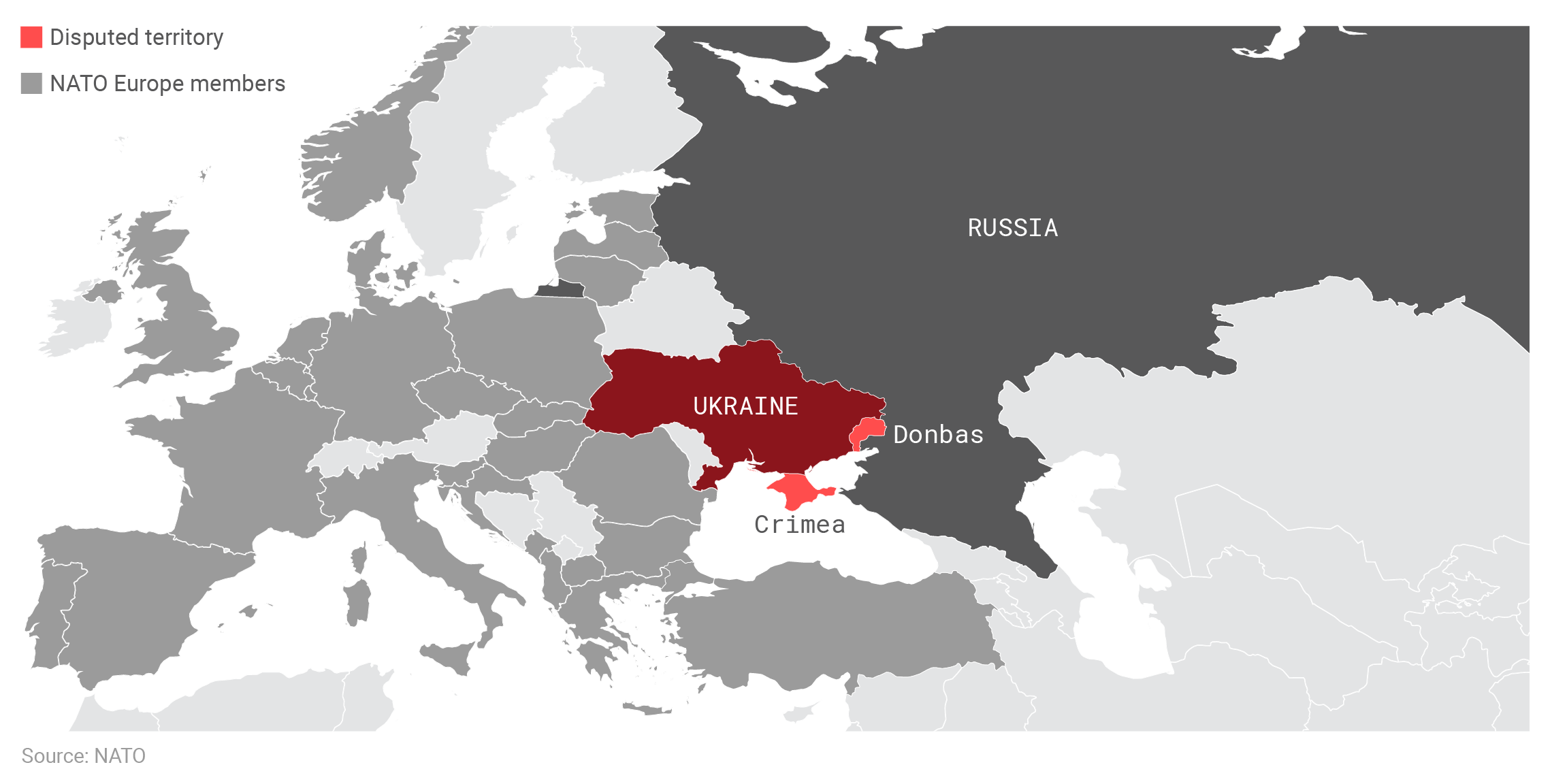
shares a 1,200-mile border with Ukraine and views the prospect of Kyiv
joining NATO and basing U.S. and allied forces there as a threat. Russia
will absorb significant costs—monetary and human—to prevent this
outcome.
A resolution in Ukraine that does not account
for Russia’s concerns is unrealistic; therefore, U.S. and European
leaders should account for them, starting with ruling out Ukrainian
accession to NATO.
Because of the risk of escalation,
potentially to nuclear war, the U.S. should seek détente with Russia and
support the establishment of a neutral, non-aligned Ukraine that serves
as a buffer state between Russia and the West.
Repeating the same mistakes in Ukraine
President Biden met with Ukrainian President Volodymyr Zelensky at
the White House in September 2021 and reiterated the U.S. commitment to
Ukraine’s territorial sovereignty. The meeting suggests the Biden
administration intends to continue the failed policy of his two
predecessors: providing piecemeal security assistance to Ukraine and
supporting its eventual accession to NATO.
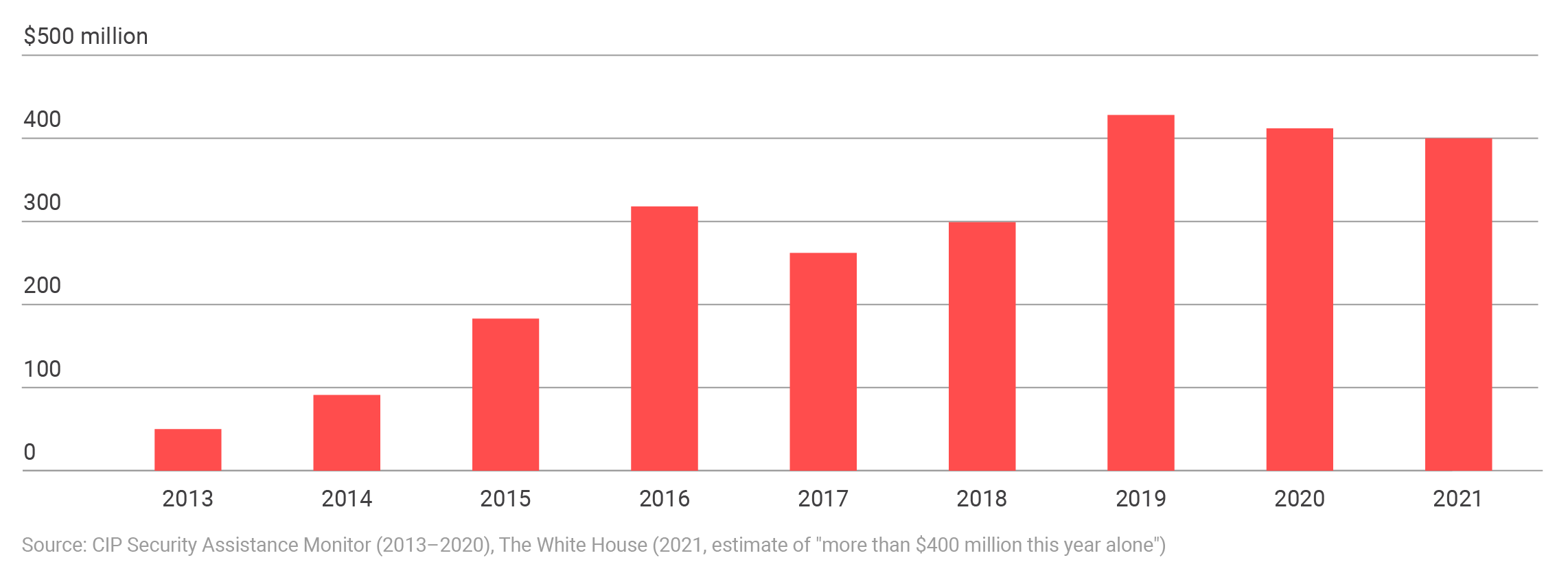
Annual U.S. military aid to Ukraine
The U.S. has provided $2.5 billion in military support to Ukraine since 2014, including more than $400 million in 2021 alone.
U.S. military aid to Ukraine
Ahead
of the meeting, President Biden presented a $60 million military aid
package to Ukraine, which included Javelin anti-tank missiles, small
arms, and ammunition.1 Since
hostilities broke out between Ukraine and Russia in 2014, the United
States has provided $2.5 billion in security aid to Kyiv, with more than
$400 million in the last year alone.2
U.S. security assistance has come in the form of training, equipment,
and weaponry, including tactical unmanned aerial vehicles, night vision
devices, sniper rifles, small arms, Javelin anti-tank missiles,
high-mobility multipurpose wheeled vehicles, and Mark VI patrol boats.
The United States has also provided secure communications, satellite
imagery and analysis support, counter-battery radars, and equipment to
support military medical treatment and combat evacuation procedures.3
While these weapon systems and equipment increased the warfighting
capabilities of Ukraine’s security forces, they failed to meaningfully
alter the balance of power between Ukraine and the Russian-backed
separatists or bring an end to hostilities. They also failed to stop
Russian interference in Ukraine, ranging from direct military aid to
influence operations and cyber-attacks.
Despite these continued military transfers from the United States,
the conflict continues into its seventh year because the underlying
causes of the war have not been sufficiently addressed—particularly
Russia’s concern Ukraine will become a western bulwark by allowing U.S.
and NATO forces to station there.
Holding out prospects for Ukrainian membership in NATO
The
Biden administration continues to rhetorically support Ukraine’s
aspirations to join NATO. A joint statement released after the White
House meeting in September declared “the United States supports
Ukraine’s right to decide its own future foreign policy course free from
outside interference, including with respect to Ukraine’s aspirations
to join NATO.”4 Secretary of Defense Lloyd Austin reinforced this message during a visit to Kyiv in October.5
Yet even as the administration voiced its support, it has, wisely, not
formally extended membership. President Zelensky previously discussed
his annoyance at the reluctance of western leaders to admit Ukraine into
NATO, and the lack of a firm commitment by Biden likely exacerbates
Zelensky’s frustrations.6
The reasons for the administration’s apparent hesitancy to extend
outright NATO membership likely reflect an understanding of the dangers
of admitting Ukraine into the alliance. Rather than decrease the
possibility of war, offering Ukraine NATO membership risks provoking a
Russian military response which has the potential to instigate a larger
war between the United States and a nuclear-armed Russia. Not only would
such a scenario be devastating for Ukrainians, but it also could
escalate to the nuclear level; therefore, avoiding this outcome should
be a top policy priority. Even short of war, protracted hostility
between the United States and Russia over Ukraine could spill over into
other areas, costing the United States time and resources better devoted
to higher priorities. Nevertheless, the United States and NATO continue
to play to the edge of offering full membership, recognizing Ukraine as
an Enhanced Opportunities Partner in 2020 and conducting joint military
exercises as recently as September 2021 to increase Ukraine’s
interoperability with NATO forces.7
Continued U.S. security assistance to Ukraine and dangling false
hopes of NATO membership prolong the conflict in Ukraine and increase
the risk of counterproductive war between the United States and Russia.
The Biden administration’s current policy draws out the suffering of
Ukrainians and prevents the possibility of establishing stable and
constructive relations between the world’s two greatest nuclear powers.
An overview of the conflict
Hostilities in Ukraine began in November 2013 when, under heavy
pressure from Moscow, Ukrainian President Viktor Yanukovych rejected an
association agreement that would have led to greater economic
integration with the European Union.8
This decision sparked large protests in Kyiv against Yanukovych, which
escalated tensions throughout Ukraine between citizens who preferred
closer ties with Europe and those who preferred closer ties with Russia.
✓ As protests intensified and became more violent, Yanukovych fled to
Russia in February 2014. The following month, Russian forces seized, and
ultimately annexed, the Crimean Peninsula.9
Pro-Russian separatists, with Russian backing, fought Ukrainian
security forces in the eastern Ukrainian regions of Donetsk and Luhansk.
These two regions declared themselves independent from Ukraine
following disputed local referendums in May 2014.10
As a result of a long-intertwined history, eastern Ukraine has strong
cultural, economic, and political ties with Russia. These factors
intensified the conflict, igniting a civil war between pro-Russian
separatists and pro-Ukrainian security forces. A national census
conducted in 2001 found that while 77 percent of Ukrainian citizens
identify as ethnic Ukrainians, a sizable minority (17 percent) identify
as ethnic Russians.11 The
majority of those claiming Russian ethnicity reside in eastern and
southern Ukraine. Indeed, ethnic Russians make up the majority of
Crimea.12 The Russian language
is used extensively throughout the eastern and southern regions of the
country, and 29 percent of Ukrainians consider Russian to be their first
language.13 Survey data
illuminates this geographical divide further: Ukrainians living in
central and western Ukraine prefer closer relations with Europe while
those residing in the south and east prefer closer relations with
Russia.14
Diplomatic efforts so far have failed to end the violence. In
September 2014, Ukrainian, Russian, and separatist leadership signed the
Minsk Protocol, seeking to achieve a ceasefire and create the
conditions necessary to resolve the conflict. The implementation of the
agreement quickly broke down with both sides accusing the other of
ceasefire violations.
In February 2015, a renewed effort in the form of Minsk II between
the leaders of Ukraine, Russia, Germany, and France was agreed upon.
Minsk II called for several conflict management measures, including a
ceasefire and the pullback of heavy weaponry from the front line;
amnesty for fighters; an exchange of hostages; humanitarian assistance;
Ukraine resuming socio-economic ties with the Donbas region; the
disarmament of all illegal groups; and the withdrawal of all foreign
armed formations, mercenaries, and military equipment from the country.
The agreement also attempted to address key political issues and called
for Ukrainian authorities to reestablish full control over the
Ukraine-Russia border, a dialogue on local elections in the Donbas
region in accordance with Ukrainian law, and constitutional reform that
would provide greater autonomy for the Donbas region.15
Like its predecessor, Minsk II failed to end the conflict—ceasefire
violations and sporadic heavy fighting have continued since 2015.16
Geography is destiny for Ukraine
Ukraine must live within the politics of its geography.
Kyiv’s ability to manage its foreign affairs is largely dictated by the
country’s location.
The
conflict remains frozen with neither side claiming new territory for
several years. The 260-mile-long contact line runs across the Donbas
region, effectively splitting the country into east and west. Both sides
implement restrictions on civilian movement, and the overall security
situation remains volatile. While the intensity of the fighting has died
down from the initial stages of the conflict, the possibility of
further escalation remains high with 250 ceasefire violations (mostly
small arms fire and shelling) per day observed in September 2021.17
So far, the war has killed more than 14,000 people and wounded more
than 30,000. More than 1.6 million Ukrainians were internally displaced
because of the fighting.18
Why current U.S. policy is not working
Given the significant power disparity between Ukraine and Russia,
U.S. military aid does little but prolong a civil war and heighten
U.S.-Russia tensions. Modestly increasing the capabilities of Ukraine’s
military forces by providing high-tech equipment and lethal weaponry
provides a minuscule benefit at the expense of a vast risk.
Providing military aid risks a tit-for-tat escalation with Russia as
Moscow can assist its proxies in kind, essentially canceling out any
U.S. efforts. Security aid that provides Ukraine an opportunity to
retake contested territory could escalate the conflict to the point
where Moscow may commit overt conventional military forces in support of
the separatists. Moscow has periodically moved tens of thousands of
troops to the Ukrainian border, reminding Kyiv that it is outmatched
militarily. In Spring 2021, Russia stationed close to 80,000 troops near
Ukraine’s border at the same time as major NATO exercises were being
conducted in eastern Europe.19 In November 2021, Russia stationed 90,000 troops near Ukraine’s borders, signaling again its military superiority.20 A direct conflict with Russia would surely prove devastating for Ukraine.
Supporters of providing U.S. security aid might argue Ukraine need
not defeat Russia in the event of a full-scale invasion. Rather, the
goal should be to deter further Russian aggression by inflicting
significant damage to Russian military forces. The United States
provided Javelin missiles and Mark VI patrol boats explicitly with the
intention of deterring Russian armor and naval threats.21
Besides being dismissive of the brutal consequences to Ukrainians, this
line of thinking omits the reality that Moscow views the prevention of a
pro-western Ukraine as a core strategic interest.22
Russia will therefore go to great lengths to prevent that outcome.
Despite years of tough economic sanctions from the United States and
Europe, Russia’s primary aims and its resolve in Ukraine remain
unchanged. The historical record also suggests Russia will tolerate
great military costs in pursuit of national security, as evident by
World War II, the Soviet-Afghan War, and the Chechen Wars. More
recently, Moscow demonstrated its resolve to use military force in
Georgia, Syria, and parts of Ukraine. As many as 500 Russian personnel
died in Ukraine in the first year after the annexation of Crimea,
according to the U.S. State Department.23
Given Russia’s view of Ukraine’s significance to its security, one can
reasonably expect Russian forces will bear a substantial burden to
prevent a western-oriented Ukraine.
Moreover, U.S. and European leaders have naively strung along Ukraine with the notion it may one day join NATO.24
This would be a tremendous miscalculation—Russia has made it clear it
views accession as a “red line” the West should not cross.25
Failing to rule out Ukrainian membership in NATO risks a sudden Russian
attack on Ukraine, with the potential of igniting a major NATO-Russia
conflict. With Russia already at war in eastern Ukraine, acceptance into
the alliance could immediately trigger NATO’s Article 5 and bring the
United States and all other NATO allies to militarily defend Ukraine.
Such a scenario could quickly escalate to the nuclear level, making it
imperative western policy makers honestly assess the devastating
consequences that could follow such a misguided policy.
Reaching a realistic resolution in the U.S. interest
Unlike Russia, the United States does not have a strong security
interest in Ukraine that would provide an impetus for U.S. service
members to fight and die over it. The United States does, however, have a
strong incentive to lower the risk of war with Russia and work toward
improved U.S.-Russia relations. On humanitarian grounds, it would also
be good to avoid prolonging the suffering of Ukrainians.
Ending the conflict requires a political settlement that accounts for
the geopolitical anxiety of Russia. One need not agree with Russia’s
concerns, but accounting for them is necessary to ensure a prudent
Ukraine policy. U.S. and European leaders should pursue a policy that
would see Ukraine become a neutral buffer state, neither aligned with
Russia nor the West.26 A
neutral Ukraine would not seek integration with western or Russian
security institutions, nor would it allow either side to utilize its
territory for military purposes. Rather, it would tactfully reflect its
precarious geographical reality—being a large but relatively weak state
situated on the border of a great nuclear power. The United States has
two main levers to incentivize Russia and Ukraine to bring about this
resolution: Ending the possibility of Ukraine becoming a NATO member and
halting direct security aid to Ukraine.
A neutral status would not preclude Ukraine from establishing
stronger trade ties with the United States, other European countries,
and Russia; however, it would require taking NATO expansion off the
table.27 Preventing Ukraine
from joining NATO enhances U.S. security by reducing the risk of war
with nuclear-armed Russia over a territory with little geopolitical
significance to the United States—keeping Ukraine out of NATO also
happens to be Russia’s primary objective. Even without a formal
membership action plan for Ukraine to join NATO, rhetoric of potential
membership from U.S. and European leaders counterproductively
incentivizes Russia to continue its interference in Ukraine. Such
rhetoric should stop, otherwise Russia will seek to keep Ukraine divided
to prevent NATO accession and will maintain the possibility of further
escalation, if needed, to do so.
The United States should cease direct security aid, and in particular
lethal aid, as it has protracted the conflict, can be equally matched
by Russia, and risks further escalation. Given the imbalance of power
between Russia and Ukraine, the United States cannot realistically
provide enough security aid to tip the scale in Ukraine’s favor at an
acceptable level of cost and risk. Security aid may also have unintended
escalatory consequences should Ukrainian forces gain an acute military
advantage over the separatists. Moscow may commit overt military forces
should it believe Ukraine will attempt to retake contested territory.
Moreover, U.S. security aid makes Ukraine more dependent on the
wherewithal of the United States to continue the conflict, shifting
Ukraine’s security burden to American taxpayers.
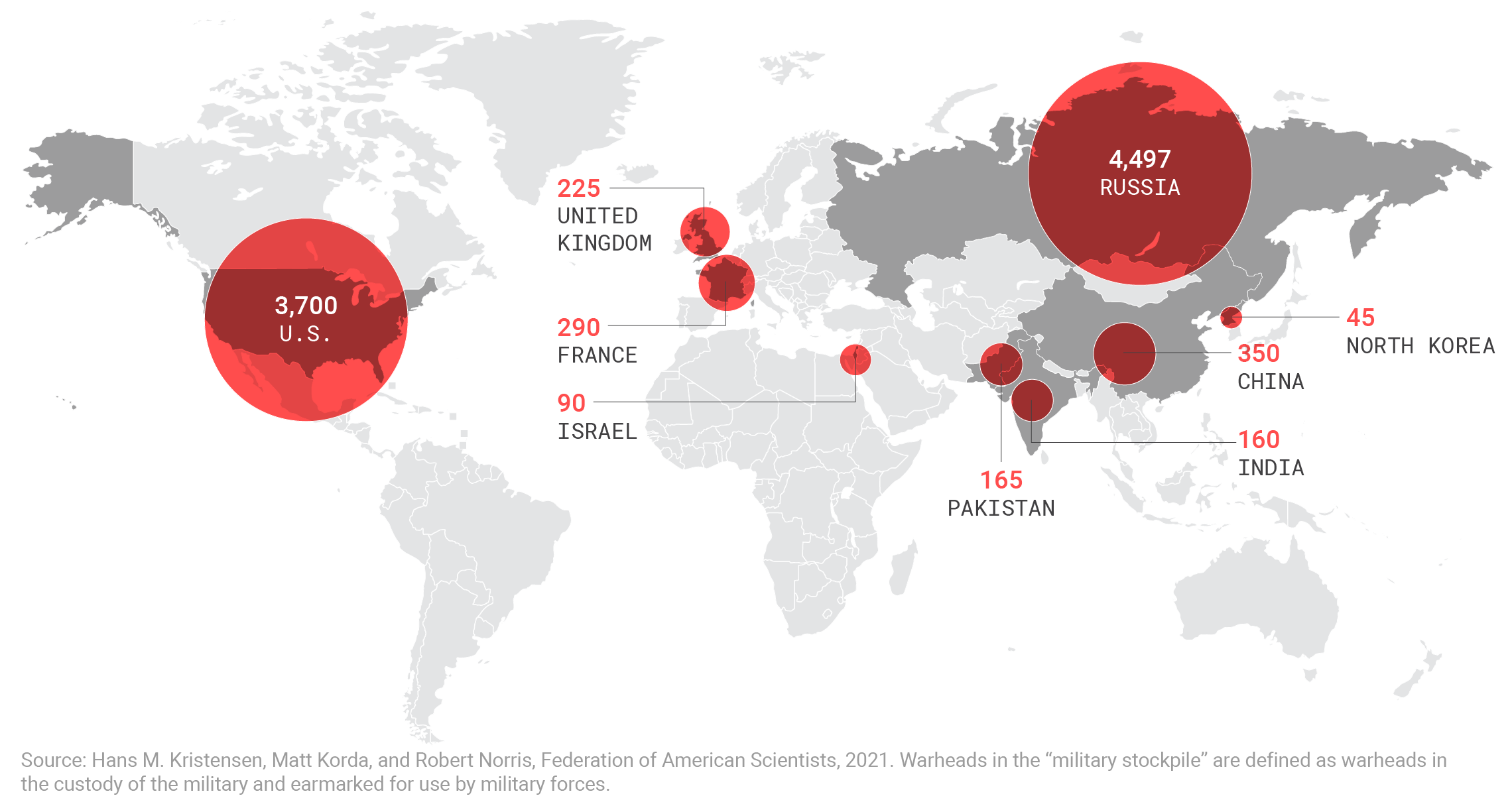
Number of nuclear weapons in each country’s military stockpile
The U.S. and Russia hold nearly nine of every 10 deployed
and stored nuclear warheads in the world. Avoiding a nuclear conflict
remains the highest U.S. national security priority with respect to
Russia.
Providing
hope to Ukraine that NATO will come to its defense, including by
continuing U.S. security aid, allows Kyiv to avoid making difficult
political accommodations necessary to end the war.28
A political settlement will likely necessitate that Ukraine accepts its
unique role as a neutral buffer state in Eastern Europe. The prospect
of being protected forever by the United States lets Ukrainian leaders
avoid pressing for a resolution to the conflict.
A settlement could result in Russia ending its support for separatist
groups in the Donbas region, allowing Ukraine to work toward national
reconciliation. Russia and European countries should take responsibility
for providing significant humanitarian and economic aid to help those
affected by the conflict. War-torn areas will need assistance rebuilding
vital infrastructure to allow displaced citizens to return home and
normal economic activity to resume. Since the civil strife has been
partly fueled by ethnic and cultural tensions, a neutral Ukraine should
also be encouraged to protect minority rights and increase local
autonomy for the Donbas region.
The Ukraine crisis has poisoned U.S.-Russia relations for the last
seven years, a dangerous status quo given the importance of avoiding
conflict between nuclear weapons states. Sympathy for Ukraine’s
unfortunate geopolitical circumstances is natural; however, current
policy undermines U.S. security and exacerbates the suffering of
Ukrainians. Working toward a realistic resolution in the form of a
neutral, non-aligned Ukraine could provide an avenue for the United
States and Russia to form a constructive and predictable relationship.
As the United States shifts its focus to the greater threat of China,
détente with Russia should guide U.S. policy.29
25 Tom Balforth, “Kremlin Says NATO Expansion in Ukraine Is a ‘Red Line’ for Putin.”
26 Mike Sweeney, “Saying ‘No’ to NATO-Options for Ukrainian Neutrality.”
27 While Russia opposes
Ukraine’s European Union aspirations, it is unlikely that their
interests would be threatened by trade that does not come with
institutional ties.
" . .In recent years, citizens’ initiatives in Arizona created a higher
minimum wage and recreational marijuana legalization. This year, two
initiatives from the public passed, one of which will increase
disclosures of dark money spent on elections and another that limits
medical debt.
✓ The new restrictions will be in place for the 2024
election, where abortion rights advocates are eyeing a potential ballot
measure to enshrine access to abortion. The initiatives come after years
of restrictions from the legislature that have made the process more
costly and difficult.
Opponents to the measure warned that the additional requirements could
disenfranchise voters and expose their personal information to potential
identity theft, while proponents said the voter ID law would make
voting by mail, the main way Arizonans vote, more secure.
Arizona voters approve Republican measures to restrict ballot initiatives
Rachel Leingang
4 - 5 minutes
"Two
Republican ballot measures that will restrict how citizens can get
their own priorities on the ballot in the future were approved by voters
in Arizona, while one measure to institute stricter voter ID requirements failed.
The mixed messages sent by voters on these measures
aligned with the state’s increasingly purple, swing-state style, where
candidates and proposals that win come from both sides of the aisle.
Groups
planning to run initiatives will now need those measures to focus on a
single subject. For measures that seek to increase taxes, they will now
need to get a 60% supermajority of votes for approval. The tax increase
measure passed narrowly, with 50.7% in favor, while the single subject
question received 55% of the vote.
“The irony is that, with such a
slim majority, just over 30,000 votes, voters gave away their authority
to have a simple majority make decisions,” said Stacy Pearson, a
spokesperson for Will of the People Arizona, the campaign against the
three initiative-related measures.
A third measure aimed at
restricting the citizens’ initiative process by allowing lawmakers to
tinker with measures after they passed netted just 36% of voters in
favor, failing at the ballot.
The Republican-controlled state
legislature, which sent questions to the ballot on eight topics this
year, from in-state tuition for undocumented students to tax increases
to fund rural fire districts.
Progressive policies rarely find an
audience at the legislature, so groups have used direct democracy to
enact them instead, often at a cost of many millions of dollars while
facing an intense, well-funded opposition and lawsuits that seek to
throw the measures off the ballot. In recent years, citizens’
initiatives in Arizona created a higher minimum wage and recreational
marijuana legalization. This year, two initiatives from the public
passed, one of which will increase disclosures of dark money spent on
elections and another that limits medical debt.
The new
restrictions will be in place for the 2024 election, where abortion
rights advocates are eyeing a potential ballot measure to enshrine
access to abortion. The initiatives come after years of restrictions
from the legislature that have made the process more costly and
difficult.
Groups that run initiatives fear the new measures will
mean even fewer policies can make the ballot and that the new
restrictions will not be applied narrowly. Citizens’ initiatives cannot
cost the state money, so they often come with fees or tax structures to
fund themselves, which they worry may be construed as a tax measure that
needs 60% approval.
As for single subjects, most measures cross
various parts of state law to ensure they are enacted completely, so
initiative users are not sure how courts will construe how a
single-subject rule applies to them.
Running ballot measures will
become more expensive, and there will be more avenues for litigation
against them, Pearson said. “I think anyone looking at initiatives in
Arizona needs to find clarity on the definition of a tax increase … It
just complicates what should be a very simple decision for voters,” she
said.
The voter ID measure, which had the backing of the Arizona
Republican party, narrowly failed, coming in with about 49.6% of the
vote. It would have required additional information from voters on
mail-in ballots, including a date of birth and an ID number, and
eliminated an option for in-person voters to prove their identity and
address using documents like utility bills and bank statements. . ."



.jpg)





(1).jpg)













.jpg)
.jpg)
.jpg)
.jpg)
.jpg)
.jpg)
.png)


