Friday, November 25, 2022

Democracy in Pakistan: Political Turmoil Following The Ouster of Elected Prime Minister


"The saga of Mr. Khan’s embrace of the military and his fallout and confrontation with the generals is a reminder of the limits of power exercised by civilian politicians in Pakistan, where the military has ruled directly for 33 years and always been the power behind the throne.


Top stories

GUEST ESSAY 24 November 2022 

www.nytimes.com

Opinion | Why Imran Khan Can’t Outplay Pakistan’s Military

Abbas Nasir (Mr. Nasir is a Pakistani journalist.)
9 - 11 minutes

" After surviving an assassination attempt on Nov. 3 while leading a protest march, Mr. Khan accused Shehbaz Sharif, who succeeded him as prime minister of Pakistan, Rana Sanaullah, the interior minister, and a third man of conspiring to assassinate him. In a significant breach in civil-military relations, Mr. Khan claimed that the third man was a major general in the Inter-Services Intelligence, the dreaded spy agency of Pakistan’s military, which supported his own rise to power. . .

✓ Mr. Khan took office as prime minister in August 2018 and was deposed by a no-confidence vote in Parliament in April of this year. Rakishly handsome, utterly vain and stubborn at 70, Mr. Khan hasn’t reconciled with his loss of power.

For several months now he has been discrediting the democratic process, blaming his ouster on an American-led foreign conspiracy and attacking Mr. Sharif’s government as an “imported government” full of “thieves.” He commenced on Oct. 28 an energetic roadshow across Pakistan demanding immediate national elections, which aren’t due for a year.

Mr. Khan’s own legend, the story of the cricket captain of steely determination who won his greatest sporting victory — the 1992 Cricket World Cup — with a team almost everybody wrote off, plays a big role in how he persists in politics. He had asked his team to play like a “cornered tiger,” and they ferociously fought their way to victory. . .

Many Pakistani analysts believe the military saw that Mr. Khan’s rise would be beneficial in reducing the dominance of the two major political parties, which revolved in and out of power: former Prime Minister Benazir Bhutto’s Pakistan People’s Party (inherited by her widower and her son after her death) and the former prime minister Nawaz Sharif’s Pakistan Muslim League (Nawaz).

By the early 2010s, Mr. Khan aligned with Pakistan’s military and welcomed power brokers from older political parties into his. He reinvented himself into a populist rallying against corruption and misrule, promising a New Pakistan — a welfare state inspired by the early days of Islam. And he raged against American drone war in Khyber-Pakhtunkhwa Province, earlier known as the North-West Frontier Province, and the tribal areas bordering Afghanistan.

He emerged as a political force after the general elections of 2013. His party won the third largest number of seats, but Nawaz Sharif got the largest number of votes and formed the government. Three years later, in 2016, Nawaz Sharif — the older brother of the current prime minister — fell out with the military over national security policy and the military began to undermine him.

✓✓ Since shortly after the birth of Pakistan in 1947, the generals have ensured the removal of intransigent politicians attempting to challenge the military either with a coup or with facilitating the election of obedient, chosen ones.

Mr. Khan played his role by ferociously accusing the older Mr. Sharif and his family of corruption and seeking his removal — not through elections but through judicial investigations and prosecution. After Mr. Sharif’s dismissal on corruption charges in 2017, a pliable judiciary disqualified him from holding public office and imprisoned him for hiding assets and not being “honest” despite no convincing evidence that he abused his office for personal gain.

In the 2018 elections, Mr. Khan’s party was seen as the military’s favorite. Independent press was gagged, and there were allegations of rigging and “copious evidence” that Pakistan’s military interfered to help Mr. Khan win. In his first three years in office, Mr. Khan spoke gleefully about being on the “same page” with the Pakistan Army chief, General Qamar Javed Bajwa, and helped him with a second three-year term as the army chief.

Mr. Khan’s tenure was defined by a disregard for civil liberties and independent press, the hounding of his opponents and ignoring procedures of parliamentary democracy. He failed to improve the economy, inflation rose and the International Monetary Fund halted funding after his government refused to stick to its commitments.

His foreign policy didn’t fare any better. Pakistan’s most important relations, with the United States, Saudi Arabia and China, remained icy during his tenure. President Biden didn’t even make a customary phone call to Mr. Khan after the start of his term. Projects in the multibillion-dollar China-Pakistan Economic Corridor remained more or less stalled.

✓✓. . . Apart from his failures of governance, in October 2021, Mr. Khan committed the cardinal sin of interfering in the military’s personnel decisions.

In March, in the lead-up to the vote of no confidence, a spokesman for General Bajwa publicly declared that the army has “nothing to do with politics.”

Pakistan got the message: Mr. Khan might still be prime minister, but he was not under the protective canopy of the army and the intelligence services anymore. The coalition of opposition parties moved to oust him and Mr. Khan lost crucial allies and legislators of his own party. A vote of no confidence was moved in the national assembly.

In April, Mr. Khan tried to avoid the confidence vote — which decides the fate of a government — by dissolving the national assembly, but the Supreme Court declared his actions unconstitutional and ordered the vote be held. Mr. Khan didn’t have a majority in parliament and was ousted.

Mr. Sharif, the leader of the opposition coalition, took over as prime minister and moved briskly to repair long fractured ties with the military. And in a first, after Mr. Khan’s ouster, his supporters — urban youth and sections of the middle class — who have traditionally been strong supporters of Pakistan’s military, clashed with the police, vandalized property and tried to forcibly enter a military cantonment area.

Mr. Khan has resumed his cry for immediate elections with the halo of a martyr. But he is quickly conceding that the military will always dominate Pakistan’s politics and told the newspaper The Dawn that “using their constructive power can get this country out of institutional collapse.”

He has also dialed back his allegations of an American conspiracy behind his ouster, waking up to the importance the military attaches to its relationship with Washington. The new tack suggests that he is happy with military interference in politics as long as it is on his behalf.

> On Thursday Prime Minister Sharif appointed Lt. Gen Syed Asim Munir as the new army chief, who will take over after Gen. Bajwa retires on Tuesday. General Munir had clashed with Mr. Khan during his tenure as the I.S.I. chief in 2019.


✓✓ Yet Mr. Khan’s populist messaging is gaining wider traction. Pakistan’s economy is faltering. Inflation is higher than 25 percent. Recent floods have affected more than 30 million people, and caused damage and economic losses of around $30 billion. Pakistan needs stability and improved governance, but Mr. Khan’s ambitions are bound to increase political turmoil."

Thursday, November 24, 2022

Keeping U.S. troops in Syria prolongs the civil war...Keeping U.S. troops in Syria courts war with larger powers

The US has roughly 900 soldiers in Syria, mainly in the northeast of the country, who work with the Syrian Democratic Forces (SDF), which is led by the YPG, to fight against ISIL remnants???


The ISIS territorial caliphate has collapsed in Syria, and the U.S. military presence today prolongs a civil war and endangers U.S. troops to spoil a complete Syrian government victory and deprive it of oil revenue.

  • U.S. support for rebels convinced Russia and Iran to redouble their own military assistance to Damascus—worsening the civil war—and badly failed.2
  • As ISIS gained power, the U.S. directly intervened militarily in Syria toward degrading and eliminating the group's territorial caliphate. U.S. airstrikes, coupled with Kurdish- and Arab-led ground operations assisted by U.S. SOFs, accelerated under President Trump. Congress never authorized sending U.S. forces into Syria.
  • With ISIS’s caliphate collapsed by early 2019 and its remnants scattered, U.S. objectives shifted yet again—in large part to preventing Russian and Iranian influence in Syria and spoiling a complete Syrian government victory by depriving it of oil revenue


Keeping U.S. troops in Syria courts war with larger powers

  • For the U.S., Syria’s geostrategic position is insignificant. It has no notable natural resources, international waterways, or other kinds of strategically important attributes. U.S.-Syria relations have long been poor.
  • The situation is different for Iran and Russia, both of which have expended enormous military, economic, and diplomatic resources to ensure the survival of a long-time partner in Damascus. For Russia and Iran, a Syrian government victory would be a return to the status quo—not an expansion of power in the Middle East.
  • Keeping U.S. forces on the ground increases the risks of confrontation with Syrian, Iranian, and Russian forces—and possibly our own NATO ally Turkey. Such a scenario could spark all-out war in the region.
  • U.S. troops have already engaged in dangerous skirmishes with Iran-backed forces, Russian mercenaries, and regular Russian army units. Fights with Assad-backed forces are increasingly likely.
  • Preserving a U.S. military presence to frustrate Iran's or Russia’s status-quo ambitions in Syria courts wider conflict with both powers, a dangerous and unnecessary distraction from true strategic priorities.5
  • The existence of a Syrian government backed by Russia and Iran is not preferable but does not hinder core U.S. interests in the Middle East. Leaving these powers to exercise influence in war-torn Syria is no gift to them.

THIS IS A REPORT FROM MAY 2021

www.defensepriorities.org

It is time for U.S. troops to leave Syria — Defense Priorities

8 - 10 minutes
 

Daniel DePetris

May 10, 2021


U.S. interests militate against keeping troops in Syria

  • Core U.S. interests in the Middle East are narrow: (1) preventing significant, long-term disruptions to the flow of oil and (2) defending against anti-U.S. terrorist threats.
  • Neither U.S. interest justifies keeping U.S. forces in Syria, which holds only 0.1 percent of global oil reserves. U.S. forces originally deployed to Syria to help annihilate ISIS’s territorial caliphate, which was achieved by March 2019.
  • Since then, the U.S. military presence there has transformed well beyond a counterterrorism mission with a series of murky objectives and needless risks.
  • Rather than an endless occupation, the U.S. should acknowledge success and withdraw the approximately 900 U.S. troops that remain in eastern Syria.

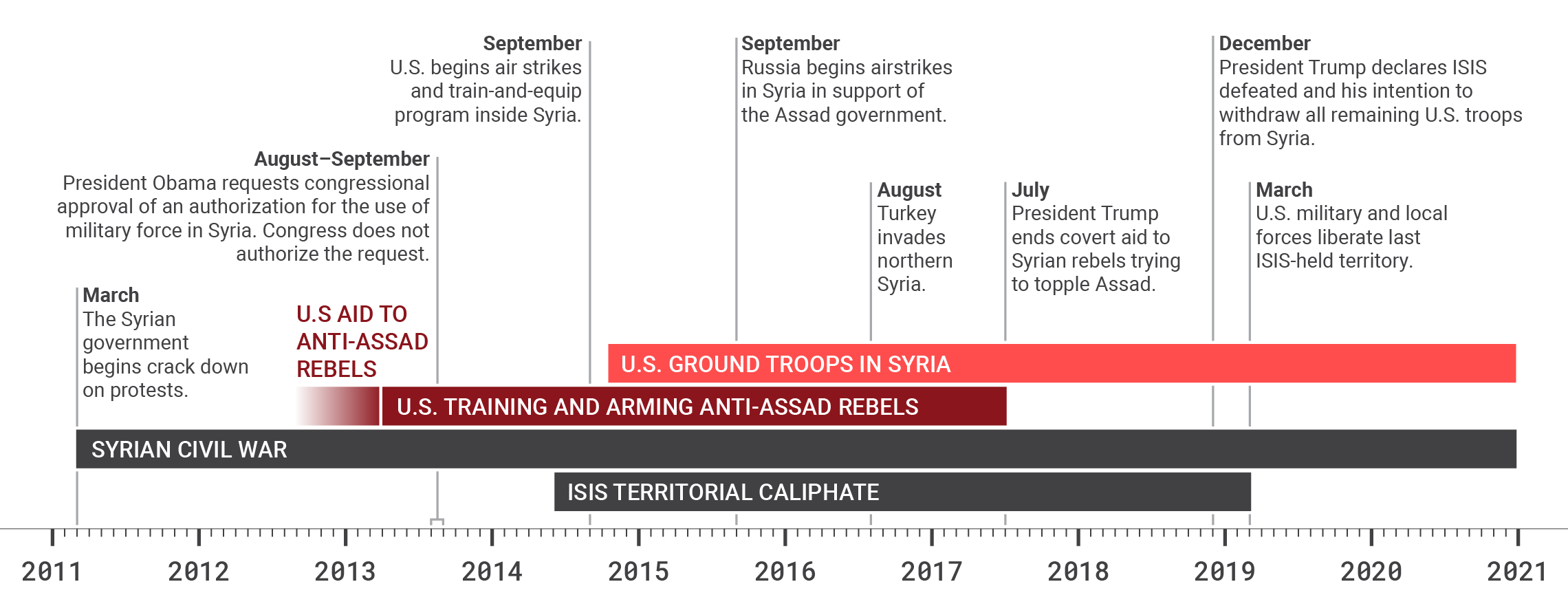
Timeline of U.S. intervention in the Syrian civil war

Around 900 U.S. troops remain in Syria, even after the collapse of ISIS’s territorial caliphate.

Around 900 U.S. troops remain in Syria, even after the collapse of ISIS’s territorial caliphate.

REPORT TODAY

www.aljazeera.com

Turkish air attacks on Syria threaten US personnel: Pentagon

Al Jazeera
3 - 4 minutes

Turkey has stepped up air attacks on northern Syria since the November 13 Istanbul bombing.

Turkish air attacks in northern Syria threaten the safety of United States military personnel and the escalating situation is jeopardising years of progress against ISIL (ISIS) fighters, the Pentagon has said.

The public comments on Wednesday represent the strongest condemnation by the US of NATO ally Turkey’s air operations in recent days against Kurdish-led YPG (People’s Protection Units) forces in northern Syria to date.

“Recent air strikes in Syria directly threatened the safety of U.S. personnel who are working in Syria with local partners to defeat ISIS and maintain custody of more than ten thousand ISIS detainees,” the Pentagon’s spokesman, Air Force Brigadier General Pat Ryder, said in a statement.

Ryder said the escalating situation threatened the progress made in the fight against ISIL fighters in the region. . . . .

This is not the first time Turkey’s operations in northern Syria have threatened US personnel. In 2019, American troops in the area came under artillery fire from Turkish positions as Turkey waged an offensive against US-allied Kurdish fighters at the time.

Turkey has repeatedly complained to the US that support for the YPG-led SDF undermines Washington’s position on the PKK and its commitment to Turkey’s security.

Erdogan maintains that Turkey will only be able to remove the threat from the PKK and the YPG by clearing the militias from the Turkey-Syria border and creating a “safe zone” in northern Syria.

Source: Al Jazeera and news agencies


 READ MORE

RELATED CONTENT

news.usni.org

Report on Armed Conflict in Syria and U.S. Response - USNI News

5 - 6 minutes

The following is the Nov. 8, 2020, Congressional Research Service report, Armed Conflict in Syria: Overview and U.S. Response.

From the report

In March 2022, the Syria conflict marked its 11th year. Analysts estimate that the conflict has killed over half a million people (including combatants) and displaced half of Syria’s prewar population. Challenges for U.S. policymakers in Syria include countering groups linked to Al Qaeda, responding to the threat posed by Islamic State (IS/ISIS) remnants and detainees, facilitating humanitarian assistance, and managing Russian and Iranian challenges to U.S. operations.

Conflict Status. In early 2022, United Nations (U.N.) Special Envoy for Syria Geir Pedersen described the conflict in Syria—between the Syrian government and its partners on one side and various opposition and extremist groups on the other side—as a “stalemate,” noting that “militarily, front lines remain unshifted.” Pedersen stated that “any of a number of flashpoints could ignite a broader conflagration.” In 2022, incoming U.S. Central Command (CENTCOM) commander General Michael Kurilla stated that the Asad government is “positioned to end the civil war militarily,” but noted that the underlying conditions driving the conflict (including political disenfranchisement, poverty, water scarcity, and economic instability) would likely persist. . .. .

U.S. Military Presence. Roughly 900 U.S. troops operate in Syria in support of counter-IS operations by local partner forces, as part of Operation Inherent Resolve (OIR). U.S. forces in Syria continue to face threats from Iran-backed militias, which have targeted U.S. positions in the country.

Policy Debates. Policymakers are faced with a number of—at times competing—policy priorities in Syria. The Islamic State seeks to exploit deteriorating economic conditions in the country; however, projects to bolster economic activity in Syria may have the unintended effect of aiding the Asad government. Similarly, policymakers disagree on whether the benefits of efforts to alleviate economic conditions in neighboring Lebanon outweigh the risk that these efforts could benefit Asad. Policymakers also face the additional complications of regional states, including U.S. allies, pursuing their own objectives in Syria, whether in the form of military operations or efforts to normalize diplomatic ties with the Asad government."

 .


NYT Columnist Thomas Friedman: “The World Will Push Back” Against Trump ...

    Jan 27, 2026 #amanpourpbs From ICE's violent crackdown in Minneapolis to President ...