Saturday, December 03, 2022

SPACE NEWS . . .It wasn’t long ago that there was a duopoly in space: the United States and Russia


The space arms race keeps accelerating, new reports warn

by
"As space becomes increasingly important to terrestrial activities, the tools and weapons available to disrupt and damage satellites are proliferating around the world

COLORADO SPRINGS – It’s hard to imagine how the world’s economies and military forces would operate without unfettered access to services provided by satellites in space. But as space becomes increasingly important to terrestrial activities, the tools and weapons available to disrupt and damage satellites are proliferating around the world, according to two reports released April 4.

“The existence of counterspace capabilities is not new, but the circumstances surrounding them are,” says the 2022 edition of the Secure World Foundation’s “Global Counterspace Capabilities: An Open Source Assessment.” 

“Today there are increased incentives for development, and potential use, of offensive counterspace capabilities. There are also greater potential consequences from their widespread use that could have global repercussions well beyond the military, as huge parts of the global economy and society are increasingly reliant on space applications,” the report says. 

Brian Weeden, director of program planning at the Secure World Foundation and one of the editors of the report, said the broad theme this year is “proliferation.” Previously only a handful of nations had space weapons. “We just keep adding more countries every year,” he said. Based on open-source information, this year’s report details the counterspace capabilities of the United States, Russia, China, India, Australia, France, Iran, Japan, North Korea, South Korea and the United Kingdom.

A separate report by the Center for Strategic and International Studies, the Space Threat Assessment 2022, also uses open-source information to track the developments of counterspace weapons that threaten U.S. national security interests in space.

It wasn’t long ago that there was a duopoly in space: the United States and Russia, Susan Gordon, former principal deputy director of national intelligence, wrote in the introduction to the CSIS report. 

This is a new era where space has become the “domain in which every interest of an adversary or competitor is affected,” Gordon noted.

China was once an afterthought in the space race, she added. This past year China launched the most satellites of any nation, “demonstrated its intention to project hard and soft power through the growth in on-orbit military support capabilities, and grabbed our attention and imagination with its counterspace demonstrations ranging from hypersonic missile launches to co-orbital rendezvous with other satellites.”

Russia, the earliest innovator in space, “re-grabbed our attention with its direct-ascent anti-satellite test that created a threatening debris field as well as apparent GPS jamming in Ukraine that showed how counterspace is being integrated into combined operations,” Gordon said. 

“The proliferation of international and commercial vehicles on orbit, while presaging a new era of space use for every aspect of governmental, business, and societal advance, will demand attention on the responsible use of space as a shared environment.”

Weeden said that of all the weapons that could be used to take down satellites, the most concerning today are cyberattacks because they are relatively easy to pull off, as seen in the February 24 attack against Viasat’s KA-SAT network that interrupted satellite broadband service in Ukraine just as Russian forces began invading the country. 

“The Viasat attack is a very interesting event,” Weeden told reporters. “It shows that attacks often are not against the satellites but the ground system, in this case the modems used to send and receive data.”

Todd Harrison, CSIS senior fellow and co-author of the threat assessment report, noted that such cyberattacks “are not physically destructive, nobody’s life is at risk so they are viewed as the type of attack anybody can do with impunity.”


Commercial Launch Military

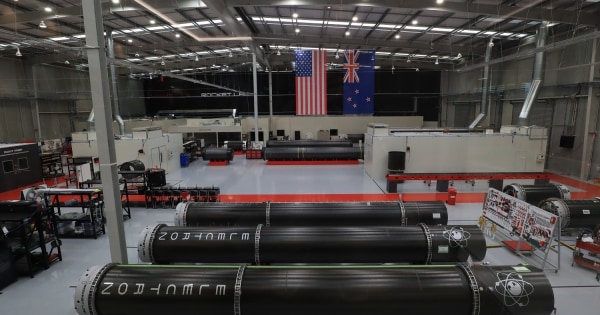
Rocket Lab launches subsidiary focused on national security market  


The company's new subsidiary is called Rocket Lab National Security

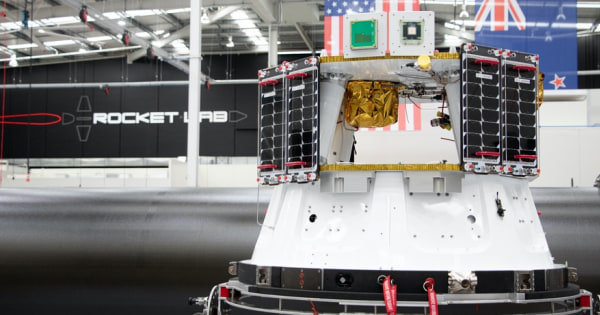
WASHINGTON — Rocket Lab,  a launch services company and space hardware manufacturer, announced Dec. 1 it is creating a separate entity to focus on U.S. defense and intelligence agency customers.

The new business sector, called Rocket Lab National Security, also will work with U.S. allies, the company said.

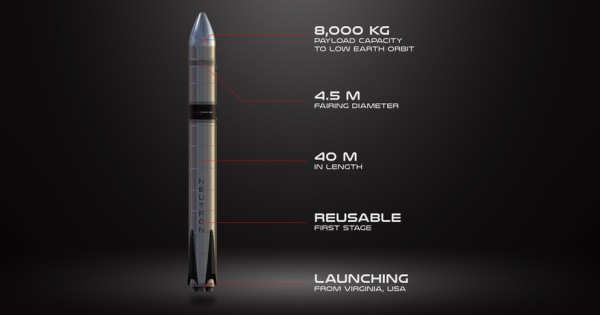
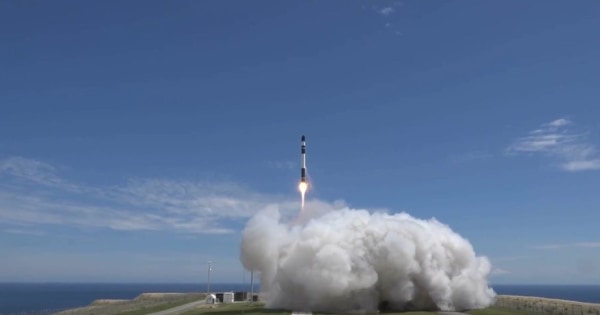
Rocket Lab, which went public in August 2021 via a merger with a special purpose acquisition company, is looking to sign more defense and intelligence customers for its small launch vehicle Electron and its future medium-lift rocket Neutron — expected to debut in 2024. The company decided it needs a separate business dedicated to this market, a spokesperson said in a statement to SpaceNews

“National security missions and payloads on Electron and Neutron, which can have different bureaucratic requirements to commercial launches, will be contracted through the RLNS subsidiary,” the spokesperson said. 

Having a dedicated national security subsidiary will help understand these customers’ requirements, “which may be dedicated rapid call-up launch, satellite design, build and integration, spacecraft operations, or all of the above.”

The establishment of a national security business follows Rocket Lab’s recent introduction of a “responsive space” program aimed at government customers. 

Rocket Lab USA is based in Long Beach, California. The company operates a launch site in New Zealand and will soon start flying from Wallops, Virginia. 

Since Electron’s first launch in 2017, Rocket Lab has secured multiple deals with national security agencies, including the National Reconnaissance Office, the U.S. Space Force and the Defense Advanced Research Projects Agency. 

Rocket Lab’s solar power business supplies solar cells for U.S. Space Force missile-warning satellites. Another sector of the company recently won contracts to provide separation systems for the U.S. Space Force’s Space Development Agency satellites.

Rocket Lab also signed a research agreement with the United States Transportation Command to explore the use of rockets for point to point cargo delivery.

“Top of the list for national security is reliability and responsiveness,” said Brian Rogers, senior director of Rocket Lab’s global government launch services.

email sharing button Email
reddit sharing button Share
linkedin sharing button Share
twitter sharing button


Morearrow


This Modern World 12.02.22


Eric Berger's Rocket Report | ArsTechnica

 Eric Berger / Eric Berger is the senior space editor at Ars Technica, covering everything from astronomy to private space to NASA, and author of the book Liftoff, about the rise of SpaceX. A certified meteorologist, Eric lives in Houston.

arstechnica.com

Rocket Report: SpaceX launch delayed indefinitely; Virgin Orbit cancels funding round

by Eric Berger - Dec 2, 2022 1:00 pm UTC
9 - 11 minutes

"Due to current market conditions, the company has elected not to proceed."

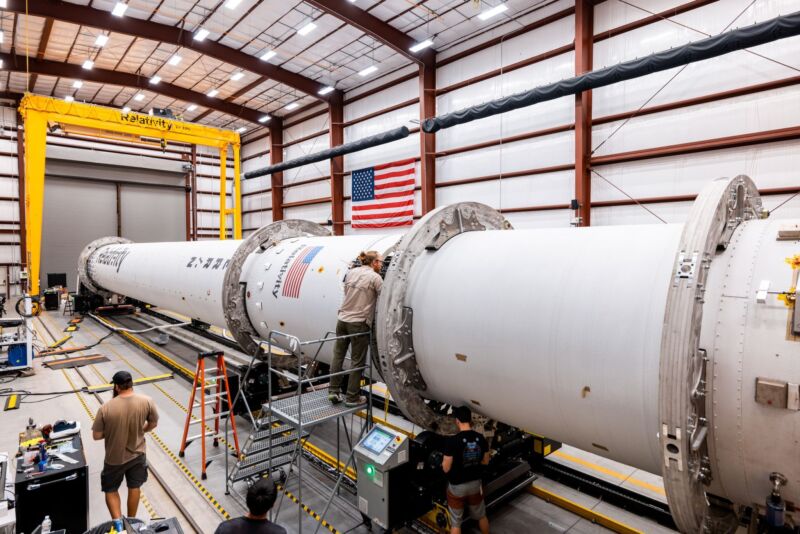
The Terran 1 rocket is shown in Relativity Space's hangar in Florida.

Trevor Mahlmann

Welcome to Edition 5.19 of the Rocket Report! Back from the Thanksgiving holiday, there is a lot of news to get to this week, including a report card on the SLS rocket's performance (excellent) and some wild and woolly news from north of the US border. Read on for more.

As always, we welcome reader submissions, and if you don't want to miss an issue, please subscribe using the box below (the form will not appear on AMP-enabled versions of the site). Each report will include information on small-, medium-, and heavy-lift rockets as well as a quick look ahead at the next three launches on the calendar.

Virgin Orbit ends security offering. The US-based launch company announced on the evening before Thanksgiving a "cessation" of a securities offering. "Due to current market conditions, the company has elected not to proceed with an offering," Virgin Orbit said in a statement. "Any future capital raising transactions will depend upon future market conditions." Previously, in October, Virgin Orbit CEO Dan Hart said the company was seeking to raise additional capital after going public as a special purpose acquisition company, or SPAC.

That's not great, but ... As part of the SPAC process, the company set a target to raise $483 million. However, the company only raised $228 million a year ago. Virgin Orbit has an excellent record of technical achievement, with four consecutive successes of its LauncherOne system. But there have long been questions about its financial viability, given the limited potential for growth with an air-launched rocket. This is certainly not the end of the road for Virgin Orbit, which is nearing a historic launch from Cornwall in the United Kingdom. Financially, it also has a hedge fund commitment to fall back on that is valued at $250 million.

ABL debut launch attempt is scrubbed. The first test flight of ABL Space Systems’ new small satellite launcher from Alaska has been delayed until no earlier than December after technical issues cut short a series of launch attempts in mid-November, Spaceflight Now reports. ABL conducted three countdowns during a week-long launch period at the Pacific Spaceport Complex on Kodiak Island, Alaska, to try to send aloft the company’s first RS1 rocket, which is capable of lifting 1 metric ton to low-Earth orbit.

Try again before Christmas ... A November 14 launch attempt was scrubbed about 30 minutes before liftoff due to unexpected data during propellant loading on the RS1’s first stage, later found to be caused by a leaking valve in the pressurization system. A second launch attempt on November 17 was aborted at T-minus 1.8 seconds during ignition of its nine kerosene-fueled E2 first-stage engines. Another countdown on November 21 was also aborted during the engine startup sequence. That was the final launch attempt available to ABL until the company’s next series of launch dates begins on December 7. (submitted by EllPeaTea)

The easiest way to keep up with Eric Berger's space reporting is to sign up for his newsletter, we'll collect his stories in your inbox.

Electron picks up TROPICS launch contract. NASA said it selected Rocket Lab to provide the launch service for the agency’s Time-Resolved Observations of Precipitation Structure and Storm Intensity with a Constellation of Smallsats, or TROPICS, mission. Rocket Lab will launch four CubeSats for NASA on two Electron rockets, targeted for no earlier than May 1.

Ready to go for next year ... This timeframe will enable NASA to provide observations during the 2023 Atlantic hurricane season, which begins June 1. The TROPICS constellation targets the formation and evolution of tropical cyclones, including hurricanes, and will provide rapidly updating observations of storm intensity. The launch of the first two TROPICS satellites, earlier this year on an Astra rocket, failed. (submitted by EllPeaTea and Ken the Bin)

Skyroot makes successful suborbital debut. Skyroot Aerospace successfully launched its small suborbital Vikram-S rocket on November 18, TechCrunch reports. The 6-meter-tall rocket reached an altitude of 89.5 km, as planned by the company, officials with the Indian startup said. The company is part of India's nascent commercial space sector.

Orbit up next ... Founded in 2018 by former ISRO scientists Pawan Kumar Chandana and Naga Bharath Daka, Skyroot has raised $68 million in total, including $51 million in a Series B round led by Singapore-based GIC in September. It has plans to develop a series of increasingly capable orbital "Vikram" rockets in the coming years. (submitted by Ken the Bin)

Relativity completes Terran 1 stacking. The company said it has successfully mated the first and second stages of the Terran 1 rocket ahead of a debut launch. "The next time Terran 1 is out on the pad, it will be stacked and vertical. Upcoming milestones to track: rollout, static fire, and launch," the company said in its newsletter. The company also said it completed thrust vector control testing.

Slipping into the new year ... Given that Relativity has yet to roll the Terran 1 out to the pad for its static fire test, it looks increasingly unlikely that the rocket will make its debut in 2022. However, the company is in good position to test its additively manufactured rocket early in 2023, perhaps even in January.

Phantom Space gets a NASA launch contract. Phantom Space—yes, the Phantom Space co-founded by Jim Cantrell—has received a "task order" from NASA to launch four CubeSats on the company's Daytona rocket. The CubeSats will launch no earlier than 2024, NASA said, as part of the agency’s Venture-class Acquisition of Dedicated and Rideshare (VADR) program. This is NASA's program to on-ramp a greater diversity of US rockets for government launch contracts.

Tolerating some higher risks ... NASA will not launch any high-value satellites through VADR, which the agency says allows it to procure "commercial launch services for payloads that can tolerate higher risk." There are currently 13 companies eligible to bid on VADR launch contracts, including established firms such as SpaceX and ULA, and less-established firms such as L2 Solutions in Houston. It will be interesting to see if Phantom Space can succeed in lofting the CubeSats for NASA. (submitted by Ken the Bin)

Australian launch facility raises environmental concerns. Conservationists say planned rocket launches on the Eyre Peninsula in South Australia pose an extinction-level threat to the wren, one of Australia’s smallest birds, The Guardian reports. The subspecies of southern emu-wren at the site is listed as endangered under existing law but as vulnerable nationally. Australia’s environment minister, Tanya Plibersek, is considering lifting the national status to endangered. That change would matter for project approvals and funding decisions for the Southern Launch spaceport.

Regulatory approval is pending ... The Nature Conservation Society of SA says land clearance, disturbance by humans, including noise, vibrations and cars, as well as an increased risk of bushfire, put the bird at extreme risk. The Southern Launch chief executive, Lloyd Damp, said the company had engaged “pre-eminent independent experts” as part of its environmental impact statement. “The outcomes show we will have a very positive effect on their habitat through environmental management such as feral animal eradication programs,” he said. (submitted by Onychomys)

This Canadian company has ambitions, baby! I confess to not having heard of Edmonton-based Space Engine Systems until a spaceQ story crossed my desk this week. There's a lot going on here, but if I may try to summarize, the company is working on a) a single-stage-to-orbit space plane, b) a hypersonic vehicle for point-to-point transport of body organs for medical transplants, c) a Moon-capable spacecraft, and d) a hypersonic drone named "Sexbomb" for defense applications.

That's a full plate ... Like I said, a lot is happening here. And it's difficult to divine whether any of this is real. I suspect the answer is no, it's not. But it makes for fun reading. Make sure you check out the image at the top of the article, which appears to be a comically low-fidelity rendering of a "high temperature wing bending test facility." Something is bent, that's for sure.

Let's Go Surfing!. . .in the Dessicated Arizona Desert


Cannon Beach surf park in Mesa announces anchor tenant KTR - AZ Big Media

AZ Business Magazine
3 - 4 minutes

 RELATED CONTENT 


cannon beach az from www.abc15.com
Mar 23, 2021 · In Gilbert, a developer has proposed building a 25-acre water park with three lagoons for cable-based surfing, skiing, and kneeboarding
cannon beach az from fabulousarizona.com
Apr 7, 2021 · Cannon Beach, a 37-acre surf, shop, gym and multi-use development project, has broken ground in Mesa. The first attractions of the fun-time ...
May 3, 2022 · Mesa City Council in November approved modifications to Cannon Beach's plans for a “surf lagoon” surrounded by shopping and dining. 

www.visitmesa.com

Cannon Beach Announces Groundbreaking | Visit Mesa

4 - 5 minutes

Surf Lagoon and Entertainment District to Bring Impressive Attraction to Mesa

March 23, 2021 Mesa, Ariz. – Surf’s up Mesa! A 37-acre surf, shop, gym and multi-use development project is set to break ground on Tuesday, March 30 at 11 a.m. The oasis is being made possible by Cannon Beach Developers and is located at the cross streets of Power and Warner roads in Mesa. The project, two and a half years in design and development, will bring the ocean to Arizona in a place unlike any other in the state.

"We hope Cannon Beach will bring out the best in its patrons by challenging them to join, or at least be inspired by, new activities,” said Cole Cannon, lead developer at Cannon Beach.

Revel Surf will anchor the development with a 3.3-acre surf lagoon that features the world’s first Swell MFG’s Traveling Surf Technology and UNIT Surf Pool’s Stationary Rapid Surf Technology, in one location. This unique combination will create a more natural surfing lineup with a peak wave rather than a right-session-only or left-session-only option as found in many of today’s wave pools.

“The Swell MFG will create peak waves and provide some of the most epic and diverse wave sets for every level of surfer,” said Matt Gunn, co-founder of Swell MFG. “We look forward to welcoming every level of surfer to enjoy this surf lagoon.”

This new technology and layout has gained the attention of the professional surf community due to its ability to cater to all skill levels.

“Our wave technology and vision for this project will be like nothing you have seen in the market to date and I’m so grateful to be a part of this incredible project and team,” said Shane Beschen, former pro surfer and X Games gold medalist.

“Combining Swell MFG’s state-of-the-art traveling waves with the best stationary rapid surfing wave on the market by UNIT Surf Pool is going to make this surf park the most highly sought-after surf destination in the U.S.,” said Tony Finn of UNIT Surf Pool and wakeboard creator. “Together you have the perfect surfing experience for people of all ages, abilities, and skill levels. There has never been a better opportunity for surf lessons and technical progression than there will be here.”

The development is geared toward the growing population settling in the east Valley. With a burgeoning influx of California surfers, young and old that have relocated to Arizona and yearn for the beach, as well first timers who want to venture into the world of surfing. Whether you are a spectator or participant there is something for everyone at Cannon Beach — specialty dining, fish tacos on the beach, day spa, gym, splash pad for kids, and overall good vibes.

The Cannon Beach development design team includes talent from Hawaii to Germany. The land planning project was developed in consultation with Arizona locals EPS Engineering, H20 Design, and Adaptive Architects.

Revel Surf plans to open May 2022, with the surrounding amenities to follow including an on-sight hotel, retail, office, dining and more. The Cannon Beach development ground is currently entertaining proposals from potential tenants for its various pad locations.


MEDIA CONTACT

Claire Natale, Evolve Public Relations and Marketing
202-294-5999
claire@evolveprandmarketing.com 


19 hours ago · Cannon Beach, the 37-acre surf, shop, gym and multi-use development project has announced a new anchor tenant, KTR.
Mar 30, 2021 · A beach oasis is in the works to "bring the ocean to Arizona." Cannon Beach Developers is set to break ground on a 37-acre water park and ...

"Cannon Beach, the 37-acre surf, shop, gym and multi-use development project has announced a new anchor tenant, KTR. Located at the cross streetsof Power and Warner roads in Mesa, Cannon Beach is expected to open in 2023.

The project broke ground in June 2021 and will bring the ocean to Arizona in a place unlike any other across the state. It has 500,000 square feet of retail, restaurant and hotel space centered around the focal point, a state-of-the art surf lagoon, and now KTR, an indoor action sports center.


READ ALSO: Here’s why East Valley tourism may end up bigger and broader than ever


KTR is the power-packed thrill-infused fun zone for families with children of all ages offering skateboarding, scooters, a parkour/ninja warrior course, trampoline, BMX, and other high-flying aerialist attractions. This will be the seventh KTR location in the Valley and is set to become the corporate franchise headquarters. Located on the mezzanine level overlooking the lagoon, the new, 30,000 square foot space will include special attractions for guests of all ages and will also be another option for onsite private events.

“Cannon Beach and KTR is a match made in heaven for families looking for a healthy alternative to getting kids off their digital devices while having the freedom to play,” said Cole Cannon, founder of the Cannon Beach project. “There isn’t a better anchor to compliment the surf and lifestyle amenities of the development. Whether you need your family to burn some energy on one of the attractions or to put your feet in the sand and watch surfers ride the waves, this is the place to be.”

KTR will compliment Cannon Beach’s line up of attractions and restaurants with its flare for the extreme fun and adventure. Kids can learn how to surf before they try out the actual lagoon. It will also offer its hallmark programming that has facilitated countless birthday parties, group/corporate events, and training, including at the Olympic level.

“We are thrilled to join Cannon Beach and be another opportunity for fun and adventure,” said Ron Sciarro, co-founder of the KTR franchise. “Cole’s team and ours share the value of using our resources to better the community and we look forward to hosting a variety of groups. We’re especially excited to invite non-profit entities and church groups to our facility at no cost throughout the operating season in hopes of giving a little something back to the communities we love and serve.”

For more information about Cannon Beach visit www.cannonbeachaz.com/ . For more information about KTR visit www.ktr-centers.com/ . 

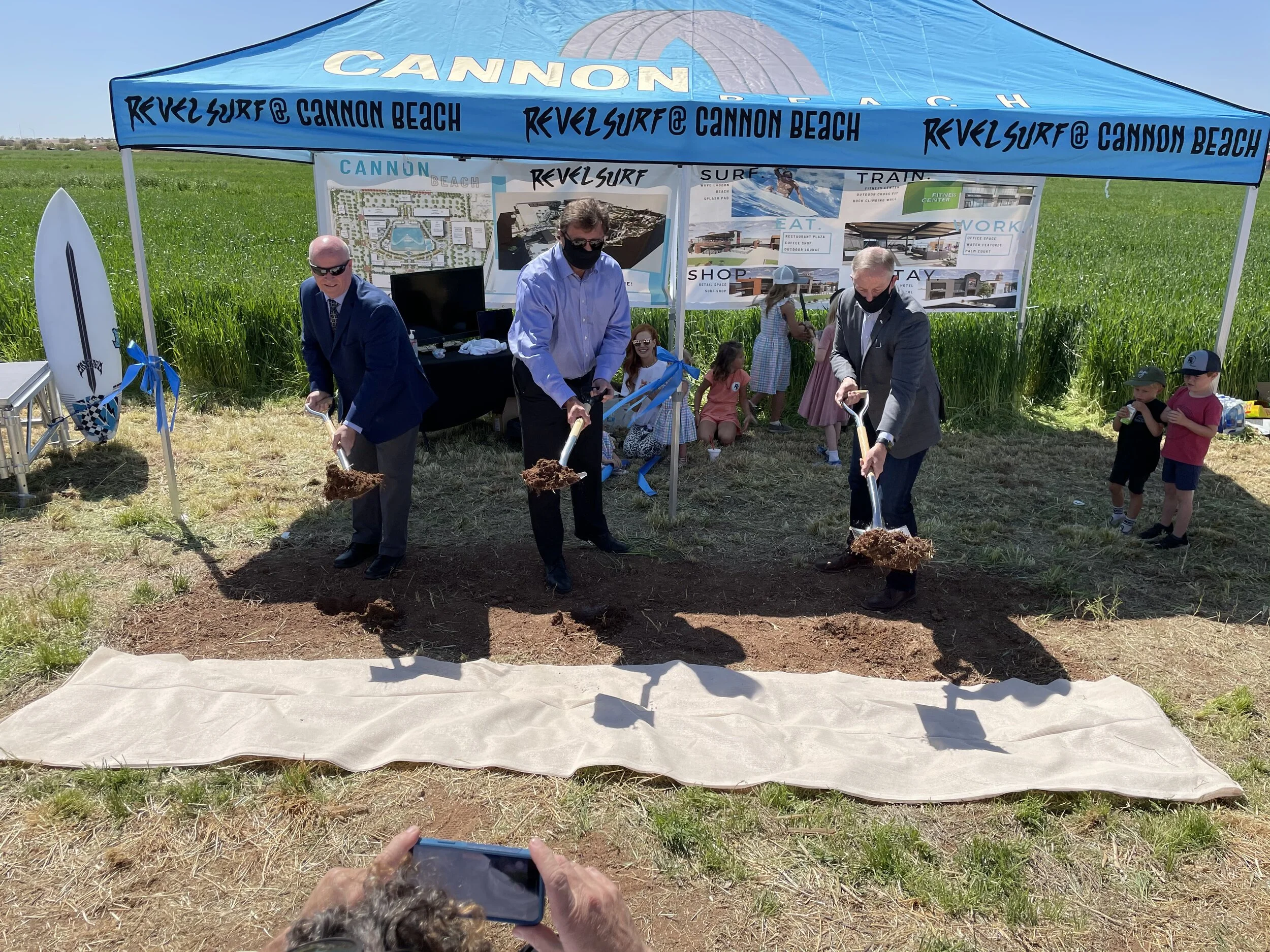
Photos from Cannon Beach’s official groundbreaking on March 30th, 2021.

The Cannon Beach and Revel Surf team kicking off construction of the soon-to-be resort.

The Cannon Beach and Revel Surf team kicking off the construction of the soon-to-be resort.

(Pictured from left to right, Tony Finn– inventor of sport of wakeboarding and UNIT Surf Pool Distributor, Cole Cannon– lead developer of Cannon Beach, Eric Di Bella-  Adaptive Architects, Matt Gunn– Executive Director of Swell MFG , Shane Beschen– Pro Surfer and Gold Medalist and Creative Director of Swell MFG, not pictured is John Bushey- Chief Engineer of Swell MFG and Jessica O’Leary- UNIT Surf Pool Distributor.)

The Cannon Beach and Revel Surf team.

The Cannon Beach and Revel Surf team.

Local Mesa, Arizona officials, including Councilmember Kevin Thompson and Mayor John Giles kicking off the construction of Cannon Beach.

Local Mesa, Arizona officials, including Councilmember Kevin Thompson and Mayor John Giles kicking off the construction of Cannon Beach.

Mesa, Arizona Mayor John Giles speaking at the Cannon Beach and Revel Surf groundbreaking.

Mesa, Arizona Mayor John Giles speaking at the Cannon Beach and Revel Surf groundbreaking.

TOTALITARIAN VIBE: CIA Venture Capital Arm Partners With In-Q-Tel + Trust Lab

To keep pace with startups’ agility and speed, many large corporations have created functions and investment strategies to engage external innovators—with more than 750 corporations making venture investments in 2018.6 The primary motivation for many of these investments is less financial than strategic, gaining insight into new products, the competitive environment, and partnership opportunities.7 (See the sidebar “What’s driving spin-ins?”)

Government can adapt this model to realize similar benefit—an approach the CIA pioneered in 1999 when it established its not-for-profit venture arm, In-Q-Tel, to invest in ventures with strategic relevance to the defense and intelligence communities.

theintercept.com

CIA Venture Capital Arm Partners With Ex-Googler’s Startup to “Safeguard the Internet”


Sam Biddle
6 - 8 minutes

Trust Lab was founded by a team of well-credentialed Big Tech alumni who came together in 2021 with a mission: Make online content moderation more transparent, accountable, and trustworthy. A year later, the company announced a “strategic partnership” with the CIA’s venture capital firm.

Trust Lab’s basic pitch is simple: Globe-spanning internet platforms like Facebook and YouTube so thoroughly and consistently botch their content moderation efforts that decisions about what speech to delete ought to be turned over to completely independent outside firms — firms like Trust Lab. In a June 2021 blog post, Trust Lab co-founder Tom Siegel described content moderation as “the Big Problem that Big Tech cannot solve.” The contention that Trust Lab can solve the unsolvable appears to have caught the attention of In-Q-Tel, a venture capital firm tasked with securing technology for the CIA’s thorniest challenges, not those of the global internet.

“I’m suspicious of startups pitching the status quo as innovation.”

The quiet October 29 announcement of the partnership is light on details, stating that Trust Lab and In-Q-Tel — which invests in and collaborates with firms it believes will advance the mission of the CIA — will work on “a long-term project that will help identify harmful content and actors in order to safeguard the internet.” Key terms like “harmful” and “safeguard” are unexplained, but the press release goes on to say that the company will work toward “pinpointing many types of online harmful content, including toxicity and misinformation.”

Though Trust Lab’s stated mission is sympathetic and grounded in reality — online content moderation is genuinely broken — it’s difficult to imagine how aligning the startup with the CIA is compatible with Siegel’s goal of bringing greater transparency and integrity to internet governance. What would it mean, for instance, to incubate counter-misinformation technology for an agency with a vast history of perpetuating misinformation? Placing the company within the CIA’s tech pipeline also raises questions about Trust Lab’s view of who or what might be a “harmful” online, a nebulous concept that will no doubt mean something very different to the U.S. intelligence community than it means elsewhere in the internet-using world.

No matter how provocative an In-Q-Tel deal may be, much of what Trust Lab is peddling sounds similar to what the likes of Facebook and YouTube already attempt in-house: deploying a mix of human and unspecified “machine learning” capabilities to detect and counter whatever is determined to be “harmful” content.

“I’m suspicious of startups pitching the status quo as innovation,” Ángel Díaz, a law professor at the University of Southern California and scholar of content moderation, wrote in a message to The Intercept. “There is little separating Trust Lab’s vision of content moderation from the tech giants’. They both want to expand use of automation, better transparency reports, and expanded partnerships with the government.”

How precisely Trust Lab will address the CIA’s needs is unclear. Neither In-Q-Tel nor the company responded to multiple requests for comment. They have not explained what sort of “harmful actors” Trust Lab might help the intelligence community “prevent” from spreading online content, as the October press release said.

Though details about what exactly Trust Lab sells or how its software product works are scant, the company appears to be in the business of social media analytics, algorithmically monitoring social media platforms on behalf of clients and alerting them to the proliferation of hot-button buzzwords. In a Bloomberg profile of Trust Lab, Siegel, who previously ran content moderation policy at Google, suggested that a federal internet safety agency would be preferable to Big Tech’s current approach to moderation, which consists mostly of opaque algorithms and thousands of outsourced contractors poring over posts and timelines. In his blog post, Siegel urges greater democratic oversight of online content: “Governments in the free world have side-stepped their responsibility to keep their citizens safe online.”

Even if Siegel’s vision of something like an Environmental Protection Agency for the web remains a pipe dream, Trust Lab’s murky partnership with In-Q-Tel suggests a step toward greater governmental oversight of online speech, albeit very much not in the democratic vein outlined in his blog post. “Our technology platform will allow IQT’s partners to see, on a single dashboard, malicious content that might go viral and gain prominence around the world,” Siegel is quoted as stating in the October press release, which omitted any information about the financial terms of the partnership.

Unlike typical venture capital firms, In-Q-Tel’s “partners” are the CIA and the broader U.S. intelligence community — entities not historically known for exemplifying Trust Lab’s corporate tenets of transparency, democratization, and truthfulness. Although In-Q-Tel is structured as an independent 501(c)3 nonprofit, its sole, explicit mission is to advance the interests and increase the capabilities of the CIA and fellow spy agencies.

Former CIA Director George Tenet, who spearheaded the creation of In-Q-Tel in 1999, described the CIA’s direct relationship with In-Q-Tel in plain terms: “CIA identifies pressing problems, and In-Q-Tel provides the technology to address them.” An official history of In-Q-Tel published on the CIA website says, “In-Q-Tel’s mission is to foster the development of new and emerging information technologies and pursue research and development (R&D) that produce solutions to some of the most difficult IT problems facing the CIA.”

Siegel has previously written that internet speech policy must be a “global priority,” but an In-Q-Tel partnership suggests some fealty to Western priorities, said Díaz — a fealty that could fail to take account of how these moderation policies affect billions of people in the non-Western world.

“Partnerships with Western governments perpetuate a racialized vision of which communities pose a threat and which are simply exercising their freedom of speech,” said Díaz. “Trust Lab’s mission statement, which purports to differentiate between ‘free world governments’ and ‘oppressive’ ones, is a worrying preview of what we can expect. What happens when a ‘free’ government treats discussion of anti-Black racism as foreign misinformation, or when social justice activists are labeled as ‘racially motived violent extremists’?”

RELATED CONTENT 

ANNOUNCEMENT

www.prnewswire.com

Trust Lab to Help Federal Market Safeguard the Web from Misinformation and Harmful Actors 


Trust Lab
2 - 3 minutes

Trust Lab enters strategic partnership with In-Q-Tel

, /PRNewswire/ -- Trust Lab, the company dedicated to creating a safer internet using ML-powered Trust & Safety, today announced its strategic partnership with In-Q-Tel (IQT) for a long-term project that will help identify harmful content and actors in order to safeguard the internet.

Trust Lab's category-defining technology uses ML-based classifiers and rules engines to identify high-risk and harmful content, accounts, and transactions at scale. In addition to pinpointing many types of online harmful content, including toxicity and misinformation, Trust Lab's technology can be used to understand critical trends and narratives relevant to national security.


"Our technology platform will allow IQT's partners to see, on a single dashboard, malicious content that might go viral and gain prominence around the world," said Tom Siegel, Co-Founder and CEO of Trust Lab. "It's a positive step forward in helping safeguard the internet and prevent harmful misinformation from spreading that could influence elections or cause other negative outcomes." 

About Trust Lab

Trust Lab, the company dedicated to creating a safer internet, uses ML-based classifiers and rules engines built by Trust & Safety experts from Google, YouTube, Reddit and TikTok to identify and measure high-risk and harmful content, accounts, and transactions at scale. The majority of the leading social media companies use Trust Lab's innovative tools and services, as do leading marketplaces, messaging companies, as well as content hosting services of different sites. Trust Lab also works with both the U.S. Government and the European Union to protect free speech online while identifying harmful content.

SOURCE Trust Lab


www.nytimes.com

Opinion | The C.I.A.’s Top Technologist Is Uncomfortable With Facebook

‘Sway’
39 - 49 minutes 


NEWS RELEASE: Voyager Entertainment Presents Mesa International Film Festiva


www.mesanow.org

Mesa International Film Festival Returns to Downtown Mesa

1 - 2 minutes


This weekend the Mesa International Film Festival returns to downtown Mesa. Activities kick off on Thursday, Dec. 1st from 5 p.m. to 8 p.m. at Benedictine University with speakers Joanne Williams and Matthew Earl Jones discussing the advantages of filming in Arizona and concluding with Oscar winner (and Mesa native) Troy Kostur giving a keynote address moderated by Hitesh Patel of Voyager Entertainment.

Over 200 films from around the globe will screen over the weekend culminating in an awards brunch on Sunday, Dec. 4. 

All screenings will take place at ASU's MIX Center while filmmaker networking events will be held at local businesses in downtown Mesa including Chupacabra Taproom, Oro Brewing and Jarrod's Coffee, Tea and Gallery. 

Tickets and/or badges are required to attend screenings/events and can be purchased online or at the event Box Office. 


For more information visit, http://mesainternationalfilmfestival.com.


Mesa Film Festival participants are given the opportunity to learn about various aspects of filmmaking and network with industry professionals. Topics may include but are not limited to writing, cinematography, casting, entertainment law and marketing.

The Mesa Film Festival offers mentoring sessions that provide participants with the opportunity to sit down one-on-one with industry professionals.