Saturday, December 24, 2022

The Patriot Missile: Phased Array Tracking Radar for Intercept on Target


> The Patriot system has been around since the mid-1980s after being recommended for deployment to Europe by the The Army and in 1985 passed a NATO tactical evaluation and became fully operational.


✓ It was not until 1991, during the Gulf War, when its ability to intercept and destroy Iraqi SCUD missiles aimed at Saudi Arabia was celebrated. According to Raytheon, the system is operated or at least bought by 17 nations which includes Germany, Japan, Saudi Arabia, the U.A.E. and Poland...


While the latest Patriot systems are vastly most capable than the much-maligned versions that were employed during the first Persian Gulf War in 1990-1991, there is simply no such thing as a perfect missile defense shield, something the War Zone has explored in detail in the past.


13 hours ago · During his visit to Washington on December 21, Ukrainian President Volodymyr Zelenskiy singled out the inclusion of a Patriot missile system announced in a ...


www.forbes.com

Here’s What A Patriot Missile Does — And Why It’s Important To Ukraine 


Anthony Tellez
5 - 6 minutes

Topline

"In a $1.85 billion aid package to Ukraine, the Biden Administration is including the most advanced air defense system in the U.S. arsenal, the Patriot system, which Ukraine had been asking for, and some believe could be a game-changer in Russia's ongoing invasion of its neighbor.

Key Facts

The Patriot, which stands for Phased Array Tracking Radar for Intercept on Target is built by Raytheon Technologies Corp., and is a surface-to-air missile and anti-ballistic system thought to be one of the most sophisticated in the world.

What makes the Patriot one of the most sought-out defense systems is its capability to stop cruise missiles and short-range ballistic missiles before they reach their intended target, as well as target aircrafts.


The system is mounted on trucks, making them mobile, and each system has a battery capable of holding up to four missiles with a total of eight launchers, and has a range between 20 to 100 miles.


Ukraine has been asking for the system since Russia ramped up its missile strikes on the recaptured Ukrainian city of Kherson, while also targeting power plants and other energy infrastructure, leaving millions without heat or electricity.

What the system means for Ukraine is a more advanced line of defense to protect itself from further Russian missile strikes.

The announcement to provide the air defense system was made on the same day Ukraine President Volodymyr Zelensky met with President Biden and members of Congress — his first trip outside the Ukraine since the war began.

✓ The Biden Administration had already been in talks to send the Patriot, reports The Washington Post, and that the Pentagon was preparing to send the system over, despite prior hesitation to do so to avoid the ire of Russia.


Though the U.S. has agreed to deploy the system, it will take months before it touches Ukrainian soil as it first will reach Germany, reports Reuters, and will take months to train Ukrainian soldiers on how to operate the system, U.S. officials told Reuters.

✓  President Vladimir Putin has already dismissed the patriot missile as “a pretty old system” in a press conference he held Thursday in Moscow, and said he was confident it would not pose a threat.

Crucial Quote

"Over the past three hundred days, the Kremlin has tried and failed to wipe Ukraine off the map. Now, Russia is trying to weaponize winter by freezing and starving Ukrainian civilians and forcing families from their homes," said U.S. Secretary of State Antony Blinken in a statement. "In response. . . the United States is providing critical new and additional military capabilities to help Ukraine defend itself from Russia's ongoing brutal and unprovoked assault."

Contra

One of the main concerns about sending the Patriot to Ukrainian forces is the logistics of be noing able to operate the system. 


Just one Patriot battery would require 90 soldiers to operate and it comes with computers, a phased array radar, a control system and power generating equipment, according to the U.S. Army. Even though it was approved to be sent, it will realistically take some time before it reaches Ukraine soil as the Ukrainian forces must be trained on how to operate the system first which may take months. Lt. Gen. Mark Hertling, a retired commander of the U.S. Army Europe, told CNN there are some unrealistic expectations of how effective the system could be. “These systems don’t pick up and move around the battlefield,” Hertling told CNN. “If anyone thinks this is going to be a system that is spread across a 500-mile border between Ukraine and Russia, they just don’t know how the system operates.” 

RELATED CONTENT

www.cgtn.com

Live updates: U.S. announces additional military aid for Ukraine

CGTN
2 minutes

– Ukrainian President Volodymyr Zelenskyy arrived in Washington on Wednesday for his first known overseas trip since the Russia-Ukraine conflict began about 300 days ago.

– U.S. President Joe Biden welcomed Zelenskyy at the White House and announced that the U.S. will send Ukraine a Patriot missile defense system as part of an additional $1.8 billion assistance package.

– Kremlin said providing Ukraine with weapons would not contribute to settling the conflict between Moscow and Kyiv.

– Russian Defense Minister Sergei Shoigu visited troops "on the frontline" and "talked to servicemen and thanked them," Russian Defense Ministry said Thursday. 

– Russian officials and a delegation of the International Atomic Energy Agency held a new round of consultations in Moscow on Thursday on cooperation in ensuring the safety of the Zaporizhzhia nuclear power plant.

– Ukrainian President Volodymyr Zelenskyy arrived in Washington on Wednesday for his first known overseas trip since the Russia-Ukraine conflict began about 300 days ago.

– U.S. President Joe Biden welcomed Zelenskyy at the White House and announced that the U.S. will send Ukraine a Patriot missile defense system as part of an additional $1.8 billion assistance package.

– Kremlin said providing Ukraine with weapons would not contribute to settling the conflict between Moscow and Kyiv.

– Russian Defense Minister Sergei Shoigu visited troops "on the frontline" and "talked to servicemen and thanked them," Russian Defense Ministry said Thursday. 

– Russian officials and a delegation of the International Atomic Energy Agency held a new round of consultations in Moscow on Thursday on cooperation in ensuring the safety of the Zaporizhzhia nuclear power plant.

The Patriot missiles going to Ukraine have a long wartime history 


A Patriot missile system seen in Croatia in 2021 as part of an exercise. US Army / Alexandra Shea
6 - 7 minutes

"On December 21, Ukraine President Volodymyr Zelensky spoke before the United States Congress, on his first trip out of his country since Russia’s February 2022 invasion. Speaking against tyranny and drawing a direct analogy to American successes in the Revolutionary War’s Battle of Saratoga and World War II’s Battle of the Bulge, Zelensky promised to see Ukraine through to victory. He also asked for weapons. He asked for artillery, tanks, and planes, and he asked for one weapon specifically by name: Patriot missiles.

“If your Patriots stop the Russian terror against our cities, it will let Ukrainian patriots work to the full to defend our freedom,” said Zelensky. “When Russia cannot reach our cities by its artillery, it tries to destroy them with missile attacks.”

On the same day, the Department of Defense announced it was sending Ukraine its first Patriot air defense battery, along with missiles for it. 

Missile defense

There are, broadly, two ways that militaries can use long-range explosives in war. The first is specific attacks, trying to find military bases or ammunition depots, fixed targets with clear impact on the ability to fight a war. Another is to use bombardment as a weapon of punishment, to inflict pain generally on a population, hoping that the destruction and demoralization hastens victory. Cruise missiles, which can be quite precise weapons, can serve the latter function when fired in barrages at targets far away.

Stopping cruise missiles is hard, in part because of their long range and ability to change direction in flight. Missile defense, which are systems that pair sensors like radar with interceptors like missiles, is one way to stop some of the attacks. Missile defense is a hard problem, even when only talking about missiles with conventional (non-nuclear) warheads, but it’s also a technology that has been developed for decades.

In November, the Department of Defense announced it was joining Spain in supplying Ukraine with HAWK missile interceptors. These weapons were first developed in the 1950s, deployed in the 1960, and upgraded versions still in use by many nations today. HAWKs are useful against aircraft, and they destroyed planes and helicopters when fired by Kuwaiti forces against Iraq in 1990. 

Patriot missiles 

While the United States retained HAWKs in its inventory and other nations deployed them, Patriot missiles have been the standard of interception for a long time. A Patriot missile battery consists of launchers, missiles, a command room to control firing, and a radar to identify and track targets. Once a target, like a plane or a missile, is detected for intercept, the operators fire in response, and then the Patriot missile flies to intercept, its own sensors guiding it along the course. Early Patriot missiles would intercept targets by exploding near them. Modern Patriot missiles destroy their targets in a physical collision.

Patriot missiles also had a major debut in the 1991 Gulf War against Scuds, a ballistic missile fired by Iraq, though that debut should come with caveats.

“During the 1991 Gulf War, the public was led to believe the [sic] that the Patriot had near-perfect performance, intercepting 45 of 47 Scud missiles,” wrote Jeffrey Lewis of Middlebury Institute of International Studies in 2019. “The U.S. Army later revised that estimate down to about 50 percent — and even then, it expressed ‘higher’ confidence in only about one-quarter of the cases. A pesky Congressional Research Service employee noted that if the Army had correctly applied its own assessment methodology consistently, the number would be far lower. (Reportedly that number was one — as in one lousy Scud missile downed.)”

Patriot missiles have improved considerably since then. During the 2003 invasion of Iraq, Patriot missiles were much more effective at intercepting ballistic missiles than they were in 1991, though there were still limits to their performance. The missiles have seen extensive use by Saudi Arabia and the United Arab Emirates, intercepting missiles, rockets, and drones fired into the countries by forces in Yemen as part of that ongoing war. Israel has also used Patriot missiles to shoot down a Syrian fighter-bomber.

Part of the challenge of using Patriot missiles is that they are made to destroy big threats, like bombers and ballistic missiles, while also being used to destroy smaller targets, like drones. In his speech before Congress, Zelensky said “Iranian deadly drones sent to Russia in hundreds — in hundreds became a threat to our critical infrastructure.”

These drones, most especially the self-detonating Shahed-136s, are used like cruise missiles to barrage a target from afar, but built from much cheaper parts.

“The high cost per missile and the relatively small number of missiles in a battery means that Patriot operators cannot shoot at every target,” wrote Mark Cancian and Tom Karako of CSIS, a think tank, earlier this month. “High-value Russian aircraft and ballistic missiles would be appropriate targets. Shooting $4 million missiles at $250,000 Russian cruise missiles might be justified if those missiles would hit sensitive targets. Shooting a $4 million missile at a $50,000 Iranian Shahed-136 drone would probably not.”

So long as Russia launches or threatens to launch cruise missiles into Ukraine, Patriot missiles can have a role in stopping the severity of the attack. To comprehensively deal with threats to the country, Ukraine can incorporate the Patriots into a holistic and layered defense, with everything from retaliatory rocket strikes to “threat emitters” that confuse sensors.

When it comes to stopping attacks, Ukraine may need not to use just Patriots, but Vampires—which are truck-mounted drone interceptors—too."

Friday, December 23, 2022

Uniquely American Football ...and the SuperBowl 2023 Clean Zone in Phoenix

 FIRST -- This is Nuts! 

www.techdirt.com

City Of Phoenix Engages In Insane Protectionism On Behalf Of The NFL

Wed, Dec 21st 2022 08:02pm - Timothy Geigner
4 - 5 minutes

from the clean-zone-defense dept 


"We’re a tad early for our annual season in which we point out that the NFL likes to play make believe as to its trademark rights for the Super Bowl. You can go read through the history of our posts on the topic, but essentially the NFL seems to think that its trademark rights allow it to control more strictly any commercial operations’ mere mention that this game exists than it actually can. The First Amendment is a thing, you see, and trademarks cannot keep every business from mentioning any reference to the Super Bowl without the NFL’s permission. Certainly it can pick official sponsors and exert some control over whether businesses can suggest an association with the league or the game, but it cannot, for instance, tell a local bar that it can’t tweet out a special on drinks during the Super Bowl on game day.


But the NFL pretends otherwise. And it appears to have found a partner in the city of Phoenix for one of the most bonkers examples of government censorship and prior restraint I can recall. See, Phoenix has setup a “clean zone” within the city that requires anyone wanting to post any new signage to get approval for that from the city… and the NFL.

Property owners in Phoenix are objecting to a new downtown “Clean Zone” that requires them to get permission from city hall, the National Football League (NFL), and/or a private Super Bowl host committee in order to display temporary signage and advertisements in the run-up to the game. In October, the city passed a resolution creating its “Clean Zone” in downtown. Within that area, property owners are required to get a city permit for temporary signage as well as the approval of the NFL and/or the Arizona Super Bowl Host Committee.

“It’s a blanket prior restraint on speech,” says John Thorpe, an attorney with the free market Goldwater Institute. “There are no guidelines, no criteria they give for what the NFL or the [Arizona Super Bowl Host] Committee are allowed to base their decisions on.”

✓ Thorpe is exactly correct and there is zero chance any of this would survive litigation on First Amendment grounds. Notably, this resolution was passed so late in the game that there is potentially not enough time for litigation to even occur. The city has decided to so completely prostrate itself before the almighty NFL that it is giving the league veto power on any new signage that would go up from local businesses, which are ostensibly the city’s actual constituents.


Given that the NFL likes to play pretend with its rights, you can absolutely see where this is going. No signage that has anything mentioning the Super Bowl will be allowed by non-sponsors. Likely any references to the game by other name would also result in a complaint or rejection. 


This. Is. Nuts. . .

✓ Thorpe has sent a letter to the city, but the city has already trotted out its bullshit talk-track that this is all about protecting local business owners as well as the NFL’s trademark rights.

The intent is “to protect local businesses from ‘ambush’ or ‘guerrilla’ marketing attempts during the event period,” according to a fact sheet on the Clean Zone.

At a Super Bowl small business workshop in November, a city staffer also said that the purpose was to protect consumers from “unlicensed merchandise” and official Super Bowl sponsors from unauthorized competition.

“The NFL sponsors are making a huge financial commitment to be one of those designated sponsors, and we need to provide that protection to those sponsors in the downtown area where a lot of the Super Bowl events are happening,” said the staffer.


“We really wanted the game to be played here!” is not a justification for a city law that blatantly violates the First Amendment in about as clear a manner as possible. For all signage speech to have to pass a permit process is about as clear cut as it gets.

✓✓ The open question is whether anyone can do anything about it before mid-January, when the law takes effect."

Filed Under: , , , , , ,
Companies: nfl


www.forbes.com

Sex Scandals Don’t Seem To Be Helping The NFL’s Goal Of Attracting More Women Fans 


Jabari Young
7 - 9 minutes

The NFL says it wants to welcome more female fans, but the number of women viewers has gone down over the last eight years and the league’s reactions to recent sex scandals make a turnaround less likely.


"You’d think that Roger Goodell, the National Football League’s $64-million-a-year commissioner, might’ve been better prepared for the question.

It was no secret that the findings of the congressional investigation released December 8 were damning. Not only had team owner Daniel Snyder ignored and downplayed sexual misconduct by team executives for decades at the NFL’s Washington Commanders, but the league had actively helped him avoid accountability, according to the 79-page report. The results of the investigation went public the same week that quarterback Deshaun Watson returned from an 11-game suspension related to accusations of sexual misconduct from two dozen women. Watson denied the allegations, and settled lawsuits with most of the women. Then he signed the biggest fully guaranteed contract in NFL history.

Snyder, who disputed the findings and accused the Democrats behind the congressional investigation of playing politics, still owns the Commanders. Watson, now with the Cleveland Browns, is still slinging footballs on Sundays. If the NFL was trying to attract and keep female fans, as the league says is its goal, maybe this wasn’t the best way to do it.

In fact, NFL viewership by both men and women is down about 3% this season through Week 14 compared with 2021. The NFL hasn’t been able to grow its female TV viewership, whose eight-year high was 6.3 million in 2015. It’s on pace for 5.9 million this season, according to figures provided by the league.

Last week, at a press conference at the Four Seasons Hotel in Irving, Texas, standing behind a podium emblazoned with the NFL shield he’d all but sworn to protect, Goodell looked befuddled when asked about the decline in women watching.

“We’ll continue to make sure we invite women into our game, make sure they know they’re appreciated,” Goodell said. “This is a game that they all love, too. And they’ve been a big part of it. We continue our efforts with respect to getting more women involved, not just in our operation, but in our football operation, which I think is a really positive change.”

The NFL’s 2022 problem is reminiscent of its problem in 2014, when running back Ray Rice was caught on video delivering a knockout punch to the woman who was then his fiancee. (Rice hasn’t played since. He and his now wife, Janay, are expecting their second child.) It was also the year that former defensive lineman Greg Hardy was convicted of assaulting a woman. (Hardy’s conviction was later overturned after a financial settlement. He subsequently signed with the Dallas Cowboys.) Also in 2014, NFL cheerleaders sued the league, accusing teams of paying less than minimum wage. (Teams settled with the cheerleaders without admitting wrongdoing.)

While the loss of women fans isn’t a catastrophic tidal wave — and can’t be definitively blamed on what might be the worst year in the NFL’s checkered history of fraught attitudes toward women — it’s also a signal that the league, which has an all-time-high ten female team owners, nevertheless has yet to fully come clean about its priorities. That can lead to business losses, according to Tony Ponturo, a former Anheuser-Busch vice president of sports marketing.

“If you’re losing women, and you’re just being propped up by males, that will eventually catch up to you,” Ponturo told Forbes.

For the past eight years, the gender split in viewership has remained remarkably consistent, with women hovering between 34% and 36%, according to TV ratings furnished by the league. The NFL blamed this year’s loss of women fans on the move of Thursday night games to Amazon’s streaming service, where female viewership is 31%, from broadcast networks, where it’s 36%.

The importance of women to the NFL’s business model, and the success of its partnerships, is magnified when it comes to the Super Bowl, the most lucrative day on the calendar for the world’s most profitable sports league. The NFL says the percentage of women inches closer to 50% for the big game. As every fan knows, advertisers pay more for the Super Bowl, which typically draws an audience of 100 million, and advertisers love women because they tend to make the spending decisions for families.

NBCUniversal charged advertisers around $6.5 million for 30-second spots during the 2022 Super Bowl. The 2023 Super Bowl returns to Fox, and the network is reportedly seeking more than $7 million per spot. In 2020, the last time Fox aired the Super Bowl, the network sold more than $600 million worth of ads.

“The advertiser needs to look out for themselves,” Ponturo said. “Is there slow erosion coming from somewhere that you’re now overpaying for something that’s not there?”

Results of the congressional investigation underscore that the NFL still has a woman problem..." READ MORE 

>

UKRAINE WAR MONEY-MACHINE$$$$$$$$$

Maxar’s ubiquitous images of Russia’s invasion of Ukraine paved the way for other players in the commercial remote sensing industry to showcase their capabilities, demonstrating the value of unclassified intelligence that military agencies can share globally. . .Maxar Technologies acquired by private equity firm in $6.4 billion deal

spacenews.com

Dark clouds, silver linings: Five ways war in Ukraine is transforming the space domain - SpaceNews 


Sandra Erwin, Debra Werner
12 - 15 minutes

"Russia’s unprovoked invasion of Ukraine was the biggest story of 2022. Aside from reviving Cold War fears of nuclear war and playing havoc with energy markets, it’s been a black swan event for a space industry still adjusting to a black swan called COVID.

Russia’s flouting of international order set in motion a realignment with near, medium and long-term implications, casting dark clouds over the global space community but also revealing some silver linings.

The ongoing war in Ukraine has accelerated the U.S. Defense Department and intelligence community’s embrace of commercial satellite communications and Earth observation. Nations around the world, taking note of the commercial contributions, have backed domestic space startups and forged relationships with existing satellite service providers.

Satellites coupled with NATO weapons systems have helped Ukraine mount a formidable defense. On the diplomatic side, public dissemination of satellite imagery has stymied Russian disinformation operations and helped document war crimes and atrocities.

The war’s impact has been equally profound on the launch side.

While Russia’s self-inflicted exile has proved a nuisance for space companies depending on Russian hardware, Russia’s most important space exports before the invasion were launch vehicles.

With Russia’s Soyuz sidelined, possibly permanently, Europe is reckoning with gaps in its ability to deploy and maintain vital space infrastructure without outside assistance. Near term, that’s meant the European Space Agency and the European Union are pivoting from Russian dependence to U.S. dependence a la SpaceX.

Commercially, the loss of Soyuz, trade embargoes and Russian missile strikes on Dnipro’s Yuzhmash factory fed the supply chain dumpster fire that’s slowed constellation deployment.


1. STRANDED SATELLITES

Credit: SpaceNews illustration/B. Berger

The International Space Station is one of the few Russian-involved international endeavors to carry on business-as-usual post invasion. Other civil and commercial space programs haven’t fared as well.

The termination of Soyuz launch contracts stranded more than a dozen non-Russian satellite missions.After an eight-month pause, OneWeb resumed launching satellites for its broadband constellation in October on India’s GSLV Mark 3 rocket. A second Indian launch and three SpaceX Falcon 9 flights are lined up to help OneWeb complete its first-generation global constellation.

The European Space Agency also had to find new space transportation.

ESA’s Rosalind Franklin rover was scheduled to launch in September 2022 on a Russian Proton rocket and descend to the Martian surface in 2023 on a Roscosmos-built landing platform. With European and Russian cooperation severed, ESA has drafted plans for a European descent vehicle, making it unlikely the ExoMars mission will launch before 2028.

Other missions slated for Soyuz have had an easier time regrouping.

Two pairs of Europe’s Galileo navigation satellites have signed up for rides in 2023 on Arianespace Ariane 6 rockets.

Falcon 9 rockets are scheduled to transport ESA’s Euclid cosmology mission to Earth-sun L-2 Lagrange point next year and ESA’s Hera mission to Dimorphos, the asteroid struck by NASA’s Double Asteroid Redirect Test, in 2024.

Meanwhile, Europe’s Vega-C rocket is now slated to launch ESA’s EarthCARE Earth science mission in early 2024.

Before the Russian invasion, ESA and Roscosmos were planning a trio of lunar exploration missions, which have now been scrapped.

The war and Western sanctions have forced nations to choose between partnering with the West or Russia. Lacking western partners, Russia has more closely aligned itself with China and forged a pact with Iran that led to the August launch of an Iranian remote-sensing satellite on a Soyuz rocket.


Credit: Flickr

2. EUROPE’S WAKE-UP CALL

Russia’s invasion of Ukraine was a wake-up call for Europe’s space sector.

ESA, the European Union and individual nations have spent the last 10 months dismantling programs with Russian involvement and fostering domestic capabilities.

“We have to focus on ensuring full European autonomy in space as well as investing more in commercial growth areas,” Géraldine Naja, the European Space Agency’s director of commercialization, industry and procurement, said in November at the Space Tech Expo Europe in Bremen, Germany.

To bolster European autonomy, the ESA member states approved a 16.9 billion euro budget ($17.5 billion) over three years at the Ministerial Council Meeting in November, about 16.6 percent more than the spending plan approved in 2019.

“We must take bold decisions today. As I’ve said before, we must invest in the future because we are in a crisis,” ESA Director General Josef Aschbacher said in the leadup to the budget vote.

The European Parliament and European Union member states also agreed to contribute 2.4 billion euros toward a six billion euro campaign with ESA to establish a satellite communications constellation called IRIS2, for Infrastructure for Resilience, Interconnectivity and Security by Satellite.

“The efforts and energy made at [the] European level to move this initiative forward at record speed also reflect, in my view, the importance of IRIS² in an increasingly contested geostrategic environment,” Thierry Breton, European Union commissioner for the internal market, said in a Nov. 17 blog.

Meanwhile, efforts to bolster funding for European startups, already underway before the invasion, have snowballed.

The European Commission, European Investment Bank and European Investment Fund have pledged to invest one billion euros over five years in early-stage European space and Earth-observation companies through the Cassini fund.


3. SATELLITES IN THE CROSSHAIRS

Credit: SpaceNews illustration/B. Berger

Just a few days into the conflict, Ukraine’s Vice Prime Minister Mykhailo Federov reached out via Twitter to Elon Musk, asking SpaceX’s boss to provide Ukraine with Starlink satellite internet antennas, which Musk shipped right away.

That did not go over well with the Russians. Konstantin Vorontsov, deputy director of the Russian foreign ministry’s department for non-proliferation and arms, told a United Nations committee meeting that Starlink, although a commercial system providing internet services, “might no longer be considered purely civilian” and would be considered a military target.

The aggressive rhetoric can’t be brushed aside, given Russia’s demonstrated anti-satellite weapons capability. If Ukraine, for example, uses Starlink for military command and control, “these satellites would become legitimate military objectives for Russian forces,” noted U.S. Air Force Academy law professor Lt. Col. Timothy Goines.

Commercial remote sensing satellites that tracked Russia’s pre-invasion moves and galvanized the West in support of Ukraine also have drawn Putin’s ire.

“The Russians saying commercial space is fair game, I think that’s huge,” said Scott Herman, a former DigitalGlobe and BlackSky executive. “We are entering uncharted waters that no one actually understands or knows what are the actual legal implications.”

Shooting a satellite down would be the extreme and less likely scenario. More plausible are cyber or jamming attacks, where attributing responsibility is much harder.

In such scenarios, what constitutes an act of war and how the U.S. or NATO should respond are “unanswered legal questions right now,” Herman said.

These developments led the Pentagon to consider adding indemnification provisions in future contracts to compensate commercial companies if their satellites were attacked while supporting the U.S. military in a conflict.

“This has significant business implications because most satellite insurance policies do not cover acts of war,” Herman said.

Commercial operators optimize their satellites for efficiency and to generate revenue, not necessarily for resiliency during war. So the government providing some type of indemnification is a “a pretty good answer,” Herman said.

Speaking at a recent space investment conference, a top U.S. congressional appropriations staffer said he expects this issue to gain more attention.

Ukraine showed the value of commercial satellites, said William Adkins, professional staff member of the House Appropriations defense subcommittee.

“But the flip side of that is the degree to which commercial assets can become targets,” Adkins said. “That’s both a policy issue and a technical issue to think through in the future, as other conflicts are certainly going to come down the road.”


Credit: Maxar Technologies

4. IMAGERY ANALYSIS GOES MAINSTREAM

One of the most searing images of Russia’s invasion — a huge military convoy stretching more than 65 kilometers northwest of Kyiv — was taken by one of Maxar’s WorldView satellites.

The use of satellite images to shape the narrative of this war is the work of the Maxar News Bureau, an organization that has worked in relative obscurity for years.

Earth-observation company Maxar, which operates four high-resolution imaging satellites, created the news bureau in 2017 to leverage its satellite imagery and analysis for social good and global transparency. It built relationships with trusted media organizations worldwide and provided visual content at no cost to support their reporting.

“High-resolution satellite imagery and analytics are a powerful complement to good journalism, providing indisputable truth at a time when credibility is critical,” the company said in a 2018 news release.

Over the past few years, Maxar’s imagery exposed the displacement and killing of Rohingya Muslims in Myanmar; provided evidence of human trafficking and illegal fishing; monitored the growth of refugee camps in Uganda; chronicled the physical toll of wars in Iraq and Syria; and revealed the devastation of numerous natural disasters.

The bureau started monitoring the buildup of Russian forces and hardware along the Ukrainian border months before the invasion started in February 2022. Maxar’s bureau staff and news organizations every day aggregate and analyze thousands of images to identify newsworthy activities happening in Ukraine, including revelations of war crimes and human rights violations.

Maxar is, first and foremost, a commercial business. Its Earth imaging generates about $1.1 billion a year in revenue, about two-thirds of that from U.S. government contracts. But the Ukraine war cemented the role of the news bureau in promoting global transparency and combatting the spread of disinformation.


5. COMMERCIAL SPY SATELLITES SHINE

Credit: SpaceNews illustration/B. Berger

Maxar’s ubiquitous images of Russia’s invasion of Ukraine paved the way for other players in the commercial remote sensing industry to showcase their capabilities, demonstrating the value of unclassified intelligence that military agencies can share globally.

Companies like BlackSky and Planet have followed in Maxar’s footsteps providing electro-optical imagery to the news media. Commercial synthetic aperture radar imagery from Capella Space and Iceye also has seen higher demand, as radar penetrated heavy cloud coverage over Ukraine. Radio-frequency data providers like HawkEye 360 and Spire Global used satellites to track Russian GPS jammers.

Commercial electro-optical imagery has opened the door to these other geospatial services, said Amy Hopkins, Capella Space vice president and general manager of government services.

The crisis in Ukraine has helped “make us that much more capable” in figuring out how information can be collected, analyzed and delivered, Hopkins said.

Companies like Maxar helped the rest of the industry by making the U.S. government customer “comfortable with the concept of buying commercial capabilities,” said HawkEye 360 CEO John Serafini.

Herman, the former BlackSky executive, said Ukraine has helped put companies on the map, although that doesn’t necessarily guarantee sales or government contracts.

“A conflict like this actually helps you develop meaningful use cases and scenarios that you can then use to illustrate the value of your product,” he said.

Companies that have demonstrated their capabilities in Ukraine “can take it to the market and investors and say, ‘here’s all the stuff we were doing,” Herman said. Wars and natural disasters are painful, “but one of the silver linings is that it really helps us test our capabilities and build demonstrable use cases that help us sell in the future,” he added.

This article originally appeared in the December 2022 issue of SpaceNews magazine.


Re-Allocating Weapon Assets From American Longest War in Afghanistan to The Ukraine


JANUARY 2022

www.politico.com

Inside Biden’s secretive weapons shipment to Ukraine 


By ALEXANDER WARD and QUINT FORGEY
19 - 24 minutes

With help from Betsy Woodruff Swan, Paul McLeary, Lee Hudson and Daniel Lippman

"CNN successfully raised NatSec Daily’s collective eyebrow with this tidbit buried deep in a Monday evening story: The United States secretly greenlit weapons transfers to Ukraine in the middle of a tense standoff with Russia.


“In late December, the Biden administration quietly authorized an additional $200 million in security assistance to Ukraine,” the story’s five reporters wrote. “The security package authorized the shipment of much of the same defensive equipment the US has provided in the past, including small arms and ammunition, secure radios, medical equipment, spare parts and other equipment.”

Your friendly neighborhood newsletter team and our POLITICO colleagues worked over the last 24 hours to track down more information on this transfer, and here’s what we now know.

✓ The $200 million was approved as part of President JOE BIDEN’s drawdown authority, which empowers him to have the secretary of State ask the secretary of Defense to deliver items from existing Pentagon stock to a country in peril. The president’s team is then required to tell Congress “that an unforeseen emergency required immediate military assistance,” per the Defense Security Cooperation Agency’s website. . .

✓ An adviser to Ukrainian President VOLODYMYR ZELENSKY, who talked to NatSec Daily, and a person familiar with the package who spoke with our own PAUL MCLEARY, said the United States will send radar systems and some maritime equipment, though it’s unclear when the first deliveries will be made.

The Zelensky adviser added that the Ukrainians were informed of the forthcoming aid last month “at the senior level.”


“Given that U.S. intelligence consistently suggests that Russia may launch a full-blown invasion using all its military might, this aid would allow Ukraine to inflict additional damage on Russia but would not significantly alter the outcome,” the adviser said.

✓ This isn’t the first time Biden has used his drawdown authority: In August, he committed the United States to send $60 million in military aid to Kyiv shortly ahead of a meeting with Zelensky. Part of that tranche, including small arms and ammo, were delivered to Ukraine last month.


“We have been providing defensive assistance to Ukraine, including through deliveries that have taken place in just the last few weeks. We will continue to do so in the weeks and months ahead through a range of mechanisms, including the Ukraine Security Assistance Initiative,” a State Department spokesperson told us. . .

✓ Other countries may also send some of their equipment to help Ukraine. In December, news broke that Estonia was weighing transferring Javelin anti-tank missiles and 122mm howitzers to Kyiv, but was waiting on approval from the U.S. to send the Javelins, as well as Germany and Finland, from which Estonia originally sourced the howitzers.

✓ During a Sunday appearance on ABC News, Secretary of State ANTONY BLINKEN said: “We have been providing significant defensive assistance to Ukraine, including as recently as the last couple of weeks. Almost half a billion dollars this year alone. That’s continued, that will continue, and if there is further aggression by Russia against Ukraine, we’ll see even more of that. We are making sure, to the best of our ability — and other allies and partners are doing the same — that Ukraine has the means to defend itself.”

WH PROVIDING $300M IN AID TO AFGHANISTAN: National Security Council spokesperson EMILY HORNE announced today that the U.S. would provide an additional $308 million in humanitarian aid to Afghanistan, whose people face a brutal winter with few provisions.

✓ “This brings total U.S. humanitarian aid in Afghanistan and for Afghan refugees in the region to nearly $782 million since October 2021,


1 hour ago · US Secretary of State Antony Blinken admitted on Thursday that the much-criticized withdrawal from Afghanistan, which he called “America's ...


www.rt.com

US admits Afghan pullout helped arm Ukraine

RT
3 - 4 minutes

"Secretary of State Blinken said aiding Kiev would have been “more complicated” without exit from Kabul

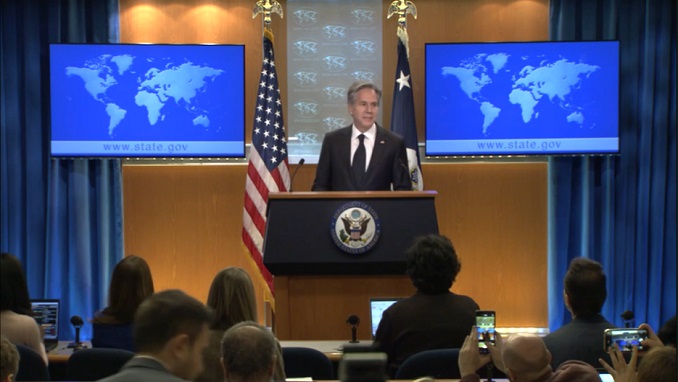
US Secretary of State Antony Blinken admitted on Thursday that the much-criticized withdrawal from Afghanistan, which he called “America’s longest war,” helped Washington redirect resources to Ukraine just months later.


Appearing at the State Department for a year-end press conference, Blinken painted a rosy picture of Washington’s diplomatic accomplishments. The exit from Afghanistan, which happened in August 2021, came up because one reporter took issue with Blinken’s claim of strong relationships with US “allies and partners,” some of whom she said were critical of how that US handled that operation.

Consultations were “sustained, they were intense, and we strongly took note of everything that we heard from allies and partners in advance of the decisions that President [Joe] Biden made and that we made,” Bliken insisted, arguing that claims otherwise are “not born out by the facts.”

Though the reporter had asked about lessons of that withdrawal in “dealing with Russia and China,” Blinken proceeded to argue that “if we were still in Afghanistan, it would have, I think, made much more complicated the support that we’ve been able to give and that others have been able to give Ukraine” against Russia.

The last US soldier departed from the Kabul airport on August 31, 2021. The US-backed Afghan government had collapsed without much of a fight two weeks earlier, leaving the Taliban in control of the country – as they had been in 2001.

While the cost of the 20-year conflict has been estimated at over $2 trillion, the US spent almost $73 billion in 2021 dollars on training, equipping, maintaining and supplying the Afghan National Defense and Security Forces (ANDSF), most of it from the Pentagon budget. The bulk of ANDSF weaponry and equipment ended up in Taliban hands.

By comparison, the Russian Defense Ministry estimated earlier this week that total Western aid to Ukraine this year amounted to over $97 billion. The Pentagon alone has spent at least $20 billion in direct “security assistance” to Ukraine since February 2022, by its own admission. Other US government departments, NATO and EU members accounted for the rest.

Ukrainian President Vladimir Zelensky visited Washington in person on Wednesday, receiving a pledge from Biden to fund Kiev for “as long as it takes” and a $1.85 billion packet of weapons and ammunition, including a battery of Patriot air defense missiles. Zelensky also addressed a special joint session of Congress, with a plea to approve another $45 billion in aid for 2023. The Senate did so the following day." All

 RELATED CONTENT

focuswashington.com

Afghan Pullout Helped Arm Ukraine, State Secretary Blinken Admits

2 - 3 minutes

"The much-criticized, hectic withdrawal from Afghanistan helped Washington redirect resources to Ukraine just months later, US Secretary of State Antony Blinken admitted on Thursday during his year-end press conference.

Just two weeks after the US-backed Afghan government had collapsed without much of a fight, leaving the Taliban in control of the country like in 2001, the last US soldier departed from the Kabul airport on August 31, 2021.

While Blinken was trying to paint a rosy picture of Washington’s diplomatic accomplishments, one reporter took issue with his claim of strong relationships with US “allies and partners,” which has brought up the exit from Afghanistan.

Although she was actually asking about the lessons learned from that withdrawal in dealing with Russia and China, Blinken proceeded to argue that the US presence in Afghanistan would have made much more difficult the aid and support it gives Ukraine against Russia.


Without exit from Kabul and the war in Afghanistan, which he called “America’s longest war,” Secretary of State Blinken said that aiding Kyiv would’ve been much more complicated.

Last year, the US spent almost $73 billion in 2021 dollars on training, equipping, maintaining, and supplying the Afghan National Defense and Security Forces (ANDSF) – most of it from the Pentagon budget – while the cost of the 20-year conflict has been estimated at over $2 trillion.

The bulk of ANDSF weaponry and equipment, however, ended up in Taliban hands.

By its own admission, since February 2022 the Pentagon alone has spent at least $20 billion in direct “security assistance” to Ukraine while other US government departments, NATO, and EU members accounted for the rest of the aid. . .


www.cgtn.com

Live updates: U.S. announces additional military aid for Ukraine

CGTN
2 minutes

– Ukrainian President Volodymyr Zelenskyy arrived in Washington on Wednesday for his first known overseas trip since the Russia-Ukraine conflict began about 300 days ago.

– U.S. President Joe Biden welcomed Zelenskyy at the White House and announced that the U.S. will send Ukraine a Patriot missile defense system as part of an additional $1.8 billion assistance package.

– Kremlin said providing Ukraine with weapons would not contribute to settling the conflict between Moscow and Kyiv.

– Russian Defense Minister Sergei Shoigu visited troops "on the frontline" and "talked to servicemen and thanked them," Russian Defense Ministry said Thursday. 

– Russian officials and a delegation of the International Atomic Energy Agency held a new round of consultations in Moscow on Thursday on cooperation in ensuring the safety of the Zaporizhzhia nuclear power plant.

– Ukrainian President Volodymyr Zelenskyy arrived in Washington on Wednesday for his first known overseas trip since the Russia-Ukraine conflict began about 300 days ago.

– U.S. President Joe Biden welcomed Zelenskyy at the White House and announced that the U.S. will send Ukraine a Patriot missile defense system as part of an additional $1.8 billion assistance package.

– Kremlin said providing Ukraine with weapons would not contribute to settling the conflict between Moscow and Kyiv.

– Russian Defense Minister Sergei Shoigu visited troops "on the frontline" and "talked to servicemen and thanked them," Russian Defense Ministry said Thursday. 

– Russian officials and a delegation of the International Atomic Energy Agency held a new round of consultations in Moscow on Thursday on cooperation in ensuring the safety of the Zaporizhzhia nuclear power plant.


(The following is a long-read sequencing)

www.belfercenter.org  

Lessons for Leaders: What Afghanistan Taught Russian and Soviet Strategists

Author: Simon Saradzhyan
80 - 102 minutes

Introduction

Thirty years ago this month, Gen. Boris Gromov became the last serviceman of the Soviet 40th Army to cross the Friendship bridge from Afghanistan into Uzbekistan, heralding the end of a Soviet military intervention that had lasted nearly a decade. That intervention, which began in December 1979 (with 30 military advisors and some guards remaining beyond February 1989), did not only fail to firmly anchor Afghanistan to the so-called socialist camp, as the Soviet Politburo had hoped, but contributed to the demise of the USSR by imposing formidable human, financial, economic, political and reputational costs on the already declining empire; needless to say, it caused numerous casualties and widespread grievances among Afghans as well. Debates continue to this day about the full array of national-level, organizational-level and personal-level factors that led the Communist Party leadership—including General Secretary Leonid Brezhnev and a handful of other Politburo members—to adopt a resolution on Dec. 12, 1979, authorizing the deployment of a “limited contingent of Soviet troops” to Afghanistan. However, even with that debate unfinished, the Soviet experience in Afghanistan offers plenty of lessons to explore—some of which can, perhaps, be applied by the U.S. and its allies as Washington leans toward ending its own military campaign in this war-plagued Central Asian country.

The following is a selection of military-political lessons gleaned mostly from the recollections of Soviet strategists who were involved in making and executing the fateful decision to send troops to Afghanistan, as well as from writings by some of post-Soviet Russia’s prominent military analysts. Where possible, the author made an effort to relay these strategists’ analysis of the failures and successes of the intervention because he felt that such assessments, based on first-hand experience, are not always given their due in English-language literature on the subject. The lessons listed below, which are discussed in greater detail in subsequent sections of this research paper, are lined up in the order in which they would have come up—starting with the Soviet leadership’s decision to consider sending a large contingent of troops into Afghanistan, moving onto its management of the actual intervention and, finally, onto its decision to withdraw the troops and beyond. All of these lessons are meant for consideration by nations’ military-political leadership. . ." READ MORE

NYT Columnist Thomas Friedman: “The World Will Push Back” Against Trump ...

    Jan 27, 2026 #amanpourpbs From ICE's violent crackdown in Minneapolis to President ...