Sunday, January 01, 2023

XBB 1.5: New COVID Surge in America for Year 2023


Bright Lights, Big Covid 


by Mark HennonCommunity
6 - 7 minutes

on the night before christmas all through new york streets

nasty critters were stirring making humans their eats

with few masks few vaxes so few people cared

that almost all Americans slept unprepared

for coughing sneezing and stupid brain fog

too tired to stop starting a long covid slog

2020 All Over Again?

New York and New Jersey have fallen to infection by the XBB covid family, the most-contagious and antibody-conquering virus yet.

The XBB family was less than two percent of covid cases two weeks before Thanksgiving, and now they’re over 50 percent on Christmas Eve.

XBB’s most evil spawn, XBB 1.5, pole-vaulted the variant from 20% share-of-cases in those two states to over 50% in just two weeks.

Quick Takeover Mimics 2020 Invasion

XBB 1.5 turned the former covid champions into also-rans. At 22.1% and 19.9%, BQ1 and BQ1.1 lost a combined 20.5% in the two weeks December 10-24. XBB 1.5 also squeezed all nine other variants in CDC Region 2 into smaller shares, relegating pre-BQ champ BA5 down to a paltry 3.7%.

That is some strong stuff. And I predict 1.5 will mushroom in the United States the same way D614G did in 2020, and will go worldwide after gaining huge strength from the antibody resistance of its F486P mutation.

But it won’t be Santa Claus asking 1.5 to guide his sleigh, it’ll be the grinch.

Shades of D614G

The speed and magnitude of the XBB invasion resembles the 2020 covid attack by the D614G variant, which ravaged the East Coast before marching south and west with a relentless infection that killed over 350,000 Americans.

On May 8, 2020, I quoted a Los Alamos National Laboratory report: “The mutation Spike D614G is of urgent concern; after beginning to spread in Europe in early February, when introduced to new regions it repeatedly and rapidly becomes the dominant form. Also, we present evidence of recombination between locally circulating strains, indicative of multiple strain infections.”

XBB 1.5 has all that, on steroids.

On May 23, 2020, this map showed U.S. counties with high covid rates:

CovidCountiesonMay10.2020forBrightLights.png

Colored red for “voted Trump” in 2016 and blue for “voted Clinton,” it shows the path of D614G from New York / New Jersey south to Florida and west to Louisiana. The West Coast got the original Wuhan version, plus some skip-over D614G via airplane from the East (as did Chicago).

Thirty-one months and two weeks later, the “pie” charts on the CDC region map below show XBB infection (purple slices) highest in the northeast, spreading down the East Coast and branching west.

XBB’s taking much the same path D614G did in 2020. Again, with some skip-over via airplane.

Nationally, XBB is now 18.3% of all cases in the United States. That’s up 630% in just the past four weeks.

In the Northeast, XBB is is over 50%, but on the West Coast it’s as low as 5.6%, and 4.1% in Texas. But 4.2% is where XBB was nationally for the week ended December 3. It jumped to 7.1% by Dec. 10, 11.2% at Dec. 17, and now 18.3% on Christmas Eve.

With its firm foothold everywhere in the U.S., I predict

a near-total XBB 1.5 grip on the nation by February 3, 2023.

XBBinCDCregions12.24.22.png

Will XBB 1.5 Be Worse Than Previous Covids?

  • (1) We have the September 2022 vaccines, but only 14.6% of Americans have gotten them.

  • (2) We have antibodies and immunities in us already, but they are out-of-date, worn-out, and weak.
  • (3) We had monoclonal and other treatments, but almost all are useless now, except Paxlovid, the pills you start taking within five days of first covid symptoms.
  • (4) We have plenty of masks, but very few use them.
  • (5) Hospitals have lots of PPE, but nurses and doctors are overworked and stressed by flu, RSV and other diseases.
  • (6) Original XBB was extremely antibody-resistant, and XBB 1.5 is even more elusive, like a stealth bomber, so it figures to hit harder and spread throughout your body more quickly.

So yes, it sure looks bad, especially for all ages in the Long Covid category. Because without vaccine, it’s easier for the most-contagious-ever covid to prosper and spread in your body like metastasizing cancer, and because XBB 1.5 is so impervious to monoclonal treatments, it’s harder to get rid of, hence Long Covid.

1.5 ducks the punches your antibodies and “immunities” blindly throw, because they can’t see it. 1.5 then infects you cell-by-cell, making about 1,000,000 copies of itself in each cell, and soon overwhelms your defenses with sheer (insanely large) numbers. Bad and very bad things happen to you, some of them for a very long time.

Hospitalizations are already up in high-XBB areas. Death rate changes uncertain, but in numbers of actual cases and with Long Covid wrecking lives, brains, and careers, XBB 1.5 is on track to inflict the most destruction of any covid mutant yet.

XBB 1.5 looks like the Balrog of covids, and thanks to Republican refusal to fund medical preparedness and research—we’re not ready for it.

P.S.: My advice: Do what you can to protect yourself ASAP: mask, gloves, shot, distance, disinfect, and make a plan for Paxlovid, the sooner you take it after symptoms, the better.

And spread the word. Please forward this freely.

LINKS:

< https://covid.cdc.gov/covid-data-tracker/#variant-proportions >

< https://www.dailykos.com/stories/2020/5/23/1947089/-Red-State-Covid-Boom-Two-Brutal-Graphics >

< https://www.cdc.gov/nchs/pressroom/podcasts/2022/20220107/20220107.htm >

< https://www.dailykos.com/stories/2020/5/8/1943685/-States-Open-To-Super-Coronavirus >

Socio-Economic Shift


azbigmedia.com

5 Metro Phoenix zip codes switch from homeowner to renter majority - AZ Big Media

RENTCafe
5 - 6 minutes

The American dream of homeownership has been rehashed throughout the past decade, with more households renting than at any point in the last 55 years. Although renting was previously considered an alternative brought on solely by circumstances, one-third of this decade’s renters now say that it’s a matter of choice. In fact, according to our previous study, a diverse set of 23 large and mid-sized cities transitioned from owner- to renter-majority between 2010 and 2020. And five Metro Phoenix zip codes have switched from homeowner to renter majority during that time.


READ ALSO: Ranking Arizona: Top 10 best places to live for 2022


This time, we wondered how these changes might look at the local level. So, we put each of the 50 largest U.S. cities under the magnifying glass and analyzed the renter and owner mix of each zip code. In a first-of-its-kind analysis that uses the most recent data from the U.S. Census Bureau, we wanted to see which zip codes radically changed their structure. In other words, what zip codes do renters prefer? In doing so, we found that 101 zip codes switched to renter-majority in the last 10 years.

With the addition of these communities, renters represent the majority population in 41% or 632 of the 1,553 zip codes analyzed in the 50 largest U.S. cities.


101 Zip Codes Made the Switch From Homeownership Dream to Renter Haven

The number of renters in the U.S. rose by 12% between 2011 and 2020 — three times faster than the 4% increase in homeowners, according to the most recent U.S. Census estimates. Thus, it comes as no surprise that, during this time period, as many as 101 zip codes switched from owner- to renter-majority.

For this report, we compiled the 101 zip codes into a list and ordered them from highest to lowest percentage change in order to get a better view of where the biggest changes in the owner versus renter mix took place.

The first zip code on the list is 43240 in Columbus, OH. About 68% of the people living in Columbus’ 43420 are renters — as a result of a whopping 157% increase in the last 10 years. A densely populated area, the zip code largely overlaps with the Polaris neighborhood, which is home to a community of young renters with a median age of 31. Here, residents earn a per capita income of $43,000 — 25% higher than that of the Columbus metro area, per Census data.

Next up is Chicago’s 60606, which coincides with the West Loop neighborhood. In this area, the number of renters grew by two and a half times in a decade (151%). A thriving community that flaunts a 63% renter population, its residents are mostly Millennials and Gen Zers with high academic achievements.

Zip Codes with Fastest-Growing Renter Populations: Downtown Areas Are the Trendiest for Renters 

Many of the zip codes with the fastest-growing renter populations are located in city cores. Specifically, eight of the 20 neighborhoods that grew their renter populations by more than 80% in the past decade are in or near downtowns. Similarly, our latest report on the top neighborhoods for apartment construction showed a historic boom in centrally located areas in the last five years — a timely response to the increased demand for rentals in these locations.

In this respect, San Antonio, TX is home to the top-trending neighborhood for renters nationwide: zip code 78215 in downtown San Antonio boasting an incredible growth rate of 238% in renter population. Here, the proportion of renters more than tripled, going from a mere 735 in 2011 to 2,482 in 2020.

Downtown Miami follows closely, registering a record 173% increase in zip code 33123. Almost 10,000 renters live in downtown Miami as of the latest Census data. Meanwhile, 3,820 new apartments were built here between 2017 and 2021 in an attempt to accommodate the growing renter community, which is mostly comprised of Millennials and Gen Zers.

Zip code 55415 — located in central Minneapolis, MN, — rounded out the top three with an impressive 162% leap in its number of renters. The Twin City downtown area is more than twice as renter-friendly as it was in 2011. And Minneapolis as a whole is a clear reflection of the same trend, with renter households taking over the city.

Despite the growth that central areas registered in the last 10 years, the pandemic created a temporary downturn for downtowns, with many of them left vacant and desolate as workers moved from the office to home. As such, it remains to be seen if a post-COVID world will bring about a second bounceback — especially if rising numbers of renters continue to pump life into city centers. 


Meanwhile, three of the five cities that are home to the largest numbers of trending renter zip codes are in the South, with Houston, TX leading the way with a total of 16 zips. Dallas, TX and Miami, FL follow closely behind with 12 zip codes each. Breaking the Southern sway are Los Angeles, CA and Chicago, IL with 14 and 12 zip codes, respectively.

Arizona: High Costs-of-Living


azbigmedia.com

Here's how much housing affordability has dropped in Arizona - AZ Big Media

George W. Hammond
6 - 8 minutes

"Flagstaff and Prescott typically have the lowest housing affordability in Arizona, but not this last quarter. In the second quarter 2022, only 22.3% of homes sold in the Phoenix metro were affordable to those earning the median family income according to the National Association of Home Builders (NAHB)/Wells Fargo Housing Opportunity Index released August 11. Nationally, the share of homes affordable to families earning the U.S. median income moved down to 42.8% compared to 56.9% in the first quarter, the lowest since the Great Recession. All Arizona metros had a drop in affordability and only three had a higher share of affordable homes than the nation. These were Sierra Vista-Douglas at 54.2%, Yuma at 43.3%, and Lake Havasu City-Kingman at 42.9%. Tucson at 40.6% was lower than the U.S. for the first time in over a decade. Prescott Valley-Prescott had a share of 28.5% and Flagstaff was at 22.8%. Arizona did better than neighboring state California, which had the metros with the lowest affordability in the country, the worst being Los Angeles at 3.6%.


READ ALSOArizona No. 2 for largest house price appreciation


The inflation rate was 8.5% in July, but lower than the June figure of 9.1% according to the August 10 Consumer Price Index release from the Bureau of Labor Statistics. Core inflation, all items less food and energy, was up 5.9% over the last 12 months. Energy prices fell in July while prices for food and other items such as shelter and medical care were higher, leaving the CPI unchanged for the month on a seasonally adjusted basis. The index for all items less food and energy increased 0.3% over the month.

Use your cursor as a tooltip to switch series ON/OFF at the bottom of the chart. Run your cursor over the chart to view values.

Arizona remains near the bottom of all states when it comes to children’s wellbeing, ranking 44 overall in the 2022 Kids Count Data Book released August 8. The state ranked 40 overall in 2021. Massachusetts (1), New Hampshire (2), and Minnesota (3) were the three top-performing states in the nation for 2022 while New Mexico (50), Louisiana (49) and Mississippi (48) were the bottom-performing states. The index is based on indicators grouped into four categories, economic well-being, education, health, and family and community. Arizona’s rank for economic well-being dropped to 41 in 2022 from 35 in 2021. The state’s education rank remained the same at 47, and health was nearly the same at 29 (was 28 in 2021). Family and community was the only category with an improvement for this year, with Arizona ranking 44 compared to 46 last year.

U.S. nonfarm payroll employment expanded in July by 528,000 on a seasonally adjusted basis. This was much more than the monthly average increase of 388,000 for the prior four months. Total employment is now at its pre-pandemic level though there are sectors that have not yet recovered, including government, which is still below pre-pandemic levels. The largest increases in employment for the month were in leisure and hospitality, which is still below its February 2020 level, and professional and business services, which is above its February 2020 level. The unemployment rate ticked down to 3.5% after sitting at 3.6% for the previous four months. Both the labor force participation rate (62.1%) and the employment-to-population ratio (60.0%) were little changed over the month and remained below what they had been in February 2020, according to the August 5 U.S. Bureau of Labor Statistics release.

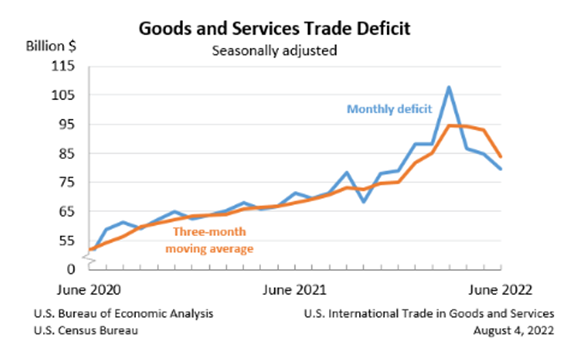
After spiking this March, the U.S. trade deficit has decreased the last three months. The June deficit of goods and services was $79.6 billion, down from a revised May figure of $84.9 billion according to the Aug 4 joint U.S. Census Bureau and U.S. Bureau of Economic Analysis release. Exports rose $4.3 billion to $260.8 billion in June while imports decreased $1.0 billion for the month landing at $340.4 billion. Year-to-date, the deficit was 33.4% higher than the same period a year ago.

US trade deficit May 2022

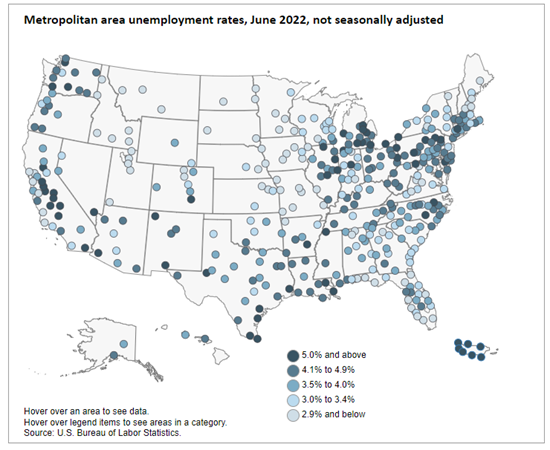
Unemployment rates were lower this June than a year earlier for all metropolitan areas in the U.S. save one, Yuma. Yuma also had the highest metropolitan area unemployment rate in the nation for June at 17.2%, not seasonally adjusted. The lowest jobless rate for the month was in Portsmouth, NH-ME at 1.8% according to the August 3 Bureau of Labor Statistics release. Other Arizona metropolitan area unemployment rates in June were Flagstaff at 4.8%, Lake Havasu City-Kingman at 4.7%, Phoenix at 3.4%, Prescott at 3.4%, Sierra Vista-Douglas at 4.3%, and Tucson at 4.0%.

US metropolitan area unemployment rate June 2022

Phoenix house price gains have been eclipsed by metropolitan areas in Florida and Texas. The top gains in over the year house prices for May were in Tampa (36.1%), Miami (34.0%) and Dallas (30.8%). Phoenix price gains were 29.7% for May based on the S&P CoreLogic Case-Shiller Price Index released July 26. Nationally, house price gains dipped to 19.7% compared to 20.6% in April. The 20-city composite was also lower than the previous month, posting an annual gain of 20.5% in May compared to 21.2% in April. The metropolitan area with the lowest one-year change in house prices for the month was Minneapolis at 11.5%.

Advanced estimate of the second quarter 2022 real gross domestic product (GDP) indicated it decreased at an annual rate of 0.9%. A second estimate with more complete source data will be released on August 25. Real GDP decreased 1.6% in the first quarter 2022.

Arizona nonfarm employment increased 3.6% over June of last year according to the July 21 report from the Arizona Office of Economic Opportunity. Government was the only sector to post a decrease in employment compared to the same month last year, down 100 jobs. Leisure and hospitality along with trade, transportation, and utilities had the largest job gains over the year. Job growth in Arizona’s metropolitan areas for June included 5.8% in Yuma, 5.8% in Flagstaff, 4.0% in Phoenix, 3.8% in Lake Havasu City-Kingman, 3.4% in Prescott, 2.7% in Tucson, and 2.7% in Sierra Vista-Douglas. The state’s unemployment rate was 3.3% in June, up from 3.2% in May. Read more about Arizona’s June employment report in a recent article by George Hammond titled “Arizona’s Labor Market Still Tight in June.”

George W. Hammond, Ph.D., is the director and research professor at the Economic and Business Research Center (EBRC).

Suburban Sprawl: A Fast-Growing Cancer in The Drought-Stricken Desert Environment


azbigmedia.com

Why experts say Arizona housing crisis is a 'growing cancer' - AZ Big Media

Arizona State University
7 - 8 minutes

The housing crisis in Arizona can be defined in many ways. Let’s start with a few numbers:

According to the real estate website Redfin, the median sale price for a Phoenix home rose from $325,000 in January 2021 to $404,300 by October 2021, a 24.4% increase.

The average rental property, in real dollars, was $1,034 in 2017. Today it’s $1,537 — and that’s expected to rise to $2,475 in five years if demand continues to outpace supply.


READ ALSOArizona No. 2 for largest house price appreciation


Economist Elliott Pollack told azcentral.com that “this is the worst housing supply/demand imbalance I’ve ever seen. We’re at the precipice of a very serious problem.”

The solution?

It’s not waiting for the market to self-correct, according to Rashad Shabazz, an associate professor in Arizona State University’s School of Social Transformation.

“We can no longer believe the market is going to take care of this,” Shabazz said. “We can’t have all housing be market-driven. That’s not working, and it hasn’t worked at the beginning. The belief the market is going to correct itself, is going to be the savior … that’s the reason we’re here in the first place.”

Panel looks at Arizona housing crisis

✓ Shabazz was the moderator Thursday in a panel discussion put on by ASU’s Project Humanities to discuss Arizona’s affordable housing crisis. For 90 minutes, the panelists delved into the reasons for the crisis, the impact on homelessness and what needs to be done to address the problem.

Camaron Stevenson, managing editor of the Copper Courier, a civic communications outlet in Arizona, and previously the director of communications at the Arizona Housing Coalition from 2018–2020, said part of the problem is the lack of regulation on landlords.

“There’s no requirements at the state, local or national level for landlords to provide housing at certain price points,” he said. “Their only obligation is to get as much money as they can out of the house.”

✓✓ Stevenson also cited the number of corporations that are buying homes. In 2021, corporations purchased 31% of single-family homes in Arizona, according to CoreLogic, a California-based data analytics firm.

“If you have everything you need to buy a home, you have the loan lined up, the down payment ready to go and you can make a $1,500 a month mortgage, but a large corporation buys the house for cash, there’s nothing you can do, and then you’re renting from that corporation for $2,000 a month,” Stevenson said.

It’s not just a question of affordability but accessibility.

“In 2018, people could have a bought a house. But with the same resources, the same means, the same amount of money they’ve saved, there are not houses available today to pursue at that price point,” Stevenson said.

“Then they might look at other options, places where housing is more affordable but with less accessible services or the school systems might be worse for their kids,” he said.

Nic Smith, vice president for real estate development for Chicanos Por La Causa, said the crisis is in part attributable to the fact supply hasn’t met up with demand. From 2001 to 2010, more than 487,000 new housing units were built in metro Phoenix. From 2011 to 2020, that number decreased to 240,000. Meanwhile, 880,000 new residents are expected to move to the Valley this decade.

But, Smith added, the housing industry is an easy target and home prices are reflective of other societal problems, a point echoed by Joan Serviss, executive director of the Arizona Housing Coalition.

“If you want to drill it down to the simplest nature, houses are going up in price and wages are oftentimes either stagnant or, because of inflationary factors, going down,” Serviss said. “That’s causing an impact not just in evictions but by folks living precariously, working double jobs just to keep up or living on the streets.”

Stevenson called the housing crisis a “growing cancer” that began with discriminatory practices like redlining – “it specifically targeted Black, Latinos and people of color” — but has spread to every segment of society except for the wealthy.

“It’s everywhere,” he said. “People that you see who are unhoused, asking for money or setting up encampments, that’s such a small portion of people who don’t have a place to live. People are living with family members temporarily or living in cars or motels or hotels because they can’t save up enough money for a deposit or they have a conviction on their record.

“Just because someone doesn’t have a place to live or is living out of their car doesn’t mean they don’t have a full-time job. That’s not uncommon. Fifteen or 16 bucks an hour, that pays for food and gas, but that’s not going to get you housing. You see examples of folks working hard and doing everything they can to provide for themselves and their family and it doesn’t really matter.”

Shabazz said one of the hidden costs of the housing crisis is its impact on the environment.

“People are having to drive 30, 40, 50 minutes or even an hour-and-half each way to work every day because the center of economic activity in the Valley is the central corridor and they can’t afford to live there.

✓ “It means people have to get from Maryvale to downtown, or Apache Junction to downtown, and it has this deep carbon impact. It makes our already hot city hotter and produces more smog in a smog-filled city.”

A woman attending the event asked if one possible solution is to allow zoning for cheaper micro homes.

“Right now, frankly, the demand isn’t there,” Smith said. “To propose a project with 200-square-foot or 300-square-foot homes, you have to have a whole lot of people willing to live in a small living space.”

More practically, Stevenson said it’s important for tenants to not only educate themselves as to what rights they have but to advocate for change in the state legislature.

“Find out who represents you and ask for ways to keep landlords in check,” he said. “Right now, there’s no limitations on what landlords can charge, what rent increases can be or how much time they have to give you before you have to move out.”

Stevenson also said it’s critical that public defenders are made available for tenants who are being convicted.

“Over 90% of tenants have no legal representation when they go to court,” he said. “But if someone has legal representation, it drastically increases the chance somebody won’t be evicted.”

The panelists all agreed on one fact: There isn’t an easy or immediate fix for the current crisis.

“The contradictions between work-market forces and the lack of available housing are really conspiring to place people in a very precarious position,” Shabazz said.

GARY NELSON'S 2022 IN-AND-OUT BIG NOTHING-BURGER: The Mesa Tribune


www.themesatribune.com

2022 a year of turmoil, inflation and change

Gary Nelson, Tribune Contributor
9 - 12 minutes

"A mild-mannered East Valley politician took center stage this year in the high-stakes effort to expose the machinations behind Donald Trump’s attempted coup in 2021.

Rusty Bowers, a Republican serving his second stint in the Arizona House and House Speaker since 2019, testified on June 21 before a select committee of the U.S. House.  His story was chilling.

Defying more than two centuries of constitutional tradition, Trump refused to concede his 2020 presidential election and his legal team applied extraordinary pressure on public officials in various swing states in an effort to illegally overturn that result.

One of those states was Arizona, and as House Speaker, Bowers found himself in the crosshairs.

Bowers described the Trump team’s tactics in his June 21 testimony.

He said John Eastman, one of Trump’s lawyers, told him to hold a vote in the Legislature to decertify Arizona’s presidential electors “and let the courts sort it out.”

Bowers said he told Eastman, “You’re asking me to do something that’s never been done in the history of the United States.”

Bowers’ testimony implicated another East Valley politician in Trump’s plot to steal the election, which led to a murderous assault on the U.S. Capitol on Jan. 6, 2021.

Bowers said U.S. Rep. Andy Biggs, R-Ariz., called him the morning of the insurrection and “asked if I would sign on both to a letter that had been sent from my state and/or that I would support a decertification of the electors, and I said I would not.”

Bowers said Trump lawyer Rudy Giuliani never came through with evidence that Biden’s election was fraudulent.

Other witnesses told the committee Biggs was closely involved in planning the rally that led to the Capitol riot. Biggs denied that allegation.

Further, the House committee produced evidence that before Trump left office, presidential pardons were solicited by four of Arizona’s congressional Republicans, with Biggs specifically seeking one for himself. Biggs denied that, too.

Bowers also had to fight in the Legislature to keep Republicans from overturning election results. In February he blocked a bill sponsored by Rep. John Fillmore, R-Apache Junction, that would have allowed the Legislature to overturn elections at will.

Bowers’ effort to defend the American democracy did not sit well with Republican voters. He was trounced by David Farnsworth in the August primary for a seat in the state Senate; Farnsworth had received Donald Trump’s endorsement.

Biggs won re-election to a fourth term in the U.S. House representing Arizona’s Fifth Congressional District.

After losing the primary election in August, Bowers defiantly lashed out at Arizona’s Republican leadership in an interview with The Guardian.

“Taking away the fundamental right to vote, the idea that the Legislature could nullify your election, that’s not conservative. That’s fascist. And I’m not a fascist,” Bowers said.

Still one county

In February a group of Arizona Republican legislators led by a staunch backer of Trump proposed breaking Maricopa County into four smaller ones.

The bill, introduced by Rep. Jake Hoffman, R-Queen Creek, would have split the county into three sections that supported Trump in the 2020 election, leaving one isolated largely Democratic area.

Although the Maricopa County Board of Supervisors is dominated by Republicans, it has drawn the ire of Trump supporters for upholding the 2020 election.

Hoffman was one of 11 Republicans who signed a document falsely claiming to be official electors who planned to cast the state’s Electoral College votes for Trump.

Bowers opposed Hoffman’s bill, one argument being the enormous expense required to build three new sets of county facilities.

Hoffman’s proposal died.

Housing costs soar

Potential homebuyers in the East Valley were stymied by stunningly high prices for even modest dwellings. Then, as prices began to slacken in late spring, steep hikes in mortgage interest rates only prolonged their misery. Rental prices also soared, reflecting an overall housing shortage.

Prominent Valley economist Elliott Pollack told the Gilbert Town Council in February that the housing market merely reflects long-term trends that can’t be fixed easily.

“The first decade of this century, we overbuilt in both single-family homes and apartments,” Pollack said. “The second decade of this century we way underbuilt and we are now at a situation where the vacancy rates for both single-family housing and for apartments are as low as they have ever been.”

The dramatic rise in prices pushed median prices in several East Valley ZIP codes past the $1 million mark.

On the other end of the spectrum, the Maricopa Association of Governments reported in March that it had found more than 5,000 homeless people during a countywide survey in January. That number was 35 percent higher than in 2020.

Some East Valley cities, notably Gilbert and Queen Creek, wrestled with whether to continue allowing the construction of new apartment complexes in the face of pressure from those who preferred neighborhoods featuring expensive single-family homes.

COVID abates

History may note 2022 as the year COVID-19 faded into the background even as its toll continued to mount.

In January, Arizona became the 11th state to record 25,000 deaths from the pandemic. By late in the year the statewide toll was approaching 32,000. Breakdowns by city were not available but Maricopa County had reported more than 18,000 deaths over the course of the pandemic, which broke out in early 2020.

Water, water… anywhere?

A wet monsoon season notwithstanding, Arizona grappled with the long-term effects of a megadrought that began when the century did.

The situation on the Colorado River now is dire.

By late summer, Lake Powell held less water than at any time since it was filled more than half a century ago. Lake Mead also was far below capacity.

With the seven states that use Colorado River water bickering over how to deal with the shortfalls, East Valley cities and farmers contemplated the impact of reductions in their allotments from the Central Arizona Project, which siphons water from the river and delivers it as far away as Tucson.

Mesa, for example, expects to lose 7,000 acre-feet, or about 16 percent of the city’s share of Colorado River water, in 2024.

In the short term, cities are confident that they can deliver water to a still-growing population, relying on diversified water portfolios that include not only the CAP but also the Salt River Project system and groundwater.

Farmers have less to fall back on, and some in Pinal County said economic ruin could result from a lack of water for their crops.

And it’s far from a free ride for the cities, where the cost of delivering water is staggering, and growing. The Mesa City Council learned late this past summer that the price tag for three major water infrastructure projects has ballooned to a stunning $674 million.

Meanwhile, Queen Creek approved a $21-million deal to purchase Colorado River water from GSC Farm in Cibola that will yield 2,033 acre-feet of water annually for the town through the Central Arizona Project canal system. That would satisfy the water needs of at least 4,066 homes a year and possibly as many as about 6,000.

Goodbye to 2 mayors

Queen Creek Mayor Gail Barney, whose public service had an impact far beyond the town that was his home since he was 6 months old, died June 2 after a months-long battle with a lung infection. He was 74.

Barney’s 20 years on the Town Council were marked by unprecedented growth and development for what had been a sleepy ranching community. His impact reached across the region due to his involvement with other entities such as Phoenix-Mesa Gateway Airport.

Former Mesa Mayor Keno Hawker, who spent a total of 18 years on city council before leaving office in 2008, died in October at age 76.

Hawker spearheaded initial formal planning efforts for Mesa’s rapidly developing Gateway area. He also championed the first leg of light rail into Mesa, which led to two extensions that helped infuse new life into downtown.

Mesa Headlines

•Bell Bank Park, a 320-acre amateur and youth sports complex, opened in January at Ellsworth and Pecos roads. By autumn, however, revenue had fallen far short of projections and the project appeared to be going into default.

•Arizona State University’s downtown Mesa campus opened for the 2022-23 academic year. Sidney Poitier, the Oscar-winning namesake of the university’s film school, died in January.

•Cactus League baseball season took a hit when a 99-day lockout by Major League Baseball owners wiped out half of the spring-training games.

•Mesa native Troy Kotsur won the Academy Award for best supporting actor for his role in CODA. He is the second deaf actor to ever win an Oscar.

•Gary Ernst, who in 38 years of coaching at Mountain View High School became Arizona’s all-time winningest basketball coach, was fired without explanation. A public uproar over the firing was to no avail.

•Former City Councilman Scott Somers won election to his old District 6 seat to replace term-limited Kevin Thompson. Jenn Duff won a November runoff election to retain her District 4 seat. And Alicia Goforth was unopposed to replace David Luna in Council District 5.

•Mesa Public Schools issued new guidelines for accommodating transgender and gender-non-comforming students in schools July 14, triggering critics who say the district’s diversity and inclusion initiatives are going too far. The school district said it was simply following federal guidelines.

•Voters gave landslide approval in November to a $157 million general-obligation bond package for public safety.

An Unusual Year It Was. . . 2022


finance.yahoo.com

2022 was an unusual year for the stock market 📉

Sam Ro
9 - 11 minutes

This post was originally published on TKer.co

The S&P 500 closed Friday at 3,839.50, down 19.4% for the year. This makes 2022 the worst year for the S&P since 2008 and the fourth-worst year since the index’s launch 1957.¹

(Source: Yahoo Finance)

(Source: Yahoo Finance)

While it may be the case that the stock market usually goes up, 2022 was a reminder it doesn’t always go up. This is just part of the deal when it comes to successful long-term investing. The road to stock market riches comes with lots of ups and downs.

According to data compiled by Carson Group’s Ryan Detrick, the S&P 500 has had a positive year 71% of the time. It’s an incredible track record, but it isn’t perfect.

(Source: Carson Group)

(Source: Carson Group)

If history is a guide, then the odds favor positive returns in 2023. According to Detrick’s data, the S&P follows a negative year with a positive year 80% of the time with an average gain of 15%.

Again, the track record isn’t perfect. While it’s unusual for the S&P to see two consecutive years of negative returns, it’s not unprecedented. It happened after 1973 and 2000, and the subsequent year’s returns actually got worse.

(Source: Carson Group)

(Source: Carson Group)

TKer’s best insights about the stock market 📈

  • 10 truths about the stock market 📈The stock market can be an intimidating place: It’s real money on the line, there’s an overwhelming amount of information, and people have lost fortunes in it very quickly. But it’s also a place where thoughtful investors have long accumulated a lot of wealth. The primary difference between those two outlooks is related to misconceptions about the stock market that can lead people to make poor investment decisions.

  • Stomach-churning stock market sell-offs are normal🎢 Investors should always be mentally prepared for some big sell-offs in the stock market. It’s part of the deal when you invest in an asset class that is sensitive to the constant flow of good and bad news. Since 1950, the S&P 500 has seen an average annual max drawdown (i.e., the biggest intra-year sell-off) of 14%.

  • Wall Street's 2023 outlook for stocks 🔭 I wouldn’t bet everything on a one-year prediction.Keep in mind that recent stock market performance won’t tell you what’ll happen in the coming months. Knowing where earnings are headed next year won’t necessarily tell you where stocks are headed. And while we’re on the subject of prices and earnings, the price/earnings ratio won’t tell you what’s coming next year, either. However, we do know that the stock market usually goes up in most years, and the long game is undefeated. And when you’re investing in stocks, time is a valuable edge.

  • How stocks performed when the yield curve inverted ⚠️ There’ve been lots of talk about the “yield curve inversion,” with media outlets playing up that this bond market phenomenon may be signaling a recession. Admittedly, yield curve inversions have a pretty good track record of being followed by recessions, and recessions usually come with significant market sell-offs. But experts also caution against concluding that inverted yield curves are bulletproof leading indicators.

  • How the stock market performed around recessions 📉📈 Every recession in history was different. And the range of stock performance around them varied greatly. There are two things worth noting. First, recessions have always been accompanied by a significant drawdown in stock prices. Second, the stock market bottomed and inflected upward long before recessions ended.

  • In the stock market, time pays ⏳ Since 1928, the S&P 500 generated a positive total return more than 89% of the time over all five-year periods. Those are pretty good odds. When you extend the timeframe to 20 years, you’ll see that there’s never been a period where the S&P 500 didn’t generate a positive return.

  • 700+ reasons why S&P 500 index investing isn't very 'passive'💡 Passive investing is a concept usually associated with buying and holding a fund that tracks an index. And no passive investment strategy has attracted as much attention as buying an S&P 500 index fund. However, the S&P 500 — an index of 500 of the largest U.S. companies — is anything but a static set of 500 stocks. From January 1995 through April 2022, 728 tickers have been added to the S&P 500, while 724 have been removed.

  • The key driver of stock prices: Earnings💰 For investors, anything you can ever learn about a company matters only if it also tells you something about earnings. That’s because long-term moves in a stock can ultimately be explained by the underlying company’s earnings, expectations for earnings, and uncertainty about those expectations for earnings. Over time, the relationship between stock prices and earnings have a very tight statistical relationship.

  • When the Fed-sponsored market beatings could end 📈 At some point in the future, we’ll learn a new bull market in stocks has begun. Before we can get there, the Federal Reserve will likely have to take its foot off the neck of financial markets. If history is a guide, then the market should bottom weeks or months before we get that signal from the Fed.

  • What a strong dollar means for stocks 👑 While a strong dollar may be great news for Americans vacationing abroad and U.S. businesses importing goods from overseas, it’s a headwind for multinational U.S.-based corporations doing business in non-U.S. markets.

  • Economy ≠ Stock Market 🤷‍♂️ The stock market sorta reflects the economy. But also, not really. The S&P 500 is more about the manufacture and sale of goods. U.S. GDP is more about providing services.

  • Stanley Druckenmiller's No. 1 piece of advice for novice investors 🧐 …you don't want to buy them when earnings are great, because what are they doing when their earnings are great? They go out and expand capacity. Three or four years later, there's overcapacity and they're losing money. What about when they're losing money? Well, then they’ve stopped building capacity. So three or four years later, capacity will have shrunk and their profit margins will be way up. So, you always have to sort of imagine the world the way it's going to be in 18 to 24 months as opposed to now. If you buy it now, you're buying into every single fad every single moment. Whereas if you envision the future, you're trying to imagine how that might be reflected differently in security prices.

  • Peter Lynch made a remarkably prescient market observation in 1994 🎯 Some event will come out of left field, and the market will go down, or the market will go up. Volatility will occur. Markets will continue to have these ups and downs. … Basic corporate profits have grown about 8% a year historically. So, corporate profits double about every nine years. The stock market ought to double about every nine years… The next 500 points, the next 600 points — I don’t know which way they’ll go… They’ll double again in eight or nine years after that. Because profits go up 8% a year, and stocks will follow. That's all there is to it.

  • Warren Buffett's 'fourth law of motion' 📉 Long ago, Sir Isaac Newton gave us three laws of motion, which were the work of genius. But Sir Isaac’s talents didn’t extend to investing: He lost a bundle in the South Sea Bubble, explaining later, “I can calculate the movement of the stars, but not the madness of men.” If he had not been traumatized by this loss, Sir Isaac might well have gone on to discover the Fourth Law of Motion: For investors as a whole, returns decrease as motion increases.

  • 'Past performance is no guarantee of future results,' charted 📊 S&P Dow Jones Indices found that funds beat their benchmark in a given year are rarely able to continue outperforming in subsequent years. According to their research, 29% of 791 large-cap equity funds that beat the S&P 500 in 2019. Of those funds, 75% beat the benchmark again in 2020. But only 9.1%, or 21 funds, were able to extend that outperformance streak into 2021.

  • One stat shows how hard it is to pick market-beating stocks 🎲 Picking stocks in an attempt to beat market averages is an incredibly challenging and sometimes money-losing effort. In fact, most professional stock pickers aren’t able to do this on a consistent basis. One of the reasons for this is that most stocks don’t deliver above-average returns. According to S&P Dow Jones Indices, only 22% of the stocks in the S&P 500 outperformed the index itself from 2000 to 2020. Over that period, the S&P 500 gained 322%, while the median stock rose by just 63%.

¹ Data via S&P Dow Jones Indices:

Data via S&P Dow Jones Indices.

Data via S&P Dow Jones Indices.

This post was originally published on TKer.co

Sam Ro is the founder of TKer.co. Follow him on Twitter at @SamRo

PROPAGANDA WARS FOR HEARTS & MINDS

 “The United States deliberately misleads public opinion … in an attempt to confuse the international audience, . ." Tian Julin, a spokesperson for China’s defence ministry, said the US Indo-Pacific Command had distorted facts about the incident and that it was the US aircraft that had engaged in “dangerous maneuvers” against the Chinese jet.

www.aljazeera.com

China accuses US of ‘slander, hype’ after aircraft clash 


 A still image from a video shot on December 21, 2022, shows a Chinese Navy J-11 fighter jet flying close to a US Air Force RC-135 aircraft in international airspace over the South China Sea [US Indo-Pacific Command via Reuters]
Al Jazeera
3 minutes

Defence ministry says US distorted facts following a confrontation between a Chinese jet and a US plane over the South China Sea.

China’s defence ministry has accused the United States of violating international law and of “slander and hype” following a confrontation between a Chinese fighter jet and an American reconnaissance plane over the contested waters of the South China Sea.

The statement late on Saturday came days after the US military claimed that a Chinese J-11 fighter jet had come within 6 metres (20 feet) of a US RC-135 aircraft on December 21, forcing the latter to take evasive manoeuvres to avoid a collision.

But Tian Julin, a spokesperson for China’s defence ministry, said the US Indo-Pacific Command had distorted facts about the incident and that it was the US aircraft that had engaged in “dangerous maneuvers” against the Chinese jet.

Tian said the US aircraft was conducting intentional close-in reconnaissance on China’s southern coastline when the People’s Liberation Army sent fighter jets to track and monitor the plane.

Despite multiple warnings from the Chinese side, the US aircraft suddenly altered its flight stance in a “dangerous approach movement, which seriously compromised the flight safety of the Chinese military aircraft,” he said.

✓ The defence ministry also released a video of the incident, which it said showed the US aircraft manoeuvring towards the Chinese jet.

“The United States deliberately misleads public opinion … in an attempt to confuse the international audience,” Tian said.

“We solemnly request the US side to restrain the actions of frontline naval and air forces, strictly abide by related international laws and agreements, and prevent accidents in the sea and the air.”

China claims almost the entire South China Sea as its sovereign territory, but parts of it are contested by Vietnam, the Philippines, Malaysia, Taiwan and Brunei.

Trillions of dollars in trade flow every year through the waterway, which also contains rich fishing grounds and gas fields.

US military planes and ships routinely carry out surveillance operations and travel through the region, moves that China says are not good for peace.

Relations between the US and China have been tense, with friction rising between the world’s two largest economies over a range of issues, including Beijing’s human rights record and its claims over the self-ruled island of Taiwan.

Source Al Jazeera and news agencies 

READ MORE 

www.rt.com

Putin gives unusual New Year address 


RT
3 - 4 minutes

Russia’s president has broken years-long tradition, addressing the nation from a military HQ

"Russian President Vladimir Putin delivered his traditional New Year's Eve address on Saturday, speaking to the nation about the challenges the country has faced over the past year and the achievements it has made. The address venue differed drastically from the traditional Kremlin courtyard stand-up shots of the president, with Putin this year recording the annual message at the Southern Military District HQ. During his visit, he also met with top military brass and gave state awards to distinguished soldiers.

The unusually long address primarily revolved around the ongoing special military operation in Ukraine, the large-scale conflict which broke out late in February. The dramatic events have shown that Russia, "our multi-ethnic country has demonstrated its courage and dignity, as it always has during times of trouble," he said, praising the country’s military and common citizens alike.

"Russian soldiers, militia and volunteers are fighting for our homeland, for truth and justice, to ensure peace and security for Russia. All of them are heroes to us. Their burden is the heaviest today. With all of my heart, I wish a Happy New Year to all participants of the special military operation," the president said.

While the outgoing year has been "full of worries and anxiety" and many "tough, but necessary decisions" have been made, the country has made "critical steps towards achieving Russia’s full sovereignty and a vital consolidation of our society," the president said. 

"This was a year of pivotal and fateful events that set the foundation of our common future and our true independence. This is what we are fighting for today. We are protecting our people in our historic lands, new constituent territories of the Russian Federation," the president stated, referring to the four formerly-Ukrainian regions, incorporated into Russia after September referendums.

Not only Russia but the whole world experienced a "significant change" over the past year, Putin said, adding that the efforts to harm Russia made by the collective West, which has been backing Ukraine in the ongoing conflict, have largely failed. The ongoing conflict has been "inspiring for other nations as they aspire to forge an equitable and multipolar world," the president noted.

"Russia has been living under sanctions since the events in Crimea in 2014. Yet this year, an all-out sanctions war has been declared against us. The masterminds behind it expected our industrial, financial and transportation sectors to collapse. This didn’t happen," Putin stressed." 

www.rt.com

How the year 2022 ended the American unipolar era 


RT
6 - 7 minutes

The post-Cold War world had long been crumbling, and after this year, it’s finally gone

The year 2022 is coming to an end. It has been a year which has significant consequences for the future of global geopolitics, and will be remembered as such in the history books.

Specifically, it marked the closing of three decades of American unipolarity, which had begun with the collapse of the Soviet Union in 1991, and forced through a new multipolar world consisting of numerous competing great powers.

When the USSR fell in 1991, the US entered a period of unprecedented dominance whereby it finalized its position as the global hegemon. Its political, economic, and military power was unparalleled, and as such it had free rein to shape the global order to its liking. It is no surprise that in this period, the US did not pursue ‘great power competition’ but actively vested itself in scores of regime-change operations across every continent as it sought to implement what George H.W. Bush described as “the new world order.

This included wars in Iraq, former Yugoslavia, Libya, Afghanistan, and Syria to name but a few. Likewise, it was able to use its undisputed power over institutions such as the United Nations to pile sanctions on smaller countries who defied its will, such as Iran and North Korea. Owing to the hubris of its Cold War victory in the belief in the inevitability of its ideology, or ‘the end of history’, the US during this period did not seek to counter states such as Russia or China precisely because it believed, at least initially, that these states were on a pre-determined path to westernization and liberalization. As such, the US actively promoted globalization through free trade and investment, perceiving them as a vehicle for its own values.

Fast forward to 2022, and the last remnants of these premature hopes have been swept away. Although long in the making, the past 12 months marked the ultimate consolidation of a new geopolitical era. Russia’s military operation in Ukraine proved to be a decisive turning point, which represented the final break from the world established by the fall of the USSR. The main catalyst of this shift was the US itself, which no longer liked what the globalization it was once championing, was now providing. That being the depletion of its hegemony through the resurgence of rival states which did not reform to its liking (Russia and China).

Seeing the rise of these countries, which had through America’s own approval integrated themselves within the global economy and prospered, but not adopted the American values as anticipated, the US veered back towards great power competition and began to provoke geopolitical conflict with a view to reasserting control over its wayward allies. This became extremely obvious in the foreign policy of the Biden administration, which sought to take an uncompromising approach to the expansion of NATO (igniting the conflict in Ukraine), while also aggressively accelerating attempts to contain China through the creation of new alliance systems such as AUKUS and escalating tensions over the Taiwan Strait.

These actions by America have changed the world. While the average Westerner, deceived by the mainstream media discourse, blames Putin, the reality is the US is the one that has actively dismantled the post-Cold War 1991 international order precisely because it believes it now comes at the expense of American power. Part of this is the effort to actively ‘roll back’ globalization. By creating geopolitical conflict, the US strives to reassert its military influence whilst forcing its allies to decouple from the targeted enemy country, even if that comes at a great expense to that ally’s economy. The US has sought to rip up energy markets with Russia, so European countries are forced to buy American gas instead. Likewise, it is bulldozing the entire semiconductor supply chain while forcibly rebuilding it around itself in a bid to isolate China. In doing so, it aims to destroy the integration of certain regions, such as Russia with Europe, China with Asia.

The implications of these actions are huge. As the US tries to reclaim its hegemony, other countries are subsequently forced to increase their national capabilities and strategic autonomy to prevent themselves from being dominated. This has created new arms races, new technology races, and also the expansion of blocs alternate to the West, such as BRICS, the Shanghai Cooperation Organization (SCO), and more. Whether the US likes it or not, this is the reality of the multipolarity it sought to prevent in the first place. The world now increasingly resembles what it looked like before 1914, or worse, before 1939, where there are not just two rival great powers, but a plethora of nations scrambling for influence. While the US strives to maintain its hegemony, it faces off against the challengers of China and Russia, but there are other rising powers too, including India and Indonesia.

As such, the year 2022 will stand as a definitive moment of change. The post-1991 world, although long fluttering, is finally gone. The new world is an increasingly uncertain arena of geopolitical conflict, making it less stable, less certain, and more divided than at any point since the end of the Second World War. This isn’t a new Cold War as such, it’s a new great game."

The statements, views and opinions expressed in this column are solely those of the author and do not necessarily represent those of RT.

Most Read

X

Cartoon Carousel The nation’s cartoonists on the week in politics | By POLITICO STAFF 01/23/2026 05:00 AM EST

Every week political cartoonists throughout the country and across the political spectrum apply their ink-stained skills to capture the fo...