Tuesday, February 21, 2023

SAY WHAT??? Feds fine Mormon church $5M for hiding $32B using shell companies

The SEC’s order provides rare insight into how Ensign Peak, which is thought to manage more than $100bn on behalf of the Mormon church, seeks to keep its investments and their value hidden from public view.

The Salt Lake City-based adviser, founded by the Mormon church in 1997, created 13 shell companies with locations throughout the US. Between 1997 and 2019, these companies rather than Ensign Peak filed 13F forms, according to the regulator.

“Ensign Peak developed its approach to filing forms 13F in the names of these LLCs with the knowledge and approval of the Church, which sought to avoid disclosure of the amount and nature of its assets,” the order states.

The SEC pointed to interactions between Ensign Peak and senior church leaders, including a plea for Ensign “to ensure that neither the ‘Street’ nor the media [could] connect the new entity to Ensign Peak”. Ensign expressed concerns that the shell companies could “attract unwanted attention” as their assets grew.

Ensign Peak, which manages the money the Mormon church receives through donations, is considered to be among the world’s largest investment vehicles. It invests in a wide range of assets, including stocks, bonds and real estate, but little else is known about its operations.

In a statement addressing the SEC settlement, the church said “Ensign Peak received and relied upon legal counsel regarding how to comply with its reporting obligations while attempting to maintain the privacy of the portfolio.” It added that it regretted “mistakes made”.


SEC Charges The Church of Jesus Christ of Latter-day Saints for Disclosure Failures

 
Church of Jesus Christ of Latter-day Saints, Its Investment Adviser Settle SEC Probe - Reddit

www.reddit.com › exmormon › comments
11 hours ago · Church of Jesus Christ of Latter-day Saints, Its Investment Adviser Settle SEC Probe ... That is potentially a larger issue than the monetary fines. 


finchannel.com

SEC Charges The Church of Jesus Christ of Latter-day Saints for Disclosure Failures

The FINANCIAL Since 2005
3 - 4 minutes

Crime Police

The Securities and Exchange Commission today announced charges against Ensign Peak Advisers Inc., a non-profit entity operated by The Church of Jesus Christ of Latter-day Saints to manage the Church’s investments, for failing to file forms that would have disclosed the Church’s equity investments, and for instead filing forms for shell companies that obscured the Church’s portfolio and misstated Ensign Peak’s control over the Church’s investment decisions. The SEC also announced charges against the Church for causing these violations. To settle the charges, Ensign Peak agreed to pay a $4 million penalty and the Church agreed to pay a $1 million penalty.

The SEC’s order finds that, from 1997 through 2019, Ensign Peak failed to file Forms 13F, the forms on which investment managers are required to disclose the value of certain securities they manage. According to the order, the Church was concerned that disclosure of its portfolio, which by 2018 grew to approximately $32 billion, would lead to negative consequences. To obscure the amount of the Church’s portfolio, and with the Church’s knowledge and approval, Ensign Peak created thirteen shell LLCs, ostensibly with locations throughout the U.S., and filed Forms 13F in the names of these LLCs rather than in Ensign Peak’s name. The order finds that Ensign Peak maintained investment discretion over all relevant securities, that it controlled the shell companies, and that it directed nominee “business managers,” most of whom were employed by the Church, to sign the Commission filings. The shell LLCs’ Forms 13F misstated, among other things, that the LLCs had sole investment and voting discretion over the securities. In reality, the SEC’s order finds, Ensign Peak retained control over all investment and voting decisions.

“We allege that the LDS Church’s investment manager, with the Church’s knowledge, went to great lengths to avoid disclosing the Church’s investments, depriving the Commission and the investing public of accurate market information,” said Gurbir S. Grewal, Director of the SEC’s Division of Enforcement. “The requirement to file timely and accurate information on Forms 13F applies to all institutional investment managers, including non-profit and charitable organizations.”

Ensign Peak agreed to settle the SEC’s allegation that it violated Section 13(f) of the Securities Exchange Act of 1934 and Rule 13f-1 thereunder by failing to file Forms 13F and for misstating information in these forms. The Church agreed to settle the SEC’s allegation that it caused Ensign Peak’s violations through its knowledge and approval of Ensign Peak’s use of the shell LLCs.

Paul Feindt conducted the SEC’s investigation under the supervision of Tracy Combs and Tanya Beard of the Salt Lake Regional Office and Laura Metcalfe of the Denver Regional Office

3 hours ago · The overarching drive of The Church of Jesus Christ of Latter-day Saints to keep the ... the Utah-based faith and its investment arm, Ensign Peak Advisors, ...
11 hours ago · Ensign Peak Advisers Inc. is the title of the fund. While failing to file the proper forms


11 hours ago · Ensign Peak Advisors Inc. Filed Forms that Obscured Mormon Church's Investments in $32 Billion Portfolio, the SEC Says. 

news4sanantonio.com

Feds fine Mormon church $5M for hiding $32B using shell companies 


DANIELLE MACKIMM | KUTV Staff
4 - 5 minutes

SALT LAKE CITY (KUTV) — The Church of Jesus Christ of Latter-day Saints in conjunction with its investment management company agreed to pay a combined $5 million Tuesday to settle charges placed upon the religious organization by the Security and Exchange Commission concerning the church's previous failure to accurately report on its multibillion-dollar stock portfolio.

According to the order of cease-and-desist issued by the SEC Feb. 21, Ensign Peak Advisers Inc., a Church of Jesus Christ of Latter-day Saints organization created to manage the Church's investments, deceived benefactors along with the public as a whole by failing to file forms which would have disclosed the Church's equity investments between 1997 and 2019. The investment portfolio had reportedly reached $32 billion by 2018.

Rather than filing forms with the SEC in the company's name, court documents stated that Ensign Peak would file its 13F forms under a different Limited Liability Company created by The Church in order to "avoid disclosure of the amount and nature of its assets."

In the settlement reached Tuesday, the church agreed to pay forth $1 million while Ensign Peak agreed on $4 million.

We allege that the LDS Church’s investment manager, with The Church’s knowledge, went to great lengths to avoid disclosing The Church’s investments, depriving the Commission and the investing public of accurate market information,” Gurbir S. Grewal, Director of the SEC’s Division of Enforcement was quoted saying in a statement issued by the SEC Tuesday. “The requirement to file timely and accurate information on Forms 13F applies to all institutional investment managers, including non-profit and charitable organizations," he added.

Church leaders confirmed that Ensign Peak has corrected its reporting approach since 2019 in a statement issued Tuesday, writing, "In June 2019, the SEC first expressed concern about Ensign Peak’s reporting approach. Ensign Peak adjusted its approach and began filing a single aggregated report. Since that time, 13 quarterly reports have been filed in full accordance with SEC requirements."

The statement continued, reading, "This settlement relates to how the forms were filed previously. Ensign Peak and The Church have cooperated with the government over a period of time as we sought resolution. We affirm our commitment to comply with the law, regret mistakes made, and now consider this matter closed."

FULL CHURCH STATEMENT:

"The Church of Jesus Christ of Latter-day Saints and its affiliated investment manager, Ensign Peak Advisors, Inc., have settled a matter with the Securities and Exchange Commission (SEC).

"Investment managers who oversee a portfolio of public equities above a certain threshold are required to file Forms 13F with the SEC quarterly. These forms publicly disclose the names of the securities and their values.

"Since 2000, Ensign Peak received and relied upon legal counsel regarding how to comply with its reporting obligations while attempting to maintain the privacy of the portfolio. As a result, Ensign Peak established separate companies (LLCs) that each filed Forms 13F instead of a single aggregated filing. Ensign Peak and the Church believe that all securities required to be reported were included in the filings by the separate companies.

"In June 2019, the SEC first expressed concern about Ensign Peak’s reporting approach. Ensign Peak adjusted its approach and began filing a single aggregated report. Since that time, 13 quarterly reports have been filed in full accordance with SEC requirements.

"This settlement relates to how the forms were filed previously. Ensign Peak and the Church have cooperated with the government over a period of time as we sought resolution.

"We affirm our commitment to comply with the law, regret mistakes made, and now consider this matter closed."

7 hours ago · Ensign Peak Advisors filed forms that obscured the church's investments in a $44 billion U.S. equities portfolio, SEC says.
12 hours ago · Ensign Peak Advisors Inc., the money manager, and the church settled the SEC's investigation without admitting or denying wrongdoing. What's News. See More ...
12 hours ago · To settle the charges, Ensign Peak agreed to pay a $4 million penalty and the Church agreed to pay a $1 million penalty. The SEC's order finds that, from 1997 ...
11 hours ago · The Church of Jesus Christ of Latter-day Saints and the company that manages its stock investments have agreed to pay a combined $5 million offer of ...
8 hours ago · The Church of Jesus Christ of Latter-day Saints and its investment arm, Ensign Peak Advisers Inc., agreed to pay a total of $5 million to settle a US ...
7 hours ago · Regulators had accused the Church of Jesus Christ of Latter-day Saints and Ensign Peak Advisors of trying to obscure the size of the church's vast ...
5 hours ago · A US financial watchdog fined the Church of Jesus Christ of Latter-day Saints and its investment arm $5 million for using shell companies to avoid giving ...
6 hours ago · The Church of Jesus Christ of Latter-day Saints (LDS) and its investment management company have agreed to pay a combined $5 million to settle charges they ...
7 hours ago · The Mormon Church and its investment management company, Ensign Peak Advisers Inc., have agreed to pay a combined $5 million to settle charges.
8 hours ago · Posted: 10 minutes ago // Feb. 21, 2023 7:46 p.m. UTC. The Church of Jesus Christ of Latter-day Saints and its investment arm, Ensign Peak Advisers, ...


www.wsj.com

Church of Jesus Christ of Latter-day Saints, Its Investment Adviser Settle SEC Probe

Dave Michaels and Jonathan Weil
1 minute

Ensign Peak Advisors filed forms that obscured the church’s investments in a $44 billion U.S. equities portfolio, SEC says

WASHINGTON—Ensign Peak Advisors Inc., which oversees a $44 billion U.S. equities portfolio for the Church of Jesus Christ of Latter-day Saints, will pay $4 million to settle regulatory claims that the money manager obscured the church’s investment holdings. 

The Mormon Church will also pay a $1 million fine, the Securities and Exchange Commission said Tuesday. The money manager and the church settled the SEC’s investigation without admitting or denying wrongdoing.

21 February 2023: Street logs worst day in over 2 months on rate

"With inflation still far from the Fed's 2% target, and the economy retaining much of its vigor, money market participants have been revising upwards where they see the Fed fund rates peaking - currently at 5.35% in July and staying near those levels throughout the year. 

"Today, the realization is that the Fed is not kidding around about higher for longer, and in fact it might be a little bit higher for a little-to-a-lot bit longer," said Carol Schleif, chief investment officer at BMO Family Office.

U.S. stocks had an upbeat start to the year after their worst annual showing in more than a decade in 2022, as investors hoped the central bank's rate-hike cycle was nearing its end. Such positivity makes equity markets susceptible to pull-backs though, when data undermines such expectations.

"The market keeps looking for a dovish pivot, and they are just not going to get it," said Schleif.

READY TO READ MORE >  


Dec 30, 2022 · Nouriel Roubini sees at least five major challenges that will create new cost pressures in the years ahead.


1 hour ago · Feb 21 (Reuters) - Wall Street posted its worst performance of the year on Tuesday, with the main benchmarks ending down as investors interpreted a rebound ...


Video for worst day in two years on the stock market
Duration: 13:36
Posted: 4 hours ago
www.ft.com

US stocks record worst day in two months on rate rise worries 


Martha Muir, Jaren Kerr, Kate Duguid
1 - 2 minutes

"US stocks recorded their worst day in two months on Tuesday, as investors were unnerved by economic data suggesting interest rates have further to rise after months of increases by the Federal Reserve.

The blue-chip S&P 500 index ended down 2 per cent, with declines in every sector. The tech-heavy Nasdaq Composite slid 2.5 per cent. Both indices had their steepest daily losses since December 15.


The Vix index, a measure of stock market volatility and often dubbed Wall Street’s “fear gauge”, rose above 23, its second highest level of the year.

Markets have wobbled in recent days as investors gird for further interest rate rises from the Fed to combat inflation in the US economy. Yields on benchmark Treasury bonds reached three-month highs on Tuesday.

“The reason for the sell-off in the stock market is a reassessment of the [US Federal Reserve’s] path and the stark rise in Treasury rates,” said Lou Brien, strategist at DRW Trading. “The move higher in Treasury yields reinforces the Fed being tighter for longer.”

✓ Benchmark 10-year Treasuries slid, pushing yields up to 3.95 per cent — their highest since early November. Interest rate-sensitive two-year notes yielded 4.73 per cent, approaching levels last hit in November, which were the highest since 2007.

✓ S&P Global’s US composite purchasing managers’ index registered a reading of 50.2, an eight-month high that beat market expectations of 47.5, according to data released on Tuesday. That was mirrored by other bullish readings in the eurozone earlier in the day. A level above 50 indicates industry growth.

The data followed strong US payrolls and retail sales figures in recent weeks.

“Expectations of rate cuts later in the year were never very realistic,” said Michael Metcalfe, head of macro strategy at State Street Global Markets. “There was an assumption that tightening would start to limit growth, and now people seem to have flipped from expecting a recession to a boom in a short period of time, based on a few releases which, granted, all say the same thing.”

In Europe, the benchmark Stoxx 600 closed down 0.2 per cent and Germany’s Dax shed 0.5 per cent after the S&P surveys for the eurozone also indicated private sector activity in the bloc was better than expected.

Investors were now more focused on interest rates than the prospect of stronger profits because of robust economic activity, said Neil Birrell, chief investment officer at asset manager Premier Miton. “People thought the end was in sight and there was some certainty, but every time we get a number like [the European PMI] it worries investors.”

Olli Rehn, a governing council member of the European Central Bank, on Monday said rates would peak during the summer, but that inflation was “excessively high”.

“With inflation so high, further rate hikes beyond March seem likely, logical and appropriate . . . I assume that we will reach the ‘terminal rate’ in the course of the summer,,” he said.

✓ The yield on the 10-year German Bund rose as much as 0.01 percentage points to 2.56 per cent, closing at its highest point since the eurozone debt crisis in the summer of 2011.

Brent crude settled 1.2 per cent lower to $83.05 a barrel, while the US equivalent WTI lost 0.2 per cent to $76.16, with both benchmarks falling further after making slight losses last week.

✓ In Asia, the Hang Seng index fell 1.7 per cent, while China’s CSI 300 gained 0.3 per cent after rising 2.45 per cent on Monday, its best one-day performance since late November. The index has risen 6.6 per cent this year."

Additional reporting by Jennifer Hughes in New York

READ MORE 


global.chinadaily.com.cn

Wall Street logs worst day in over 2 months on rate fears

代艳
3 - 4 minutes

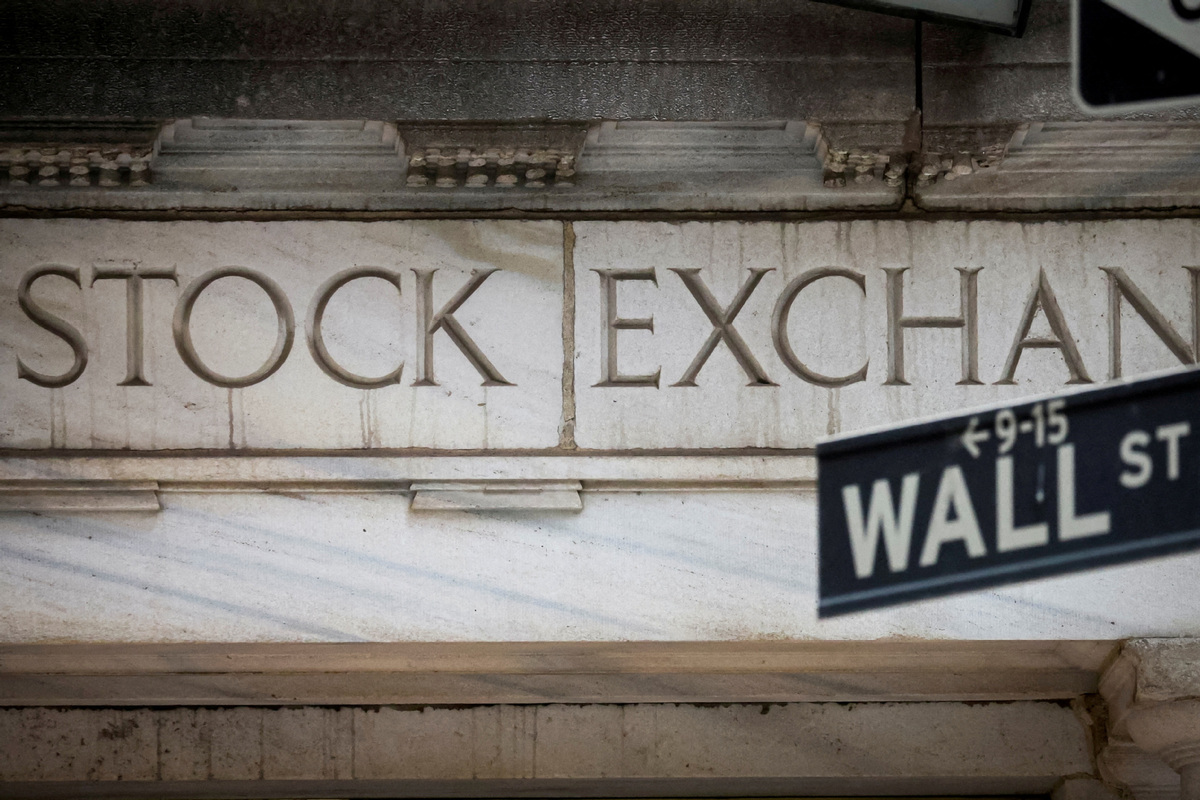
FILE PHOTO: The Wall Street entrance to the New York Stock Exchange (NYSE) is seen in New York City, US, Nov 15, 2022. [Photo/Agencies]

NEW YORK -- Wall Street's major averages fell sharply on Tuesday as investors fretted over the prospects of higher interest rates.

The Dow Jones Industrial Average plunged 697.10 points, or 2.06 percent, to 33,129.59. The S&P 500 sank 81.75 points, or 2 percent, to 3,997.34. The Nasdaq Composite Index shed 294.97 points, or 2.5 percent, to 11,492.3.

The three major indexes booked their worst daily percentage declines since Dec. 15, according to FactSet data.

All the 11 primary S&P 500 sectors ended in red, with consumer discretionary and technology down 3.34 percent and 2.4 percent, respectively, leading the slide.

The Cboe Volatility Index, widely considered as the best fear gauge in the stock market, surged 7.72 percent to 22.87.

The market sell-off came as latest US economic data fueled worries that interest rates will need to stay higher for longer to tame inflation.

A survey released Tuesday by S&P Global showed that flash US manufacturing PMI (Purchasing Managers' Index) rose to 47.8 in February from the prior month's reading of 46.9.

The S&P Global flash US services business activity index posted 50.5 in February, up from 46.8 in January, and signaled the first expansion in service sector output since June 2022.

Last week, the January US Consumer Price Index and Producer Price Index showed inflation inching higher, dashing hopes of an early end to rate hikes.

"Concerns that the Federal Reserve will need to hike rates further and hold them there for longer appeared prominent in investors' minds," UBS analysts said in a note on Tuesday.

The Fed has raised its policy rate by 450 basis points since last March from near zero to a range of 4.5-4.75 percent. Top Fed officials have stressed that more needs to be done to curb inflation.

St. Louis Fed President James Bullard said last week that he pushed for a higher interest rate increase at the last meeting and could see a more aggressive move ahead.

Cleveland Fed President Loretta Mester said she "saw a compelling economic case" for a 50 basis-point increase at the recent meeting, noting the US central bank has to be prepared to move higher if inflation remains stubbornly high.

Markets had been pricing in two 25 basis point interest rate hikes for this year, but recent data had investors to price in a potential third interest rate hike, according to strategists at LPL Financial Research.

"What has caught the market's attention, however, is the slight probability for a 50 basis point rate hike at the March meeting has been climbing higher," they said on Tuesday, adding that this week's release of the Fed's preferred inflation index, the Personal Consumption Expenditures Price Index, "will be especially important in forecasting the Fed's next policy decision."

The Fed on Wednesday is set to publish the minutes from its Jan 31-Feb 1 meeting.

US financial markets were closed on Monday due to the Presidents' Day holiday.

For the trading week ending Feb. 17, the Dow slipped 0.13 percent, the S&P 500 fell 0.28 percent, and the technology-heavy Nasdaq rose 0.59 percent.


www.reuters.com

Wall Street posts worst day of 2023 on higher-for-longer rate fears

4 minute read February 21, 20235:36 PM MST Last Updated an hour ago
4 - 6 minutes

  • Summary
  • Companies
  • Biggest daily falls on Wall St since Dec. 15
  • Home Depot falls as FY profit forecast disappoints
  • Big tech stocks hit in widespread decline
  • U.S. business activity expands for first time in 8 months
  • Indexes down: Dow 2.06%, S&P 2%, Nasdaq 2.5%

Feb 21 (Reuters) - Wall Street posted its worst performance of the year on Tuesday, with the main benchmarks ending down as investors interpreted a rebound in U.S. business activity in February to mean interest rates will need to stay higher for longer to control inflation.

For the S&P 500 (.SPX) and Nasdaq Composite (.IXIC), it was their third session in a row closing lower, while the decline in the Dow Jones Industrial (.DJI) wiped out its gains for 2023.

The falls came after the S&P Global Purchasing Manufacturer's index, which reflects business activity in the United States, returned to expansion for the first time in eight months in February. The 50.2 reading, up from 46.8 in January, was buoyed by a robust services sector, according to a survey. . .

Investors will look to the minutes detailing discussion at the Fed's last policy meeting, due out on Wednesday, for further clues on attitudes within the central bank on rates.

The Dow Jones Industrial Average (.DJI) fell 697.1 points, or 2.06%, to 33,129.59, the S&P 500 (.SPX) lost 81.75 points, or 2.00%, to 3,997.34 and the Nasdaq Composite (.IXIC) dropped 294.97 points, or 2.5%, to 11,492.30.

A trader works on the floor of the New York Stock Exchange (NYSE) in New York City, U.S., February 17, 2023. REUTERS/Brendan McDermid

Among those hit by Tuesday's widespread declines were big tech stocks, with Tesla Inc (TSLA.O), Amazon.com Inc (AMZN.O), Microsoft Corp (MSFT.O) and Google-parent Alphabet Inc (GOOGL.O) all falling between 2.1% and 5.3%.

Not helping them was the fact the U.S. benchmark 10-year Treasury notes hit a fresh three-month high.

Higher yields typically weigh on growth stocks, whose valuations tend to be based on future profits that are discounted heavily as rates go higher.

The semiconductor index (.SOX) was also impacted, dropping 3.3%.

Elsewhere, Home Depot Inc (HD.N) slumped 7.1% to a three-month low after the No. 1 domestic home improvement chain warned of weakening demand and issued a dour profit forecast for 2023.

Smaller rival Lowe's Cos Inc (LOW.N) fell 5.1% ahead of its results next week.

Walmart (WMT.N) forecast full-year earnings below estimates and painted a grim picture of hotter-than-expected food inflation squeezing profit margins. However, the world's largest retailer rose 0.6%.

All of the major 11 S&P 500 sectors fell, with the consumer discretionary index's (.SPLRCD) 3.3% decline leading the way.

Volume on U.S. exchanges was 11 billion shares, compared with the 11.62 billion average for the full session over the last 20 trading days.

The S&P 500 posted two new 52-week highs and one new low; the Nasdaq Composite recorded 57 new highs and 112 new lows."

Reporting by Johann M Cherian and Medha Singh in Bengaluru and David French in New York; Editing by Marguerita Choy and Anil D'Silva

RELATED

2 days ago · Instead, core inflation will remain sticky-above 4%. The US Federal Reserve wants to stop around 5% (interest rate) and the European Central Bank (ECB) at about ...

New Report: U.S. Hegemony and Its Perils

From China Global Television Network yesterday

news.cgtn.com

How the U.S. becomes the most warlike nation through military hegemony 


CGTN,China Global Television Network
5 - 6 minutes

"Almost one year has passed since the Russia-Ukraine conflict began in February 2022, but there's still no end in sight. War-weary Ukrainians' hope for peace was dashed again as the U.S. government continues to fuel the war with weapons.

During his surprise visit to Kyiv on Monday, U.S. President Joe Biden announced the U.S. would be providing $500 million in additional military aid to Ukraine, and imposing new sanctions against Russia.

Biden's gesture proves once again the country's military hegemony as highlighted in a new report released on Monday, showing how U.S. hegemony perils world peace and stability.

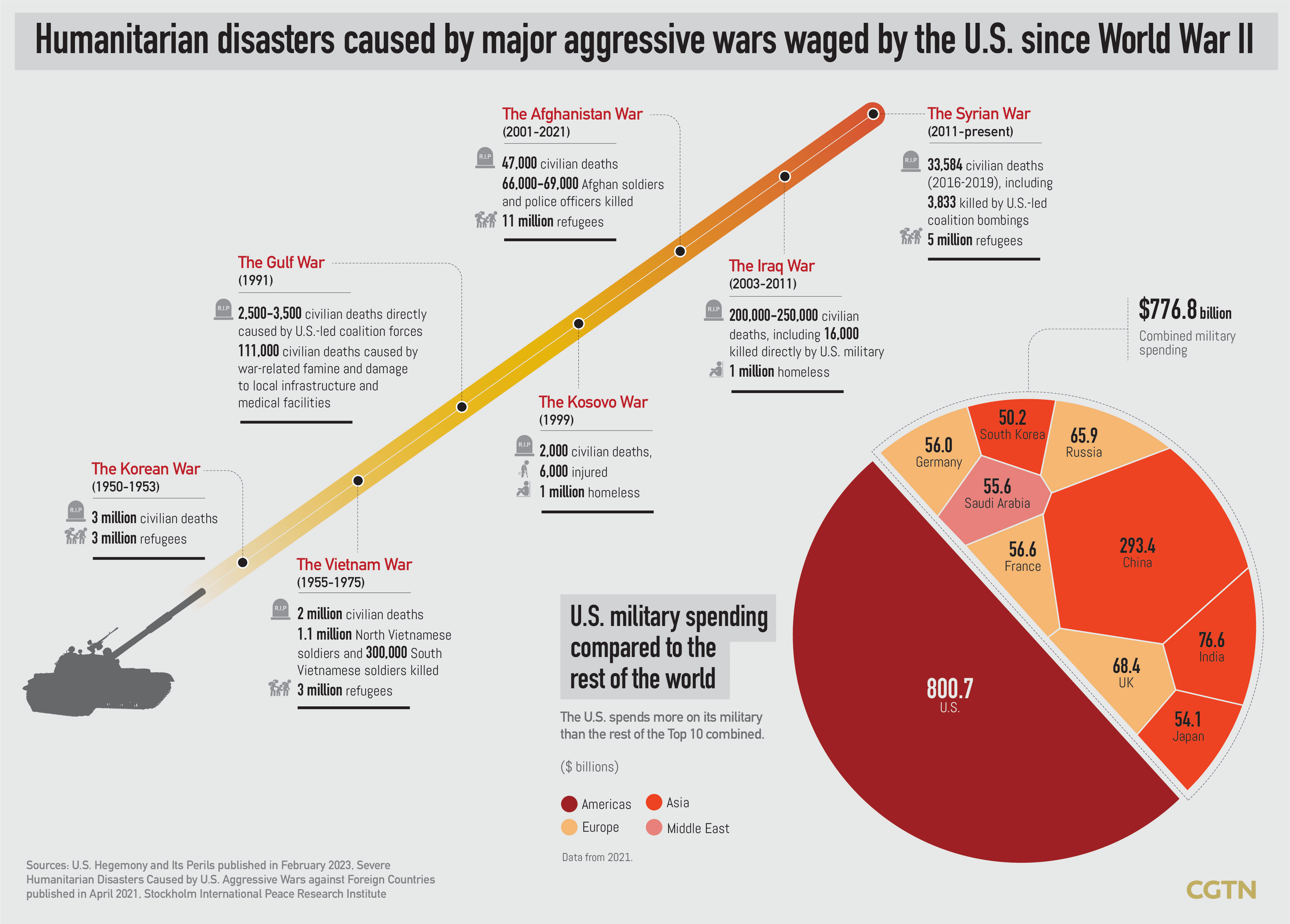
✓ The report says the U.S. average annual military budget has exceeded $700 billion in recent years, accounting for 40 percent of the world's total. The huge amount of money has supported the U.S. government to conduct various military operations across the world for decades.

✓ The U.S. undertook nearly 400 military interventions globally from its founding in 1776 to 2019, 34 percent of which were in Latin America and the Caribbean, 23 percent in East Asia and the Pacific, 14 percent in the Middle East and North Africa, and 13 percent in Europe, the report says, citing data from a Tufts University report.

Alex Lo, a South China Morning Post columnist, pointed out that the U.S. is repeating old tactics it used in the 20th century, waging proxy, low-intensity, and drone wars, in Ukraine, Iraq, Afghanistan, Libya, Syria, Pakistan and Yemen, in order to set up pro-American puppet regimes in these countries.

At present, the U.S. has about 800 overseas military bases, with 173,000 troops deployed in 159 countries, the report adds.

'The most warlike nation'

As former U.S. President Jimmy Carter put it, the U.S. is undoubtedly the most warlike nation in the history of the world.

Since it gained independence in 1776, the U.S. has constantly sought expansion by force in North America. Among the wars it provoked or launched after World War II, the War in Afghanistan stood out as America's longest-running overseas military operation.

How the U.S. becomes the most warlike nation through military hegemony

During the two-decade-long war, a total of 47,000 Afghan civilians and 66,000 to 69,000 Afghan soldiers and police officers unrelated to the September 11 attacks were killed in U.S. military operations, and more than 10 million people were displaced, according to the report.

In addition, the war in Afghanistan destroyed the country's economy and the Afghan people were left destitute.

After the Taliban took over capital Kabul in August 2021, the U.S. froze some $9.5 billion in assets belonging to the Afghan central bank, Da Afghanistan Bank (DAB), a move considered "pure looting."

In February 2022, Biden signed an executive order unfreezing billions in Afghan funds in U.S. banks, which will be split between humanitarian aid and the victims of the September 11 attacks. The move was met with sharp condemnation from rights organizations and Afghan advocates.

Humanitarian tragedies

Humanitarian tragedies caused by U.S. military hegemony go far beyond Afghanistan.

✓ In the name of fighting terrorism, the wars and military operations launched by the U.S have claimed over 900,000 lives since 2001, with some 335,000 of them civilian, the report says. For example, the 2003 Iraq War resulted in some 200,000 to 250,000 civilian deaths, including over 16,000 directly killed by the U.S. military, and left more than a million homeless.

✓ The U.S. has created 37 million refugees around the world, according to the report. Since 2012, the number of Syrian refugees alone has increased tenfold. Between 2016 and 2019, 33,584 civilian deaths were documented in the Syrian fighting, including 3,833 killed by U.S.-led coalition bombings, half of them women and children.

✓ The aftermath still lingers as the U.S. adopted appalling methods in major wars since 1950s.

The report says the U.S. used massive quantities of chemical and biological weapons as well as cluster bombs, fuel-air bombs, graphite bombs and depleted uranium bombs in these wars, causing enormous damage on civilian facilities, countless civilian casualties and lasting environmental pollution."

UN Security Council is 'set to hold meeting about Nord Stream pipeline explosions today


www.spiegel.de

Nord Stream Attacks Expose Vulnerability of European Infrastructure

Gerald Traufetter, Anna-Sophie Schneider, Fidelius Schmid, Marcel Rosenbach, Marina Kormbaki, Martin Knobbe, Claus Hecking, Matthias Gebauer, Ullrich Fichtner, Markus Becker, Maik Baumgärtner, DER SPIEGEL
26 - 33 minutes

The route of the gas pipelines through the Baltic Sea could have been copied out of a cruise catalogue. From Ust-Luga near St. Petersburg, the route leads through the Gulf of Finland, then south past the Estonian island of Hiiumaa, past Gotland in Sweden, past Bornholm through Danish waters before approaching the German coast and ending in Lubmin in the eastern German state of Mecklenburg-Western Pomerania. It's a route where you wouldn't typically expect anything out of the ordinary to happen, a region intended for comfortable vacations. A place where all was well.

Aus: DER SPIEGEL 40/2022

Anschlag in der Tiefe

Heftige Explosionen haben die Röhren der deutsch-russischen Pipelines Nord Stream 1 und 2 in der Ostsee aufgerissen und fast 800 Millionen Kubikmeter Gas entweichen lassen. Während Geheimdienste nach den Tätern suchen, macht der Fall klar, wie verwundbar die Infrastruktur des Westens ist.

Lesen Sie unsere Titelgeschichte, weitere Hintergründe und Analysen im digitalen SPIEGEL.

Zur Ausgabe

Take the Nord Stream 1 natural gas pipeline, for example, the completion of which wasn't permitted until 2009, when officials finally reached an agreement on contractually stipulated respect for cod spawning periods. The "Core Issues Paper on Fish and Fisheries," which teemed with mentions of sprat, herring and ruffe, was just a part of the environmental impact assessment – and it was 50 pages long on its own. Such papers tell the story of a different, better yesterday, of orderly procedures, of peaceful rule of law, transparent processes and binding treaties. On Monday, however, a little more of that world disappeared.

Contracts don't seem to apply any longer in the Baltic Sea. Russia’s war in Ukraine has, it seems, reached Europe's great inland sea and turned its floor into an offshore war zone. On that day, officials reported shocks from the underwater worlds off Denmark and Sweden, in the Bornholm Basin, baffling damage and large-scale destruction.

Initially, reports spoke of three leaks in the Nord Stream 1 and Nord Stream 2 pipelines, with a fourth added later. It then emerged that the first explosion had taken place in a Russian-built section of the pipeline. The affected pipelines are not currently being used to transport gas, but they were still filled with hundreds of millions of cubic meters of natural gas.

The aerial shots of circles of roiling seawater, a vast whirlpool, immediately became the focus of news reports around the world. But what is the story behind those images? Has Russia really opened up a new front? Did the United States, as immediately discussed by many voices on Twitter and other social media platforms, finally drive a stake in the heart of a pipeline project that it has always strongly opposed? Are Ukrainian forces involved? Is it conceivable that "rogue units" were at work, out-of-control intelligence agencies that wanted to write history on their own? Or was it, as is often reflexively whispered in conspiracy theorist circles when it comes to processing unexpected and perplexing developments, Israeli's Mossad?

At the moment, there is not yet any evidence – neither concrete nor circumstantial – to back any specific version of events. If there are any meaningful leads at all, they will require weeks of legwork on the part of civilian and military investigators. . ." READ MORE


8 minutes ago · It asks U.N. Secretary-General Antonio Guterres to urgently establish an independent international investigation of the sabotage to identify " ...
12 minutes ago · It says Russian authorities have been informed about the ongoing investigations. Story continues below advertisement. Security Council experts ... 
www.washingtonpost.com

Russia calls UN meeting on Nord Stream pipelines sabotage

Edith M. Lederer | AP
3 - 4 minutes

UNITED NATIONS — Russia called a Security Council meeting Tuesday on last September’s explosions at the Nord Stream 1 and 2 gas pipelines from Russia to Western Europe after circulating a resolution calling for a U.N. investigation of the sabotage.

Ahead of the meeting, the ambassadors of Denmark, Sweden and Germany sent a letter to council members saying their investigations have established the pipelines were extensively damaged “by powerful explosions due to sabotage.”

The letter, circulated Tuesday morning, said further investigations are being conducted in all three countries and that it’s unclear when they’ll finish. It says Russian authorities have been informed about the ongoing investigations.

Security Council experts held closed consultations Monday on the Russian draft resolution and council diplomats said there was opposition to it. No vote was expected at Tuesday’s meeting, council diplomats said.

Some council diplomats view the resolution as a “spoiler” attempt to take the spotlight off U.N. meetings and adoption of a U.N. General Assembly resolution condemning Russia’s invasion of Ukraine and demanding the withdrawal of all its forces on Thursday, the eve of the first anniversary of President Vladimir Putin’s invasion of Ukraine.

Nord Stream 1 carried Russian gas to Germany until Moscow cut off supplies at the end of August 2022. Nord Stream 2 never entered service as Germany suspended its certification process shortly before Russia invaded Ukraine on Feb. 24, 2022. The explosions on the Nord Stream 1 and 2 pipelines took place on Sept. 26.

Russia has alleged that the U.S. was behind the attack, and the country’s resolution says the sabotage “occurred after the repeated threats to the Nord Stream by the leadership of the United States.”

The U.S. denies the allegation. U.S. State Department spokesman Ned Price last week called it “pure disinformation” that the U.S. was involved in targeting Nord Stream.

In their letter to the council, Denmark, Sweden and Germany reiterated that acts of sabotage against the pipelines were “unacceptable, endanger international security and give cause for our deep concern.”

Concerns about the indirect effects on greenhouse gas emmissions are ”substantial and worrisome,” the letter said.

The Russian draft resolution, circulated to Security Council members and obtained by The Associated Press, expresses serious concern at the “devastating consequences to the environment” from the acts of sabotage which also “pose a threat to international peace and security.”

It asks U.N. Secretary-General Antonio Guterres to urgently establish an independent international investigation of the sabotage to identify “its perpetrators, sponsors, organizers and accomplices.” It says pipeline operator Russia and other interested parties have been barred from national investigations into the matter.


apnews.com

Russia calls UN meeting on Nord Stream pipelines sabotage

By EDITH M. LEDERER
3 - 4 minutes

UNITED NATIONS (AP) — Russia called a Security Council meeting Tuesday on last September’s explosions at the Nord Stream 1 and 2 gas pipelines from Russia to Western Europe after circulating a resolution calling for a U.N. investigation of the sabotage.

Ahead of the meeting, the ambassadors of Denmark, Sweden and Germany sent a letter to council members saying their investigations have established the pipelines were extensively damaged “by powerful explosions due to sabotage.”

The letter, circulated Tuesday morning, said further investigations are being conducted in all three countries and that it’s unclear when they’ll finish. It says Russian authorities have been informed about the ongoing investigations.

Security Council experts held closed consultations Monday on the Russian draft resolution and council diplomats said there was opposition to it. No vote was expected at Tuesday’s meeting, council diplomats said.

Some council diplomats view the resolution as a “spoiler” attempt to take the spotlight off U.N. meetings and adoption of a U.N. General Assembly resolution condemning Russia’s invasion of Ukraine and demanding the withdrawal of all its forces on Thursday, the eve of the first anniversary of President Vladimir Putin’s invasion of Ukraine.

Nord Stream 1 carried Russian gas to Germany until Moscow cut off supplies at the end of August 2022. Nord Stream 2 never entered service as Germany suspended its certification process shortly before Russia invaded Ukraine on Feb. 24, 2022. The explosions on the Nord Stream 1 and 2 pipelines took place on Sept. 26.

Russia has alleged that the U.S. was behind the attack, and the country’s resolution says the sabotage “occurred after the repeated threats to the Nord Stream by the leadership of the United States.”

The U.S. denies the allegation. U.S. State Department spokesman Ned Price last week called it “pure disinformation” that the U.S. was involved in targeting Nord Stream.

In their letter to the council, Denmark, Sweden and Germany reiterated that acts of sabotage against the pipelines were “unacceptable, endanger international security and give cause for our deep concern.”

Concerns about the indirect effects on greenhouse gas emmissions are ”substantial and worrisome,” the letter said.

The Russian draft resolution, circulated to Security Council members and obtained by The Associated Press, expresses serious concern at the “devastating consequences to the environment” from the acts of sabotage which also “pose a threat to international peace and security.”

It asks U.N. Secretary-General Antonio Guterres to urgently establish an independent international investigation of the sabotage to identify “its perpetrators, sponsors, organizers and accomplices.” It says pipeline operator Russia and other interested parties have been barred from national investigations into the matter.

X

Official from Tass: Russian President Vladimir Putin's address to the Federal Assembly


NO CAPTAIN ONBOARD