Tuesday, August 01, 2023

GLOBAL DEFENCE & SECURITY NEWS


First Ukrainian AMX-10RC combat reconnaissance vehicle captured by Russian forces


According to a tweet from Ukraine Weapons Tracker dated July 27, 2023, an AMX-10RCR was captured by Russian forces after being abandoned by the Ukrainians. Furthermore, two days later, OSINTdefender tweeted an image showing probably the same AMX-10RCR loaded onto a truck, presumably heading toward Moscow.
Follow Army Recognition on Google News at this link

Army Recognition Global Defense and Security news
Russian forces towing a captured Ukrainian AMX-10RCR Armored Reconnaissance Vehicle (Picture source: Osint Defender )

With this information at our disposal, it is reasonable to assume that a French AMX-10RCR has indeed been captured by Russian forces. We previously published an article discussing some unfounded criticisms of this armored reconnaissance vehicle onArmy recognition on July 5, 2023. France delivered a total of 40 AMX-RCR to Ukraine in March 2023.

According to a video published on the Twitter account of the Ukrainian Ministry of Defense Oleksii Reznikov on April 18, 2023, the AMX-10RC/RCRs are currently in service with the Ukrainian naval infantry unit and deployed in Ukraine to fight Russian troops.

The AMX-10RCR is equipped with a 105 mm gun, making it a formidable force on the battlefield when used properly. This main armament is complemented by a coaxial 7.62 mm machine gun, and another 7.62 mm machine gun is mounted on the turret, enhancing the tank's versatility in countering threats from different angles.

This reconnaissance vehicle offers excellent protection against medium-caliber weapons fire and artillery shell splinters, safeguarding its crew during reconnaissance missions and combat engagements. Although it does not possess the heavy armor of main battle tanks, its maneuverability, and speed compensate for its relatively lighter protection.

Capable of reaching speeds of up to 85 km/h, this vehicle can swiftly traverse various terrains, enabling it to react promptly to changing battlefield conditions and conduct effective reconnaissance missions. With an operational range of 800 kilometers, the AMX-10RCR can perform extended missions without frequent refueling or repositioning.

The AMX-10RCR is operated by a crew of four, including the driver, gunner, commander, and loader, who work together to optimize the vehicle's capabilities in combat scenarios. Despite its potent armament, the vehicle maintains manageable dimensions, measuring 9.15 meters in length, 2.95 meters in width, and 2.66 meters in height.

Distinguishing itself from its predecessor, the often-confused AMX-10RC, the AMX-10RCR features improved armor, a new firing control system, and an active protection system.

With all this evidence in our possession, it is reasonable to conclude that Russia has indeed acquired an AMX-10RCR and will likely conduct extensive studies on the vehicle in the coming weeks and months to learn as much as possible. However, it may take some time before we see an AMX-10RCR deployed by the Russian armed forces.


AMX 10RCR A French Armored Reconnaissance Vehicle Finds Itself in Russian Hands 925 002
Captured AMX-10RCR Armored Reconnaissance Vehicle on a Russian Truck( picture source: video footage from OSINT defender ) 

____________________________________________________________________________________

FOCUS - ANALYSIS - PHOTO REPORTS

Army Recognition Global Defense and Security news

US Secretary of Defense Austin's 8th trip to Indo-Pacific Region: Unbreakable Alliance between the US and Australia has never been stronger

August 01, 2023
On July 29, 2023, U.S. Secretary of Defense Lloyd J. Austin, Secretary of State Antony Blinken, and their Australian counterparts, Deputy Prime Minister Richard Marles and Minister of Foreign Affairs and Trade Penny Wong, met in Brisbane, Australia for the…

Aeolus wind satellite's data turned into music

MEDICAL WEARABLES >> Scientists Control Human DNA with Electricity in 'Leap Fprward' // Direct Current (DC)-Actuated Regulation Technology,” or DART, that can Trigger Specific Gene Responses with An Electric Current

There is currently an explosion of interest in medical wearables, which are health-centric portable technologies such as fitness trackers, biosensors, blood pressure monitors, and portable electrocardiogram devices. 
“Electrogenetic interfaces that would enable electronic devices to control gene expression remain the missing link in the path to full compatibility and interoperability of the electronic and genetic worlds,” the researchers added. 
With that in mind, the team aimed to forge a direct connection between our “analog” DNA, which is the biological alphabet that governs the life-cycles of all organisms on Earth, and the electronic systems that form the basis of digital technologies. 

Tech

Scientists Control Human DNA with Electricity in 'Leap Forward', Study Reports

Breakthrough research represents “the missing link that will enable wearables to control genes in the not-so-distant future,” researchers say.
By Becky Ferreira

July 31, 2023, 9:25
Scientists Control Human DNA with Electricity in 'Leap Forward', Study Reports
IMAGE: DA-KUK VIA GET
210329_MOTHERBOARD_ABSTRACT_LOGO
ABSTRACT breaks down mind-bending scientific research, future tech, new discoveries, and major breakthroughs.
Scientists have demonstrated that human genes can be controlled with electricity, a breakthrough that could pave the way toward wearable devices that program genes to perform medical interventions, reports a new study.   
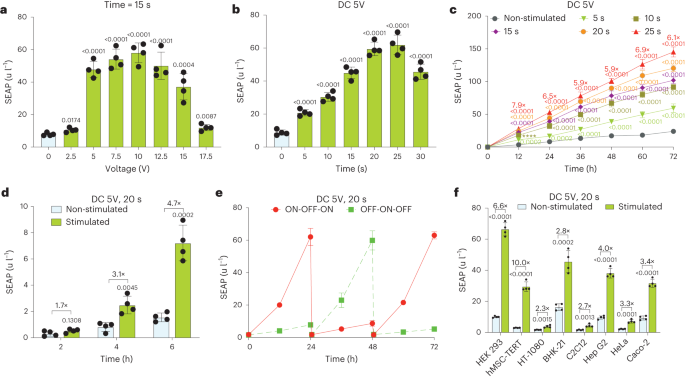
In a novel experiment, researchers were able to trigger insulin production in human cells by sending electrical currents through an “electrogenetic” interface that activates targeted genes. 
  • Future applications of this interface could be developed to deliver therapeutic doses to treat a wide range of conditions, including diabetes, by directly controlling human DNA with electricity.  
  • There is currently an explosion of interest in medical wearables, which are health-centric portable technologies such as fitness trackers, biosensors, blood pressure monitors, and portable electrocardiogram devices. 
  • Smart wearables have become an essential tool for many doctors and patients, spurring researchers to continue developing novel platforms for collecting medical data or even performing medical interventions.
  • Now, scientists led by Jinbo Huang, a molecular biologist at ETH Zürich, have invented a battery-powered interface that they call “the direct current (DC)-actuated regulation technology,” or DART, that can trigger specific gene responses with an electric current. ]
  • Huang and his colleagues described the device as “a leap forward, representing the missing link that will enable wearables to control genes in the not-so-distant future,” according to a study published on Monday in Nature.
“While biological systems are analog, programmed by genetics, updated slowly by evolution and controlled by ions flowing through insulated membranes, electronic systems are digital, programmed by readily updatable software and controlled by electrons flowing through insulated wires.” 

  • The same group at ETH Zürich had originally demonstrated that genes could be electrically activated as part of a study that was published in 2020
  • This new modified design simplifies the initial design by implanting human pancreatic cells into mice with type 1 diabetes. 
  • The researchers then used electrically-stimulating acupuncture needles to switch on the exact genes involved in regulating doses of insulin, a hormone that is essential for the treatment of diabetes. 
  • As a consequence, the blood glucose concentrations of the model mice returned to normal levels. 

Battery-powered device controls gene expression in diabetic mice

Huang and his colleagues said this electrical fine-tuning of mammalian gene expression sets the stage for “wearable-based electro-controlled gene expression with the potential to connect medical interventions to an internet of the body or the internet of things,” according to the study.

  • “While we chose DART-controlled insulin production for proof-of-concept validation, it should be straightforward to link DART control to the in situ production and dosing of a wide range of biopharmaceuticals,” the team concluded. 

“We believe simple electrogenetic interfaces such as DART that functionally interconnect analog biological systems with digital electronic devices hold great promise for a variety of future gene- and cell-based therapies.”

An electrogenetic interface to program mammalian gene expression by direct  current | Nature Metabolism


Cartoon Carousel The nation’s cartoonists on the week in politics | By POLITICO STAFF 01/23/2026 05:00 AM EST

Every week political cartoonists throughout the country and across the political spectrum apply their ink-stained skills to capture the fo...