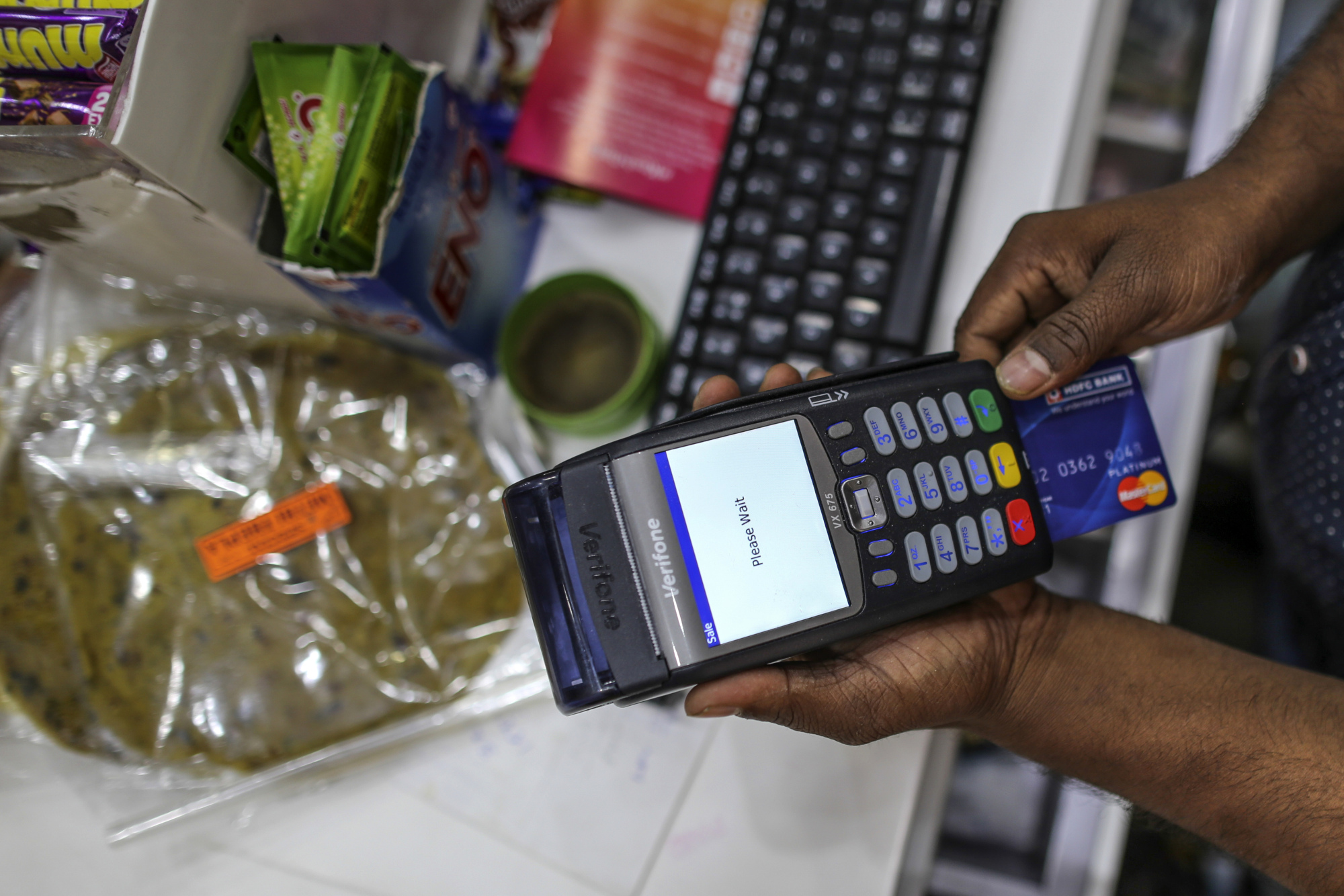
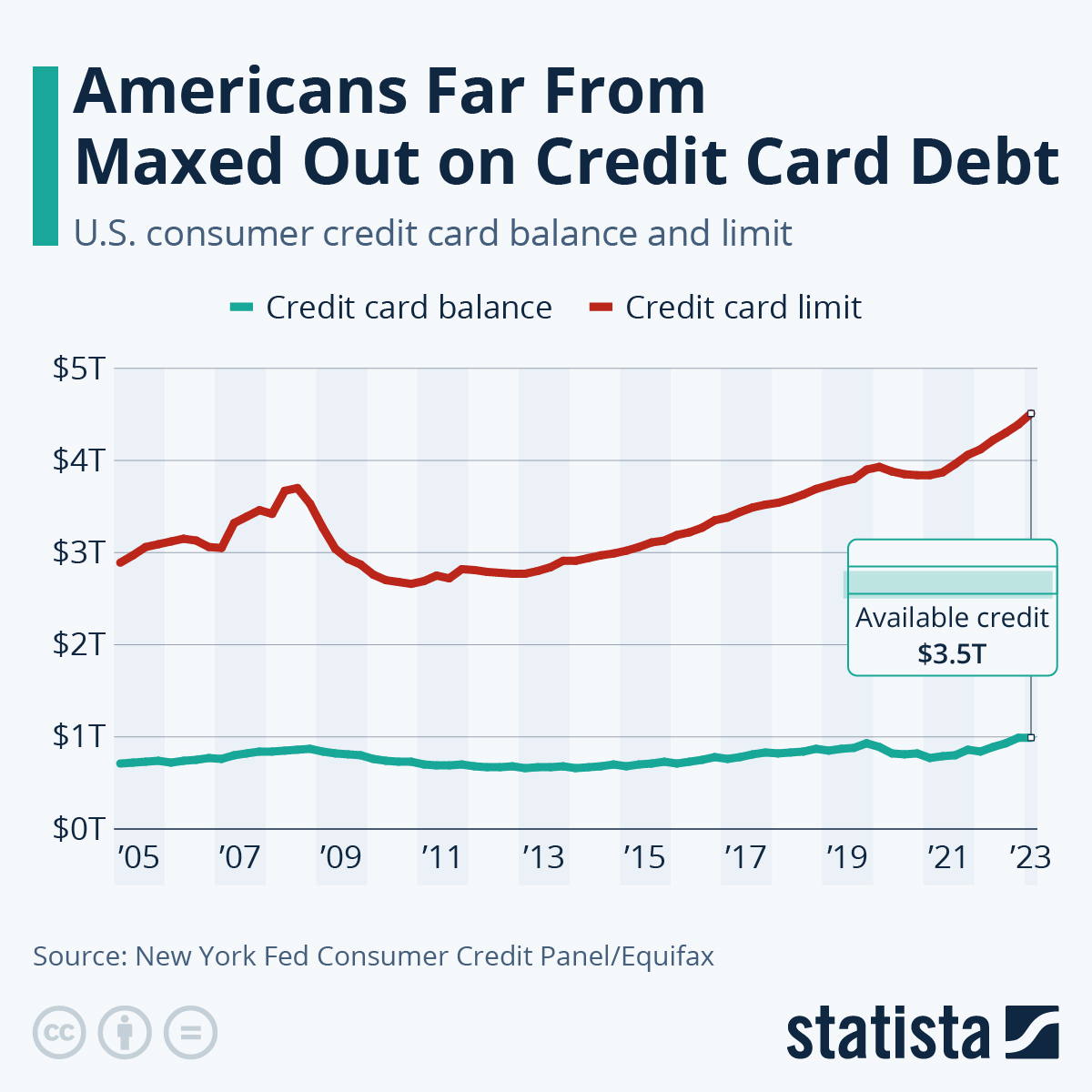
Americans increasingly turned to their credit cards to make ends meet heading into the summer, sending aggregate balances over $1 trillion for the first time ever, the New York Federal Reserve reported Tuesday.
Credit card balances jumped in the second quarter and are above $1 trillion for the first time
The record level of US household debt
US household debt hit a record $16.9 trillion in the last quarter of 2022 — around $128,824 per household, on average. This rise is due to several factors, many of which can combine and make it difficult for people to pay down loans. Here’s the data on US states with the highest household debt relative to income.
Total household debt increased by approximately $1.1 trillion (roughly 6.7%) throughout 2022.
Inflation grew by 6.4% and kept consumer prices high. The increase in overall debt can be partially attributed to a 4% rise in interest rates by the Federal Reserve in 2022.
Despite the record-high household debt at the beginning of 2023, it was below the Q4 2008 peak of $17.4 trillion once adjusted for inflation.
Over 70% of current debt is from mortgages. At the end of 2022, it accounted for $11.73 trillion; student loan debt has risen over the past two decades to become the second-largest component of household debt. In Q4 2022, it reached $1.57 trillion.
These Nazis Want to Turn New England Into a White Ethnostate
White supremacists are calling for a “peaceful separation” from the
United States — and a ban on people of color moving to New England
Men wearing "Nationalist Social Club 131" (NSC 131) shirts hold a neo-Nazi flag.
Brian Snyder /REUTERS/Redux
A neo-Nazi front group is demanding that New England
secede and establish itself as a white nation. Decrying “enemies” that
are “all around us” and vowing to defend racial “integrity,” the
People’s Initiative of New England published a revolutionary manifesto on July 27 advocating “separation from the United States of America.”
PINE is a creation of the neo-Nazi organization NSC-131.
While the latter functions outside of the political system, with often
violent street confrontations and stiff-arm, heil-Hitler salutes, PINE
is intended to give those same toxic political beliefs a more palatable
political framework. If NCS-131 exists to shock, PINE is an effort to
seduce — tempting far-right conservatives into explicitly
white-nationalist politics.
The PINE document appeals to nostalgia and shame. “Our people, who once
built the most prosperous nation the world has ever seen, have been
embarrassed, sold out and demoralized.” It alleges that the “only
option” is to establish a “sovereign and unified New England” and
thereby “set an example for revolutionaries everywhere.” In a nation
where a previous secession attempt by racists sparked the bloodshed of
the Civil War, PINE fancifully imagines a “peaceful separation.”
The call for a New England ethnostate — posted to Substack — marks a
coming out for PINE, or what it calls its “formal introduction.” The
initiative was quietly launched in April by NSC-131, also known as
Nationalist Social Club-Anti-Communist Action.
August 1, 2023 at 10:01 am – Mesa’s Hydration Donation Campaign is falling short as the community demand for bottles of water is at an all-time high. Since the start of the collection on June 5, the lifesaving campaign has received 166,367 bottles of water. That is a decline...
START @ 11:35 AND LISTEN TO CLIMATE ACTION PLAN AND NONATTAINMENT AREA
FTC's lawsuit is likely to be filed in federal court this month.
After a yearslong Amazon probe that collected millions of documents
and conducted dozens of interviews, the Federal Trade Commission next
week will meet with Amazon representatives before likely filing one of
the agency's biggest antitrust lawsuits yet, Politico reported.
Known as a "last-rites meeting," these discussions could serve as Amazon's last chance to dodge an FTC lawsuit that Bloomberg has described
as "the Big One." No one is sure what aspects of Amazon's business the
lawsuit could target, but if the FTC succeeds in court, it could result
in a forced breakup or restructuring of Amazon's $1.3 trillion
e-commerce operation, The Wall Street Journal reported.
There has been much speculation this year over what the FTC's
complaint will cover. The agency has been investigating a wide range of
concerning aspects of Amazon's business since 2019, Bloomberg reported.
Everything from how Amazon bundles its services to how Amazon treats
sellers has drawn FTC scrutiny, as has Amazon's advertising and cloud
computing businesses. But the "main allegation," Bloomberg reported
in June, "is expected to be that Amazon leverages its power to reward
online merchants that use its logistics services and punish those who
don’t."
More information will likely be revealed next week. Sources told The
Wall Street Journal that Amazon representatives will individually meet
with the three FTC commissioners: Lina Khan, Rebecca Kelly Slaughter,
and Alvaro Bedoya.
Khan rose to prominence after publishing a paper in The Yale Law Journal called "Amazon's Antitrust Paradox."
In the paper, she argued that platforms like Amazon prove that prices
are a poor measure of a company's anticompetitive behavior because the
platforms prioritize explosive growth over profits. This can lead to
predatory pricing and can create incentives for platforms to boost their
own products over competitors'. In 2017, Khan wrote:
Although Amazon has clocked staggering growth, it
generates meager profits, choosing to price below-cost and expand widely
instead. Through this strategy, the company has positioned itself at
the center of e-commerce and now serves as essential infrastructure for a
host of other businesses that depend upon it. Elements of the firm’s
structure and conduct pose anticompetitive concerns—yet it has escaped
antitrust scrutiny.
"It is as if Bezos charted the company’s growth by first drawing a
map of antitrust laws, and then devising routes to smoothly bypass
them," Khan wrote in the paper.
If that really was Bezos' strategy, he seemingly didn't see Khan
coming. Much of what her paper said in 2017 describes current aspects of
Amazon's business that the FTC has scrutinized under Khan. To fight
back, Amazon has sought to distance Khan from the inquiry, arguing that
what it sees as Khan's clear bias against Amazon could cloud the FTC's
investigation.
"Given her long track record of detailed pronouncements about Amazon
and her repeated proclamations that Amazon has violated the antitrust
laws, a reasonable observer would conclude that she no longer can
consider the company’s antitrust defenses with an open mind,” Amazon
wrote in a petition seeking to recuse Khan in 2021.
Next week's meetings will likely be the FTC's final step ahead of
lobbing an official antitrust complaint against Amazon, which The Wall
Street Journal described as marking "a signature moment in the tenure of
FTC chair Lina Khan."
Wall St falls as Moody's bank downgrades spark broad sell-off
Bansari Kamdar, Johann Cherian
August 8, 2023 8:59 AM MST
4 - 5 minutes
Drugmakers rise after positive data from Novo's obesity drug study
UPS falls after cutting annual revenue view on lower demand
Banks slide after Moody's downgrades 10 mid-sized banks
Indexes down: Dow 0.98%, S&P 1.03%, Nasdaq 1.41%
Aug
8 (Reuters) - Wall Street tumbled on Tuesday in a broad sell-off led by
financial stocks after Moody's downgraded several U.S. banks, though
drugmakers rose on Eli Lilly's strong results and positive data from
Novo Nordisk's obesity treatment.
The agency cut ratings on 10 small- to mid-sized lenders by one notch and placed six banking giants, including Bank of New York Mellon (BK.N), U.S. Bancorp (USB.N), State Street (STT.N) and Truist Financial (TFC.N), on review for potential downgrades.
Moody's also warned that the sector's credit strength would likely be tested by funding risks and weaker profitability.
Big banks Goldman Sachs (GS.N) and Bank of America (BAC.N)eased 2.9% and 3.2%, respectively, while Bank of New York Mellon and U.S. Bancorp shed 2.4% and 2.5%.
The S&P 500 Banks index (.SPXBK) slid 2.6%, while the KBW Regional Banking index (.KRX) dropped 3.1%.
"Anytime
you see the backbone of the U.S. financial system being under watch,
that gives people a lot to pause," said Brandon Pizzurro, director of
public investments at Guidestone Capital Management.
"Markets
are slowly digesting that, maybe the U.S. financial system is not
absolutely perfect and maybe we are going to have higher rates for a
much longer period of time."
...Lenders have lost 4% so far this year, compared with a 16.4% rise in the benchmark S&P 500 index (.SPX), after the collapse of Silicon Valley Bank and Signature Bank earlier this year sparked a crisis of confidence in U.S. lenders.
After
the S&P 500 and Nasdaq logged their worst week since March, Wall
Street had rallied on Monday as investors built positions ahead of
Thursday's highly awaited U.S. inflation report. . .
At 11:35 a.m. ET, the Dow Jones Industrial Average (.DJI) was down 347.27 points, or 0.98%, at 35,125.86, the S&P 500 (.SPX) was down 46.63 points, or 1.03%, at 4,471.81, and the Nasdaq Composite (.IXIC) was down 197.63 points, or 1.41%, at 13,796.77..."
Moody’s put U.S. banks on a negative watch list and warns of a ‘mild’ recession - UPI.com
Daniel J. Graeber
3 minutes
Aug. 8 (UPI) -- A drain on deposits, along with the
decline in asset value in a high-interest rate environment, led to a
downgrade in ratings for a handful of U.S. banks, Moody's said.
Moody's Investors Service downgraded the credit rating for smaller lenders such as Pinnacle Financial and put major banks such as Northern Trust under review.
In a report published late Monday,
Moody's said banks may be facing a liquidity and capital crisis "as the
wind-down of unconventional monetary policy drains system-wide deposits
and higher interest rates depress the value of fixed-rate assets."
✓ Second quarter results for many banks, meanwhile, revealed a struggle
to generate profit at a time when Moody's expects a "mild" recession to
emerge in the U.S. economy by early 2024.
The investment service added that there was a particular risk coming
from the commercial real estate portfolios for some of the banks under
review.
On top of concerns about China's economic performance, the move on
banks led to a downturn on Wall Street. All major U.S. stock indices
were in the red during the Tuesday session, with the S&P 500 down 1%
as of 11:30 a.m. EDT.
Among the major banks highlighted by Moody's, shares in Northern Trust were down around 3% to trade at $78.36 per share.
"All the headlines just turned bearish," said Ed Moya, a senior market analyst for OANDA.
The concern is reminiscent of early-year fears
of a banking crisis that was triggered by the collapse of Silicon
Valley Bank, Silvergate and others. Silvergate was the likely victim of
over-reliance on volatile, and somewhat untested, cryptocurrencies,
while SVB was caught in something of a contagion of fear.
Former SVB CEO Gregory Becker told congressional leaders earlier this
year that rumors about the health of the banking sector spread quickly
online, triggering a run on deposits that helped usher in the bank's
collapse.
The news from Moody's followed last week's decision from ratings
agency Fitch to lower the rating of the United States from the top-tier
AAA to AA+ after warning the political battle over the nation's debt ceiling was cause for concern.
"The repeated debt-limit political standoffs and last-minute
resolutions have eroded confidence in fiscal management," Fitch said as
the agency pointed to "expected fiscal deterioration over the next three
years."
STORY:
Bank shares fell on Tuesday after Moody's cut the credit ratings of
several small- to mid-sized U.S. lenders, a move that further fueled
fears that a banking crisis back in March may not be over.
Moody's
cut the ratings of 10 banks by one notch and placed another six
lenders, including Bank of New York Mellon, U.S. Bankcorp, and State
Street on review for potential downgrades.
In a note, the ratings
agency described worries about worsening profitability, a potentially
mild U.S. recession, and risks in the banks' commercial real estate
portfolios.
The cuts come after another ratings agency, Fitch, downgraded U.S. government debt from triple-A to double-A-plus.
Sam
Stovall of CFRA Research told Reuters, "Moody's putting some banks on
warning adds to Fitch's downgrade of the U.S. Treasury market last week
and gives investors additional reason to be cautious..." adding, "it
also means that the concern that we had in March over those three bank
defaults, is not over yet."
The sudden collapse of Silicon Valley
Bank and Signature Bank earlier this year sparked a crisis of confidence
in the U.S. banking sector.
Those failures prompted a run on
deposits at a host of regional banks despite authorities launching
emergency measures to shore up confidence.
Stock Market Today: Dow Drops After Regional Banks Downgrades
Data showing a drop in Chinese exports also weighed on markets
The number of domestic terrorism incidents have risen over the past decade. What are the ideologies behind domestic terrorism attacks, how does the FBI investigate them, and what are the human costs? USAFacts gathered the data to see how the government is tackling this issue.
According to the FBI, domestic terrorism involves violent acts intimidating or coercing civilian populations, influencing government policy, or affecting government conduct. These acts are driven by political, social, racial, or environmental ideologies.
The FBI’s number of open domestic terrorism-related cases has grown 357% from 2013 to 2021. This rate rose sharply beginning in 2018. The number of disrupted potential domestic terrorist attacks — interrupting or inhibiting a threat actor from engaging in a criminal act or national security — rose around the same time.
There were 231 domestic terrorism incidents between 2010 and 2021, resulting in 145 deaths and 370 injuries. Racially or ethnically motivated violent extremism led to the most lethal incidents, accounting for 94 deaths and 111 injuries.
The second-largest category of domestic terrorism, anti-government or anti-authority violent extremism, resulted in 15 deaths during the same period.
The number of federal defendants charged in domestic terrorism cases remained constant for years but grew in 2020 before doubling in 2021. This was due to an unusually high number of cases filed in Washington, DC.
US household debt hit a record $16.9 trillion in the last quarter of 2022 — around $128,824 per household, on average. This rise is due to several factors, many of which can combine and make it difficult for people to pay down loans. Here’s the data on US states with the highest household debt relative to income.
Total household debt increased by approximately $1.1 trillion (roughly 6.7%) throughout 2022. Inflation grew by 6.4% and kept consumer prices high. The increase in overall debt can be partially attributed to a 4% rise in interest rates by the Federal Reserve in 2022.
Despite the record-high household debt at the beginning of 2023, it was below the Q4 2008 peak of $17.4 trillion once adjusted for inflation.
Over 70% of current debt is from mortgages. At the end of 2022, it accounted for $11.73 trillion; student loan debt has risen over the past two decades to become the second-largest component of household debt. In Q4 2022, it reached $1.57 trillion.
As of Q3 2022, Hawaii, Idaho, and Maryland had the highest household debt-to-income ratios, meaning households that carry debt payments more than twice their gross monthly income. For every $1 of income, Hawaiian households had $2.26 in debt.
On August 1, one of the country’s three major credit rating agencies announced that it had downgraded the US credit rating from AAA to AA+. USAFacts has info on the current US credit ratings and what downgrades mean.
US scientists recently said that they have repeated a nuclear fusion reaction that produces more energy than is put into it. Learn more about how nuclear fusion works and why the country is investing in it?
From 2017 to 2020, milk was the top drink for children 12 and younger. Milk comprised 29% of beverages consumed in childhood, compared to 5% in adulthood. Bottled water was the biggest factor in changing drinking habits: Between surveys conducted from 2005 to 2006 and from 2017 to 2020, bottled water consumption rose 56%.



/cloudfront-us-east-2.images.arcpublishing.com/reuters/CQGXSUP7GFLXXGPLB662DEOVEI.jpg)




.jpg)