NOVEMBER 4, 2023


Spider-inspired, shape-changing robot
now even smaller
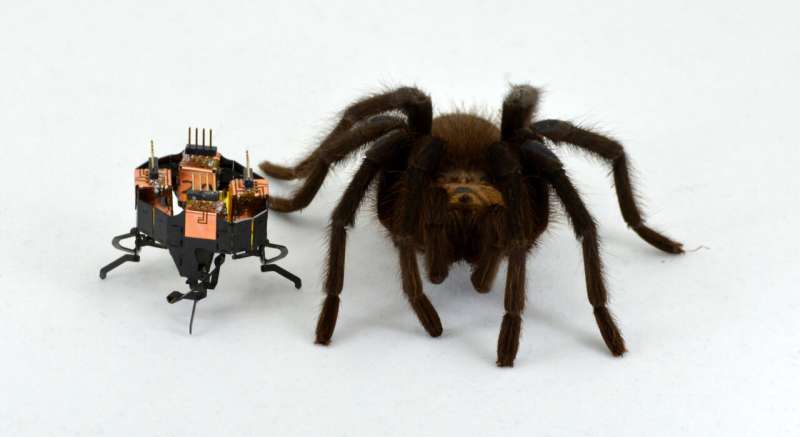
The research was led by Kaushik Jayaram, assistant professor in the Paul M. Rady Department of Mechanical Engineering, and doctoral student Heiko Kabutz. Their work recently won the Best Paper Award on Safety, Security, and Rescue Robotics at the 2023 International Conference on Intelligent Robots and Systems in Detroit.
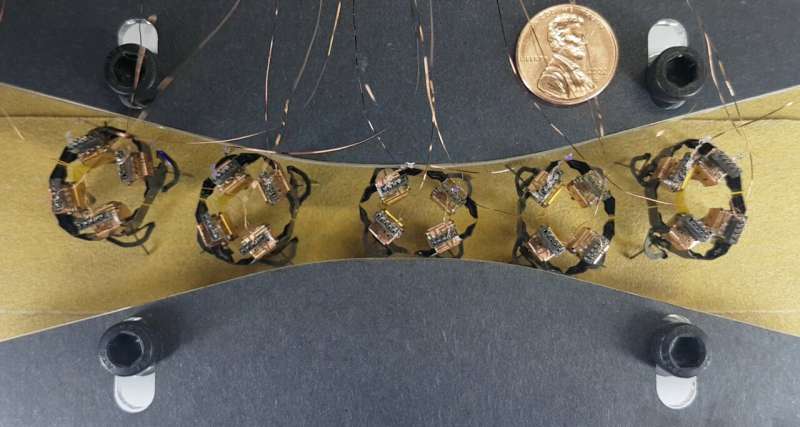
The paper improves on the team's previous miniature shape-morphing robot, called CLARI, by making it smaller and faster. The robot can maneuver expertly in cluttered environments by switching from running forward to side-to-side, not by turning but changing its shape, giving it the potential to aid first responders after major disasters. The research brings Jayaram's group one step closer to realizing insect-scale robots that can move seamlessly in natural terrains similar to their animal counterparts—largely by combining a soft robot's adaptability with a rigid robot's agility.
This latest breakthrough in miniaturization is enabled by the origami-based design and laminate fabrication technique Jayaram and his colleagues previously used to make a robot called HAMR-Jr. Using this novel approach, Jayaram and Kabutz are able to scale down (or up) their design without sacrificing mechanical dexterity, bringing such robots closer in size to real-world application needs. That includes inspecting and maintaining valuable assets like jet engines.


"Initially, I was interested in building bigger robots," said Kabutz, "but when I came to Jayaram's lab, he really got me interested in building bioinspired robots at the insect scale."
"Since these robots can deform, you can still have slightly larger sizes," Jayaram said. "If you have a slightly more size, you can carry more weight. You can have more sensors. You'll have a longer lifetime and be more stable. But when you need to, you can squish through and go into those specific gaps, such as inspection access ports in a jet engine."
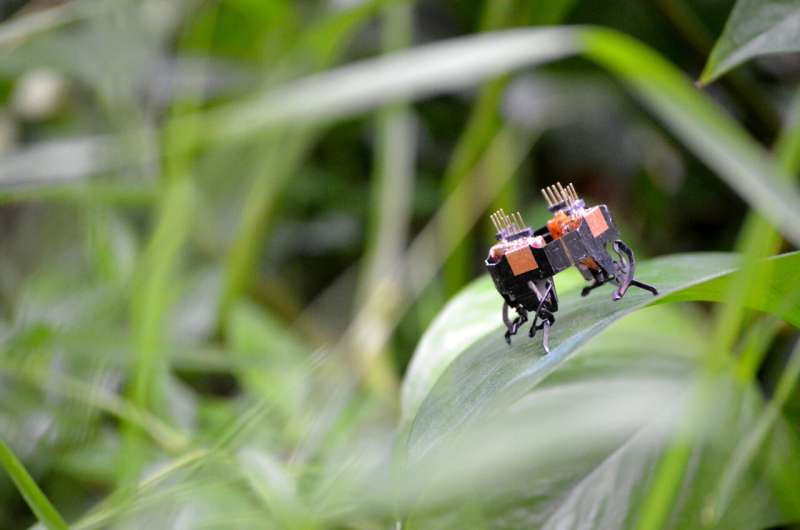
Jayaram's research team studies concepts from biology and applies them to the design of real-world engineered systems. In his lab, you can find robots modeled after the body morphologies of various arthropods, including cockroaches and spiders.
"We are fundamentally interested in understanding why animals are the way they are and move the way they do," said Jayaram, "and how we can build bioinspired robots that can address social needs, like search and rescue, environmental monitoring or even use them during surgery."
Co-authors of the new study include Alex Hedrick and Parker McDonnell, doctoral students in mechanical engineering.
More information: Heiko Kabutz et al, mCLARI: a shape-morphing insect-scale robot capable of omnidirectional terrain-adaptive locomotion in laterally confined spaces, arXiv (2023). DOI: 10.48550/arxiv.2310.04538

Bridging the best of both electrolyte worlds for a better lithium-ion battery
NOV 3, 2023

Preventing catastrophic failure in lithium ion batteries
NOV 3, 2023

Monolithically integrated photo battery achieves competitive voltage
NOV 3, 2023

Using language to give robots a better grasp of an open-ended world
NOV 2, 2023

Creating efficient p-type transparent conductors
NOV 2, 2023

Making electric vehicles last: Team develops polymer binder to extend dual-ion battery lifespan
NOV 2, 2023

Advances in machine learning for nuclear power operations spell a brighter future for carbon-free energy
NOV 2, 2023

GPT-4 falls short of Turing threshold
NOV 2, 2023

New designs for solid-state electrolytes may soon revolutionize the battery industry
NOV 2, 2023

Researchers develop solid-state thermal transistor for better heat management
NOV 2, 2023


