Friday, February 02, 2024

HIGH COUNTRY NEWS: Learning to Live with Musk Oxen | The Nome Nugget

As with any other wild animal, do not agitate or approach muskoxen. Be on the lookout for muskox sign and avoid areas frequented or occupied by muskoxen. Keep dogs under control at all times in muskox country. 
Musk oxen are likely to react defensively when provoked and can easily kill or injure dogs.
Learning to live with musk oxen (Learning to Live with Musk Oxen) — High  Country News – Know the West

___________________________________________________________________________________

POST SCRIPT 

". . .After Worland’s death, Melanie Bahnke of Kawerak wrote an open letter to policymakers and game managers, asking for further action to protect the community. “Our Tribal Leaders and elders traditionally were the ones who made decisions about the take of fish and game in our region and what is reasonable and allowable and what measures to take to protect our people,” she wrote. “I guarantee this situation would not be as out of hand as it is now if that authority had not been replaced by the current management regimes that are woefully inadequate considering the fish crashes and the current threat to humans posed by musk ox.

“I can have discussions all day long with folks about what they need to do, and they just come back and say, ‘Well, we never wanted them here in the first place.’” 
Still, locals who manage to regularly get hunting permits are finally seeing the benefits of musk oxen. 
  • They’re good eating, and in winter they have unusually lightweight but super-warm underwool, called qiviut, that can be spun into yarn and is far more valuable than cashmere. 
Roy Ashenfelter, an Iñupiaq hunter from White Mountain who spent decades working on various subsistence advisory boards and who now chairs the board of the Bering Straits Native Corporation, has seen public opinion about musk oxen

___________________________________________________________________________________

WILDLIFE

Learning to live with musk oxen

The species were introduced to Alaska’s Seward Peninsula decades ago, without local consent. Now they pose danger to life and property.


Megan Gannon

Image credit: Diana Haecker/The Nome Nugget

Feb. 1, 2024From the print edition

INTRODUCTION
"By the afternoon of Dec. 13, 2022, idyllic winter conditions had finally arrived in Nome, Alaska. Famous for hosting the finish of the Iditarod sled dog race, this remote town is closer to Russia than it is to Anchorage; here, vast tundra landscapes meet the sea ice that forms over the Bering Strait. A series of dreaded rain-on-snow events earlier in the month had made winter travel miserable. But now, a fresh white blanket covered the rolling hills, reflecting the pinks and blues of a clear sub-Arctic sky. Snowmachines were whining, and the local mushers were looking forward to another season of exercising their sled dogs. One of them, Curtis Worland, took a break from work to visit his kennel on the outskirts of Nome.


Worland was a court services officer for the Alaska State Troopers, a job that involved prisoner transport and court security. At the kennel, though, he had other obligations. Keeping a dog lot anywhere requires a constant loop of chores: feeding dogs, running dogs, scooping up dog poop. But keeping one in Nome comes with additional responsibilities: monitoring threats from musk oxen, stubborn, shaggy animals with formidable horns and a record of attacking dogs. During his decade as a musher, Worland, 36, had seen Nome’s musk oxen problems increase. He shared the dog lot with his wife and their friends, and about once a week, when musk oxen got too close, he took on the task of keeping them away. On Dec. 13, he was on a snowmachine, trying to scare off a herd that had come within a quarter-mile of the lot. No one else witnessed what happened, but one of the animals charged him. Worland received a fatal laceration to his femoral artery, and by the time emergency responders arrived, he had bled out.

The portrait that the Alaska State Troopers released in their announcement of his death shows a serious-looking man in a uniform and a fur hat. But in the slideshow during his memorial service at the local recreation center, Worland is often wearing an open-mouthed smile, or tearing it up on a dance floor. Sudden deaths are painful in any small town — Nome has around 3,700 people — and Worland was a well-liked member of the community, remembered for his adventurous spirit and love of hunting and the outdoors. 

Worland was also Nome’s first musk ox-related human fatality. 

On the Monday afternoon following his death, nearly 20 residents crowded into a small conference room at the University of Alaska Fairbanks campus in Nome. The Northern Norton Sound Fish and Game Advisory Committee was meeting for its biannual discussion of policy recommendations for state decision-makers. It’s the kind of meeting that rarely excites the public, but this one turned into an impromptu hearing on the town’s musk oxen problem. A dozen locals either called in or showed up in person, with several testifying to frequent run-ins and fears of more encounters. Mushers said that dogs were getting gored and it was getting harder to protect their kennels — but they were worried that any deterrence efforts would lead to accusations of wildlife harassment. 

The Nome Nugget, the local newspaper where I work as a reporter, published Nome resident Miranda Musich’s statement to the panel. 
  • “What happened to Curtis was the final straw for me,” she said. 
  • “We understand that musk oxen are here and that they will not go away, but we feel that they have been mismanaged and that we don’t have the right to protect ourselves and our property without risk of us being prosecuted for defending ourselves.” 
After the tragedy, Musich helped compile testimonies from other residents. To many in Nome, Worland’s death wasn’t a freak accident; it was an indictment of the region’s musk oxen management and the century of decisions that brought them here.

Cruise ship tourists visiting Nome, Alaska, approach a herd of musk oxen, causing the animals to form a protective circle.
Diana Haecker/The Nome Nugget

ONE IÑUPIAQ WORD for musk ox is umiŋmak, a term that refers to the animal’s beard-like coat. 

The word’s existence speaks to the Iñupiat’s long relationship with musk oxen, which once roamed the Arctic. Their decline is often attributed to climatic changes after the last ice age, along with predation and hunting. Around Nome, few if any Indigenous stories about the animals survive. 

MaryJane Litchard, an Iñupiaq artist and healer who grew up in Lost River, Teller, Anchorage and Nome, told me that she never heard stories about musk oxen growing up, “not even (from) my granduncle when he told me true ancient stories.” Elders told her that people sometimes saw creatures that were extinct, like mastodons. As a teenager in the 1960s, Litchard heard someone describe seeing a blue-colored musk ox and asking an elder if they’d seen a ghost. 

Records from early European settlers suggest that by the time they arrived, the animals were already rare in the region, mostly restricted to far northeastern Greenland and Northern Canada. “Epidemic disease associated with exploration and colonization — 1837 smallpox, 1900 measles, 1917 influenza — caused massive culture disruption,” said Jim Magdanz, who worked for the Alaska Department of Fish and Game’s Division of Subsistence from 1981 to 2012 and has searched for stories about musk oxen. “In some villages, only children survived. Indigenous histories of musk ox use either died in the epidemics or were rarely recorded when oral histories were written by explorers and settlers.”

Worland’s death wasn’t a freak accident; it was an indictment of the region’s musk oxen management and the century of decisions that brought them here.

The average visitor to Nome today would never guess that musk oxen were ever ghosts on the landscape. The animals adorn guidebooks and artwork at gift shops and draw wildlife viewers and photographers. With their bulky coats, sloping shoulders, short legs and upturned horns, it’s not hard to picture them roaming alongside saber-tooth tigers, woolly mammoths and other big-bodied beasts of the Pleistocene. But all the musk oxen around Nome today have ancestors that saw the inside of a train station in New Jersey. Their reintroduction to Alaska was the result of a decades-long campaign by early 20th-century settlers and promoters, one that followed a template used many times over before and since: it was a plan for developing the Arctic, drawn up without the consent of Indigenous people. . ."

AFFORDABLE HOUSING FINANCE House Passes Tax Package With LIHTC Improvements

Much of the attention has been on the bill’s expansion of the child tax credit, but the package also includes two important measures from the Affordable Housing Credit Improvement Act—restoration of a 12.5% allocation increase to the LIHTC program that expired at the end of 2021 and a reduction from 50% to 30% of the amount of private-activity bond financing required to access the 4% housing credit.

  • The House of Representatives passed a $78 billion tax bill that includes key measures to boost the low-income housing tax credit (LIHTC) program.
The tax package passed 357-70, with 188 Democrats and 169 Republicans in favor of the bill.

A tougher fight may be in store in the Senate.

 
AFFORDABLE HOUSING FINANCE UPDATE
 
House Passes Tax Package With LIHTC Improvements
 

House Passes Tax Package With LIHTC Improvements

A tougher fight may be in store in the Senate. READ MORE

Front Covers


UNDER REVIEW: Can Slowing Down Save The Planet |


Israel-Gaza War: Arab American Anger Boiling At Biden; Anti-US Prez Prot...

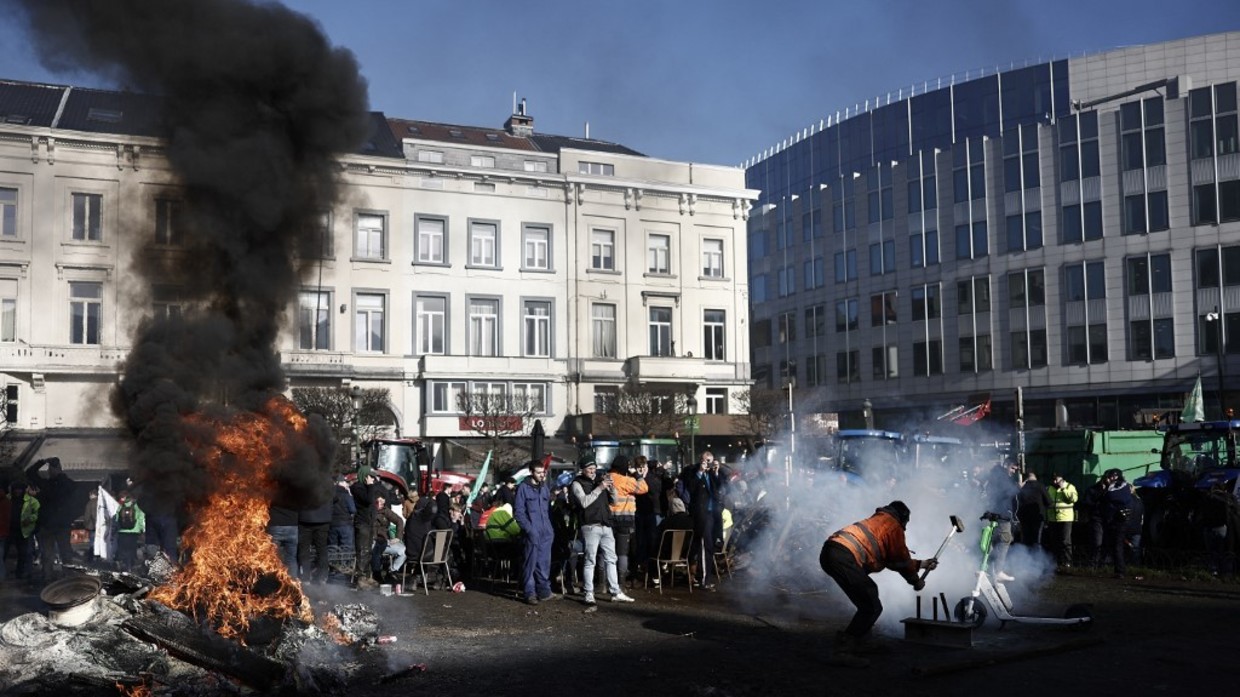
Flames and angry protests rage outside EU Parliament

Farmers on tractors create chaos outside an EU summit to protest rising  costs and bureaucracy - The Globe and Mail
Farmers are blocking key roads between Belgium and the Netherlands in the  latest sign of their anger


Angry Farmers Take Protest to EU Summit With Tractors and Fires
1 Feb, 2024 15:20

Flames and angry protests rage outside EU parliament (VIDEOS)

Thousands of farmers descended on Brussels, where they burned manure and pelted the legislature with eggs
Flames and angry protests rage outside EU parliament (VIDEOS)


A crowd of furious farmers picketed the EU Parliament building in Brussels on Thursday to protest environmental regulations and the threat to their livelihoods posed by cheap Ukrainian imports. The protesters hurled stones, eggs, and abuse at the bureaucrats behind police lines.
  • Convoys of tractors began streaming into Brussels on Wednesday night, and by Thursday morning the streets of the Belgian capital were blockaded by around 1,300 vehicles, according to a police estimate.
The farmers assembled in front of the European Parliament building on Luxembourg Square where they burned pallets and piles of manure. 
The crowd lobbed eggs, stones, fireworks, and flaming projectiles at the legislature, while similar scenes took place outside the nearby headquarters of the European Council.
Riot police used water cannons to extinguish the fires and push back stone-throwing protesters. As of Thursday afternoon, no arrests or injuries had been reported.
The protest was a culmination of months of demonstrations in different EU countries. 
  • Farmers in Germany have blocked city streets since December, demanding that Chancellor Olaf Scholz abandon his plans to scrap a diesel subsidy, while those in France have also protested rising energy costs. 
  • In Eastern Europe, farmers have been demonstrating against an EU policy allowing tariff-free imports of cheap Ukrainian grain, which significantly undercuts local produce.

Across the bloc, decisions made in Brussels are a common source of grievance. Farmers have condemned the EU’s planned Mercosur trade deal, which would allow the tariff-free importation of produce from Latin America, thereby forcing EU farmers to sell at a lower price. The farmers have also demanded that the EU roll back regulations, including a requirement that they leave 4% of their land fallow and reduce livestock numbers to lower nitrogen emissions.

A short walk from the protest, the European Council met on Thursday morning, but agricultural issues were not on the agenda. 

Instead, the council agreed on a €50 billion package of economic aid to Ukraine. However, Belgian Prime Minister Alexander De Croo told reporters that the farmers’ concerns would be discussed, stating that EU leaders “need to make sure that [the farmers] can get the right price for the high-quality products that they provide.”

With European Parliament elections coming up in June, the European Commission announced on Wednesday that it would grant the farmers some limited concessions, including a one-year exemption from the fallow land rule for some producers, and a promise to cap imports of Ukrainian poultry, eggs, and sugar. However, the commission said that it would extend the tariff-free regime for all other Ukrainian produce until June 2025. 

Dramatic footage shows Ukrainian drone boats destroying Russian warship

EU Makes BIG Decision on Russian Gas as Moscow Snubs Kallas

    Jan 26, 2026 EU Makes BIG Decision on Russian Gas as Moscow Snubs Kallas   TASS 10 hours a...