German Navy Mistakenly Fires at USAF MQ-9 Over Red Sea
A U.S. Air Force MQ-9 Reaper came close to being shot down by a German warship in a friendly fire incident over the Red Sea on Feb. 27, U.S. officials told Air & Space Forces Magazine.
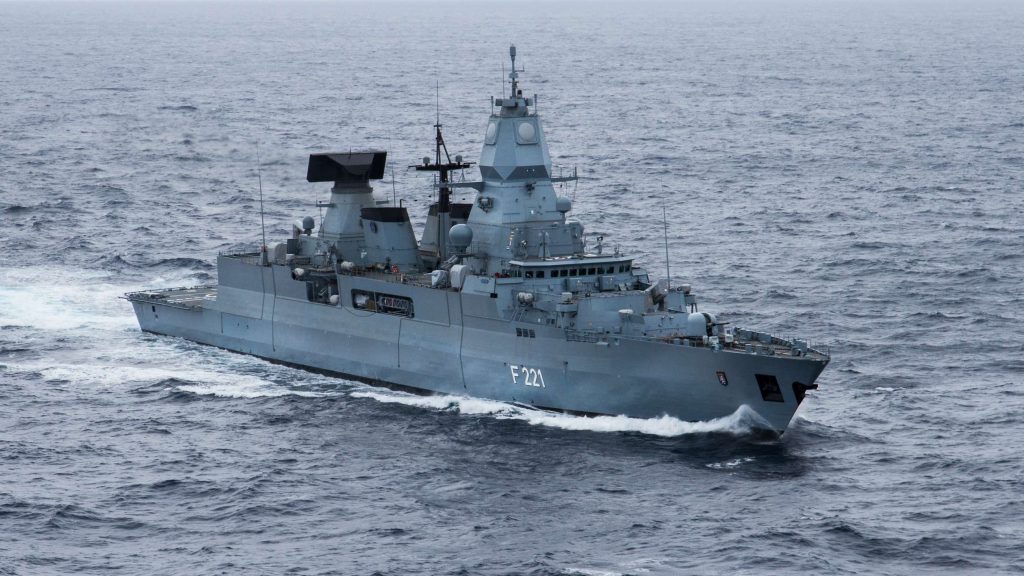
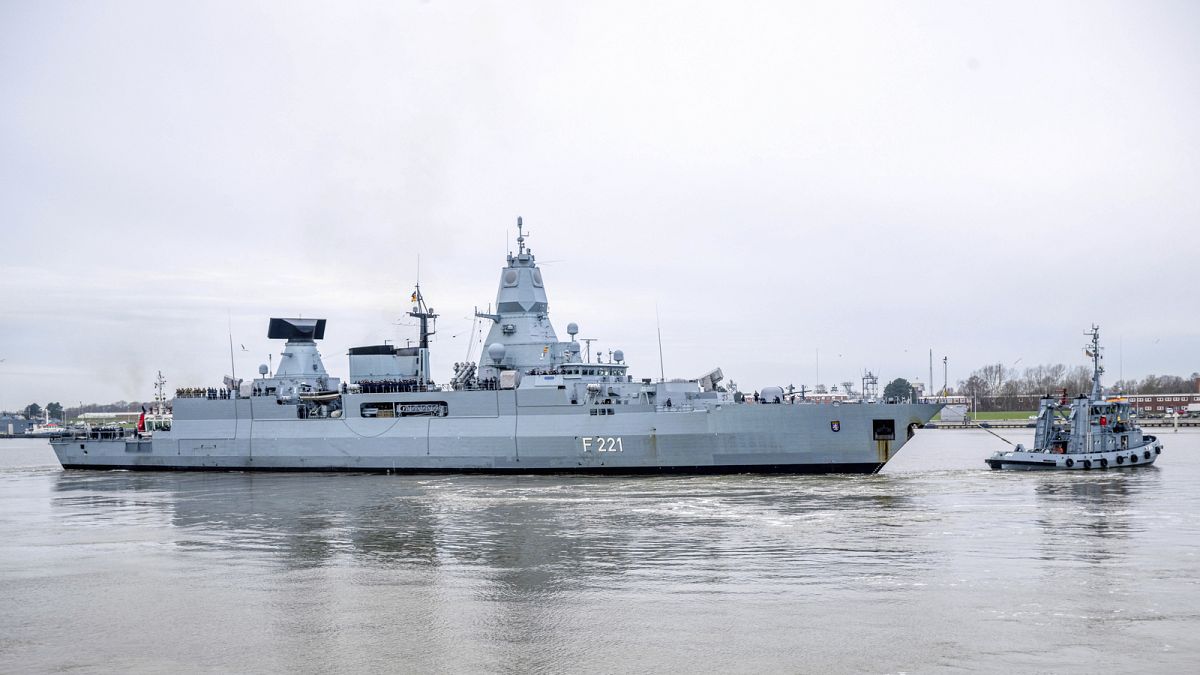
The USAF MQ-9 was targeted by the German frigate Hessen as the drone was conducting a mission for Operation Prosperity Guardian, the U.S.-led maritime operation that is protecting international shipping from Houthi attacks, a U.S. official said.
The USAF MQ-9 was targeted by the German frigate Hessen as the drone was conducting a mission for Operation Prosperity Guardian, the U.S.-led maritime operation that is protecting international shipping from Houthi attacks, a U.S. official said.
- The German ship fired two missiles at the MQ-9, but they missed the drone.
- “The UAV did not receive damage and continued its mission,” according to a U.S. defense official.
The Iran-backed Houthis have mounted more than 45 attacks against vessels in the Red Sea, Bab el-Mandeb Strait, and the Gulf of Aden since mid-November, according to the Pentagon.
- No military vessels have yet been damaged.
- But approximately 15 commercial ships—including four U.S. ships—have been “impacted,” said Maj. Pete Nguyen, a Pentagon spokesperson.
- Yemen’s internationally recognized government said March 2 the U.K.-owned Rubymar, a cargo ship carrying over 40,000 tons of fertilizer, sunk.
- CENTCOM has also conducted strikes against Houthi military facilities in Yemen to try to preclude the Houthis from launching missiles or drones.
- To support such efforts, four to eight U.S. and allied navy ships are patrolling the Red Sea at any given time, the Pentagon says.
U.S. officials have not spelled out how the U.S. coordinates and deconflicts its operations with Operation Aspides, but note that the American military has lots of experience working with allies and partners.
“As I understand it, they do coordinate and communicate on a daily basis,”
---- Pentagon Press Secretary Air Force Maj. Gen. Patrick S. Ryder told reporters on Feb. 29.
MQ-9s have played an important role in the effort to monitor and respond to the Houthis’ missile and drone attacks. The Iran-backed Houthis have shot down two Air Force MQ-9s since November.
On Feb. 28, German Minister of Defense Boris Pistorius acknowledged there was a “situation in which a drone was shot at but missed.”
“Attempts to make contact were unsuccessful, the frigate then, consistent with the rules of engagement, then engaged,” Pistorius said. “But a successful strike did not ultimately occur.”
Pistorius did not say that the drone that was targeted was a U.S. aircraft.
- A German Bundeswehr Joint Forces Operations Command spokesman told Air & Space Forces Magazine they would “not provide any further operational detail.”
- But U.S. officials confirmed that an American MQ-9 was fired upon and added that CENTCOM was working on ways to prevent friendly fire incidents in the future.
“CENTCOM is in close coordination with the E.U. and Operation Aspides to investigate the circumstances that led to this event and to ensure safe deconfliction of airspace,” a U.S. defense official said. “Operation Prosperity Guardian and Operation Aspides continue to operate alongside each other as we continue our mission to ensure freedom of navigation.”
RELATED
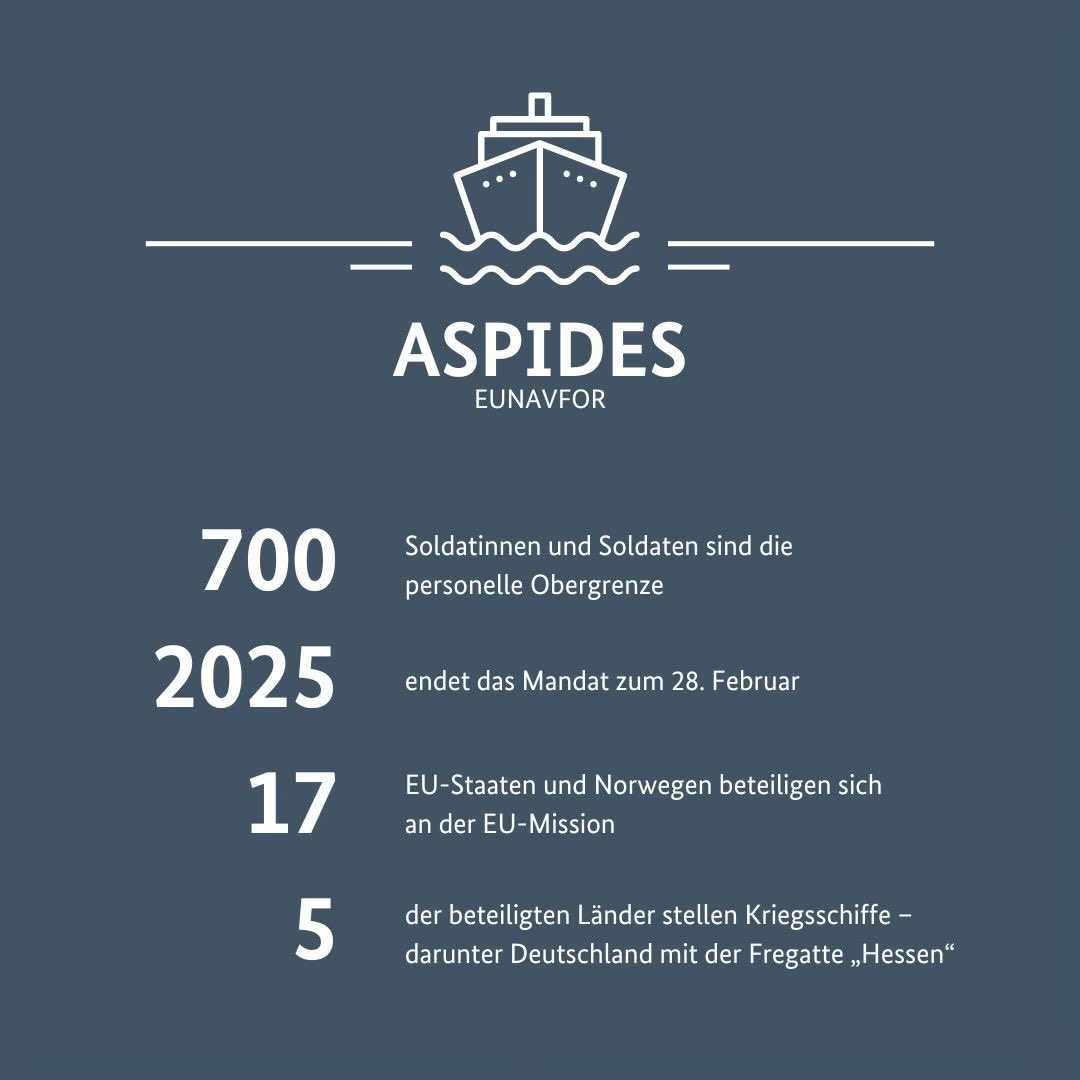
EU launches mission Aspides to protect Red Sea vessels from Houthi attacks

The European Union on Monday formally launched a bespoke naval mission to protect commercial vessels in the Red Sea from attacks by Iran-backed Houthi rebels.
Mission ‘Aspides’ - Greek for shield - will aim to preserve freedom of navigation in the Red Sea and the Gulf of Aden, a region plagued with instability since October when Houthi rebels began targeting vessels navigating the waterway with a barrage of drone and rocket attacks.
The Houthis, an Iran-backed rebel group that controls a part of Yemen, say their attacks are in retaliation for Israel’s war in Gaza that has so far claimed the lives of some 29,000 Palestinians.
The Houthis, an Iran-backed rebel group that controls a part of Yemen, say their attacks are in retaliation for Israel’s war in Gaza that has so far claimed the lives of some 29,000 Palestinians.
- With 12% of global trade and as much as 30% of global container traffic passing through the vital waterway, their strikes have threatened to severely disrupt trade flows into Europe.
- Greece will provide a commander for its operational headquarters,
- Italy will provide the force commander, and
- France the deputy force commander.
"Beyond crisis response, it's a step towards a stronger European presence at sea to protect our European interests," European Commission President Ursula von der Leyen said on social media platform X.
A senior EU diplomat said that Apsides has an exclusively "protective" mandate and will "only act when there is a threat, with minimum force."
He added that the mission will have at least four frigates and will be fully operational in a "few weeks’ time."
The operation headquarters will be located in Larissa, Greece, and will work hand in hand with "like-minded partners" already present in the region.
He added that the mission will have at least four frigates and will be fully operational in a "few weeks’ time."
The operation headquarters will be located in Larissa, Greece, and will work hand in hand with "like-minded partners" already present in the region.
- Speaking on Monday afternoon following the announcement, Italy's foreign minister Antonio Tajani said Romania as well as Albania, a candidate for EU membership, had expressed interest in joining the mission.
- Tajani claimed Italy was advocating for non-EU and non-NATO countries to have the opportunity to join the mission.
Mission strictly "defensive"
EU nations had been reluctant to back Operation Prosperity Guardian (OPG), the US-led naval mission launched in December, for fears the bloc would be contributing to an escalation in the conflict that has gripped the Middle East.
- OPG originally enlisted the support of six EU member states, three of which then distanced themselves from the mission.
The US and the UK have since led retaliatory strikes against Houthi targets on Yemeni territory, but the European bloc has distanced itself from such military action.
- "We will not be offensively neutralising a threat on land," a second senior EU diplomat said.
- "The rules of operation are strictly self-defence."
- Other member states, notably Spain, had favoured a more defensive posture and vetoed plans to repurpose the EU’s Atalanta anti-piracy mission to the region.
The launch of the EU mission comes following a respite in the Houthi's attacks, which peaked in January this year and saw Tehran move its own frigate into Red Sea waters in a sign of escalating tensions.
There have been signs of a pick-up in Houthi activity in recent days, with a Belize-flagged ship attacked Monday, hours after the US military said it had struck an unmanned underwater vessel deployed by the Houthis.
There have been signs of a pick-up in Houthi activity in recent days, with a Belize-flagged ship attacked Monday, hours after the US military said it had struck an unmanned underwater vessel deployed by the Houthis.
- Whilst the Houthis originally claimed their attacks were targeted at Israeli-owned ships, many European-operated vessels have come under fire over the past four months.
- It prompted many major shipping firms to avoid the area, opting instead for the alternative detour around the Cape of Good Hope and adding as much as a month of journey time.
NOTE: A senior EU diplomat claimed the bloc had been able to agree and launch the mission swiftly to address the threat to trade flows, despite continued rifts between the stances of EU member states on the conflict in the Middle East.


v