16 hours ago
Russian Offensive Campaign Assessment, May 3, 2024


- Zelensky warned that Russian forces are preparing to expand their offensive operations in Ukraine, likely referring to the anticipated Summer 2024 Russian offensive operation, and that Ukraine is facing a “new stage” of the war.[viii]
- Pavlyuk expressed hope that US and European military assistance will arrive in frontline areas in the near future and help blunt Russian assaults this summer and contest the theater-wide initiative in the future.[ix]

- The US military assessment concluded that the Ukrainian frontline will not collapse in the near term despite severe Ukrainian ammunition shortages.
- The US military assessment is consistent with ISW’s ongoing assessment that Russian forces will likely attempt to build on tactical gains to pursue operationally significant gains in key sectors, such as near Chasiv Yar and Avdiivka,
- in the weeks before US military assistance arrives to frontline Ukrainian units at scale but that these Russian gains will not portend a collapse of the Ukrainian defense.[xiii]
- Skibitskyi noted that Russia’s once-elite airborne (VDV) and naval infantry elements have been completely degraded and that Russia will not be able to reconstitute them to their former combat capabilities for at least a decade.[xx]
- Russian forces have heavily degraded relatively elite units by employing them in attritional ground assaults and counterattacks regardless of their designated functions and elite capabilities.[xxi]
- Degradation and the Russian military command’s decision to commit all forces along the frontline to more or less similar operations have transformed all Russian units in Ukraine regardless of their formal designations into motorized rifle units — mechanized infantry responsible for conducting combined arms ground assaults.
- Skibitskyi acknowledged that the Russian military is improving in some respects, however, and stated that the Russian military is now operating as a “single body, with a clear plan, under a single command.”[xxii] The Russian military has demonstrated an uneven propensity for operational, tactical, and technological innovation and learning, particularly with operational planning.[xxiii] The Russian military is now entirely comprised of less-elite de facto motorized rifle units, but these units continue to innovate and adapt to fighting in Ukraine while relying on materiel and manpower advantages to increasingly pressure Ukrainian forces and exploit Ukrainian vulnerabilities.[xxiv]
- Pavlyuk stated on May 2 that Russia intends to “mobilize” about 100,000 more personnel for use in offensive operations this June and July and 300,000 more personnel by the end of 2024.[xxv]
- Pavlyuk is likely referring to ongoing crypto-mobilization efforts and efforts to recruit contract service personnel and is likely not referencing another call-up of reservists similar to Russia‘s September 2022 partial mobilization.
- Skibitskyi stated that Russia is also “generating a division of reserves,” likely between 15,000 and 20,000 personnel, in central Russia to use in Russia’s anticipated Summer 2024 offensive.
- The “division of reserves” that Skibitskyi is referring to is likely included in Pavlyuk’s figure of 100,000 personnel that Russia intends to generate for use in June or July.


- The insider source claimed that the Russian MoD recently replaced Eastern Military District (EMD) Commander Colonel General Sergei Kuzmenko with Lieutenant General Alexander Sanchik and Southern Military District [SMD] Commander Colonel General Sergei Kuzovlev with Colonel General Gennady Anashkin in late March 2024.[xxxvii]
- The insider source claimed that former Western Military District (WMD) Commander Colonel General Yevgeny Nikiforov dropped out of an ongoing competition for the commander of the newly reformed Moscow Military District (MMD) and is now the Chief of Staff of the Russian Ground Forces.[xxxviii]
- The insider source did not offer claims about the command of the newly reformed Leningrad Military District [LMD], which is reportedly under the command of former Russian Ground Forces Chief of Staff Colonel General Alexander Lapin, or about the “Dnepr” Grouping of Forces, which is under the command of Russian Airborne (VDV) Forces Commander Colonel General Mikhail Teplinsky.[xxxix]
- The insider source claimed that the Russian MoD also appointed Lieutenant General Alexei Podivilov to SMD Chief of Staff and that the role of EMD Chief of Staff is currently vacant.[xl]
- The insider source claimed that the Russian MoD has made no changes to the command of the Central Military District [CMD], which Colonel General Andrey Mordvichev has commanded since January 2023 with Lieutenant General Denis Lyamin as his chief of staff since October 2023.[xli]
- Russia’s military district commanders have all recently commanded a corresponding “grouping of forces” in Ukraine, and it is highly likely that the new commanders also assumed responsibility of their military district’s respective grouping of forces.[xlii]
- ISW cannot confirm the insider source’s claims but notes that the source has been highly accurate about past military command changes.[xliii]
- The Kremlin has decided to heavily obscure the status of current military district commanders in recent months, and Mordvichev’s public prominence and the lack of changes within the CMD at a time of reported widespread changes suggests that Mordvichev has the favor of his superiors and/or the Kremlin.
- The Russian military command may also believe that command changes may be too disruptive to what it views as an offensive operation in the Avdiivka area that could achieve tactically or even operationally significant gains.
- Russian President Vladimir Putin may currently seek to reduce Russian Defense Minister Sergei Shoigu's power by balancing him with rivals, and these reported recent command changes may play into factional balancing efforts as previous command changes have.[xlix]
- Command changes do not necessarily have immediate battlefield and operational effects, however, and it will likely take some time before new commanders prove their abilities one way or another, should reports of these changes prove accurate.
- NATO stated that it is concerned about recent malign activities including those resulting in recent investigations and charges in Czechia, Estonia, Germany, Latvia, Lithuania, Poland, and the United Kingdom (UK).[l]
- NATO reported that these malign activities are part of intensifying Russian hybrid activities including “sabotage, acts of violence, cyber and electronic interference, disinformation campaigns” that Russia conducts directly and through proxies.
- NATO stated that it will continue to boost its resilience, counter hybrid threats, and ensure that member states are prepared to deter and defend against such attacks.
- The Norwegian Police Security Service reported on May 2 that it discovered an unspecified number of Russian intelligence agents operating in Vestland County who may have been preparing to sabotage critical infrastructure.[li]
- The German Ministry of Foreign Affairs (MFA) summoned the Russian Charge d’Affaires in Germany on May 3 over reports that Russian hackers under the Russian General Staff’s Main Directorate’s (GRU) control conducted cyberattacks against Germany’s Social Democratic Party as well as German logistics, defense, aerospace, and information technology (IT) companies in 2023.[lii]
- ISW also observed recent reports that the Kremlin is pursuing hybrid operations against NATO member states using GPS jamming and sabotaging military logistics.[liii]
- ISW has not yet observed Ukraine conduct strikes against military or industrial targets inside Russia using Western-provided weapons.
- Cameron announced that the UK intends to provide three billion pounds (about $3.7 billion) of annual military assistance to Ukraine “for as long as is necessary.”[lv]
- Cameron also met with Ukrainian President Volodymyr Zelensky and Prime Minister Denys Shmyhal about assistance to Ukraine and began negotiations for a new agreement on a century-long UK-Ukraine relationship to build strong security, trade, scientific, technological, educational, and cultural relationships.[lvi]

Russian President Vladimir Putin attempted to downplay recent tension in Tajik-Russian relations in a May 3 phone call with Tajik President Emomali Rahmon discussing Russian government crackdowns against Central Asian migrants living in and entering Russia following the March 22 Crocus City Hall terrorist attack. The Kremlin stated that Putin and Rahmon “exchanged views” about cooperation to fight terrorist threats and issues regarding migration.[lxi] The Kremlin reported that both leaders blamed “certain forces, including those from Tajikistan” for attempting to “artificially escalate” the situation regarding labor migrants’ entry into Russia, but expressed confidence that Tajikistan and Russia could jointly suppress these efforts and maintain their “time-tested fraternal relations.” The Tajik readout of the phone conversation notably did not include such accusations.[lxii] Putin and Rahmon both agreed to improve ministerial and departmental coordination regarding migration and to fight terrorism and extremism.[lxiii] Putin’s call with Rahmon was likely an attempt to downplay and control recent public complaints from senior Tajik officials regarding the treatment of Tajik citizens living in Russia and mass detentions of Tajik citizens entering Russia at airports and border checkpoints.[lxiv]
- The Uzbek Foreign Labor Migration Agency’s office in Russia claimed on May 3 that Russian law enforcement did not detain Uzbek citizens at Vnukovo, Sheremetyevo, Domodedovo airports in Moscow or at border crossings in Orenburg, Samara, and Saratov oblasts as some Telegram channels claimed.[lxv]
- Human rights and migrant rights activist Valentina Chupik told Russian opposition news outlet Agentstvo on May 2 that starting on May 24 Russian airports detained about 4,500 migrants at Russian airports and refused a similar number from entering Russia at land border crossings.
- Chupik stated that about half of the detainees were Uzbek citizens while Kyrgyz and Tajik citizens each made up a quarter of the detainees.[lxvi] Remittances from Russia to Uzbekistan appear to be declining and consist of a smaller portion of Uzbekistan’s yearly GDP in comparison to Kyrgyzstan and Tajikistan.[lxvii]
- A senior US defense official told Reuters that Russian forces are using a separate hangar from US forces at Airbase 101 near the Diori Hamani International Airport in Niamey, Niger.
- The official told Reuters that the situation is “not great” but is manageable in the short term.
- US Defense Secretary Lloyd Austin stated during a press conference that Russian forces are in a separate compound and do not have access to US forces or equipment and that he currently does not see a significant issue in terms of US force protection.[lxix]
- Kremlin Spokesperson Dmitri Peskov did not confirm or deny reports that Russian forces are present at the base but stated that Russia is “developing ties” with various African countries.[lxx] T
- he American Enterprise Institute’s Critical Threats Project (CTP) reported on April 12 that the Russian Ministry of Defense (MoD)-controlled Africa Corps arrived in Niger and assessed that the Africa Corps' arrival will challenge US efforts to remain in Niger in the immediate term and create long-term opportunities for the Kremlin to create conventional and irregular threats that strategically pressure Europe.[lxxi]
Key Takeaways:
- Ukrainian officials continue to highlight that Russia’s main goal for 2024 remains the seizure of Donetsk and Luhansk oblasts as Russian forces plan for their summer 2024 offensive operation.
- The first deliveries of resumed US military assistance reportedly arrived in Ukraine earlier this week, although it will likely take several additional weeks before Western weapons and ammunition arrive to frontline areas at scale.
- Ukrainian officials indicated that Russian forces in Ukraine have not significantly increased in size in recent months but that the Russian military continues to improve its fighting qualities overall despite suffering widespread degradation, especially among elite units since the start of the war.
- Ukrainian officials indicated that the Russian military will likely maintain its current personnel replacement rate and will not generate the significant number of available personnel needed to establish strategic-level reserves for larger-scale offensive operations in 2024.
- Pavlyuk stated that neither Russian nor Ukrainian forces will be able to achieve victory in Ukraine solely through attritional warfare – a consistent throughline that Ukrainian officials and military analysts have emphasized in recent months.
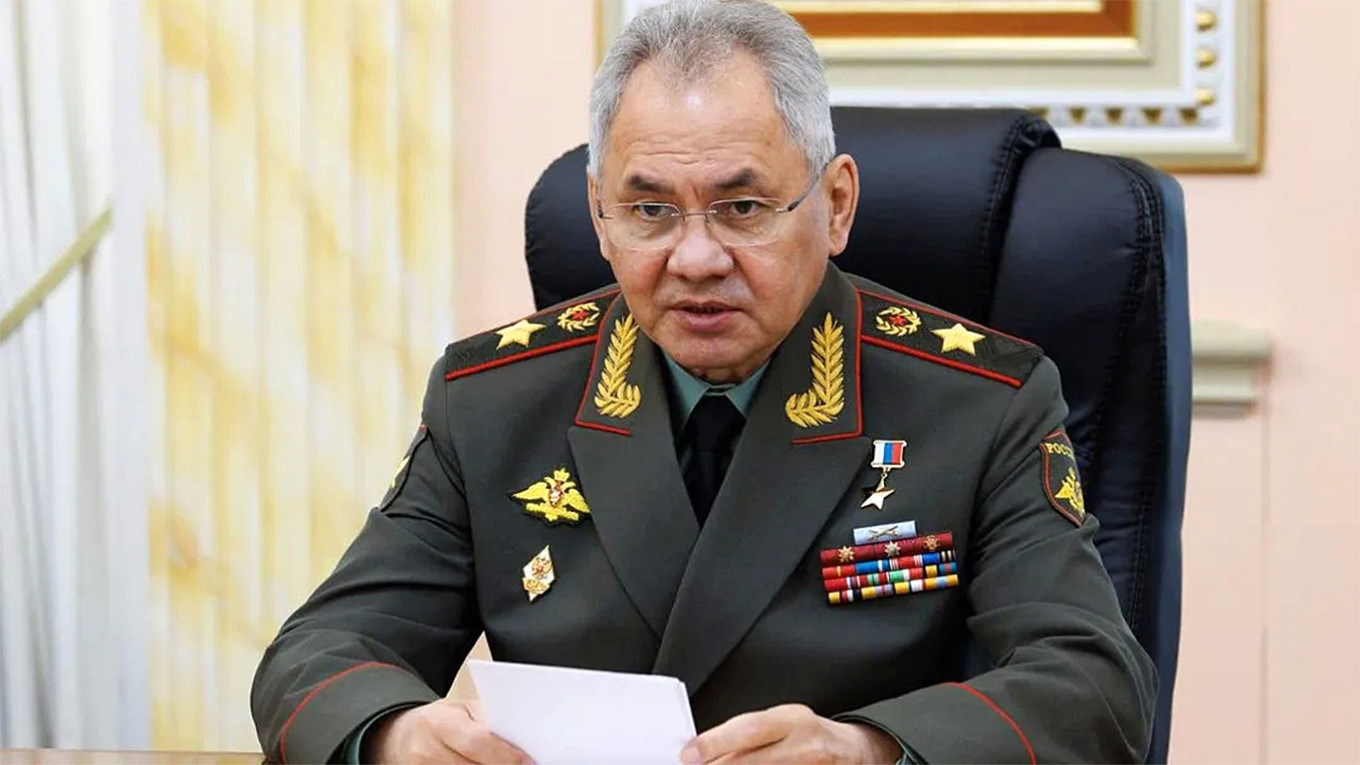
- Russian Defense Minister Sergei Shoigu issued a notably candid assessment of recent Russian advances in Ukraine and refrained from sweeping claims about the success of the Russian war effort, possibly in an attempt to temper domestic expectations about Russia’s near future successes in Ukraine ahead of the summer 2024 Russian offensive operation.
- A Russian insider source, who has routinely been accurate about past Russian military command changes, claimed on May 2 that the Russian Ministry of Defense (MoD) has replaced several high-level Russian commanders in recent months.
- NATO stated on May 2 that it is “deeply concerned” about intensifying Russian hybrid operations on NATO member territory and that these operations constitute a threat to Allied security.
- UK Foreign Minister David Cameron announced the United Kingdom’s intent to provide long-term support for Ukraine and stated that Ukrainian forces can conduct long-range strikes within Russia with UK-provided weapons.
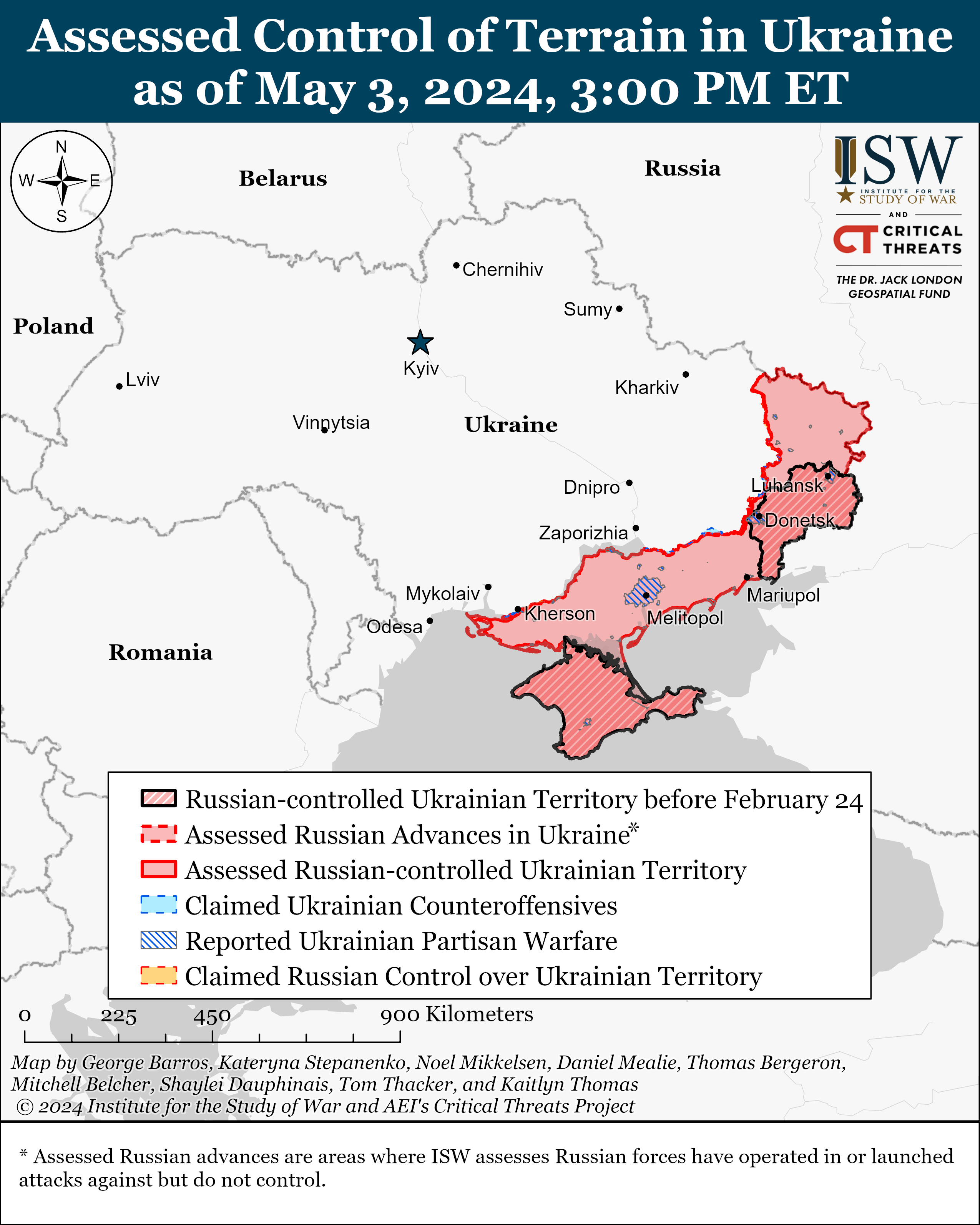
- Russian forces recently marginally advanced near Kupyansk, Avdiivka, and Donetsk City.
- Rostec General Director Sergei Chemezov announced that Russian state-owned defense conglomerate Rostec is increasing its production of all variants of guided glide bombs during a May 3 meeting with Russian Prime Minister Mikhail Mishustin.
Ukraine war briefing: Russian drone strike injures three and sparks fire in Kharki
A 13-year-old child and two women were struck by debris from downed drones...
Russian defence minister Sergei Shoigu said on Friday that Russian troops had captured 547 sq km of territory in Ukraine this year. Shoigu said Ukrainian forces were retreating all along the frontline.
The Russian defence ministry said on Friday that its air defence forces destroyed six drones that Ukraine launched overnight. Five of the drones were downed over the Belgorod region that borders Ukraine and one over the Crimean Peninsula, the defence ministry said on the Telegram messaging app.
Ukraine’s president and foreign minister has pressed British foreign secretary David Cameron to accelerate the delivery of promised military aid to Kyiv, as Russia heaps battlefield pressure on depleted Ukrainian forces in the third year of war. “It is important that the weapons included in the UK support package announced last week arrive as soon as possible,” Ukrainian president Volodymyr Zelenskiy said on the social platform X, as Cameron visited Kyiv on Thursday.
Russian defence minister Sergei Shoigu said on Friday that Russian troops had captured 547 sq km of territory in Ukraine this year. Shoigu said Ukrainian forces were retreating all along the frontline.
The Russian defence ministry said on Friday that its air defence forces destroyed six drones that Ukraine launched overnight. Five of the drones were downed over the Belgorod region that borders Ukraine and one over the Crimean Peninsula, the defence ministry said on the Telegram messaging app.
Ukraine’s president and foreign minister has pressed British foreign secretary David Cameron to accelerate the delivery of promised military aid to Kyiv, as Russia heaps battlefield pressure on depleted Ukrainian forces in the third year of war. “It is important that the weapons included in the UK support package announced last week arrive as soon as possible,” Ukrainian president Volodymyr Zelenskiy said on the social platform X, as Cameron visited Kyiv on Thursday.