Previously, France had been asked to withdraw its troops from countries such as Mali and Burkina Faso. Many European and American think tanks and media outlets expressed their concerns that this may lead to a significant decrease in Western influence in the Sahel region, allowing Russia to take advantage of the situation. Some research institutions even claimed that Western influence in the Sahel region has already “collapsed.” So, how many troops do Western countries currently have deployed in the region? Why are countries in the Sahel region asking these troops to leave? And can Russian forces replace them?
‘US army, go home’
“This is Agadez, not Washington. US army, go home!” On April 21, in the northern town of Agadez, home to a US air base, protesters held up a large banner demanding the withdrawal of US troops from Niger. Hundreds of people participated in the protest, with the organizer, Issouf Emoud, telling AFP, “Our message is clear: American soldiers, pack your bags and go home.”
The day after the protest, on April 22, Pentagon spokesperson Pat Ryder announced that Washington had begun discussions with the military government of Niger regarding the withdrawal of American troops from the country. The Pentagon plans to send a small delegation to Niger for talks, including members of the US Africa Command, but a timeline for the withdrawal has not been determined.
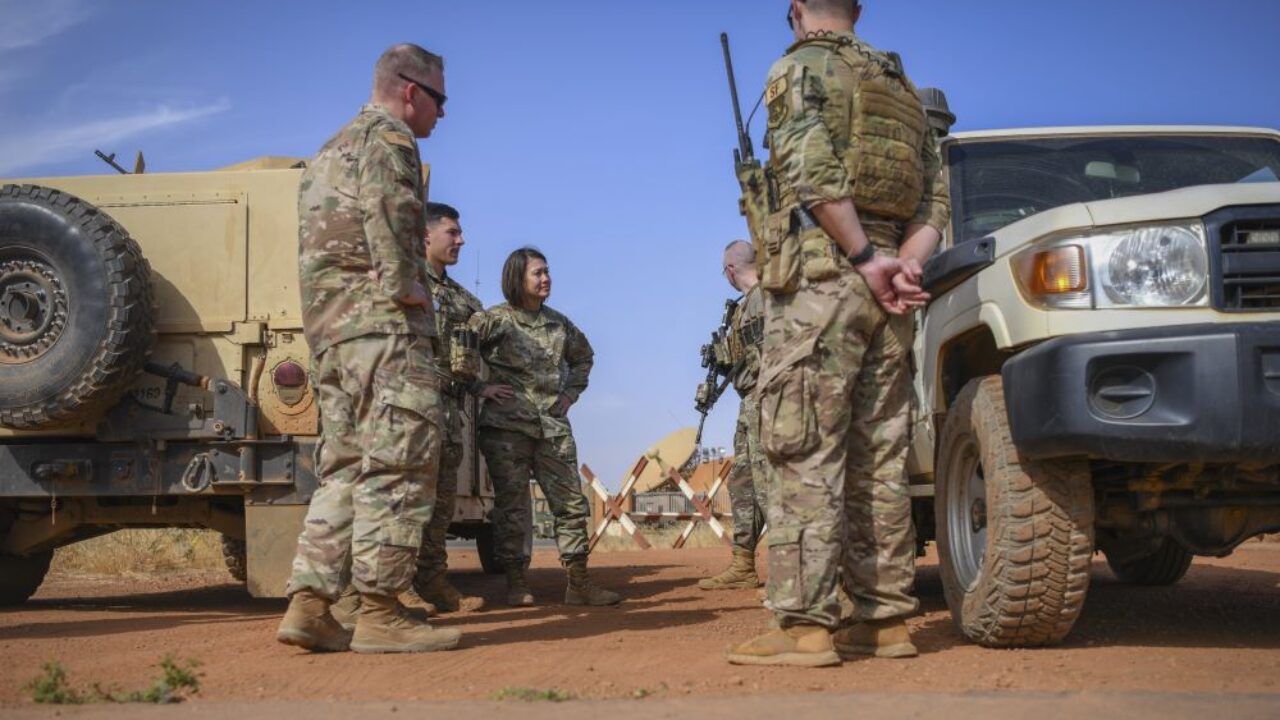
According to media reports, the US has a military presence in several African countries. After the September 11, 2001 attacks, the US increased its military footprint in Africa. In 2007, the US Department of Defense unified its efforts in Africa, establishing the US Africa Command. The US first deployed troops to Niger in 2013, and currently has approximately 1,000 troops deployed in the country split between two bases.
One of the bases is the 101 Air Base in the capital Niamey, and the other is the 201 Air Base in Agadez. The 201 Air Base serves as a drone base, at a cost of up to $110 million. It is one of the largest US drone bases in Africa, enabling Washington to conduct intelligence, surveillance, and reconnaissance activities covering almost the entire Sahel region. This region extends from the Atlantic coast of Africa to the Red Sea, including at least 14 countries such as Mali, Burkina Faso, and Niger, according to public reports.
In March of this year, Niger suddenly requested the withdrawal of US troops. Meanwhile, Chad has reportedly made the same request.
According to a Reuters report, in a letter from Chad’s Air Force Chief of Staff Idriss Amine Ahmed dated April 4 to the country’s Minister of Armed Forces, he said he had informed US officials to halt activities at the Adji Kossei Air Base, as the Americans had failed to provide documents justifying their presence there.
A US official revealed that the rotational corps of troops in Chad has less than 100 personnel, with their main role being to plan tasks in the region. A US State Department spokesperson responded to this by saying that Washington is in talks with Chadian officials regarding the future of the two countries’ security partnership.
The requests for the withdrawal of US troops by countries like Niger are the latest actions by Sahel region countries to expel Western forces. After a coup in Niger in July 2023, France was asked to withdraw its troops.
France withdrew its forces from Niger in December 2023. Previously, in February 2023, France withdrew its troops from Burkina Faso at the country’s request. On August 15, 2022, the French Defense Ministry issued a statement announcing that “Today at 13:00 (Paris time), the last military unit of the Barkhane force present on Malian territory crossed the border between Mali and Niger.”
According to media reports, as of September 2023, France had deployed around 1,500 soldiers in Niger, 1,000 in Chad, 900 in Ivory Coast, 350 in Senegal, and 400 in Gabon. Germany had also deployed about 1,000 soldiers in Mali and approximately 110 German soldiers were stationed in Niamey.
Italy once had about 300 soldiers in Niger. In December 2022, the European Union launched a three-year military training mission in Niger. On August 6, 2023, the Italian Defense Ministry stated that 65 Italian soldiers had left Niger aboard a military aircraft. In December 2023, there were reports that Germany had completed its withdrawal from Mali, thus ending its mission within the framework of the United Nations Multidimensional Integrated Stabilization Mission in Mali.
The Global Times found that, excluding the troops already withdrawn by France and those to be withdrawn by the US, the military forces of France, the US, Germany, Italy, and other countries in West and Central Africa are expected to be reduced by more than 3,000 personnel compared to the number in September 2023. It is also worth noting that in August 2023, there was a military coup in Gabon, leading to diplomatic friction between the military government and France, which could potentially result in French troops in Gabon leaving at any time.
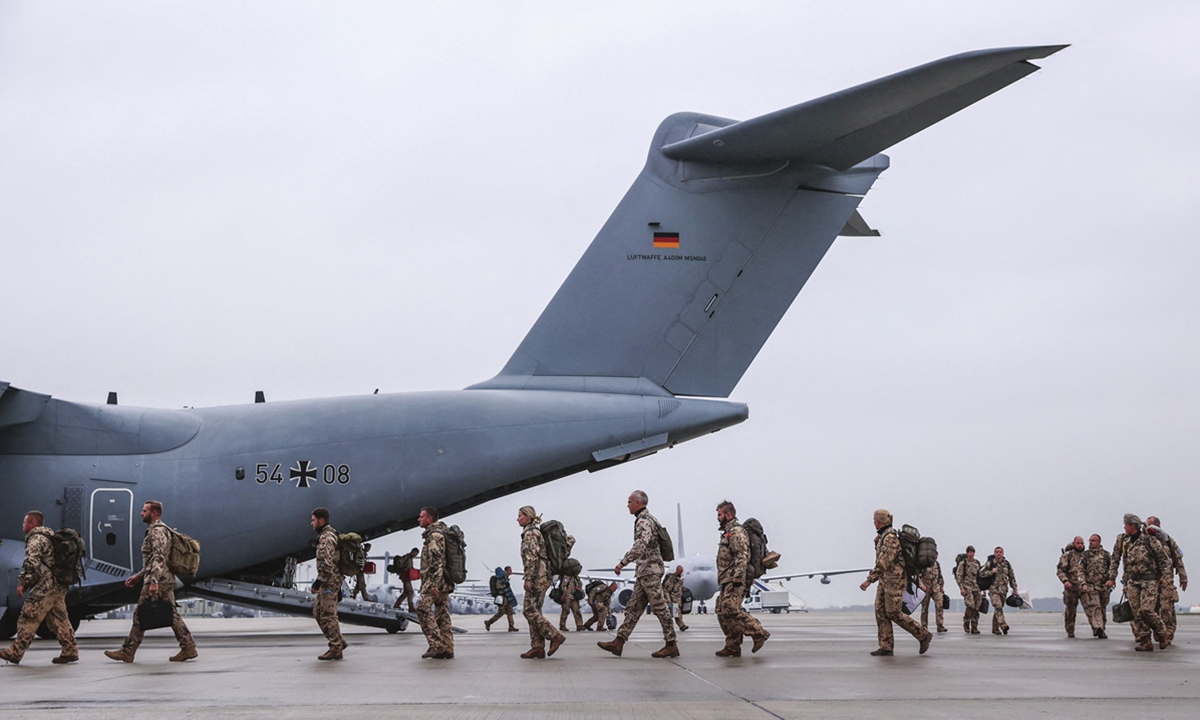
Recalled troops of the German armed forces Bundeswehr who had served in Mali, disembark from an A400M military cargo aircraft at the military air base in Wunstorf, northern Germany, on December 15, 2023. Photo: VCG
‘Nothing to lose’
As Western military forces sequentially withdraw or are drove out from countries in the Sahel region, many European and American think tanks and media sources have voiced their concerns. These sources suggest that the withdrawal of Western troops could lead to a significant increase in terrorist activities in West Africa and the Sahel, continuously deteriorating the security situation in the region.
- According to an analysis by the Intercept, a US news website, on March 19, despite a more than 900 percent increase in US military presence in Niger over the last decade, terrorism in the Sahel has not been suppressed.
- According to the US State Department, extremist militants caused only 23 casualties across Africa between 2002 and 2003.
- By contrast, data from the US Defense Department’s Africa Center for Strategic Studies shows that in 2023 alone, extremist attacks in the Sahel region resulted in over 11,643 deaths, more than a 500-fold increase from 20 years ago.
“Paternalism” refers to a powerful country using leverage or coercion to influence the decisions of a weaker country to align with its own objectives.
- The think tank mentioned that on March 16, just one day after a visit by US military officials to Niamey, the Nigerien military government announced an immediate suspension of security cooperation with the US.
Zhang Chun, a researcher at the Africa Research Center at Yunnan University, shared a similar view that Western involvement has not produced the anticipated effects in countering terrorism threats in the Sahel, and the dissatisfaction among the populations of these countries has been accumulating.
He believes that Africa, especially since entering the second decade of the 21st century, has seen a rise in strategic autonomy, which can also be described as a new wave of “decolonization movement,” shifting from the pursuit of political independence in the 1960s to today’s pursuit of security and economic independence.
‘Need some time’
As Western countries withdraw their military forces from the Sahel region, the reactions vary from relief to concern.
- The Foreign Policy Research Institute suggests that this marks a new era in which African elites take charge of African affairs.
- The trend of increasingly expressing dissatisfaction toward Western powers underscores a growing recognition that African issues are best solved by Africans themselves. However, these events also signify a pivot in Western influence in the Sahel.
Nina Wilén, the director of the Africa program at Belgium’s Egmont Royal Institute for International Relations, stated at the end of 2023 that Western influence in West Africa has seen a “collapse.”
Zhang said that there should be a nuanced view on the “collapse.”
Western influence in the Sahel: From a formal arrangement perspective, Western influence has indeed been significantly affected; however, from an informal standpoint, the extent of this impact remains unclear.
- In fact, much of the West’s influence in the region has historically operated through informal arrangements, such as France’s special relationships with African countries and Western intelligence networks.
- Rather than a “complete retreat,” Western influence in the Sahel is more likely to undergo a “structural transformation,” Zhang noted.
Western countries have not abandoned deploying military forces to other African countries. A January report by The Wall Street Journal noted that the US is attempting to sign new security cooperation agreements with preliminary discussions already underway with these nations.
Zhang believes that the influence of Russia’s “African Legion” in the Sahel and other African regions might be far less than the West claims, for several reasons:
- The West has been entrenched in Africa for a long time, and the “African Legion” cannot easily be infiltrated.
- Moreover, the end of formal arrangements with some African nations needs a convincing public excuse, and blaming Russia is more effective than emphasizing African strategic autonomy, as the former only indicates a “cunning enemy,” while the latter would admit to the West’s “own incompetence.”
Currently, Niger’s economy is facing challenges.
He Xing (pseudonym), a staffer at a Chinese company, who has been in Niger for 12 years, noted a rise in street beggars in Niamey and a decrease in the variety of goods at the largest wholesale market, with prices for basic vegetables like potatoes, onions, and tomatoes doubling.
Furthermore, the occupancy rate at the upscale Radisson Blu Hotel in Niamey has dropped to about 20 percent, primarily due to a reduction in Western visitors.
“Although this is the case, the security situation in Niamey is still good; there’s little risk even at night,” he said, though small-scale conflicts occasionally erupt along Niger’s borders. “From what we see, the Nigerien military government is looking for suitable ways to develop the economy, and they need some time.”








.png)
.png)


