Tuesday, June 04, 2024

EUROZONE GDP OUTLOOK REVISION... China's growth forecasts to 5.2%...For the U.S,, growth to be about 2.4%

Deutsche Bank revises eurozone GDP outlook for the year

Ahead in the market: All eyes remain focused on inflation | Euronews

The German economy is doing better than expected, while the UK economy is also going through a cyclical recovery.

Deutsche Bank has increased the eurozone gross domestic product (GDP) outlook for this year from 0.4% to 0.9%, according to the latest Deutsche Bank World Outlook.
  • However, the report suggests, this is likely to be due more to cyclical than structural reasons, with the bank's 2025 forecasts for the eurozone remaining the same at 1.5%. 
Regarding the eurozone, the 20 EU member states using the euro as currency, the report says: "Our inflation outlook is broadly unchanged - sticky and with upside risks in 2024, converging to target in 2025 but the composition is a little less ECB friendly, with higher services and lower core goods inflation. 

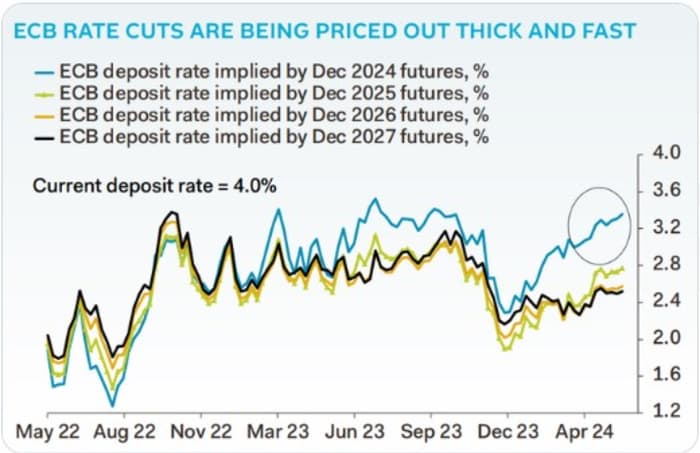
The risk is two ECB interest rate cuts, not the hoped-for three

"We have made some slight hawkish tweaks to our European Central Bank (ECB) call. Our baseline is 3 quarter point rate cuts by the ECB in 2024. The risk is 2 cuts. Previously, we had an ECB terminal rate of 2% in Q1 2026. 
"We now describe the landing zone as 2% to 2.5%. Either way, we see market pricing in 2025 as too hawkish. Declining inflation, fiscal tightening, and trade and geopolitical uncertainty all lean towards a larger easing of monetary policy."
For the US, the bank expects growth to be about 2.4% this year, which would be on the upper end of the consensus, as well as 2.2% next year. However, the forthcoming US elections could continue to pose volatility risks to the market. 
Growth in China predicted to slow....Drop from 5.2% to 4.5% next year
Looking at China, the bank in April lifted the country's growth forecasts to 5.2%, driven mainly by more government spending and exports looking up. However, for the next year, Chinese growth is expected to drop to 4.5%, as the housing market bows down to supply shooting up. 

Euro Zone Bond Yields Slide Amid Mounting Economic Concerns


Euro Zone Bond Yields Slide Amid Mounting Economic Concerns - Finimize
The bigger picture: Global economic shifts on the horizon.
The broader implications of these bond yield movements signal a cautious stance by central bankers amid economic uncertainties and labor market concerns. While the ECB is expected to cut rates, policymakers may delay actions due to unpredictable growth and employment dynamics. Additionally, the resilience of Italian bonds despite economic headwinds and the yield spread between French and German bonds following France's debt downgrade are crucial indicators of ongoing regional economic challenges. Ultimately, these developments reflect a complex and evolving global economic landscape.

Wealth of nations: Gap between rich and poor in Europe widens

Wealth of nations: Gap between rich and poor in Europe widens | Euronews

Wealth inequality between countries across Europe is very strong. In the EU, the difference in wealth per adult between the countries with the highest and lowest levels exceeds a factor of ten.

Inequality has emerged as a major concern among EU citizens. According to the 2021 Eurobarometer survey, ensuring equality of opportunities was ranked as the top priority for the EU's economic and social advancement. The most pressing issues for citizens are equal opportunities and access to the labour market, fair working conditions, and access to quality health care.

Credit Suisse and UBS's Global Wealth Report 2023 showed that wealth inequality is apparent not only within countries but also between the nations across Europe.
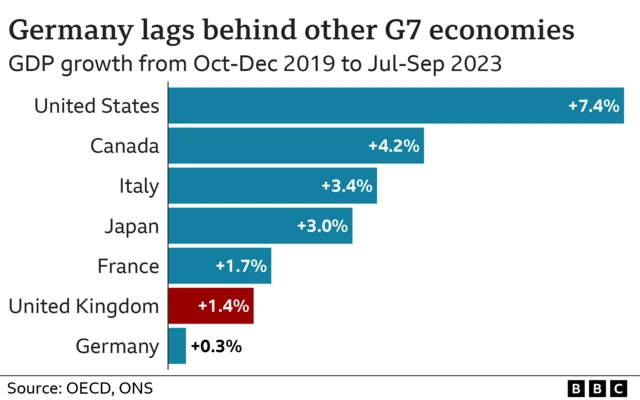
How will the UK economy compare to other countries in 2024?
Traders expect a hawkish cut from the ECB. What it means for markets. -  MarketWatch

A Resilient Global Economy Masks Growing Debt and Inequality

The world appears to have dodged a downturn, but wars and economic nationalism are leaving many countries worse off.


Global Economy Soft Landing Masks Growing Debt, Inequality - Bloomberg
Eurozone economy


Moment 'US missiles strike INSIDE Russia blasting rocket launchers Putin...

Russia Captures Praskoviivka l Upcoming Encirclement Of Ukrainian Forces

Audit of the Department of State's Humanitarian Response to the Ukraine Crisis


United States Department of State Office of Inspector General
06/03/2024 02:36 PM EDT

(U) What OIG Audited 

(U) On February 24, 2022, Russia launched a full-scale invasion of Ukraine, causing hundreds of thousands of people to flee their homes in search of safety. As a result, 17.6 million people were in urgent need of humanitarian assistance as of February 2024, with 6 million refugees recorded in Europe. The Department of State (Department) had obligated $862.2 million to assist humanitarian efforts in support of Ukraine as of February 2024.  

(U) The Office of Inspector General (OIG) conducted this audit to determine whether (1) the Department’s humanitarian assistance response to the Ukraine crisis was implemented in accordance with Department policies, guidance, and award terms and conditions and (2) the intended objectives were achieved. To conduct this audit, OIG reviewed four voluntary contributions awarded by the Bureau of Population, Refugees, and Migration (PRM) in FY 2022 to three public international organizations (PIO) with a collective value of $431.7 million.  

(U) What OIG Recommends 

(U) OIG is making nine recommendations that are intended to improve PRM’s risk assessment process and the monitoring of these awards. Based on PRM’s response to a draft of this report, OIG considers the nine recommendations resolved, pending further action. A synopsis of management’s comments on the recommendation offered and OIG’s reply follow each recommendation in the Audit Results section of this report. PRM’s response is reprinted in its entirety in Appendix C. A summary of PRM’s technical comments with OIG’s replies is presented in Appendix D.  


(U) What OIG Found 

(U) Although PRM developed terms and conditions for the voluntary contributions used to support the humanitarian assistance response to Russia’s full-scale invasion of Ukraine, 

OIG found that the terms and conditions did not include measurable objectives, which is strongly recommended in Department guidance as a result of a previous OIG audit. 
  • OIG found that absent specific, measurable objectives or corresponding performance indicators, PRM was not positioned to track progress toward intended program results. 
PRM did not include such measures, at least in part, because Department guidance for voluntary contributions does not include the same award terms and conditions requirements as for other types of federal assistance awards. 
  • OIG also found that, although PRM completed a monitoring plan for the voluntary contributions, this plan did not detail specific monitoring activities to be performed and was not tied to PRM’s risk assessment for the awards as required by Department guidance. 
  • Although PRM conducted monitoring activities, it did not track progress against measurable objectives and performance indicators for the awards. 
Therefore, OIG was limited to broadly assessing alignment of PIO activities against PIO appeals for assistance. 
  • The award activities implemented generally aligned with the appeals for which they were awarded, but OIG could not independently determine whether these activities were achieving intended objectives.  

(U) OIG found that PRM implemented internal controls to manage risk and developed best practices to guide the risk assessment process. 

PRM completed the required risk assessment for the voluntary contributions awarded; however, 
  • the risk assessment did not consistently include risk ratings for the risks identified, nor did it explicitly account for risks identified by the PIOs. 
  • OIG also found that PRM did not consistently develop mitigation measures for the risks identified as required or plans to ensure that mitigation measures identified by the PIOs were implemented in line with best practices. 
  • The shortcomings occurred, at least in part, because PRM did not have risk management officials reviewing the risk assessments at the time. 

Accounting for all identified risks is necessary for developing appropriate risk mitigation plans and guiding PRM award monitoring specific to those risks.

VENOM: THE LAST DANCE – Official Trailer (HD)