JUNE 5, 2024 REPORT
Microsoft unveils Aurora, an AI-based weather forecasting system that can also predict air pollution levels
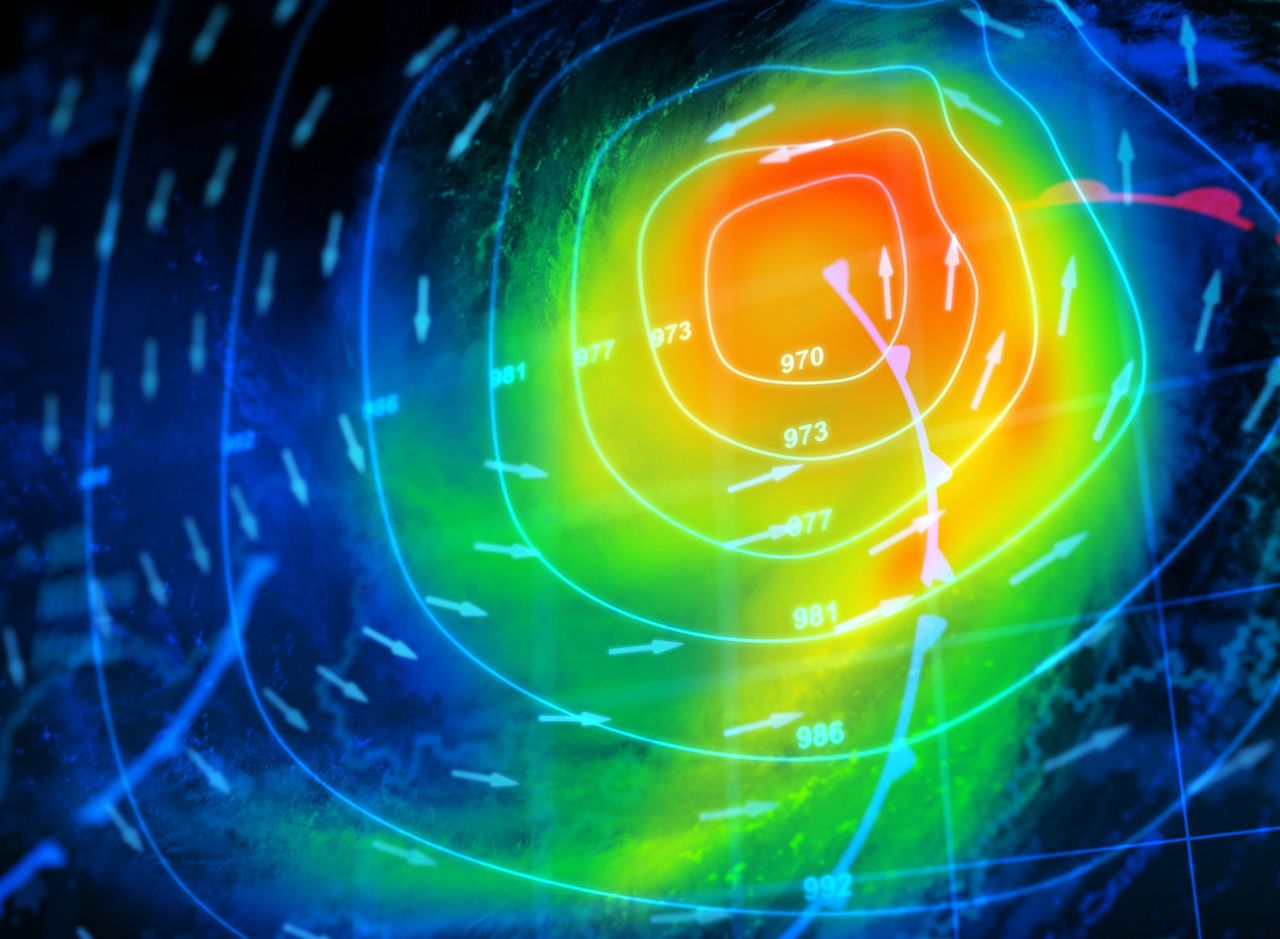
A team of computer scientists at Microsoft Research AI for Science, working with a colleague from JKU Linz, another from Poly Corporation, and another from the University of Amsterdam, has built what Microsoft describes in its press release, as a "cutting-edge foundation model"—a system called Aurora that can be used to make global weather and air pollution level predictions more quickly than traditional systems.
The group has posted a paper describing their new AI system and how well it has tested compared to conventional weather prediction models on the arXiv preprint server.
Conventional computer-based weather prediction systems typically run on supercomputers because they rely on mathematical formulas that crunch massive amounts of data. More recently, several groups (such as DeepMind and Nvidia) have taken another approach: using AI-based applications that take far less time to run.
In this new effort, Microsoft, working with its research partners, has developed a weather prediction system that it claims rivals traditional systems but takes only minutes to run—and it can predict global air pollution levels as well.
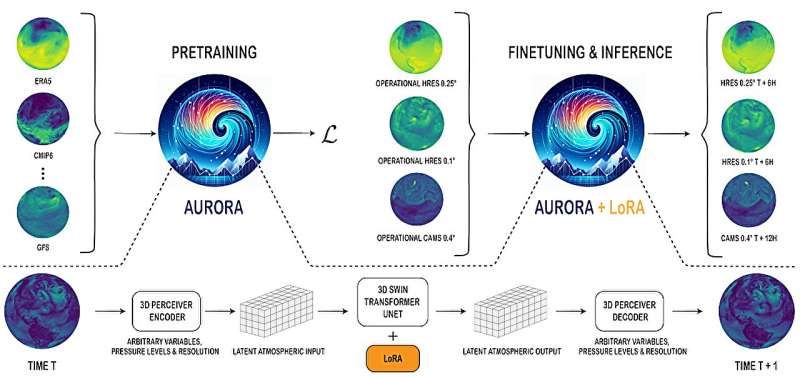
Called Aurora, the system uses 1.3 billion parameters and was trained using millions of hours of data from six climate and weather models. It can make 10-day predictions for any part of the world. It can also be used to predict the size and severity of unique weather events, such as hurricanes.
Microsoft describes it as a system made with "flexible 3D Swin Transformers, with Perceiver-based encoders and decoders." The technology allows it to use a wide variety of atmospheric data, such as wind speed, air pressure, temperature and even greenhouse gas concentrations. And that, the researchers claim, allows the system to discover patterns that would not be seen otherwise—patterns that can lead to predictable outcomes.
Unique among its capabilities is Aurora's ability to predict air pollution levels for any given urban area around the world—and to be able to do it so quickly that it can serve as an early warning system for places that are about to experience levels of dangerous pollutants.
Such an ability, the team notes, could bring a new level of prediction to areas that up to now have been underserved, such as cities in third-world countries.
The research team concludes by noting that in side-by-side accuracy tests, Aurora's predictions were similar in accuracy to standard systems now run on supercomputers. Though they acknowledge that more testing will need to be done to determine the true accuracy of their system.
----------------------------------------------------------------------------------------------------------------------------
PREVIOUSLY UPLOADED ON THIS BLOG
04 December 2023
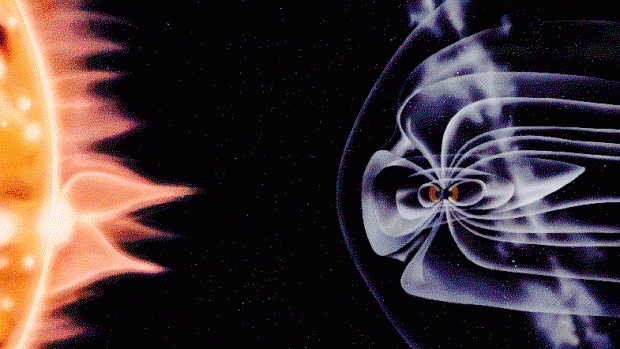
Earth's Magnetosphere

Solar flares prompt aurora alert and "Geomagnetic Storm Warning"

The National Oceanic and Atmospheric Administration’s (NOAA) Space Weather Prediction Center (SWPC), a key division of the National Weather Service, is currently keeping a close eye on the Sun following several significant solar events. These events have led to concerns about a strong geomagnetic storm, prompting the issuance of a Geomagnetic Storm Watch.
November 28 solar flare and CME
On November 27 and 28, the Sun experienced several coronal mass ejections (CMEs), which are massive bursts of solar wind and magnetic fields rising above the solar corona or being released into space. These CMEs have triggered a flurry of activities and observations by space weather experts.
A notable solar flare was detected on November 28 at 2:50pm EST. This event originated from Region 3500, a moderately complex sunspot group located near the Sun’s central meridian. The flare was associated with the fourth full halo CME observed during this period.
Interestingly, the fourth CME is moving at an accelerated pace compared to the previous ones. This increase in speed is attributed to the earlier CMEs clearing a path through the solar wind. It is anticipated that this CME will merge with two of the three earlier CMEs, with an expected arrival at Earth between the night of November 30 and December 1.
Impact from geomagnetic storm
SWPC forecasters are vigilantly monitoring the situation using NOAA’s DSCOVR satellite, which provides real-time data on solar winds. This information is crucial for understanding the strength and timing of the anticipated geomagnetic storm.
Geomagnetic storms are known to affect infrastructure both in near-Earth orbit and on the Earth’s surface. These impacts can include disruptions to communications, the electric power grid, navigation systems, radio frequencies, and satellite operations. Such storms are a significant concern for industries and services reliant on these technologies.
High auroral activity expected
An interesting and visually stunning consequence of geomagnetic storms is the aurora, commonly known as the Northern or Southern Lights. This storm has the potential to drive the aurora further south from its usual position above the polar regions.
If weather conditions are favorable, auroras may be visible across the U.S. Northern Tier and upper Midwest from Illinois to Oregon. Residents in these areas are encouraged to check NOAA’s latest aurora forecast for the best chance of witnessing this natural phenomenon.
NOAA’s SWPC continues to monitor these solar events closely, providing updates and forecasts. As the situation evolves, they will offer guidance on the potential impacts of the geomagnetic storm. The public and relevant industries are advised to stay informed and prepared for any disruptions that may occur.


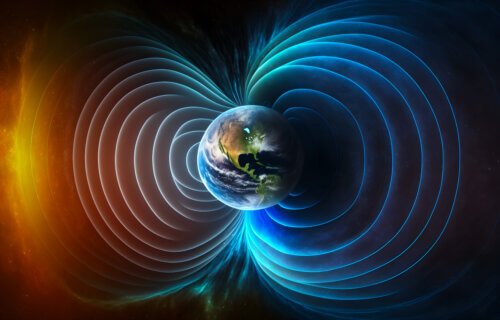
Earth’s magnetic field could completely flip soon — Physicist explains what that means
by The ConversationThe Earth’s magnetic field plays a big role in protecting people from hazardous radiation and geomagnetic activity that could affect satellite communication and the operation of power grids. And it moves.
Scientists have studied and tracked the motion of the magnetic poles for centuries. The historical movement of these poles indicates a change in the global geometry of the Earth’s magnetic field. It may even indicate the beginning of a field reversal – a “flip” between the north and south magnetic poles.
I’m a physicist who studies the interaction between the planets and space. While the north magnetic pole moving a little bit isn’t a big deal, a reversal could have a big impact on Earth’s climate and our modern technology. But these reversals don’t happen instantaneously. Instead, they occur over thousands of years.
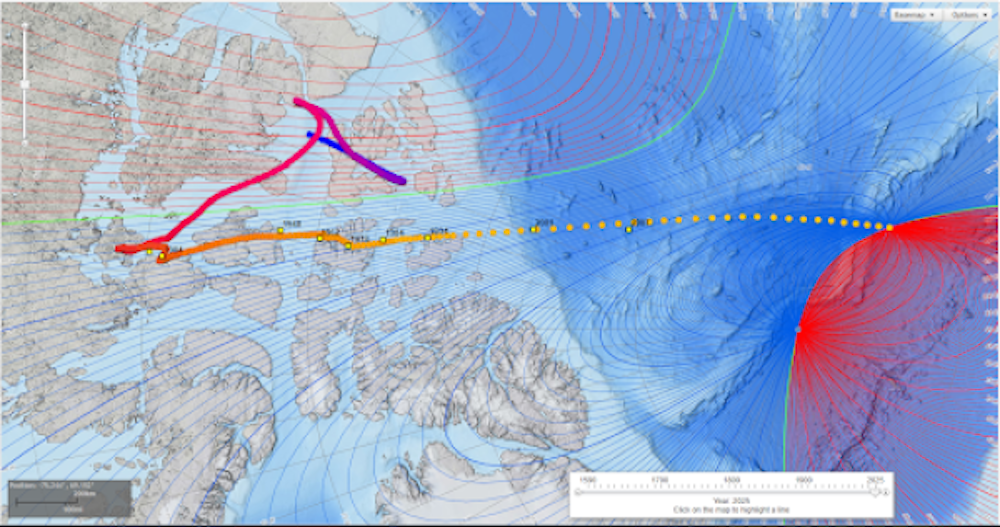
- The north magnetic pole’s observed locations from 1831–2007 are yellow squares.
- Modeled pole locations from 1590–2025 are circles progressing from blue to yellow. National Centers for Environmental Information
Magnetic field generation
So how are magnetic fields like the one around Earth generated?
Magnetic fields are generated by moving electric charges. A material that enables charges to easily move in it is called a conductor. Metal is one example of a conductor – people use it to transfer electric currents from one place to the other. The electric current itself is simply negative charges called electrons moving through the metal. This current generates a magnetic field.
- Layers of conducting material can be found in the Earth’s liquid iron core.
- Currents of charges move throughout the core, and the liquid iron is also moving and circulating in the core.
- These movements generate the magnetic field.

Earth isn’t the only planet with a magnetic field – gas giant planets like Jupiter have a conducting metallic hydrogen layer that generates their magnetic fields.
These conducting layers may have some local irregular motions due to local turbulence or smaller flows that do not follow the large-scale pattern. These irregularities will manifest in some small anomalies in the planet’s magnetic field or places where the field deviates from being a perfect dipole field.
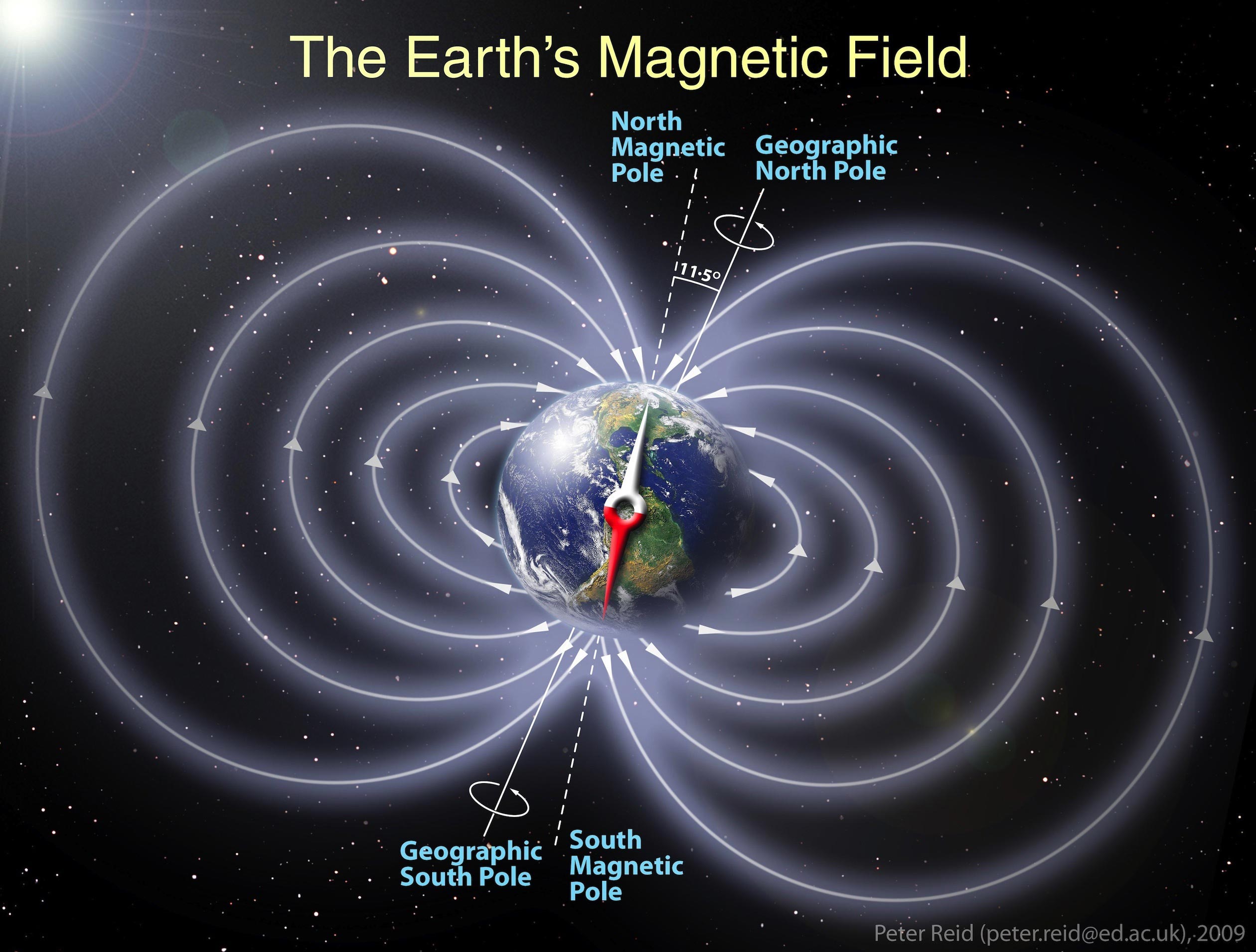
These small-scale deviations in the magnetic field can actually lead to changes in the large-scale field over time and potentially even a complete reversal of the polarity of the dipole field, where the north becomes south and vice versa. The designations of “north” and “south” on the magnetic field refer to their opposite polarities – they’re not related to geographic north and south.
The Earth’s magnetosphere, a protective bubble
- The magnetosphere plays a major role in protecting people. It shields and deflects damaging, high-energy, cosmic-ray radiation, which is created in star explosions and moves constantly through the universe.
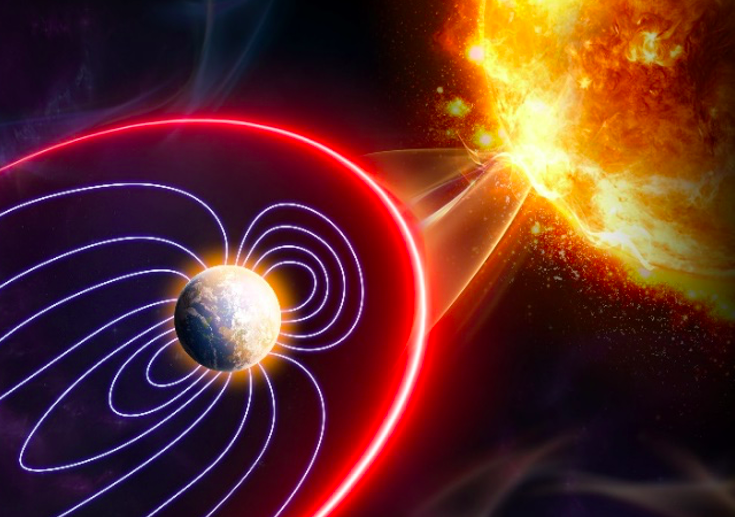
- The magnetosphere also interacts with solar wind, which is a flow of magnetized gas sent out from the Sun.
However, there are times when the Sun sheds large magnetized clouds of gas called coronal mass ejections into space. If these coronal mass ejections make it to Earth, their interaction with the magnetosphere can generate geomagnetic storms. Geomagnetic storms can create auroras, which happen when a stream of energized particles hits the atmosphere and lights up.
- During space weather events, there’s more hazardous radiation near the Earth.
- This radiation can potentially harm satellites and astronauts.
- Space weather can also damage large conducting systems, such as major pipelines and power grids, by overloading currents in these systems.

Space weather events can also disrupt satellite communication and GPS operation, which many people rely on.
Field flips
Scientists map and track the overall shape and orientation of the Earth’s magnetic field using local measurements of the field’s orientation and magnitude and, more recently, models.
- The location of the north magnetic pole has moved by about 600 miles (965 kilometers) since the first measurement was taken in 1831.
- The migration speed has increased from 10 miles per year to 34 miles per year (16 km to 54 km) in more recent years.
- This acceleration could indicate the beginning of a field reversal, but scientists really can’t tell with less than 200 years of data.
The Earth’s magnetic field reverses on time scales that vary between 100,000 to 1,000,000 years. Scientists can tell how often the magnetic field reverses by looking at volcanic rocks in the ocean.
These rocks capture the orientation and strength of the Earth’s magnetic field when they are created, so dating these rocks provides a good picture of how the Earth’s field has evolved over time.
Field reversals happen fast from a geologic standpoint, though slow from a human perspective. A reversal usually takes a few thousand years, but during this time the magnetosphere’s orientation may shift and expose more of the Earth to cosmic radiation. These events may change the concentration of ozone in the atmosphere.
Scientists can’t tell with confidence when the next field reversal will happen, but we can keep mapping and tracking the movement of Earth’s magnetic north.


More information: Cristian Bodnar et al, Aurora: A Foundation Model of the Atmosphere, arXiv (2024). DOI: 10.48550/arxiv.2405.13063


.gif)
.gif)