Thursday, August 08, 2024

The Kursk Incursion

Russia has declared a state of emergency in Kursk and local officials told the Tass news agency that 3,000 civilians had been evacuated following an attack that has clearly caught Moscow off guard.
Russian military bloggers, currently the most accurate sources of information, reported that fighting was taking place on the highway east of Korenevo, 13 miles north of the border, while the western part of Sudzha, about six miles into Russia, appeared to be under Ukrainian control.

Russia battles Ukrainian troops for third day after shock incursion

  • Russia still battling Ukrainian troops in Kursk
  • Ukraine may have control of Sudzha - bloggers
  • Putin: this is a major Ukrainian provocation
  • Ukraine remains silent about situation
  • White House: we had no prior knowledge of attack
MOSCOW, Aug 8 (Reuters) - Russian forces were battling Ukrainian troops for a third day on Thursday after they smashed through the Russian border in the Kursk region, an audacious attack on the world's biggest nuclear power that has forced Moscow to call in reserves. . .
Russia battles Ukrainian troops for third day after shock incursion –  Euractiv
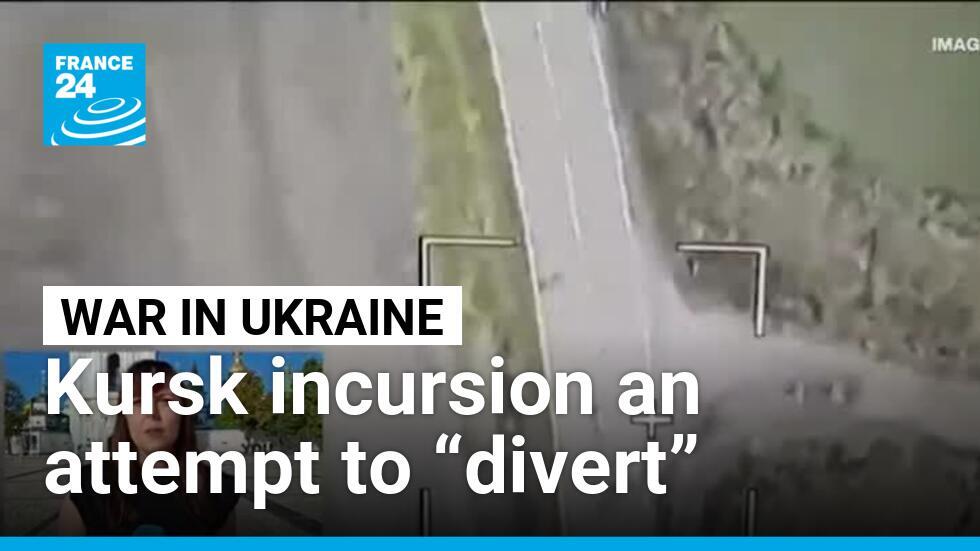
Ukraine's Kursk Incursion Aims to Distract Russian Forces Amid Setbacks on  Eastern Front – FT


The Kursk Incursion
The GSAFU stated the intensity of combat in the Sumy direction has increased. The enemy is actively applying aviation, helicopters, heavy weapons. However, with no success. Russia is suffering a significant loss. Ukrainian soldiers do everything possible to protect the civilian population.

ISW - Ukrainian Forces advance at least 10 km inside Kursk Oblast

The Institute for the Study of War (ISW), a US based think tank, in its Aug 07 Russian Offensive Campaign Assessment assessed that Ukrainian forces have made confirmed advances up to 10 kilometres into Russia's Kursk Oblast amid continued mechanized offensive operations on Russian territory on August 7. 
Geolocated footage published on August 6 and 7 shows that Ukrainian armored vehicles have advanced to positions along the 38K-030 route about 10 kilometres from the international border.
  • The current confirmed extent and location of Ukrainian advances in Kursk Oblast indicate that Ukrainian forces have penetrated at least two Russian defensive lines and a stronghold.

A Russian insider source claimed that Ukrainian forces have seized 45 square kilometres of territory within Kursk Oblast since they launched the operation on August 6, and other Russian sources reported that Ukrainian forces have captured 11 total settlements, including Nikolaevo-Daryino (1.5 kilometres north of the Sumy Oblast border), Darino (three kilometres north of the Sumy Oblast border), and Sverdlikovo (east of the Nikolaevo-Darino-Darino area), and are operating within Lyubimovka (eight kilometres north of the Sumy Oblast border).

  • Russian sources indicated that Ukrainian forces are trying to advance along the 38K-030 Sudzha-Korenovo highway, and a prominent Kremlin-affiliated milblogger claimed that by 1800 local time on August 7 Ukrainian forces had advanced both northwest and southeast along the highway and are now fighting on the outskirts of Korenovo (in the northwest direction) and Sudzha (in the southeast direction).

The Russian insider source and several other Russian sources reported that Ukrainian forces fought for and seized the Sudzha checkpoint and the Sudzha gas distribution station (southwest of Sudzha along the 38K-004 highway, 500 metres from the Sumy-Kursk Oblast border).

Geolocated imagery posted on August 7 shows that Ukrainian forces captured over 40 Russian prisoners of war (POWs) at the Sudzha checkpoint, and Radio Free Europe/Radio Liberty's Russia service posted satellite imagery that shows heavy damage to buildings at the Sudzha checkpoint.

Ukrainian military observer Kostyantyn Mashovets reported on August 7 that an unspecified unit of the Chechyna-based 71st Motorized Rifle Regiment (58th Combined Arms Army [CAA], Southern Military District [SMD]) has deployed directly to the Sudzhenskyi Raion—generally consistent with some reports from Ukrainian and Russian sources that social media footage shows Chechen "Akhmat" units in the Sudzha area since over a week ago

Chechen units reportedly suffered very heavy losses in Ukrainian attacks in the Korenovo Raion on August 7.

Grumpy Here - Please keep in mind the situation on the ground changes and most of this information is now at least 12 hours old

The Kremlin's response to Ukrainian offensive activities in Kursk Oblast has so far been contradictory, as Russian officials are attempting to balance presenting the effort as a notable Ukrainian escalation with avoiding overstating its potential implications and risking domestic discontent.

Select Russian milbloggers heavily criticised the Russian military command for not detecting preparations for or preventing Ukrainian offensive operations into Kursk Oblast.

  • Several Russian milbloggers complained that Russian forces should have prevented the Ukrainian offensive operations into Kursk Oblast as Russian forces knew that Ukrainian forces had been accumulating forces and means in the area for the past several months.
Some of the milbloggers complained that the Russian military command's inadequate reaction was due to a lack of concern about the Ukrainian accumulations, unrealistic confidence in Russian defences in the border area, assumptions about Ukrainian forces' fatigue, or false reports about the situation.

A prominent Russian milblogger criticised Russian Defense Minister Andrei Belousov for not auditing the combat command system to remove ineffective commanders upon assuming his position as Minister of Defense and called for Russian authorities to punish incompetent commanders and liars. The milblogger further claimed that Ukrainian offensive operations in Kursk Oblast prove that the Russian military command made "strategic miscalculations" and that nepotism in the Russian military is protecting ineffective military officials.


Russia scrambles against Kursk incursion
The Russian Defence Ministry says its troops are "continuing to destroy" armed Ukrainian units using air strikes, rocket and artillery fire in the Kursk region, where Kyiv's forces made a significant incursion this week. DW reports.

Moscow says it is "thwarting attempts to break through" deeper.
A top official in Russia's Kursk region says fighting is continuing for a third day after Ukrainian troops smashed through the Russian border. 
  • The audacious attack has forced Moscow to call in reserves.
About 1,000 Ukrainian troops pushed through the frontier in the early hours of August 6 with tanks and armoured vehicles.
  • They were provided with cover by swarms of drones and pounding artillery, Russian officials said.
While Ukrainian officials haven't commented on the extent of the operation around the town of Sudzha, Kursk's acting deputy governor, Andrei Belostotsky said Russian forces are fighting to stop the Ukrainians from advancing further.

"The enemy has not advanced a single metre, on the contrary, it is retreating. The enemy's equipment and combat forces are being actively destroyed. We hope that in the near future ... the enemy will be stopped," state news agency RIA-Novosti reported Belostotsky as saying.

The independent US-based Institute for the Study of War (ISW), however, said that "Ukrainian forces have made confirmed advances up to 10 kilometres (six miles) into Russia's Kursk Oblast." [ed. - as of Aug 07]
  • Russian President Vladimir Putin on Wednesday described the Ukrainian incursion into Kursk as a "large-scale provocation."

Grumpy Here: Meanwhile, things are going fine, I’m sure…


Russians forced to close three railway stations in Kursk Oblast due to hostilities
Russian propaganda sources are reporting that Russian Railways, a Russian state-owned railway company, has temporarily closed the Sudzha, Korenevo, and Psel stations in Kursk Oblast to passengers due to ongoing hostilities. Ukrainska Pravda reports.
  • Local authorities are reportedly carrying out additional infrastructure inspections and briefing staff in order to ensure traffic safety in Kursk Oblast.
Earlier, Russia's Defence Ministry confirmed the advance of supposedly Ukrainian forces in two districts of Kursk Oblast and noted that it had moved reserves to the border and was "attacking Ukrainian troops from the air".

Russia battles Ukrainian troops for third day after shock incursion | Arab  News
Battles rage in Kursk region after Ukraine's largest incursion yet into  Russia

Green Day - Holiday / Blvd. Of Broken Dreams (Demo) [Visualizer]

Anti-Drone Armed Robo-Dogs

US Military Deploys Armed Robot Dogs in Anti-Drone Training 

8 Aug, 2024 - 9:21
Defense News Army 2024

The U.S. Army is exploring new anti-drone capabilities, including using armed robot dogs to protect friendly forces from aerial threats. 
A robot dog equipped with a rifle turret is among the latest innovations being examined for this purpose. 
Observations from conflicts in Ukraine and ongoing crises in the Middle East have intensified the drive to acquire new anti-drone capabilities across the U.S. military. 
The arming of robot dogs is also of growing interest within the U.S. military and globally.


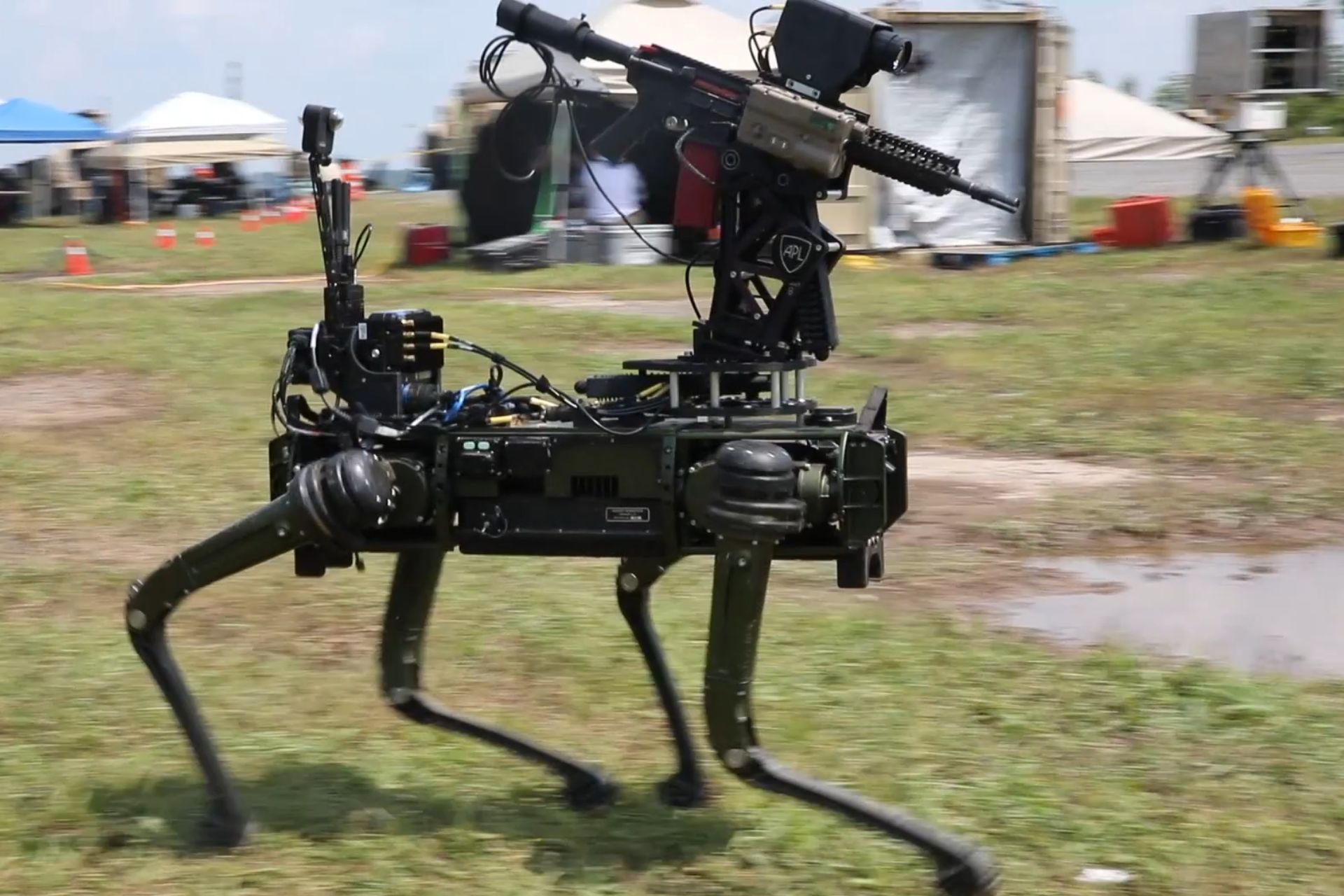
At Fort Drum, New York, during Operation Hard Kill, the Vision 60 quadrupedal unmanned ground vehicle (Q-UGV) from Ghost Robotics, equipped with an AR-15/M16-type rifle, showcased its anti-drone capabilities (Picture source: US DoD)


A Vision 60 quadrupedal unmanned ground vehicle (Q-UGV) from Ghost Robotics, armed with an AR-15/M16-type rifle, is one of the anti-drone capabilities demonstrated at Fort Drum, New York, as part of Operation Hard Kill. This event, led by the Army's 10th Mountain Division and the Development Command-Armaments Center (DEVCOM-AC), began last month and concludes this week. Operation Hard Kill is a "live fire exercise" aimed at establishing Fort Drum as a premier counter-UAS (counter-uncrewed aerial systems) training center through the demonstrated capabilities of both lethal and non-lethal systems, as described by the Army earlier this year.

The AR-15/M16 is a family of military rifles originally developed by Armalite and later adopted by the U.S. military. The M16 entered service in the early 1960s and has been widely used by military forces globally. Known for its lightweight design, modularity, and precision, the rifle uses 5.56×45mm NATO ammunition and can be configured for semi-automatic or fully automatic fire. Over the years, various models and improvements have made the M16 a versatile weapon suitable for a range of combat situations.

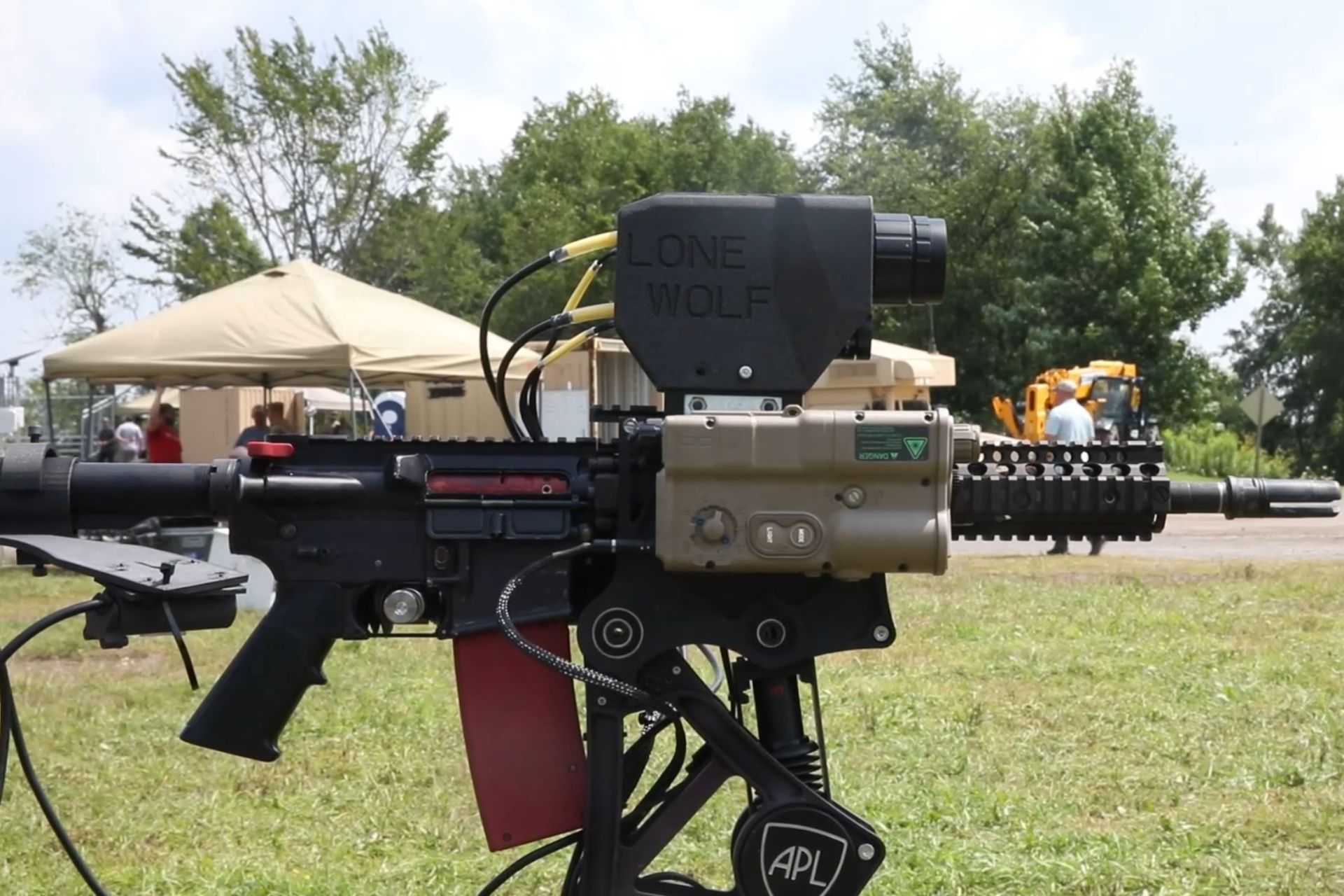
The Vision 60 Q-UGV participating in Operation Hard Kill features an anti-drone configuration with a small turret mounted at the front, on which the AR-15-type rifle is fixed. The rifle is equipped with a relatively large electro-optical targeting system, labeled "Lone Wolf," featuring a large objective lens indicative of infrared/thermal vision capabilities, useful for spotting aerial targets.


The rifle is equipped with a relatively large electro-optical targeting system, labeled "Lone Wolf," featuring a large objective lens indicative of infrared/thermal vision capabilities, useful for spotting aerial targets (Picture source: US DoD)

  • A laser aiming device is also attached to the side. A GoPro-like video camera appears mounted on a mast at the rear of the Q-UGV.
  • A video released by the Army shows individuals using tablet-like devices to remotely control the robot dog's rifle. 
  • Whether the system includes offboard sensor cueing is unknown, but some level of automated targeting would be highly preferable in the anti-drone role.

The SMASH series of computerized gun sights from Israel's Smart Shooter is an example of small arms optics offering target recognition and assisted aiming, usable in a remotely-operated configuration. SMASH variants are already in limited use by several branches of the U.S. military, and their use appears set to expand.

The turret assembly also bears the logo of Johns Hopkins University's Applied Physics Laboratory (APL), known for supporting U.S. military advanced research and development, including rapid prototyping. The War Zone has contacted APL for more information about this anti-drone robot dog.
The C-UAS-configured Vision 60 aligns with efforts by the U.S. Army and Marine Corps to extend anti-drone capabilities to the lowest levels of their force structures. In an anti-drone role, a robot dog could leverage its ability to access spaces humans cannot, providing better vantage points or expanded fields of fire to protect against aerial threats. This would allow friendly forces to engage hostile drones while remaining under cover.

Operation Hard Kill at Fort Drum showcased anti-drone capabilities like the Containerized Weapon System with laser-guided rockets and Javelin missiles, and Rheinmetall's Mission Master UGV with 7.62mm Miniguns, reflecting a trend toward counter-drone UGVs with advanced sensors. (Picture source: US DoD)

An armed robot dog with an infantry-type rifle is not a complete solution to the threats posed by uncrewed aerial systems. The Army and Marines, along with other U.S. military branches, envision a future with broader, layered anti-drone defenses.

Images and videos released from Operation Hard Kill show other anti-drone capabilities, including the Containerized Weapon System (CWS), which can be configured for anti-drone use with laser-guided 70mm rockets, Javelin anti-tank missiles, and other weapons for ground threats. A version of Rheinmetall's Mission Master unmanned ground vehicle, armed with a turret-mounted pair of 7.62mm Miniguns, also demonstrated at Fort Drum, reflects a trend in developing counter-drone UGVs equipped with small radar arrays and other sensors.

Rifle-armed robot dogs could also be used against other targets besides drones. 
  • Marine Forces Special Operations Command (MARSOC) is evaluating Vision 60s armed with rifles, and conventional Marine units are testing other robot dog types equipped with anti-armor rocket launchers. 
  • Several types of unarmed robot dogs are already in limited service within the U.S. military for various roles, including perimeter patrols around friendly bases. 
  • Armed robot dogs seem increasingly on the horizon for U.S. forces, potentially aiding in hunting hostile drones.

Military Update - US & Chinese Robot Dog Armies • UAE Expands UAV Ars...