Monday, February 17, 2025

3D Disordered Systems | Phys.org

The Anderson transition is a phase transition that occurs in disordered systems, which entails a shift from a diffusive state (i.e., in which waves or particles are spread out) to a localized state, in which they are trapped in specific regions. This state was first studied by physicist Philip W. Anderson, who examined the arrangement of electrons in disordered solids, yet it was later found to also apply to the propagation of light and other waves.

Simulations reveal Anderson transition for light in 3D disordered systems

by Ingrid Fadelli , Phys.org
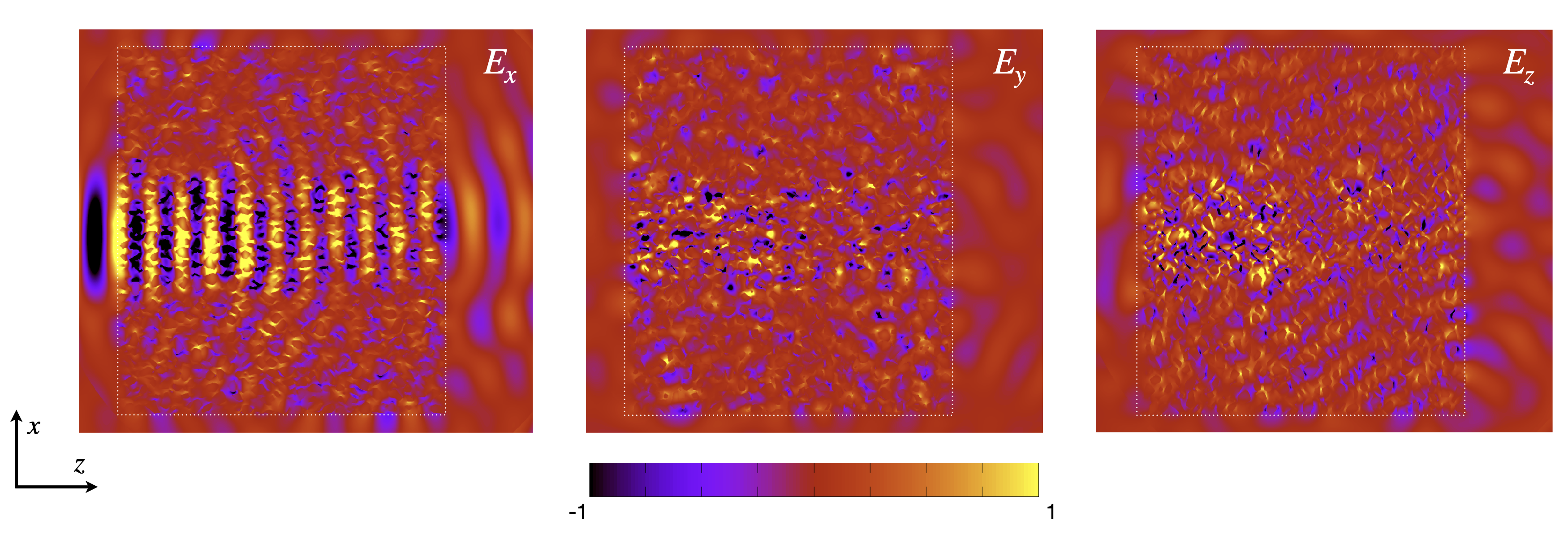
Visualization of a localized state of light found in the team's simulations. 
Credit: Yamilov et al. 

Study simulates the Anderson transition for light in a 3D disordered system

by Ingrid Fadelli , Phys.org
Visualization of a localized state of light found in the team's simulations. Credit: Yamilov et al. 

Researchers at Missouri University of Science & Technology, Yale University, and Grenoble Alpes University in France recently set out to further explore the Anderson transition for light (i.e., electromagnetic waves) in 3D disordered systems.

Their paper, published in Physical Review Letters, outlines the simulation of light wave transport in an arrangement of perfect-electric-conducting (PEC) spheres, materials that reflect electromagnetic waves.

"This paper builds on our earlier publication in Nature Physics, which demonstrated Anderson localization (AL) of light in 3D random media but didn't study how the transition from diffusion to localization unfolds," Alexey Yamilov, first author of the paper, told Phys.org.

"Previous studies of Anderson transition include model numerical calculations for electrons in disordered solids, vibrations in mechanical systems, as well as experiments with ultrasound and matter waves in cold-atom systems. They demonstrated the universality of the transition by establishing that certain quantities behave the same, whatever the physical nature of the studied physical system."

Building on their previous research, Yamilov and his colleagues, Hui Cao and Sergey Skipetrov, set out to demonstrate that the Anderson transition for light is the exact same as that observed for other types of waves. 
  • To do this, they first set out to determine whether the cross-over from diffusion to localization in the medium they examined represents a true Anderson transition.
  • In addition, they wished to probe the existence of a critical frequency separating the two regimes (i.e., diffusion and localization), which is referred to as a sharp mobility edge.
  • Finally, they explored the extent to which the Anderson transition exhibits the universal scaling behavior predicted by localization theory, to ultimately determine the universality of the transition.

"Since observation of the AL of light evaded scientists for almost 40 years, our Nature Physics paper made these questions highly pertinent," explained Skipetrov.

"Study of Anderson transition presents the same fundamental difficulty as the study of any phase transition: it only takes place in a system of infinite extent, which is never the case in experiments or . In a system of finite size, the abrupt transition is replaced by a continuous crossover."

To overcome the challenges encountered in previous studies studying phase transitions, the researchers employed a finite-size scaling approach. This approach allowed them to examine the crossover between diffusion and localization as the size of a 3D system increases.

"Standard methods of statistical physics developed to study phase transitions allow for determining transition parameters that would be observed in an infinite system, from the obtained size-dependence," said Yamilov.

"Although very powerful, this approach still requires being able to simulate light scattering in samples of large (though not infinite) size, which was made possible by the revolutionary software Tidy3D, developed by FlexCompute, Inc."

Study simulates the Anderson transition for light in a 3D disordered system

Transition from diffusion to localization in random ensembles of overlapping spheres. Credit: Alexey Yamilov et al

Using Tidy3D, a that can be used to simulate the behavior of electromagnetic waves, the researchers set out to study how the transmission of light varies along with the size of a 3D metallic system at different frequencies near the Anderson transition point.

In their simulations, they sent light pulses through the metallic structures and measured the extent to which light passed through. This allowed them to determine the exact frequency at which the transition from diffusion to localization occurs, which is known as the critical point.

"At this special point, transmission curves for different system sizes all cross each other," said Yamilov.

"The key was, of course, to start with a system which does exhibit Anderson localization of light, as we reported in our previous publication. Then, using modern computational methods, we simulated large enough systems to definitively show that this is a true phase transition, similar to what happens with electrons in disordered metals."

The simulations performed by Yamilov and his colleagues showed that the transition for light in 3D disordered systems they simulated belongs to the same universality class as other Anderson transitions. This means that even if they are more complex than electronic waves, exhibit the same fundamental behavior when they become localized.

"Until recently, 3D systems of size, sufficient to observe [the] AL of light and to systematically study it, could not be simulated due to computational constraints," said Yamilov.

"Recent advances in Finite Difference Time Domain (FDTD) algorithms, pioneered by FlexCompute Inc, finally enabled such simulations. Now, this can be done by anyone! In fact, our code is openly available to the public and FlexCompute Inc has offered access for anyone to scrutinize our results free of charge."

Symmetry is a fundamental concept in physics, with countless past studies demonstrating that some specific properties of physical systems directly follow from their symmetries, such as the time-reversal or spin-rotation symmetries, and can thus be easily predicted. The findings gathered by Yamilov and his colleagues offer a further, striking example of the importance of symmetries.

"The fact that the considered optical system possesses the time-reversal symmetry and that the only broken symmetry is the translational one (because of disorder), imposes Anderson transition to fall in the so-called orthogonal universality class, the same as for electrons in disordered metals or vibrations in solids," explained Skipetrov.

"More precisely, our quantitative analysis of the scaling behavior in the vicinity of the critical point led to the first estimate of the critical exponent ≈1.5. Its value indicates that this transition belongs to the orthogonal universality class, revealing a deep connection between light localization and other wave phenomena, e.g. electrons or sound, in disordered systems."

This recent study could soon open new possibilities for research focusing on the control of light in 3D. The ability to confine light in random structures, as demonstrated in the team's simulations, could, for instance, enable the development of new technologies, including optical devices, sensors and lasers, which could be based on nanoporous metals.

"The most pressing direction is experimental verification of Anderson localization of light in 3D metallic systems, but optical absorption of metals poses a challenge," added Cao.

"Moving to near-IR and microwave frequencies will reduce the absorption. We are looking into extending the numerical analysis to systems with controlled absorption to understand how it affects the transition. This bridges our idealized simulations with real materials and could guide experimental design."

In their next studies, the researchers plan to continue investigating the Anderson localization of light in 3D metallic systems. They also plan to explore this transition's real-world applications, specifically focusing on how the localization of light in nanoporous metals could be leveraged to enhance light-matter interactions, which could advance photocatalysts and sensing devices.

More information: Alexey Yamilov et al, Anderson Transition for Light in a Three-Dimensional Random Medium, Physical Review Letters (2025). DOI: 10.1103/PhysRevLett.134.046302. On arXiv: DOI: 10.48550/arxiv.2408.04853

OpenThinker-32B >> New AI Just Beat DeepSeek With Almost No Effort! (This Shouldn't Be Poss...

Feb 16, 2025 #AI #deepseek #OpenSource 
 
A new open-source AI model, OpenThinker-32B, has outperformed DeepSeek R1 and other major models despite using far fewer resources. 
It excels in math, coding, and logical reasoning, proving that smarter training methods can beat brute-force approaches. 
 
Another breakthrough, Huginn-3.5B, introduces latent reasoning and a unique recurrent depth technique, allowing it to refine answers internally without requiring massive computational power. 

πŸ” Key Topics:

  • The open-source AI model OpenThinker-32B outperforming DeepSeek R1 with a smarter approach
  • How latent reasoning and recurrent depth in Huginn-3.5B are redefining AI problem-solving
  • The shift from brute-force training to efficiency-driven AI models that challenge industry giants
πŸŽ₯ What’s Inside:
  • How OpenThinker-32B beats proprietary models despite using fewer resources
  • Why Huginn-3.5B’s hidden loops enable deeper reasoning without massive computation
  • The impact of open-source AI innovation on coding, math, and logical reasoning benchmarks
πŸ“Š Why It Matters:  

This video explores groundbreaking advances in *AI reasoning, open-source models, and efficiency-driven training*, revealing how smaller but smarter AI models are reshaping the landscape of artificial intelligence.  

DISCLAIMER: This video examines the latest developments in *open-source AI, logical reasoning breakthroughs, and efficiency-focused training*, highlighting their implications for AI performance and future innovations. 


Sunday, February 16, 2025

AXIOS: AI's "Massive" Power Challenge

Animated illustration of a glowing data center with four bolts of lightning feeding electricity into it.

Illustration: Brendan Lynch/Axios

Republicans on the House Energy and Commerce Committee want to power AI with fossil fuels and nuclear energy — but divergent Democrats mean the panel might struggle to do much.
Why it matters: AI's rise has prompted fears across the tech and energy industries about energy shortages and spikes in climate-warming emissions.
Go deeper (2 min. read)


Space Weather Sign of the Pole Shift, Space Rose, Deadly Cold | S0 News ...

Stock Fragility. . .Fears of Massive Crash on Wall Street

Economists are warning about record levels of 'fragility' among the biggest US stocks, signaling a warning for the market as a whole.
Despite the stock market hovering near all-time highs, major stocks are increasingly vulnerable to big fluctuations.
This is much like what happened before the dot-com bubble burst in the late 1990s. 
 
Fears of massive crash on Wall Street after America's top 50 companies see  record levels of 'fragility' | Daily Mail Online
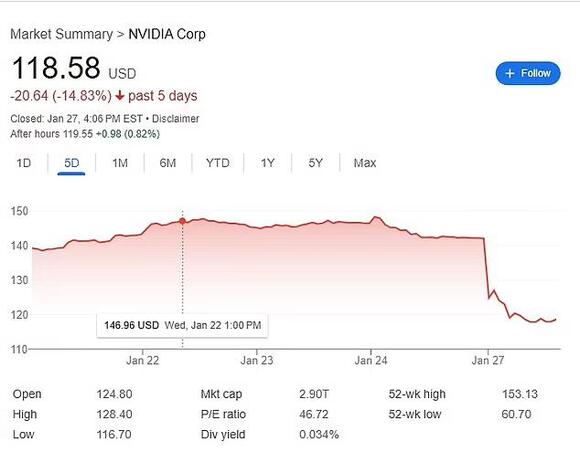
According to Bank of America strategists, 'stock fragility' is on track to reach its highest level in more than three decades among the largest 50 stocks in the S&P 500 index. 
  • That includes tech stocks such as Apple, Amazon, Microsoft and Nvidia, bank stocks such as JPMorgan Chase and Wells Fargo, and retail stocks like Costco and Walmart
Stock fragility is a measure of how much a share price moves a day relative to its usual volatility, Bloomberg reported. 
  • The increased jitters among particular stocks is a warning for the broader market - especially when coupled with uncertainty around what could happen with tariffs and interest rates. 

Some Wall Street bankers and business executives are also finding their enthusiasm for President Trump begin to falter amid this increased volatility.

JU on X: "Prihaja..." / X

The Economic Times 
Ominous sign for S&P 500 has analysts on edge as Wall Street wreck could be around the corner; here's what they are
21 hours ago
S&P 500: The calm before the storm? Ominous sign for S&P 500 has analysts  on edge as Wall Street wreck could be around the corner; here's what they  are saying - The Economic Times

THAT 50% VICTORY PLAN DEAL . . .U.S. presented Ukraine with a document to access its minerals but offered ...


One senior Ukrainian official joked that the country’s leaders would consider nearly anything to maintain U.S. support, including, the official said, a massive shipment of Ukrainian eggs. The country has an egg surplus, and leaders there are aware of their skyrocketing cost in the United States.

Zelenskiyy told reporters Saturday that he had not agreed to the Trump administration’s proposal “because it’s not ready yet.” 

He said that security guarantees were not part of the U.S. proposal, and that Ukraine needed that in any agreement with the United States.


Ukraine rejects initial Trump request for half its mineral wealth

By Michael Birnbaum, Ellen Francis, SiobhΓ‘n O’Grady and Jeff Stein Washington Post

MUNICH – Ukrainian President Volodymyr Zelenskyy rejected a Trump administration request this week that Kyiv hand over 50% of its mineral resources – an extraordinary demand that could significantly overshadow the value of aid that has been sent to Ukraine.

Ukrainian officials are working on a counterproposal that would still offer Washington more access to the country’s natural resources but would bolster U.S. security guarantees for Ukraine, seven people familiar with the discussions said.

Zelenskyy told reporters Saturday that he had not agreed to the Trump administration’s proposal “because it’s not ready yet.” He said that security guarantees were not part of the U.S. proposal, and that Ukraine needed that in any agreement with the United States.

“We can consider how to distribute profits when security guarantees are clear. So far, I have not seen that in the document,” he told reporters at an annual gathering of U.S. and European security elite.

The request came when Treasury Secretary Scott Bessent visited Kyiv on Wednesday, becoming the first Trump Cabinet official to meet the Ukrainian leader, according to three senior Ukrainian officials, two European diplomats and two more people familiar with the situation. They and others spoke on the condition of anonymity to talk frankly about the sensitive issue.

The offer and Ukraine’s consideration of it rippled through European diplomatic circles not only for its audacity but also because the war-ravaged country appeared to be seriously considering how to reach a deal in the hope of a commitment from the United States to help defend against Russia’s aggression.

One senior Ukrainian official joked that the country’s leaders would consider nearly anything to maintain U.S. support, including, the official said, a massive shipment of Ukrainian eggs. The country has an egg surplus, and leaders there are aware of their skyrocketing cost in the United States.

But another senior Ukrainian official described being taken aback by the scale of what the Trump administration demanded. The person compared it to Europeans carving up African colonies in the 18th century, and said it could also lead to the right to develop Ukraine’s resources being signed away for decades with no guarantees that investors would actually develop them.

Ukraine’s rare-earth mineral resources could be worth trillions of U.S. dollars, with rising demand in electronics, defense systems, drones, and the clean-energy and automotive industries, among others. They are difficult to extract at scale, and while Ukraine has some reserves, it does not mine them at the moment. China produces the vast majority of rare-earth minerals.

Many but not all of Ukraine’s reserves are in territory occupied by Russia.

The country’s leaders are unsure of the exact value of their overall natural resources, in part because it is unclear how much can be extracted. One internal estimate pegs the rare earths at $3 trillion to $5 trillion, while the sum total of mineral deposits may be closer to $13 trillion to $15 trillion, one senior Ukrainian official said.

Ukraine has other mineral resources in addition to rare earths, such as lithium and uranium. It is unclear whether the White House seeks access to the broader category of minerals or just rare earths.

The White House did not immediately respond to a request for comment.

  • One of the senior Ukrainian officials said that Kyiv received the proposed U.S. mineral deal just four hours before Bessent met with Zelenskyy in Kyiv on Wednesday. In that meeting, the treasury secretary “insisted” that Zelenskyy sign it immediately. Zelenskyy did not, the official said.

The Ukrainians continued to discuss the proposal on Friday, when Zelenskyy met with Vice President JD Vance and Secretary of State Marco Rubio in Munich. Ukraine has told the Trump administration that it cannot legally sign away its mineral resources in the way proposed by Washington, but Ukrainians have continued to mull alternatives, two Ukrainian officials said.

The Friday meeting was delayed for several hours when Rubio’s plane experienced mechanical difficulties and had to turn around – buying the Ukrainians valuable time to come up with a counterproposal, one of the officials said.


Zelenskyy had only a few minutes to read the U.S. proposal before his Wednesday meeting with Bessent, said one person familiar with the discussions.

  • “Ukraine has theoretically agreed” to the concept of such a deal, but disagreed with the lack of U.S. security guarantees listed in the proposal, the person said. 
  • The document Zelenskyy declined to sign this week was more of a short memorandum of understanding “governed by New York law” than a major international agreement, the person said, adding that it would not have been enforceable. 
  • Ukraine would expect any such deal to last for decades to come and wants such an arrangement to be ratified by its parliament.
  • The 50% idea appears at least partially inspired by Ukraine, which identified the material as a resource that could help bolster the economy and be tied to Western security assistance. 
  • Zelenskyy first suggested providing the United States with the materials during a meeting with Trump in September, prior to the election. 
  • The idea is also part of a “victory plan” Zelenskyy made public the following month.

But Zelenskyy has said he wants European involvement and investment in developing his country’s resources, not just Washington’s.

Zelenskyy confessed Saturday to feeling stressed about the Trump administration’s approach to his country.

Trump envoy sparks fury as 'Europe is excluded' from Ukraine-Russia peace  talks: Macron calls emergency summit | Daily Mail Online

Asked after delivering a speech at a public forum in Munich whether he felt Trump and Vance understand the stakes of Ukraine’s fight against Russia, Zelenskyy said: “I’ll be honest. We have to work on it. All of us, not only me.”

The audience of ministers and diplomats erupted in shocked laughter at his honesty, since leaders in his position typically seek to smooth away disagreements.

Trump allies have expanded and seized on the minerals idea as a way to maintain the president’s support for Kyiv.

“Ukraine has value. Literally has value,” Sen. Lindsey Graham (R-South Carolina) said Saturday in Munich at an event sponsored by Politico.

“Trump now sees Ukraine differently,” he said. “These people are sitting on literally a gold mine … I showed him a map.”

If the United States is granted Ukraine’s mineral wealth, Graham said, “we will have something to defend. We will have an economic interest in Ukraine we’ve never had. And that’s a nightmare for Putin.”

Critics say that asking for 50% of the sector doesn’t match the level of assistance Kyiv has received. Ukraine has received about $66 billion in military aid from Washington since Russia’s full-scale invasion three years ago, according to the State Department, and about $50 billion in non-military aid, according to an estimate from the Kiel Institute for the World Economy. Ukraine received about $69 billion in military aid in the eight-year-stretch between Russia’s 2014 annexation of Crimea and the full-scale invasion.

“Investment now in the Ukrainian critical minerals sector could make a lot of sense. But President Trump’s initial offer seems unreasonable, exploitative and unlikely to help end the war. This is not a good way to promote American interests.” said Simon Johnson, an economist at MIT who has been involved in helping Ukraine with its economic planning.

“I expect the Ukrainian reaction to be dismay and disbelief,” he said.

'After Ukraine EU is Next Loser’: OrbΓ‘n & Fico Mock Brussels’ Worthless ...

GREGORY BOVINO: Nazi Cosplay Time in Mineeapolis...Trump's ICE Enforcer

  UPDATE ON SUNDAY 25 JANUARY 2026 Top stories Federal agents fatally shoot Alex Pretti in Minneapolis Star Tribune Fact check: Video, witne...