EMBARGOED UNTIL RELEASE AT 8:30 a.m. EST, Thursday, March 6, 2025
|

|
EMBARGOED UNTIL RELEASE AT 8:30 a.m. EST, Thursday, March 6, 2025
U.S. International Trade in Goods and Services, January 2025
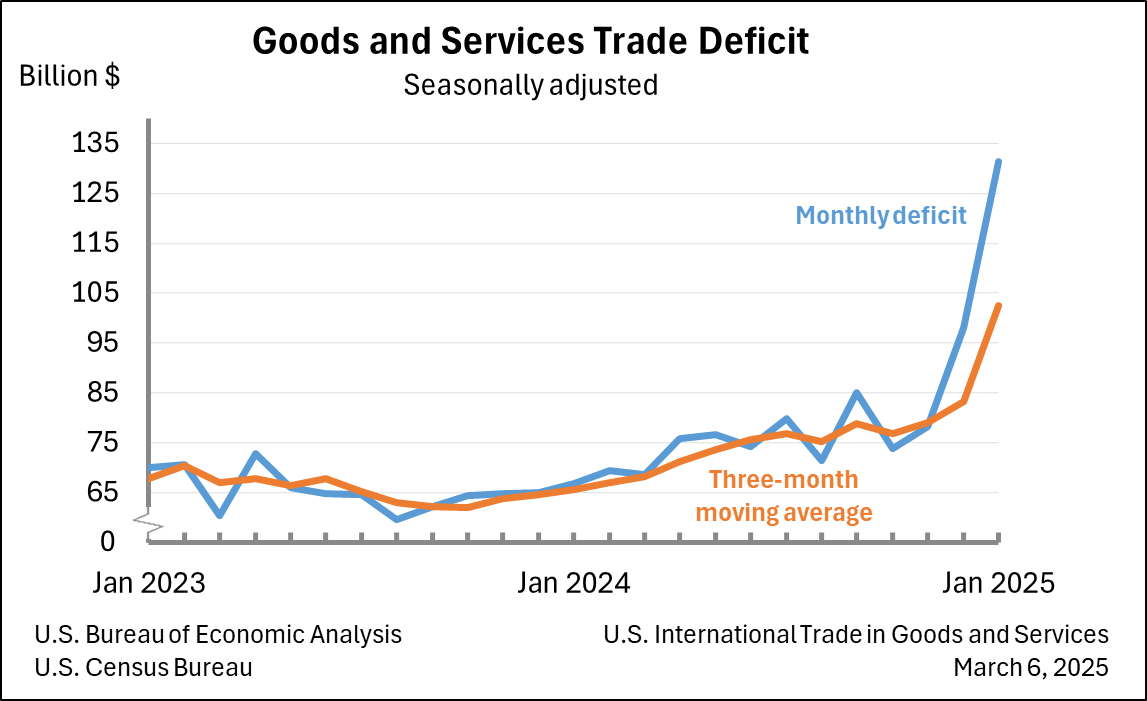
The U.S. Census Bureau and the U.S. Bureau of Economic Analysis announced today that the goods and services deficit was $131.4 billion in January, up $33.3 billion from $98.1 billion in December, revised.
| Deficit: | $131.4 Billion | +34.0%° |
| Exports: | $269.8 Billion | +1.2%° |
| Imports: | $401.2 Billion | +10.0%° |
|
Next release: Thursday, April 3, 2025 (°) Statistical significance is not applicable or not measurable. Data adjusted for seasonality but not price changes Source: U.S. Census Bureau, U.S. Bureau of Economic Analysis; U.S. International Trade in Goods and Services, March 6, 2025 |
||
Exports, Imports, and Balance (exhibit 1)
January exports were $269.8 billion, $3.3 billion more than December exports. January imports were $401.2 billion, $36.6 billion more than December imports.
The January increase in the goods and services deficit reflected an increase in the goods deficit of $33.5 billion to $156.8 billion and an increase in the services surplus of $0.2 billion to $25.4 billion.
Year-over-year, the goods and services deficit increased $64.5 billion, or 96.5 percent, from January 2024. Exports increased $10.6 billion or 4.1 percent. Imports increased $75.2 billion or 23.1 percent.
Three-Month Moving Averages (exhibit 2)
The average goods and services deficit increased $19.2 billion to $102.6 billion for the three months ending in January.
- Average exports increased $1.2 billion to $270.0 billion in January.
- Average imports increased $20.4 billion to $372.5 billion in January.
Year-over-year, the average goods and services deficit increased $37.1 billion from the three months ending in January 2024.
- Average exports increased $11.4 billion from January 2024.
- Average imports increased $48.5 billion from January 2024.
Exports (exhibits 3, 6, and 7)
Exports of goods increased $2.7 billion to $172.8 billion in January.
Exports of goods on a Census basis increased $2.8 billion.
- Capital goods increased $4.2 billion.
- Civilian aircraft increased $1.1 billion.
- Semiconductors increased $0.7 billion.
- Computers increased $0.5 billion.
- Civilian aircraft engines increased $0.5 billion.
- Consumer goods increased $1.7 billion.
- Pharmaceutical preparations increased $0.8 billion.
- Jewelry increased $0.6 billion.
- Other goods decreased $1.3 billion. (See the “Notice” for more information.)
- Foods, feeds, and beverages decreased $1.0 billion.
- Soybeans decreased $0.8 billion.
Net balance of payments adjustments decreased $0.1 billion.
Exports of services increased $0.6 billion to $97.0 billion in January.
- Financial services increased $0.2 billion.
- Telecommunications, computer, and information services increased $0.1 billion.
- Other business services increased $0.1 billion.
- Transport increased $0.1 billion.
- Maintenance and repair services increased $0.1 billion.
- Government goods and services decreased $0.3 billion.
Imports (exhibits 4, 6, and 8)
Imports of goods increased $36.2 billion to $329.5 billion in January.
Imports of goods on a Census basis increased $36.2 billion.
- Industrial supplies and materials increased $23.1 billion.
- Finished metal shapes increased $20.5 billion.
- Consumer goods increased $6.0 billion.
- Pharmaceutical preparations increased $5.2 billion.
- Cell phones and other household goods increased $1.2 billion.
- Capital goods increased $4.6 billion.
- Computers increased $3.0 billion.
- Computer accessories increased $1.2 billion.
- Telecommunications equipment increased $1.1 billion.
Net balance of payments adjustments decreased $0.1 billion.
Imports of services increased $0.4 billion to $71.7 billion in January.
- Charges for the use of intellectual property increased $0.2 billion.
- Other business services increased $0.1 billion.
- Travel decreased $0.1 billion.
Real Goods in 2017 Dollars – Census Basis (exhibit 11)
The real goods deficit increased $30.8 billion, or 27.5 percent, to $142.9 billion in January, compared to a 27.4 percent increase in the nominal deficit.
- Real exports of goods increased $0.6 billion, or 0.4 percent, to $142.3 billion, compared to a 1.6 percent increase in nominal exports.
- Real imports of goods increased $31.4 billion, or 12.4 percent, to $285.2 billion, compared to a 12.5 percent increase in nominal imports.
Revisions
Exports and imports of goods and services were revised for July through December 2024 to incorporate more comprehensive and updated quarterly and monthly data. In addition to these revisions, seasonally adjusted data for all months of 2024 were revised so that the totals of the seasonally adjusted months equal the annual totals.
Revisions to December exports
- Exports of goods were revised down $0.1 billion.
- Exports of services were revised up $0.1 billion.
Revisions to December imports
- Imports of goods were revised up $0.2 billion.
- Imports of services were revised down $0.6 billion.
- Netherlands ($4.3),
- South and Central America ($4.3),
- Belgium ($0.6), and
- Brazil ($0.6).
- China ($29.7),
- European Union ($25.5),
- Switzerland ($22.8),
- Mexico ($15.5),
- Ireland ($12.4),
- Vietnam ($11.9),
- Canada ($11.3),
- Germany ($7.6), T
- aiwan ($7.5),
- Japan ($7.4),
- South Korea ($5.4),
- India ($4.2),
- Italy ($3.5),
- Malaysia ($2.5),
- Australia ($2.0),
- Hong Kong ($1.4),
- France ($1.0),
- Singapore ($1.0), I
- srael ($0.6),
- United Kingdom ($0.5), and
- Saudi Arabia ($0.1).
- The deficit with Switzerland increased $9.8 billion to $22.8 billion in January. Exports increased $0.6 billion to $1.8 billion and imports increased $10.3 billion to $24.6 billion.
- The deficit with Ireland increased $6.2 billion to $12.4 billion in January. Exports increased less than $0.1 billion to $1.2 billion and imports increased $6.2 billion to $13.6 billion.
- The surplus with South and Central America increased $0.7 billion to $4.3 billion in January. Exports increased $0.3 billion to $18.0 billion and imports decreased $0.5 billion to $13.7 billion.
Goods and Services by Selected Countries and Areas: Quarterly – Balance of Payments Basis (exhibit 20)
Statistics on trade in goods and services by country and area are only available quarterly, with a one-month lag. With this release, fourth-quarter figures are now available.
The fourth-quarter figures show surpluses, in billions of dollars, with South and Central America ($19.1), Netherlands ($18.6), Australia ($7.1), Singapore ($7.0), Brazil ($7.0), United Kingdom ($4.9), Hong Kong ($4.3), Saudi Arabia ($3.4), and Belgium ($1.5).
Deficits were recorded, in billions of dollars, with China ($68.8), Mexico ($48.0), European Union ($38.5), Vietnam ($32.7), Germany ($21.1), Taiwan ($18.9), Japan ($17.0), Switzerland ($15.7), India ($13.2), South Korea ($12.5), Italy ($11.1), Canada ($10.5), Ireland ($7.8), Malaysia ($7.4), France ($4.5), and Israel ($2.1).
- The deficit with Switzerland increased $12.1 billion to $15.7 billion in the fourth quarter. Exports decreased $1.6 billion to $18.8 billion and imports increased $10.6 billion to $34.5 billion.
- The deficit with India increased $3.4 billion to $13.2 billion in the fourth quarter. Exports decreased $0.2 billion to $20.6 billion and imports increased $3.2 billion to $33.8 billion.
- The deficit with the European Union decreased $5.8 billion to $38.5 billion in the fourth quarter. Exports decreased $0.9 billion to $164.8 billion and imports decreased $6.7 billion to $203.3 billion.
All statistics referenced are seasonally adjusted; statistics are on a balance of payments basis unless otherwise specified. Additional statistics, including not seasonally adjusted statistics and details for goods on a Census basis, are available in exhibits 1-20b of this release.
For information on data sources, definitions, and revision procedures, see the explanatory notes in this release.
The full release can be found at www.census.gov/foreign-trade/Press-Release/current_press_release/index.html or www.bea.gov/data/intl-trade-investment/international-trade-goods-and-services.
The full schedule is available in the Census Bureau’s Economic Briefing Room at www.census.gov/economic-indicators/ or on BEA’s website at www.bea.gov/news/schedule.
Next release: April 3, 2025, at 8:30 a.m. EDT
U.S. International Trade in Goods and Services, February 2025