A wealth of new equipment is flooding the arms market. Drones are now
an indispensable part of military arsenals, and use of satellite
systems is becoming widespread; the US has a sizeable lead in this area
Global military spending rose for an eighth consecutive year in 2022
to a post-cold war peak of $2.24trn or 2.2% of global GDP, according to
the Stockholm International Peace Research Institute (SIPRI). French
army chief of staff General Pierre Schill has warned that ‘major wars
are back, and once more becoming a favoured way of settling differences’ (1).
Things started to get out of control when Russia annexed Crimea in
2014, and later parts of the Donbass. Since then the world has been
rearming. Defence industries have stepped up production and are
competing for export market share. Russia has pulled out of several arms
treaties and its 2024 defence budget is up nearly 70% year on year,
back to 1980s levels. Finance minister Anton Siluanov says it includes
‘everything needed for the front, everything needed for victory’. The
10.8trn roubles ($120bn), around 6% of GDP, will be used to accelerate
production of munitions, tanks and drones, pay troops and compensate the
families of those killed in action.
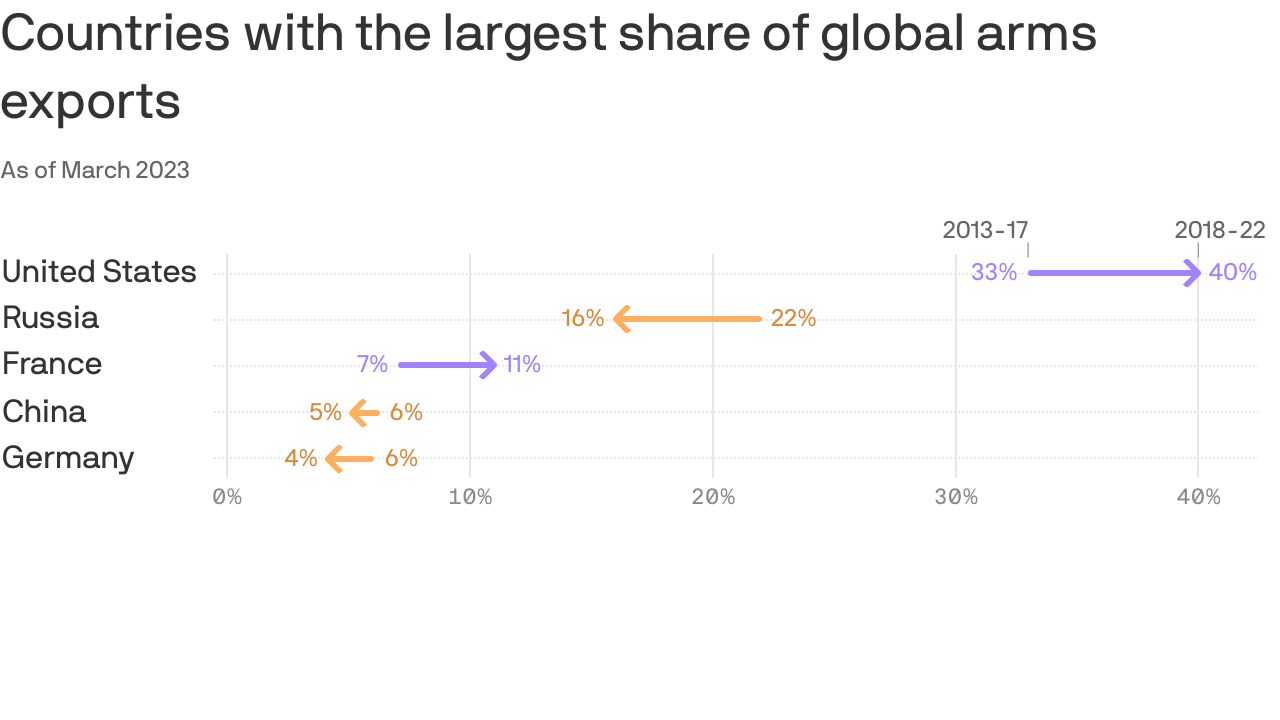
Russia was once the world’s second largest arms supplier (after the
US), accounting for 20% of global sales, mostly to Asia, the Middle East
and Africa, but has exported little since 2022. Its industry is
currently busy supplying its own army in Ukraine, where more munitions
and equipment have been lost or expended than at any time since the
second world war. Russia is estimated to have fired more than two
million shells in Ukraine in 2023, twice as many as in 2022, and the
Dutch defence analysis website Oryx says it has lost 10,000 military
land vehicles (damaged or destroyed). Western, especially US, sanctions
have also prevented major Russian deals with the Philippines (Mil Mi-17
helicopters), Indonesia (Sukhoi Su-35 fighters) and Kuwait (T-90 tanks).
Nor will there be any orders from former Warsaw Pact members or from
the Baltic states, which have joined NATO. These countries too are
rearming. Between 2014 and 2022 Lithuania’s defence spending rose by
270%, Latvia’s by 173%. The defence budgets of Finland, Hungary,
Slovakia, Romania, Poland and the Czech Republic have also soared.
Poland now spends 4% of GDP on defence and wants to double the size of
its army. It is buying Abrams tanks, HIMARS rocket launchers and Apache
helicopters from the US, and tanks and howitzers from South Korea, which
will make it a NATO heavyweight, alongside Germany.
Forget about ‘European preference’
Germany has yet to spend the $110bn allocated to the special fund for
modernising the Bundeswehr in 2022 but, showing little regard for
‘European preference’ (prioritising EU suppliers), has recently signed a
deal to buy US-Israeli Arrow missile defence systems and placed an
order for F-35 fighters with Lockheed Martin.
With Russia’s spare capacity taken up by the Ukraine war, France has
risen to second place in the global supplier rankings, with total
exports worth a record $30bn in 2022, thanks notably to Dassault’s sale
of Rafale fighters to the United Arab Emirates. Although these were
initially slow to sell (partly because of their price), they are now a
key part of France’s export lineup.
Alongside Europe’s major arms exporters – the UK, Germany, Italy and
Spain – new actors are emerging. Profiting from the ‘Ukraine effect’,
South Korea, already one of the world’s top ten producers, is openly
aiming for fourth place in the export rankings after France and Russia (2).
‘Ukraine today, East Asia tomorrow’
Japan, though uncomfortable with the idea of rearmament, fears that
‘Ukraine today may be East Asia tomorrow’, as prime minister Fumio
Kishida put it. Japan is worried by growing tensions between China and
the US, its close ally since 1945, and has decided to abandon pacifism (3).
Its new national security strategy highlights the ‘unprecedented
challenge’ posed by China’s regional ambitions. Its defence budget (just
over $50bn in 2023), has until now been capped at a notional 1% of GDP
but is due to rise to 2% by 2027. This will make Japan a regional
heavyweight and a new client for arms dealers. The US has already
promised Tomahawk long-range cruise missiles, until now restricted to
the UK and Australia.
Several Eastern European countries, including Poland, have given
Ukraine some of their older, often Soviet-era, equipment. Slovakia’s
arms industry, dormant since the cold war due to a lack of customers, is
now producing self-propelled howitzers, some of which are intended for
Ukraine, the rest for its own army. They are being promoted as cheaper
and more up to date than the French equivalent, the Caesar (4).
Major wars are back, and once more becoming a favoured way of settling differences
General Pierre Schill
France spent $2.2bn on munitions in 2023, partly to rebuild its own
stocks, depleted by the supply effort to Ukraine. Its 2024 defence
budget of $51.7bn is up 7.5% year on year. According to a National
Assembly report, it is, with Germany and the UK, among the countries
that have done the most to ‘give Ukraine the means to stand up to the
Russian army’ (5), with total aid worth $3.5bn, including transfers of artillery, armoured vehicles, shells and missiles, and training.
France also makes a large contribution to the European Peace
Facility, an off-budget fund established by the EU mainly to fund
actions such as providing defence equipment to Ukraine. Like the other
countries involved, France regularly repeats that supplying weapons to a
country that has been attacked and is exercising its legitimate right
of self-defence does not make it a party to the conflict. However, it
hopes its own arms industry will profit from the current situation.
‘The right thing to do’
Ethics and morality are secondary considerations in the arms
business. Last June, the US finally agreed to send cluster munitions to
Ukraine – ‘a very difficult decision’, Joe Biden maintained, even if it
was ‘the right thing to do’. Over 120 countries (not including the US,
Russia or Ukraine) have signed a convention banning them, because they
kill indiscriminately and claim many civilian lives long after the
fighting has ceased
Another example is the political whitewashing of Viktor Bout, a Russian arms dealer who inspired the film Lord of War
(2005). Bout spent 15 years in prison in the US but in December 2022
was exchanged for Brittney Griner, a US basketball player convicted in
Russia of smuggling and possessing cannabis. In July 2023 Bout was
elected to the legislative assembly of Russia’s remote Ulyanovsk oblast,
as a member of the ‘opposition’ Liberal Democratic Party of Russia.
Last June, the Kyiv School of Economics’ KSE Institute and the
Yermak-McFaul International Working Group on Russian Sanctions
discovered that much of Russia’s weaponry, including ballistic and
cruise missiles, uses electronic components from the US, UK, Germany,
Netherlands, Japan, Israel and China, obtained by roundabout routes and
with the connivance of Chinese traders.
The arms trade sometimes involves unlikely actors. Ukraine’s Come
Back Alive is probably the only NGO in the world supplying drones,
rocket launchers and other heavy weapons to troops with government
authorisation. Other NGOs supply tablets to be used for artillery
guidance, body armour and anything else that makes life easier for
soldiers (6).
A wealth of new equipment is flooding the arms market. Drones are now
an indispensable part of military arsenals, and use of satellite
systems is becoming widespread; the US has a sizeable lead in this area.
There are tools for exploring the deep seabed (monitoring submarine
cables, prospecting for polymetallic nodules) (7)
as well as hypersonic missiles (a field led by the US and Russia),
which are likely to be of interest to a growing number of militaries.
There is equipment used to mount cyberattacks and defend against them,
for information warfare or to protect telecoms networks. And of course,
arms manufacturers are hard at work developing the next generation of
tanks, fighter aircraft and ships for 2035-45.