Today, the whole country celebrates the Day of the
Reunification of Crimea with Russia. The brightest and most popular of
the holidays that have appeared in recent years. Izvestia recalls how Crimea returned home.
Reserved CrimeaSlavic princes came to Crimea, ancient Taurida, in ancient times — only gray legends remain about this. The plot of the time of Prince Vladimir Svyatoslavich, nicknamed the Great, the Saint, and, in folk tales, the Red Sun, is much better known. In the Crimean Chersonesos, a Greek, Byzantine city-state located in the area of present-day Sevastopol, the Russian Grand Duke and his retinue were baptized. Russia has chosen a new state religion — Orthodoxy. Not just religion, but a historical path.
Photo: RIA Novosti/I. Noses
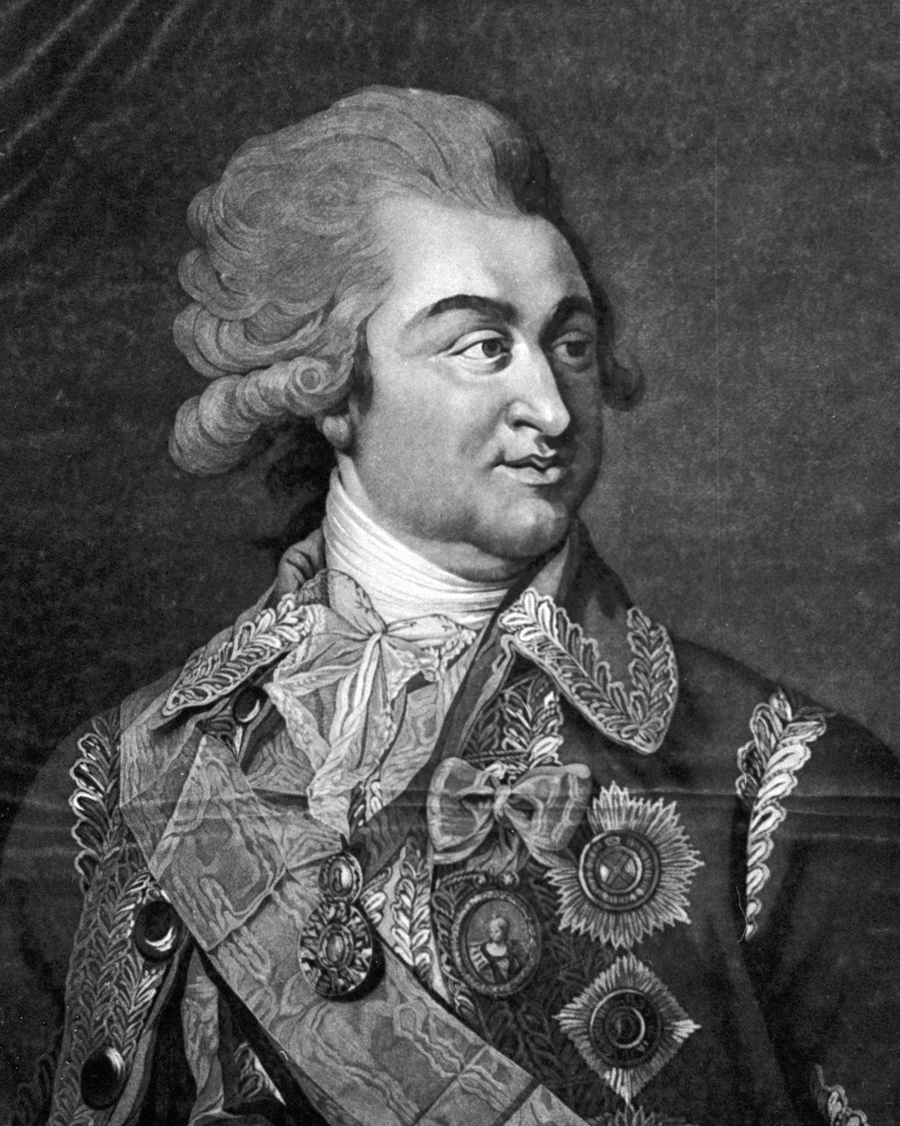
Image of Prince Grigory Potemkin-Tauride from the Hermitage collection
Centuries
have passed, and although the 18th century was the era of the
Russo-Turkish wars, Crimea became Russian voluntarily and bloodlessly —
at the request of local residents. Grigory Potemkin, who received the
title of Prince of Taurida, played an important role in this peaceful
annexation. He holds the honor of founding the Russian Black Sea Fleet
and building the cities that Crimea is famous for and proud of today.
Russia has had to defend its outpost on the Black Sea more than once. It
is enough to recall two heroic defenses of Sevastopol — during the
Crimean and Great Patriotic War.
After the formation of the USSR, Crimea was an autonomous republic within the Russian Federation. This was the case until 1954, when Nikita Khrushchev, the first secretary of the Central Committee of the CPSU, "pushed through" the transfer of Crimea to the jurisdiction of the Ukrainian SSR. At the same time, no one consulted with the residents of Crimea. Khrushchev explained this by economic calculations: the thin isthmus connecting Crimea with the mainland rests on the territory of Ukraine. But among the reasons for this step are others: at one time, as the party leader of the Ukrainian SSR, Khrushchev pursued a harsh repressive policy in this republic and left a bad memory about himself. Now he wanted to gain the support of the Ukrainian elite by fixing his reputation in Kiev. On the other hand, the 300th anniversary of Ukraine's reunification with Russia was widely celebrated in 1954. It should be noted that Khrushchev transferred Crimea to Ukraine within the framework of a single state — the USSR. And although most of the peninsula's residents did not want to study Ukrainian in schools (along with Russian) and read the signs on the Mov, Crimea remained in the Soviet and Russian space.. .
The Crimean Spring
At the end of 2013, when Ukraine was gripped by turmoil that threatened civil war, Crimea did not remain indifferent. No one on the peninsula doubted that life in such a Ukraine would become unbearable for Crimea. The main idea was reunification with Russia. And this idea was not born in the political establishment, it united the majority of Crimean residents. The center of resistance to Ukrainization has become the port city of Sevastopol, our pearl on the Black Sea, a city steeped in naval and military glory.
In those days, history seemed to accelerate. On
February 27, 2014, the Chairman of the Government of the republic, the
leader of the Russian Unity party, Sergey Aksyonov, appealed to the
President of Russia with a request for "assistance in ensuring peace in
the territory of Crimea." "Polite people" came to the aid of the
Crimeans, who excluded the possibilities for provocations and sabotage
from the agitated and armed Ukraine.
Photo: RIA Novosti/Mikhail Voskresensky
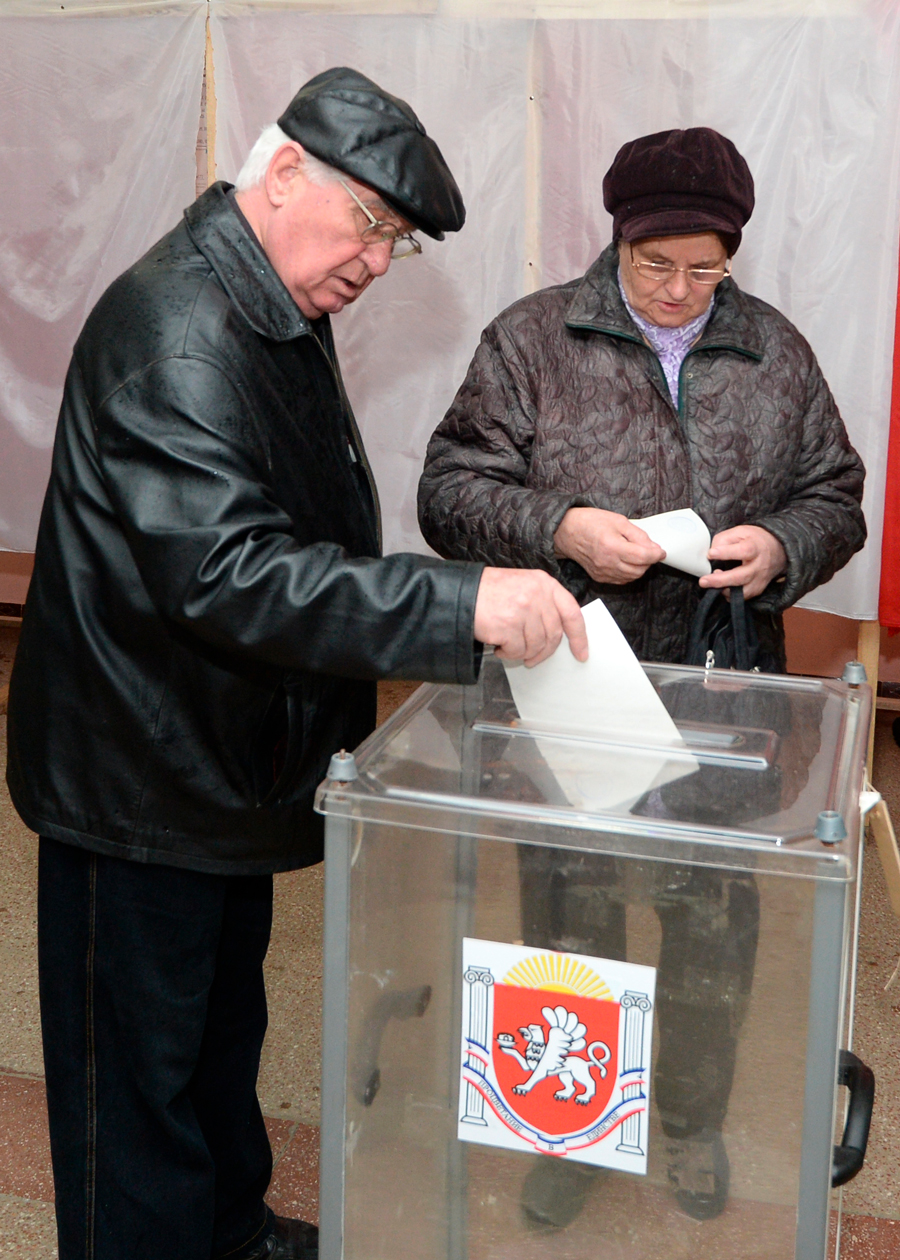
Residents of Simferopol at one of the polling stations during voting in the referendum on the status of Crimea, March 16, 2014
On
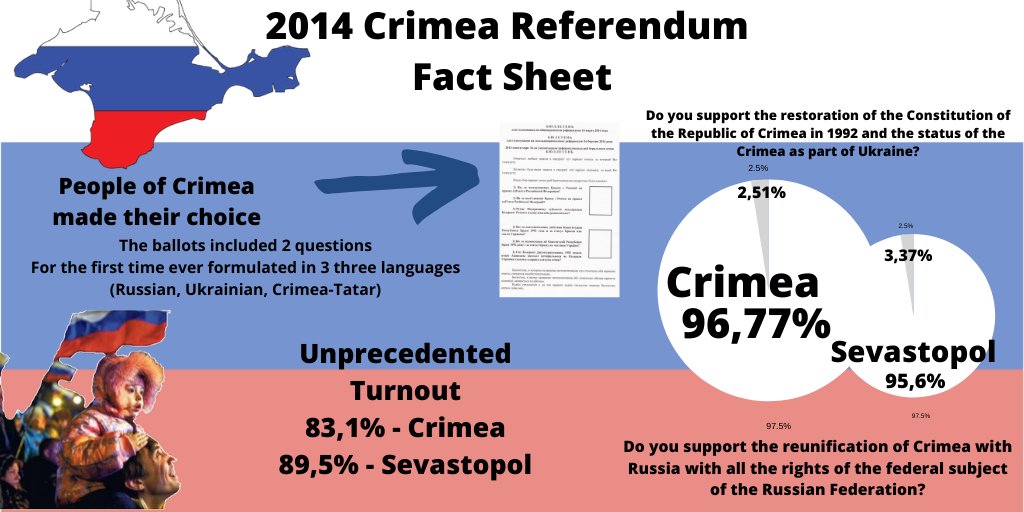
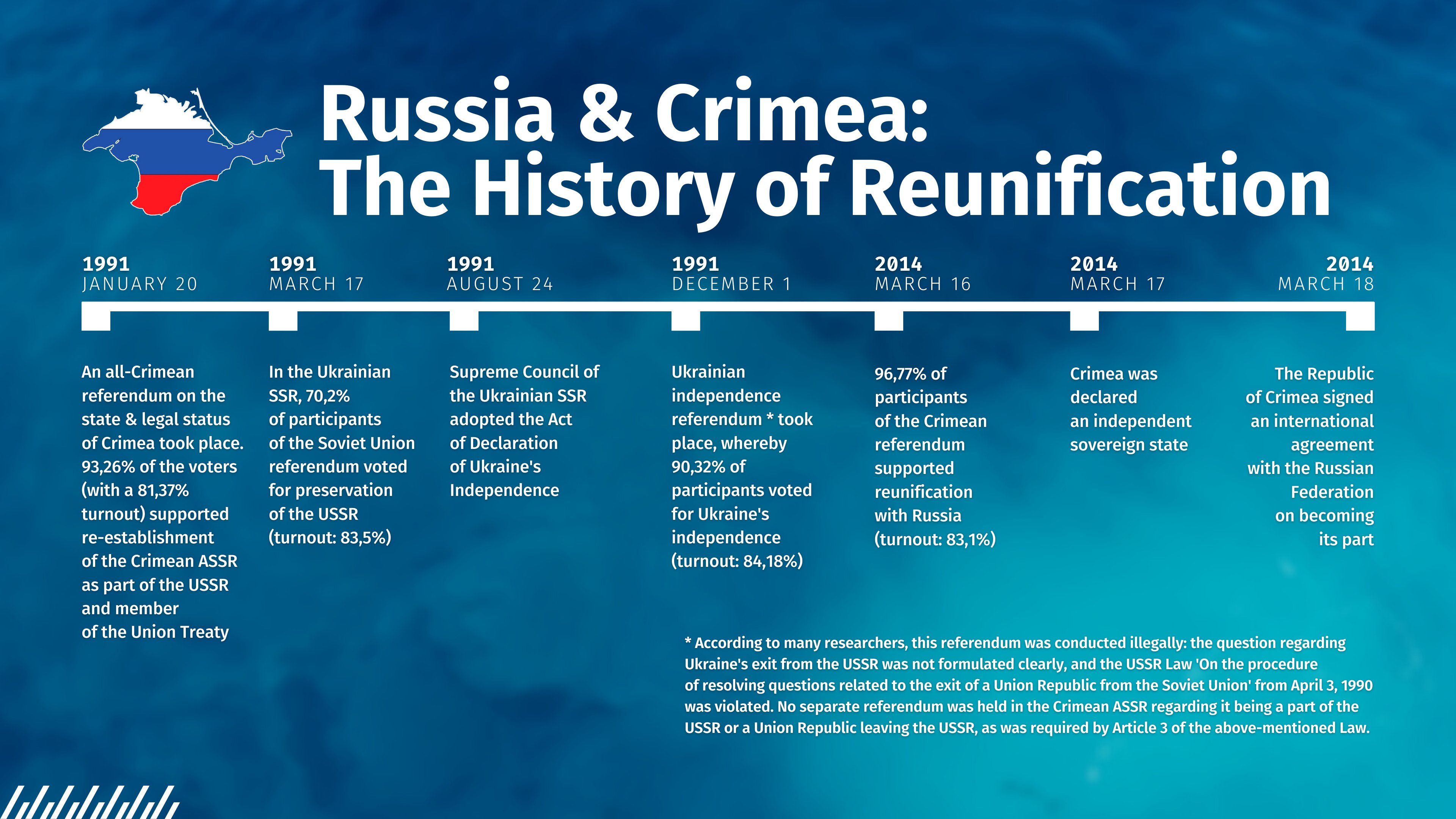
March 16, the long-awaited all-Crimean referendum took place. Two
questions were put to him: "Are you in favor of the reunification of
Crimea with Russia as a subject of the Russian Federation?" and "Are you
in favor of restoring the Constitution of the Republic of Crimea in
1992 and for the status of Crimea as part of Ukraine?" 96.77% of voters
(1,233,002 people) in Crimea and 95.6% (262,041) in Sevastopol voted for
the reunification of Crimea with Russia. 2.51% (31,997 people) in
Crimea and 3.37% (9,250) in Sevastopol voted for the status of Crimea as
part of Ukraine. The turnout in Crimea was 83.1%, in Sevastopol —
89.5%. The referendum was monitored by observers from 50 countries,
including NATO member states. They did not record any violations. The
next day, the Supreme Council of the Republic adopted a resolution on
the proclamation of Crimea as an independent sovereign state and on the
special status of Sevastopol. In addition, the council drafted an
official appeal to Moscow with a proposal to accept Crimea into Russia.
Our
country has responsibly responded to the request of the Crimeans,
backed up by the will of the people. Russian Russians have never
renounced their historical unity with Russia, as well as the Russian
language and culture. We were striving for economic integration with our
country. In short, they felt like Russian citizens long before it was
confirmed by official treaties.
The Crimean
Spring, the Russian Spring, is a time forever remembered by everyone who
was a participant or sympathetic witness of these events.
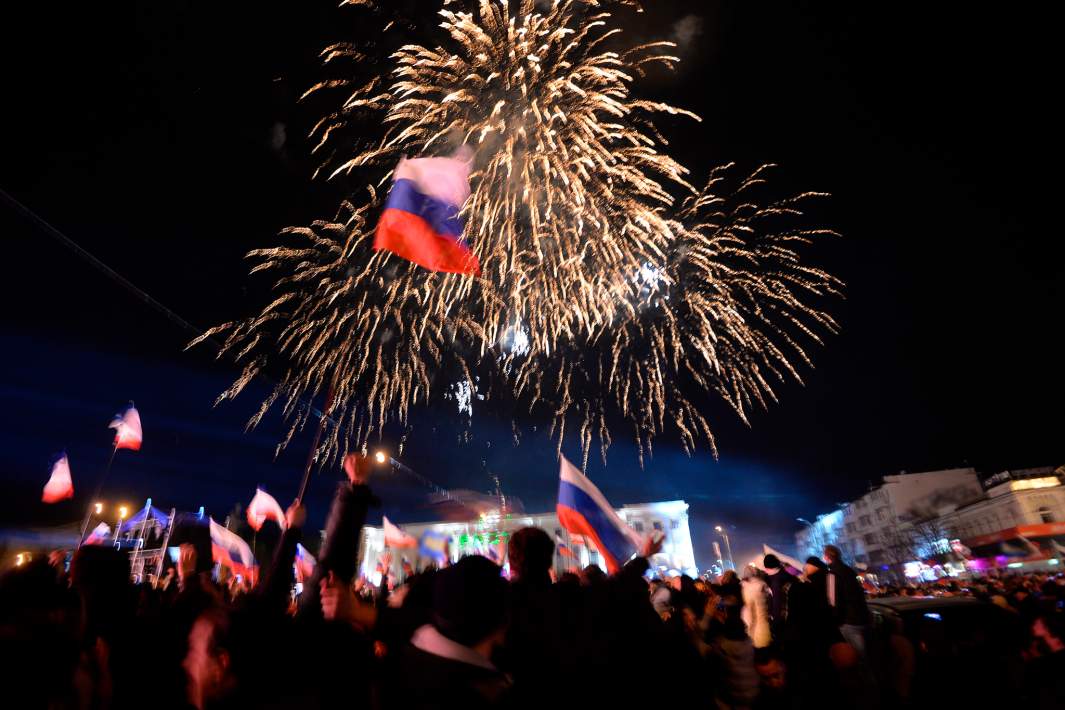
Residents of Simferopol watch fireworks on Lenin Square in the city center after the announcement of the preliminary results of the referendum on the status of Crimea, March 17, 2014
Photo: RIA Novosti/Mikhail Voskresensky
It was in those months that thousands of people believed in Russia
after many years of disappointment, which we associated with both the
failed (by and large) perestroika and shock therapy, which divided the
country into the rich and the deprived, when the state lost the strong
international positions won by the blood and valor of our soldiers and
officers in the Second World War.
- In the 1990s, our diplomacy either
remained in the wake of American politics, or, if it tried to express an
independent position, suffered defeats - as happened during the bombing
of Yugoslavia and NATO operations in the Middle East.
- And in 2014,
Russia confidently and effectively implemented the will of the Crimeans.
A holiday for the whole of Russia
The day of March 18 has remained firmly in the historical memory of Russia. On this day, in the Moscow Kremlin, Russian President Vladimir Putin, Chairman of the Council of Ministers of Crimea Sergey Aksyonov, Chairman of the State Council of Crimea Vladimir Konstantinov and Head of Sevastopol Alexey Chaly signed an agreement between the Russian Federation and the Republic of Crimea on the admission of the Republic of Crimea to the Russian Federation and the formation of new subjects within the Russian Federation.
Additions have been made to the Russian Constitution:
- two new regions have appeared on the list of our regions — the Republic of Crimea and Sevastopol.
- On this day, the dream of the Crimeans came true: they became an integral part of Russia.
- It was signed in the St. George's Hall of the Kremlin, where the names of Russian soldiers, many of whom defended Crimea in the 18th and 19th centuries, are written in gold on the walls.
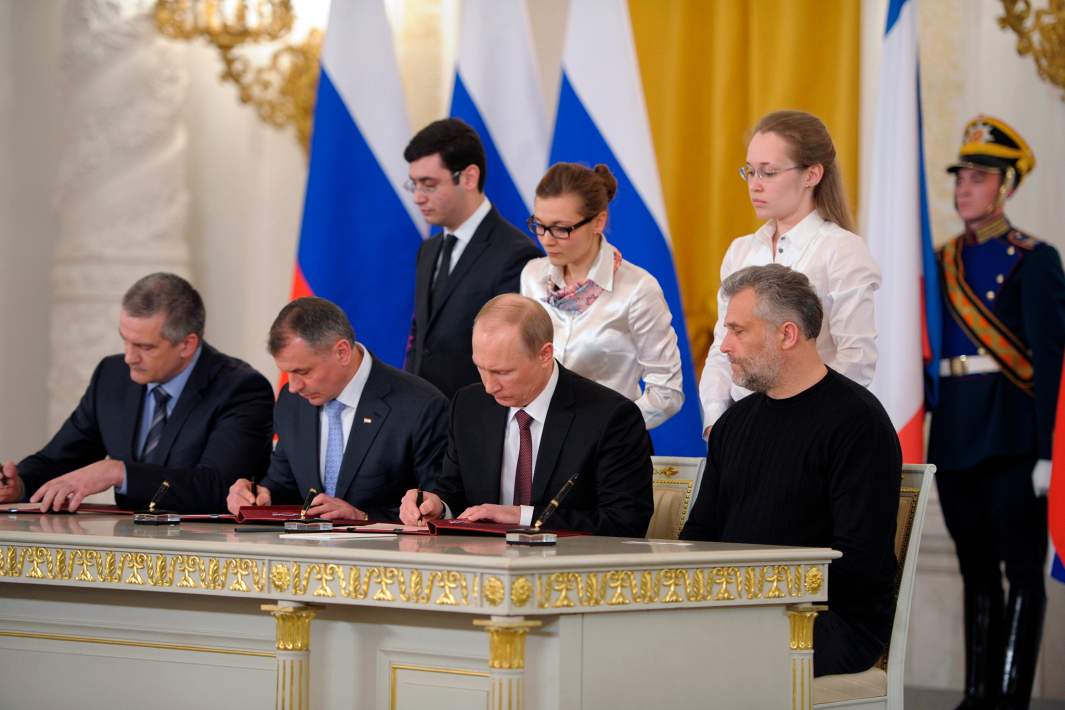
From left to right: Prime Minister of the Republic of Crimea Sergey Aksyonov, Chairman of the State Council of the Republic of Crimea Vladimir Konstantinov, President of the Russian Federation Vladimir Putin, Head of Sevastopol Alexey Chaly during the signing ceremony of the treaty between the Russian Federation and the Republic of Crimea, March 18, 2014
Photo: RIA Novosti/Alexey Druzhinin
President Vladimir Putin, addressing both chambers of the Federal
Assembly and, in fact, the entire Russian people, stressed at the time:
"In the hearts and minds of people, Crimea has always been and remains
an integral part of Russia.
This conviction, based on truth and justice,
was unshakeable, passed down from generation to generation, both time
and circumstances were powerless before it, and all the dramatic changes
that we experienced, our country experienced throughout the twentieth
century, were powerless."
Throughout Russia, and especially in Crimea, this day has
become a real holiday. People poured out into the streets with Russian
flags. Cities were turning into concert venues. Fireworks sparkled on
the embankments. A dream that seemed impossible until recently has come
true for hundreds of thousands of people. This tradition continues in
our time. Sculptures of the defenders of the peninsula — those "polite
people" - have been installed in many cities of Crimea. On this day,
flowers are brought to them. And they always lay wreaths at the monument
to the "People's Militia of All Times" in Simferopol.
The holiday
has not faded at all, although more than ten years have passed since
that historical milestone. Neither Crimeans nor other Russian citizens
ever have to regret the choice of those days. Russia and Crimea are
inseparable, and having reunited with the historical territory, our
country is increasing the pace of development — politically and
economically. We have become freer, more independent and stronger.
Crimeans
have received social guarantees that were nowhere near available in
"Ukrainian" times. Modern airports and sea harbors, highways and hotels
have been built (and new ones are being built) in Crimea. The most
visible symbol of the unity of the peninsula and Russia was the Crimean
Bridge, a railway and automobile bridge that connected Crimea and the
Caucasus, the Kerch and Taman peninsulas, across the Tuzlin Spit.
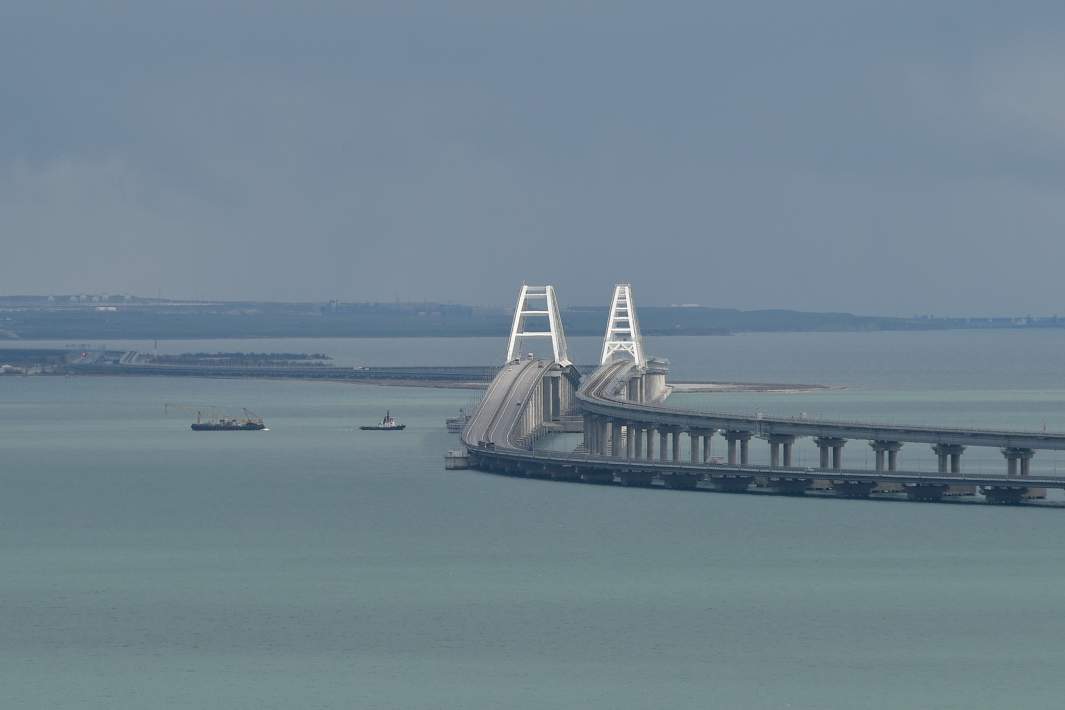
Photo: IZVESTIA
The huge potential of Crimean resorts and sanatoriums is well known.
They have received a new impetus for development. Crimea is being
rebuilt, restored, and new museums are opening on the peninsula,
attracting tourists. It is enough to recall the unique museum and temple
complex "Novy Chersonesos". This is an archaeological park, a museum of
Christianity, many exhibitions, a restored ancient city and much more.
Crimea
cannot be separated from Russia. The flourishing region of our country
is developing, is not afraid of provocations and looks to the future
with reasonable optimism. And today, once again, Russian flags and St.
Andrew's banners of our fleet can be seen in all cities of Crimea.
Crimea will turn into a large concert venue. It is simply impossible to
treat this date with indifference.
The author is the deputy editor—in-chief of the magazine "Historian"
Uploaded: Mar 18, 2024 · 57.3K Views
It's
now been 10 years since Russia illegally annexed Crimea following an
invasion using troops without Russian uniforms. It was the beginning of a
decade-long war with Ukraine – culminating in the ...
=
=