People are replacing Google search with artificial intelligence tools like ChatGPT, a major shift that has unleashed a new kind of bot loose on the web. To offer users a tidy AI summary instead of Google’s “10 blue links,” companies such as OpenAI and Anthropic have started sending out bots to retrieve and recap content in real time. They are scraping webpages and loading relevant content into the AI’s memory and “reading” far more content than a human ever would. According to data from TollBit, a New York-based start-up that helps news publishers monitor and make money when AI companies use their content, traffic from retrieval bots grew 49 percent in the first quarter of 2025 from the fourth quarter of 2024. TollBit’s report, based on data from 266 websites—half of which are run by national and local news organizations—suggests that the growth of bots that retrieve information when a user prompts an AI model is on an exponential curve.
In
recent months, a new class of agents has arrived on the scene: ones
built using large language models. Any action that can be captured by
text—from playing a video game using written commands to running a
social media account—is potentially within the purview of this type of
system.
LONDON,
June 12 (Reuters) - Evidence of "de-dollarization" around the world
remains scant, but many major investors fear a gradual drawback from
U.S. assets is now inevitable and the dollar's exchange rate may have to
fall further to clear the market.
The
debate about the U.S. dollar's dominant role in global trade, reserves
and investment portfolios has smoldered for decades, but it has reached a
crescendo during the turbulent first few months of President Donald Trump's second term in the White House.
European Central Bank boss Christine Lagarderecently put a spotlight on this shift in market thinking, noting "highly unusual cross-asset correlations" involving simultaneous drops in the dollar, Treasuries and U.S. stocks after Trump's import tariffs announcement in April.
Spooky April correlation of dollar, stocks and bonds
But
despite all of the de-dollarization noise, there are still no clear
indications of a mass withdrawal from dollar assets at large.
In fact, some investors dismiss these fears altogether given the pattern of the past 10 years.
Bank
of America strategist Ralph Axel argues that despite all of the
speculation, the world has actually been "rapidly dollarizing" over the
past decade - at least in the sense that dollar liabilities have
expanded enormously.
In
a research report on Thursday, Axel points in particular to the growth
of the so-called shadow banking system, otherwise known as "Non-Bank
Financial Intermediation", or NBFI, and refers to the universe of
investment funds, private credit firms and even crypto funds that exist
outside the regulated banking system.
All
dollar liabilities are effectively "money" in the sense that they can
be sold for dollar cash and are thus ultimately claims on the Federal
Reserve.
Some of these liabilities are direct claims, such as U.S.
Treasuries, but there are a blizzard of indirect claims through
uninsured deposits, mortgage and corporate debt and investment fund
shares.
Dollar
liabilities have clearly ballooned in the past decade. The U.S. federal
debt has increased four-fold in less than 10 years to some $36
trillion, while bank deposits have more than doubled to $18 trillion
since 2008.
And,
as Axel points out, the total size of "shadow banks" has also more than
doubled since 2009 to roughly $63 trillion, according to S&P Global
data. While much of this expansion simply reflects asset price
appreciation, Axel notes that "the NBFI system can only grow because of
demand for its liabilities."
The
point of all this number-crunching is to undermine the simplistic
de-dollarization narrative. If de-dollarization were truly accelerating
then fewer, not more, U.S. liabilities could be created, whether from
the government, traditional lenders or shadow banks. And the trend has
clearly been the other way.
"A
big selling wave can move prices and exchange rates temporarily but
does not de-dollarize," he wrote. "As a result, we think the
de-dollarization theme is less threatening, especially given what
appears to be a stronger trend of global dollarization over time."
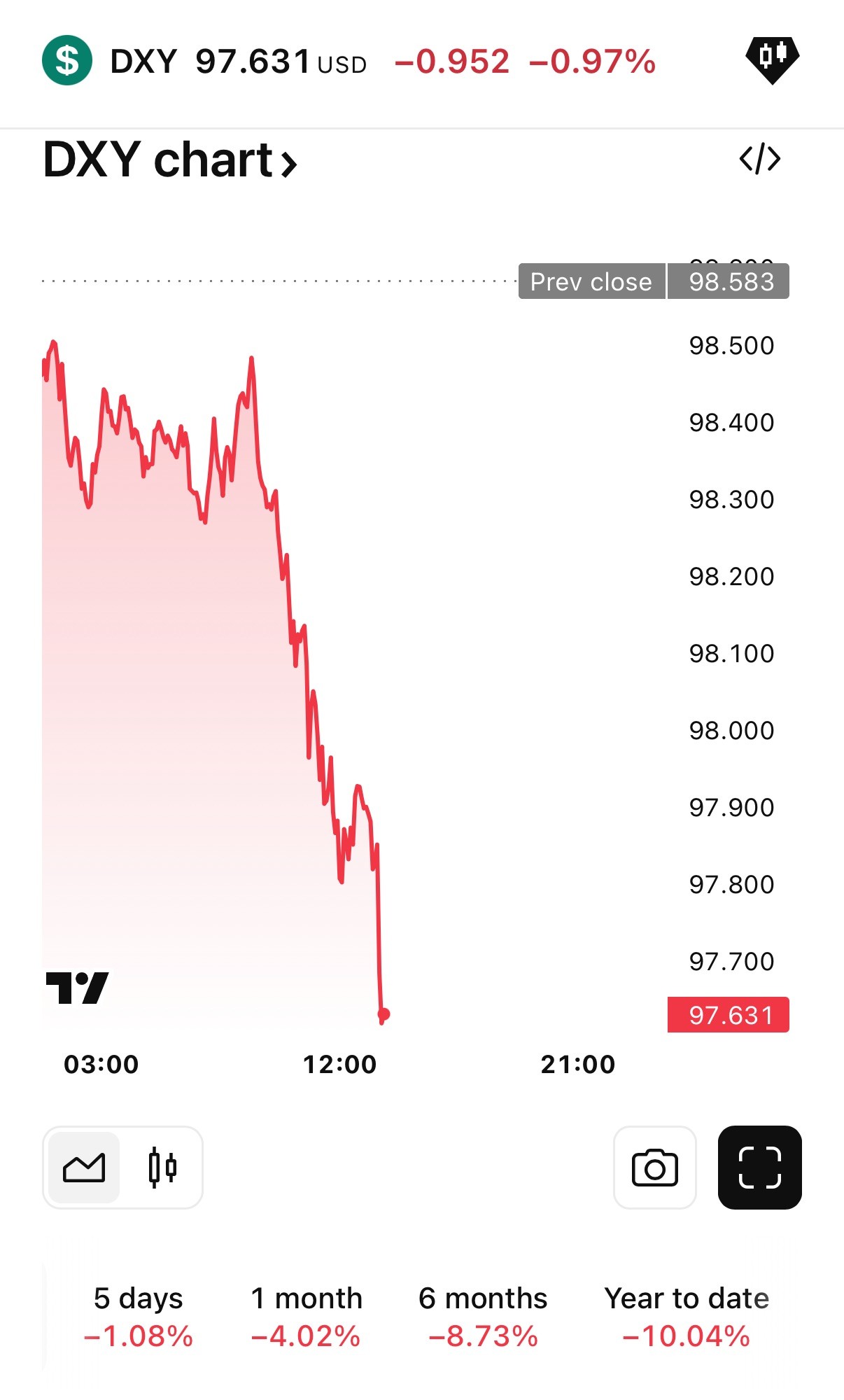
Dollar Falls to Lowest Since 2022 as Economic Outlook Dims
Today, June 12, 2025, marks another day where the U.S. dollar is experiencing weakness,
continuing a trend seen throughout the first half of the year. The U.S.
Dollar Index (DXY), which measures the dollar's performance against a
basket of other currencies, fell to 97.9029, down 0.74% from the
previous session. This puts the index at its lowest level in three
years.
Several factors are contributing to this decline:
Anticipation of Federal Reserve Rate Cuts:
While the Federal Reserve has not yet formally cut interest rates this
year, market expectations of potential easing later in 2025 are
applying downward pressure on the dollar. Data suggesting slowing
inflation and a weakening labor market increase the likelihood of future
rate cuts. Lower interest rates make U.S. assets less attractive to
foreign investors seeking yield, reducing demand for the dollar.
Persistent Trade Uncertainty:
Renewed concerns over the fragility of a trade truce between the U.S.
and China, fueled by potential new tariffs, are unsettling markets and
weighing on the dollar. The risk of renewed price pressure is
increasing.
Geopolitical Risk and De-dollarization:
Ongoing geopolitical instability, including trade conflicts and rising
international tensions, contributes to global market volatility and
encourages diversification away from the dollar.
US Fiscal Concerns:
Large government deficits and increasing national debt raise concerns
about the long-term fiscal sustainability of the U.S., eroding
confidence in the dollar.
Weakening Economic Data:
Data indicating a softening labor market and a pullback in service
sector activity paint a less optimistic picture for the U.S. economy,
further dimming the outlook for the dollar.
Impact of a Weaker Dollar:
Precious Metals Rally:
Gold and silver, traditionally viewed as safe-haven assets, are
benefiting from the dollar's weakness. As the dollar declines, precious
metals priced in dollars become more attractive globally, boosting
demand.
Shift in Investor Sentiment:
The weakening dollar has led investors to adjust their strategies, with
many opting for alternative investments and hedging their dollar
exposure.
In
summary, the dollar's weakness is a result of a combination of factors,
including anticipated Fed rate cuts, trade policy uncertainty,
geopolitical risks, and economic concerns. This trend is impacting other
asset classes, notably boosting the value of precious metals
What market pricing near mid-year suggests is that even if
de-dollarization fears are overblown, the dollar's exchange rate may be a
necessary safety valve.







Mike Dolan