














Saturday, August 09, 2025

Bloomberg Headline Clip-Grabs

 https://s.yimg.com/ny/api/res/1.2/_vJvqJ00E_CwPj2hL1Ctrw--/YXBwaWQ9aGlnaGxhbmRlcjt3PTY0MDtoPTQyOQ--/https://media.zenfs.com/en/bloomberg_holding_pen_162/985336276f68c3958e97915dc72ac968

Bloomberg News Now

Listen to the latest: White House to Clarify Gold Tariffs,Trump-Putin Meeting Set,More

5:56

Your News

Follow Topics

Choose up to 12 topics to see the latest stories on your homepage.

Recommended

Regions

Sectors

 https://pbs.twimg.com/media/Gx23pryXoAA-nbg.png

Friday, August 08, 2025

JUST IN: Trump's DOJ Is Investigating New York AG Letitia James Over His...

THERE'S A HELLUVA LOT GOING ON THERE >> South Park Just Burned ICE So Bad They MELTED

Ukraine Males between 19 and 60 years old are banned from leaving the country due to an ongoing conscription campaign

A Ukrainian man of fighting age has been apprehended before attempting to flee to Moldova using a paraglider, Ukraine's Border Guard Service has reported. Kiev is faced with a surge in draft evasion amid the country’s ongoing and controversial conscription campaign.

Fighting-age Ukrainian arrested readying paraglider to flee 

Fighting-age Ukrainian arrested readying paraglider to flee 

The man was apprehended near the city of Mogiliov-Podilsky in Vinnitsa Region, according to a statement on Friday. He was identified as a 48-year-old resident of the western Khmelnitsky Region.

  • The authorities said he purchased a light glider for €500 ($582) and was preparing to launch from a nearby field when border agents intervened.
  • Officials suggested that the flight could have ended in disaster. According to the statement, the man lacked navigation tools and the skills needed to land safely, even if he had managed to cross into Moldova.

Ukraine has barred men aged 18 to 60 from leaving the country since the conflict with Russia escalated in 2022

Amid mounting human and territorial losses the government intensified mandatory conscription efforts. Numerous videos circulating online show officers using force to press gang desperate individuals who often resist and receive support from witnesses.

RT

In another case highlighted by the Border Guard Service in late July, agents intercepted a man disguised in women’s clothing who was allegedly seeking to flee the country.
RELATED 


CRITICAL 31% CAPACITY: Lake Powell nears 'dead pool,' threatens Arizona water supply

BEA Announcement: Experimental Distribution of Personal Income Nowcast for 2024

 https://www.bea.gov/system/files/trad0625.png

US Department of Commerce Bureau of Economic Analysis

BEA Announcement: Experimental Distribution of Personal Income Nowcast for 2024

SUITLAND, Md. — The Bureau of Economic Analysis today released experimental nowcast data on the distribution of personal income in 2024. 

Distribution of personal income statistics take one of BEA’s primary economic indicators—U.S. personal income—and measure how it is distributed across households. This provides a way to assess how households share in the nation's economic growth. Production of these statistics, though, is slowed by the wait for the necessary high-quality source data.

To improve timeliness, BEA has developed an experimental nowcast for 2024 that balances user needs for relevance and accuracy. Machine learning techniques analyze relationships between published annual distributions and current National Income and Product Account totals to generate timely estimates of shares and growth of personal income by household income quintile.

The nowcast follows the release last December of updated U.S. distribution of personal income data for 2000-2022 and provisional data for 2023. These distributional statistics build on more than a decade of BEA research by bringing in data such as demographic surveys, aggregated tax records, and administrative records.


News Release

EMBARGOED UNTIL RELEASE AT 8:30 a.m. EDT, Tuesday, August 5, 2025

U.S. International Trade in Goods and Services, June 2025

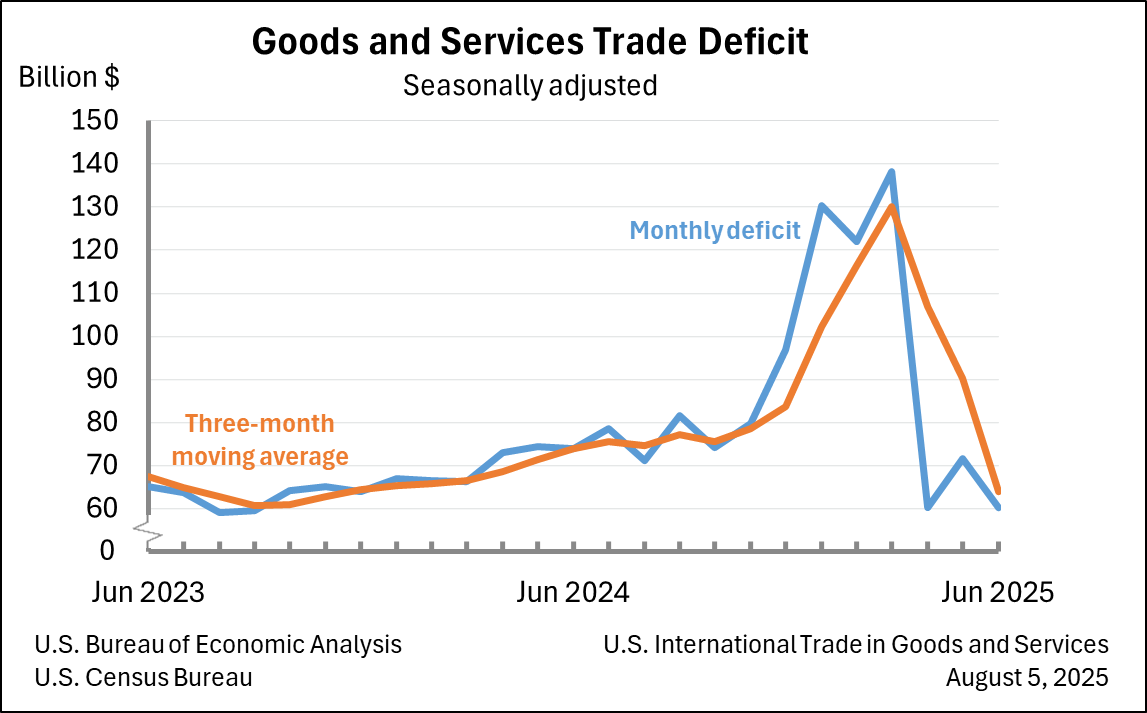
The U.S. Census Bureau and the U.S. Bureau of Economic Analysis announced today that the goods and services deficit was $60.2 billion in June, down $11.5 billion from $71.7 billion in May, revised.

U.S. International Trade in Goods and Services Deficit
Deficit: $60.2 Billion –16.0%°
Exports: $277.3 Billion –0.5%°
Imports: $337.5 Billion –3.7%°

Next release: Thursday, September 4, 2025

(°) Statistical significance is not applicable or not measurable. Data adjusted for seasonality but not price changes

Source: U.S. Census Bureau, U.S. Bureau of Economic Analysis; U.S. International Trade in Goods and Services, August 5, 2025

Goods and Services Trade Deficit: Seasonally adjusted

Exports, Imports, and Balance (exhibit 1)

June exports were $277.3 billion, $1.3 billion less than May exports. June imports were $337.5 billion, $12.8 billion less than May imports.

The June decrease in the goods and services deficit reflected a decrease in the goods deficit of $11.4 billion to $85.9 billion and an increase in the services surplus of $0.1 billion to $25.7 billion.

Year-to-date, the goods and services deficit increased $161.5 billion, or 38.3 percent, from the same period in 2024. Exports increased $82.2 billion or 5.2 percent. Imports increased $243.7 billion or 12.1 percent.

Three-Month Moving Averages (exhibit 2)

The average goods and services deficit decreased $26.0 billion to $64.0 billion for the three months ending in June.

  • Average exports decreased $1.3 billion to $282.2 billion in June.
  • Average imports decreased $27.3 billion to $346.2 billion in June.

Year-over-year, the average goods and services deficit decreased $9.8 billion from the three months ending in June 2024.

  • Average exports increased $15.6 billion from June 2024.
  • Average imports increased $5.8 billion from June 2024.

Exports (exhibits 3, 6, and 7)

Exports of goods decreased $1.2 billion to $179.1 billion in June.

    Exports of goods on a Census basis decreased $1.3 billion.

  • Industrial supplies and materials decreased $4.8 billion.
    • Finished metal shapes decreased $4.6 billion.
    • Nonmonetary gold decreased $2.0 billion.
  • Capital goods increased $2.0 billion.
    • Excavating machinery increased $1.6 billion.
    • Civilian aircraft increased $0.8 billion.
    • Computer accessories decreased $1.2 billion.
  • Consumer goods increased $1.0 billion.
    • Pharmaceutical preparations increased $1.6 billion.

    Net balance of payments adjustments increased $0.1 billion.

Treatment of Gold in BEA's International and National Economic Accounts

When incorporating the statistics in this release into BEA's National Economic Accounts, including Gross Domestic Product, or GDP, BEA replaces exports and imports of nonmonetary gold with an adjustment calculated as the difference between domestic production and industrial use of gold. For additional information, see "How are exports and imports of gold recorded in BEA's International Economic Accounts?" and "How are exports and imports of nonmonetary gold treated in BEA's National Economic Accounts?".

Exports of services decreased $0.2 billion to $98.2 billion in June.

  • Travel decreased $0.2 billion.

Imports (exhibits 4, 6, and 8)

Imports of goods decreased $12.6 billion to $265.0 billion in June.

    Imports of goods on a Census basis decreased $12.6 billion.

  • Consumer goods decreased $8.4 billion.
    • Pharmaceutical preparations decreased $9.6 billion.
  • Industrial supplies and materials decreased $2.7 billion.
    • Crude oil decreased $1.0 billion.
    • Nuclear fuel materials decreased $0.4 billion.
    • Other petroleum products increased $0.5 billion.
  • Automotive vehicles, parts, and engines decreased $1.3 billion.
    • Passenger cars decreased $1.1 billion.

    Net balance of payments adjustments increased less than $0.1 billion.

Imports of services decreased $0.2 billion to $72.5 billion in June.

  • Travel decreased $0.2 billion.
  • Transport decreased $0.2 billion.
  • Other business services increased $0.1 billion.

Real Goods in 2017 Dollars – Census Basis (exhibit 11)

The real goods deficit decreased $8.7 billion, or 9.3 percent, to $84.6 billion in June, compared to an 11.8 percent decrease in the nominal deficit.

  • Real exports of goods decreased $2.2 billion, or 1.5 percent, to $145.8 billion, compared to a 0.7 percent decrease in nominal exports.
  • Real imports of goods decreased $11.0 billion, or 4.5 percent, to $230.4 billion, compared to a 4.6 percent decrease in nominal imports.

Revisions

Revisions to May exports

  • Exports of goods were revised up $0.1 billion.
  • Exports of services were revised down $0.4 billion.

Revisions to May imports

  • Imports of goods were revised down $0.1 billion.
  • Imports of services were revised down $0.1 billion.

Goods by Selected Countries and Areas: Monthly – Census Basis (exhibit 19)

The June figures show surpluses, in billions of dollars, with 
  • Netherlands ($6.2), 
  • South and Central America ($4.4), 
  • United Kingdom ($2.2), 
  • Australia ($1.6), 
  • Hong Kong ($1.6), 
  • Brazil ($1.3), 
  • Saudi Arabia ($0.3), 
  • Singapore ($0.2), and 
  • Belgium ($0.1). 
 
Deficits were recorded, in billions of dollars, with 
  • Mexico ($16.3), 
  • Vietnam ($16.2), 
  • Taiwan ($12.9), 
  • European Union ($9.5), 
  • China ($9.4), 
  • Japan ($5.7), 
  • South Korea ($5.5), 
  • Ireland ($5.3), 
  • India ($5.3), 
  • ($4.0), 
  • Malaysia ($3.1), 
  • Italy ($1.6), 
  • Canada ($1.3), 
  • France ($0.7), 
  • Israel ($0.1), and 
  • Switzerland (less than $0.1).

The deficit with Ireland decreased $6.5 billion to $5.3 billion in June. Exports decreased $0.2 billion to $1.4 billion and imports decreased $6.7 billion to $6.7 billion.

The deficit with China decreased $4.6 billion to $9.4 billion in June. Exports increased $3.1 billion to $10.1 billion and imports decreased $1.4 billion to $19.4 billion.

The balance with Switzerland shifted from a surplus of $3.3 billion in May to a deficit of less than $0.1 billion in June. 
Exports decreased $2.4 billion to $4.1 billion and 
imports increased $0.9 billion to $4.1 billion.

All statistics referenced are seasonally adjusted; statistics are on a balance of payments basis unless otherwise specified. 

Additional statistics, including not seasonally adjusted statistics and details for goods on a Census basis, are available in exhibits 1-20b of this release. 

For information on data sources, definitions, and revision procedures, see the explanatory notes in this release. 

The full release can be found at 

www.census.gov/foreign-trade/Press-Release/current_press_release/index.html 

or  

www.bea.gov/data/intl-trade-investment/international-trade-goods-and-services

The full schedule is available in the Census Bureau's Economic Briefing Room at www.census.gov/economic-indicators/ or on BEA's website at www.bea.gov/news/schedule.

Next release: September 4, 2025, at 8:30 a.m. EDT
U.S. International Trade in Goods and Services, July 2025