Donald Trump has reportedly sent a letter to the Norwegian PM Jonas Gahr Store expressing his discontent with the Nobel Peace Prize not being awarded to him.
He has also questioned why Denmark should be the one controlling Greenland
He has also questioned why Denmark should be the one controlling Greenland.
President Trump has also posted an image on his social media platform depicting him as planting the US flag in Greenland in 2026.
The EU leaders want to approach Trump in Davos in an attempt to get him to de-escalate his claims on Greenland.
Russia and China have both confirmed receiving an invitation to join Trump’s “Board of Peace”.
A
person makes preparations at the Davos Congress Centre, ahead of the
World Economic Forum (WEF), in the ski resort of Davos, Switzerland,
January 18, 2026. REUTERS/Denis Balibouse , opens new tab
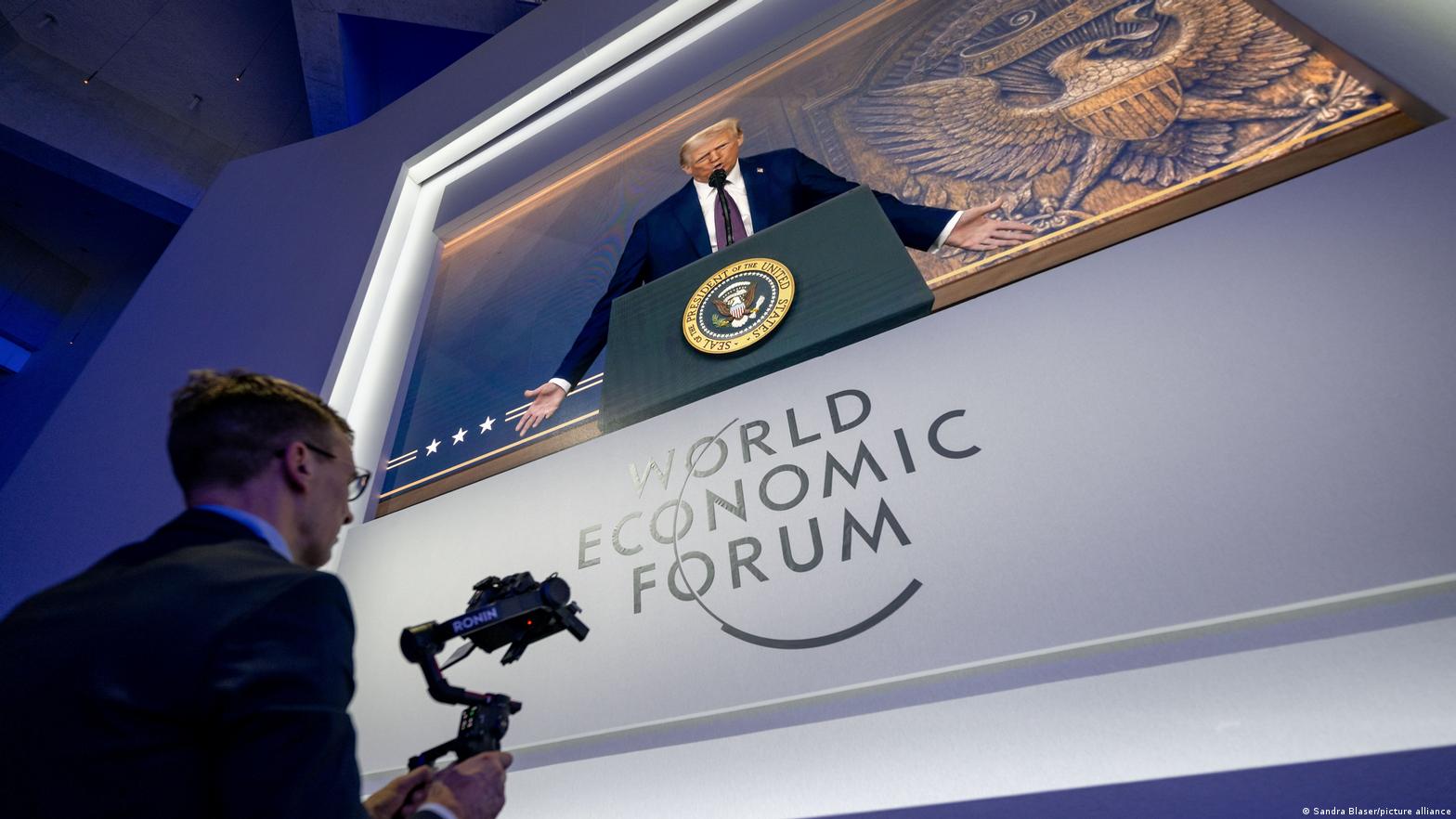
DAVOS, Switzerland, Jan 19 (Reuters) - The first time Donald Trump came to Davos in 2018 he was an awkward guest
at the global elite party.
Eight years on, the U.S. president has bent
the gathering of business and political leaders to his will.
The World
Economic Forum’s annual meeting, which kicks off
on Monday, has largely embraced the former reality TV star's agenda.
Expect more discussions of technology, deals, and realpolitik – and less
about climate change.
Report Ad
It’s
easy to dismiss the confab as a talking shop for entitled executives
and disconnected politicians.
Yet Davos, founded by Klaus Schwab in the
Swiss Alpine resort five and a half decades ago, also serves as an
admittedly imperfect mirror
of the shifting world order.
The heads of state, entrepreneurs,
investors and assorted hangers-on attending each January provide a
partial snapshot of who's who in global politics, business and finance. A
stroll along the resort’s main drag is similarly revealing.
The likes
of cybersecurity firm CrowdStrike (CRW, opens new tab,
the Abu Dhabi conglomerate, as well as governments such as Indonesia,
have paid vast sums to plaster their logos on storefronts for the week.
The USA House, which occupies a church just outside the Davos Congress
Centre draped with "Freedom 250" banners, is promising parties and
events featuring Treasury Secretary Scott Bessent and Steve Witkoff, the
special envoy to the Middle East.
Report Ad
This
year Trump will be hard to avoid. The president, who is due to address
the Davos crowd on Wednesday, is flying in just after threatening to impose tariffs
on some European countries unless the United States is allowed to buy
Greenland.
He is bringing an entourage of cabinet members including
Bessent, Secretary of State Marco Rubio and Commerce Secretary Howard
Lutnick. They will mingle with business leaders including Nvidia (NVDA.O), opens new tab boss Jensen Huang and JPMorgan (JPM CEO Jamie Dimon.
Senior politicians from around the world are joining
in:
Chinese Vice-Premier He Lifeng,
French President Emmanuel Macron,
Canada’s Mark Carney,
Friedrich Merz of Germany, and
Indonesian
President Prabowo Subianto are all due to speak.
It’s a marked contrast
with last year’s gathering, when delegates spent much of the week warily
observing the first days of Trump’s second administration 7,000 kilometres away.
The prospect of the rich and powerful squeezing into overheated hotel rooms and cocktail parties helps vindicate the WEF’s change of direction after Schwab abruptly stepped down as chairman last year.
The organisation has dropped some of its loftier rhetoric while playing up its role as an unbiased facilitator of frank debate.
Borge Brende, the former Norwegian diplomat who serves as the WEF’s CEO, last week stressed its independence, impartiality, and base in “neutral Switzerland”.
Meanwhile BlackRock (BLK.N), opens new tab boss Larry Fink, who has replaced Schwab as interim co-chair of the WEF’s board – alongside Roche (ROG.S), opens new tab Vice-Chairman André Hoffmann – has been actively courting heads of state and business leaders around the world.
His latest Greenland threat has sparked a crisis in NATO and brought angry condemnations from European countries.
In just the past few weeks he has arrested the president of Venezuela and promised to “run” the South American country, agitated for a change of government in Iran, and threatened to deploy military forces in Minnesota.
Meanwhile his administration has undermined the Federal Reserve’s independence by threatening a criminal indictment against Chair Jerome Powell.
The aggressive burst of activity contrasts with Trump’s first Davos appearance eight years ago, when he declared his hope “for a future in which everyone can prosper, and every child can grow up free from violence, poverty and fear”.
Some
of the 2,900 delegates may seek to ease their existential angst by
tuning into panel discussions with titles such as “Can Europe Defend
Itself?”, “Is Democracy in Trouble?”, and “Can We Save the Middle
Class?”.
Yet, as always, much of the real activity will take place
behind closed doors, where executives and financiers discuss deals over
drinks and dinner.
This year, many of those transactions will depend on
the whim of the U.S. government, which has spent much of the past 12
months negotiating and re-negotiating trade agreements, restricting and relaxing the sale of artificial intelligence chips to China, taking stakes in public companies, cutting deals with big drugmakers, and, most recently, selling Venezuelan oil.
One
topic that's likely to take a back seat is climate change. In previous
years the WEF made extensive efforts to bring together governments,
companies and other international organisations to tackle the problem of
a warming planet. Not this time.
A search of the official Davos
programme reveals just four sessions that reference the words “climate
change”.
In 2022, there were 16. A session billed as “An Honest
Conversation About How to Fuel Our Lives” features Chris Wright, the
U.S. energy secretary and former industry executive who has led the
charge to loosen fossil fuel regulations, in discussion with Occidental Petroleum (OXY.N), opens new tab CEO Vicki Hollub.
Fink exemplifies the shifting priorities.
In 2021, the boss of $14 trillion asset manager BlackRock wrote a letter to CEOs, opens new tab which included no fewer than 18 mentions of “net zero”.
But last summer he told, opens new tab the WEF’s International Business Council that the drive to phase out fossil fuels had “not always considered the cost to the average person, or to the emerging world.”
Previous editions of the WEF’s annual risk-perceptions survey flagged environmental issues as among the world's biggest challenges.
Trump’s attacks on the global trading system, disregard for facts and demonisation of political enemies exemplify these concerns.
Yet the president did not warrant a mention in the report’s 67 pages.
It remains to be seen whether any rival heads of state or corporate chieftains, who until now have tended to avoid public criticism of Trump, will initiate an honest debate about the threat the occupant of the White House poses to global cooperation.
Of course, the WEF owes its longevity to bending with the political and economic winds.
At various stages in its history Schwab embraced globalisation, pivoted to emerging markets like India and Brazil, schmoozed China, and cosied up to Trump.
Yet if relations between the U.S. and Europe continue to deteriorate, it will be harder to envisage business and political leaders from both sides of the Atlantic rubbing shoulders in Switzerland every January.
The gathering is notorious for helping to spawn the annual “Davos consensus” which often turns out to be wrong. Its enthusiastic embrace of Trump and his agenda may be the latest mistake.









Commentary Breakingviews