Friday, July 31, 2026

COLORADO RIVER WATER DECISION - The framework targets California, Arizona, and Nevada for the steepest water reductions in history

Arizona has planned responsibly for its water future for decades and remains well positioned to support continued economic growth.

Core Pillars of the Federal Proposal
  • Lower Basin Mandates: The framework targets California, Arizona, and Nevada for the steepest water reductions in history. [1, 2]
  • Upper Basin Reprieve: States in the Upper Basin—Colorado, Utah, New Mexico, and Wyoming—are completely spared from mandatory cuts for now. [1, 2]


But we should not be asked to shoulder a disproportionate share of the Colorado River reductions.
Statement from Danny Seiden on today's decision: https://azchamber.com/colorado-river-decision

Water cuts loom as US unveils long-awaited response to Colorado river crisis

Federal government plan outlines cuts to California, Arizona and Nevada but fix is likely to be only temporary

The US government released its anxiously awaited plan for how to manage the Colorado river crisis on Friday, outlining cuts in water supplied to California, Arizona and Nevada.

The proposal from the US Bureau of Reclamation spares Colorado, Utah, New Mexico and Wyoming from facing mandatory cuts, for now. But it is a temporary fix as the states that rely on the river continue to fight over a long-term management plan for the dwindling resource that supplies huge swaths of the western US.
The proposal is the federal government’s answer to a years-long stalemate between the seven states responsible for forming a plan on how to distribute the deep cuts needed to pull the system back from the brink. It comes just months before the framework that currently governs the essential and imperiled waterway is set to expire.

The western US is running out of water. What happens next? – Stateside with Kai and Carter

“This framework provides the flexibility to respond to changing hydrologic conditions while preserving the opportunity for the Basin States to continue working toward durable, consensus-based solutions,” said Doug Burgum, the US interior secretary, in a press release.

Under the 10-year plan, the Lower Basin states could face deep cuts of up to 3m acre-feet (3.7bn kiloliters) a year – up to 40% of their collective total – “subject to hydrology”, according to the press release by the Department of the Interior. That’s about enough water annually to serve more than 25 million people.

The plan would also allow annual releases of between 5m and 12m acre-feet from Lake Powell, the basin’s second-largest reservoir. Under the 10-year federal framework, water management decisions will be made every two years.

The federal government is expected to release a record of decision in the coming week that will detail operations under the plan in the short term, but it is likely they will closely follow a proposal issued by the lower basin states earlier this year that would shave 3.2m acre-feet from their combined total over 2027 and 2028.

Governing the enormous and essential river system has always been deeply challenging. The federal government has limited jurisdiction over water policies and agreements between states. A century-old compact that initially divided up the river gave rights to more water than there is in the system. With the river’s decline, the gap has only widened.

The combined levels of the two largest reservoirs on the river, Lake Powell and Lake Mead, have already reached record lows and it’s exceedingly unlikely that the system will bounce back, even if there is a wet winter.

An overlook near the Wahweap Marina on Lake Powell in July 2026. The reservoir is nearing a record low level. Photograph: John Locher/AP

The Bureau of Reclamation has the power to manage operations of the dams at the two central reservoirs, which provide hydroelectric power and supply the flows from the upper states to the lower, which is largely why, experts say, the cuts were directed at the lower basin states.

The river and its tributaries are the lifeblood for the American west, supplying bustling cities such as Las Vegas, Phoenix and Los Angeles, as well as agricultural centers. Roughly 40 million people in seven states, two countries and dozens of tribes rely on the river, which also irrigates 5.5m acres of farmland.

The Colorado has been overdrawn for more than a century, as demand continues to outpace supply. The climate crisis is also taking an increasingly large share. Snowmelt that feeds the river is evaporating more quickly, and thirsty soils and plants soak up more water. Flows in the Colorado are down 20% over the last century and precipitation has shrunk by about 7%.

Snaking across 1,450 miles (2,300km) from the Rocky Mountains into Mexico, the sprawling basin fuels an estimated $1.4tn in economic activity and is also home to scores of birds, fish, plants and animals, its diverse ecosystems providing critical habitat for more than 150 threatened or endangered species.

The ecosystems on the banks of the river have already paid a heavy price. Fourteen native fish species are endangered or threatened. The once-lush wetlands in Mexico’s river delta have been dry for decades and the once mighty river slows to just a trickle as it crosses the US-Mexico border.

EURO REFUGEE CRISIS: Around 60,000 migrants cross into Spain’s Ceuta exclave from Morocco

 The European Union on Friday sought to contain a major migrant crisis after around 60,000 people crossed from Morocco into Spain's North African enclave of Ceuta in just days, overwhelming local authorities and triggering diplomatic tensions across the bloc.

Around 60,000 migrants cross into Spain's Ceuta exclave from Morocco -  France 24
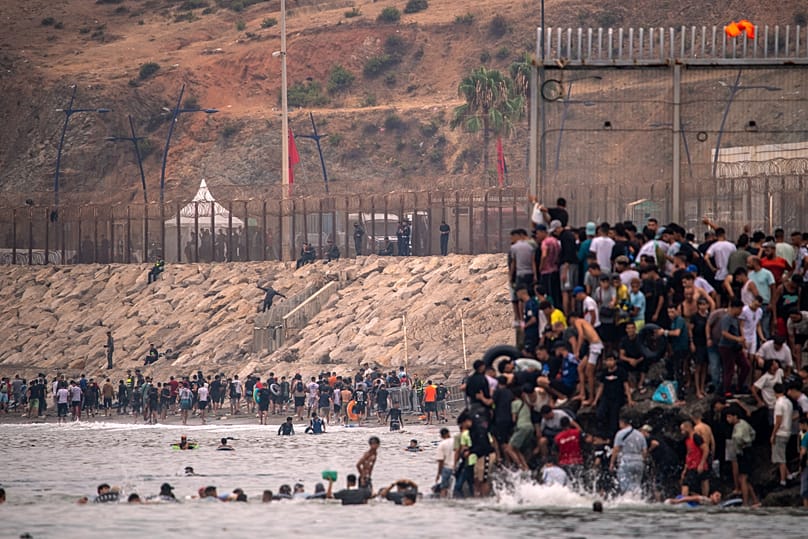
An unprecedented border crisis has unfolded in Ceuta, a Spanish exclave in North Africa, where an estimated 60,000 migrants crossed from Morocco within a 24-hour period. [1, 2]
The influx represents roughly 70% of the city's permanent population, triggering an acute humanitarian emergency and widespread political fallout across Europe. [1, 2]
Key Details of the Crisis
  • Casualties: At least 34 people have died attempting the crossing. Many drowned while swimming around the marine border fences or were crushed in stampedes near the Tarajal beach breakwater. [1, 2]
  • Demographics: The crowd consisted largely of young men, but also included women, babies, and an estimated 7,000 unaccompanied minors. [1]
  • Method of Entry: Migrants bypassed border security by swimming along the coast or climbing rock jetties to circumvent the border fence. [1]
  • The Legal Catalyst: The sudden surge followed a Spanish Supreme Court ruling earlier in July. The ruling dictated that migrants intercepted at sea while trying to reach Ceuta or Melilla cannot be summarily returned to Morocco. Spanish Prime Minister Pedro SΓ‘nchez blamed human trafficking gangs for spreading distorted information about the ruling to spark the rush. [1, 2]


Top stories


At least 60,000 migrants cross into Spanish territory of Ceuta from Morocco in a single day


By Gael Camba
Published on

At least 60,000 migrants have crossed in recent days from Morocco into Spain's Ceuta enclave, authorities have said, as Spanish Prime Minister Pedro SΓ‘nchez arrived to manage the country's biggest migrant crisis in years.

Police also said on Friday that many more people are still arriving in the enclave.

Spanish authorities said they would try to expel those who had entered illegally as quickly as possible, despite a ​court ruling that has put some new restrictions on special "border rejection" rules that allow immediate expulsions.

Upon arrival in the enclave, SΓ‘nchez said "what has emerged from our talks with Moroccan authorities is that trafficking mafias took a self-serving interpretation of a Supreme Court ruling," he said. That interpretation "spread like wildfire in recent hours."

Migrants return to Morocco from the Spanish enclave of Ceuta, Friday, 31 July 2026.
Migrants return to Morocco from the Spanish enclave of Ceuta, Friday, 31 July 2026. The Associated Press. All rights reserved.

Ebullient migrants on Thursday were walking through the streets of Ceuta, thanking the Spanish police and calling out: "Bye bye Morocco, hello Spain."

Police and Civil Guards in Ceuta appeared to do little to intervene, although some officers attempted to direct the arrivals to the local migrant reception centre.

So far, 34 people have died trying to reach the Spanish territory, police sources said.

Diplomatic fallout

Already, the Ceuta scenes of the surge in migrants were causing diplomatic fallout.

Italy on Thursday called for Spain to be suspended from Europe's open-borders Schengen zone, prompting Spain to summon Italy's ambassador and accuse Rome of using the crisis for political gain.

Two top officials within US President Donald Trump's White House on Thursday also reiterated their anti-immigration politics using video of Ceuta.

Hundreds of migrants who have irregularly entered Ceuta began to return to Morocco through the same chokepoint, the breakwater that separates the autonomous city. The migrants are being led by the military to find a way to return.

France reinforces border controls with Spain

The French Interior Minister, Laurent NuΓ±ez, stated this Friday that controls on the border with Spain will be reinforced.

"In light of the situation in the enclave of Ceuta, I gave instructions yesterday evening to immediately step up controls at the Spanish border. Furthermore, I am mobilising the Rapid Border Intervention Force to carry out thorough checks," says the French Interior Minister.

Spanish authorities 'overwhelmed'

Spanish authorities said they have been "completely overwhelmed" by the situation, El Mundo reports. Only 55 agents were on the front line when the situation broke out, according to the Spanish newspaper.

The active troops on the ground are "three or four times less than what would be needed to face something like this," says to El Mundo David Gomez, secretary of communication of the Justice Professional Association for the Civil Guard.

The influx marks the largest arrival of migrants in Ceuta since 2021 — predominantly young men and adolescents — with 18 deaths reported during the crossing, according to figures released on Friday morning by the same source.

The number of entries means the population of the enclave increased by more than 50%, as around 83,000 people are living in Ceuta.

What to know about Spain's enclave of Ceuta as migrants arrive | AP News
πŸ”΄ BREAKING: Around 60,000 people were estimated ⁠to have crossed into  Ceuta in ⁠the past ⁠few days, the leader of the Spanish enclave in ⁠North  Africa, Juan Jesus Vivas, says, more than