Monday, May 30, 2022

Romney's 2012 Running-Mate for Vice-President Paul Ryan Re-Emerges

Intro: The former Wisconsin Congressman was elected at age 45 as the youngest Speaker in The House of Representatives to serve since 1869,
Ryan said that under the “old meritocracy” it took 10 to 20 years to build a reputation as a “good policymaker.”
 

Former House Speaker Paul Ryan Emerges To Bash 'Entertainer' Politicians

Building an "entertainment brand" in Congress is bad for bipartisanship and forging policy, said Ryan. It "divides us."

Paul Ryan Mitt Romney

Former Republican House Speaker Paul Ryan emerged from self-imposed political exile to lash “entertainer” lawmakers. The former Wisconsin lawmaker didn’t name names, but insisted they come from “both parties.”

“In the ‘old days,’ like ten years ago, if you wanted to do really well in Congress, if you wanted to succeed, you climbed a meritocracy. The measurement of success was policy and persuasion,” Ryan said on CNBC’s “Squawk Box” Thursday.

"10 years ago if you wanted to do really well in Congress--you climbed a meritocracy. The measurement of success was policy and persuasion," says Paul Ryan. "That's not necessarily what motivates people anymore. There's a lot of entertainers in Congress." pic.twitter.com/QkVpZOeP67

— Squawk Box (@SquawkCNBC) May 26, 2022

...Ryan, who served as speaker form 2015 to 2019, removed himself from the political scrum after 20 years in office and opted not to run for reelection in 2018, following uncomfortable confrontations with then-President Donald Trump.

--- A reluctant Ryan eventually endorsed Trump when he was running for president. But he withdrew his support a month before the 2016 election after the Access Hollywood tape emerged with Trump boasting that he liked to “grab” women “by the pussy.”

--- Trump predictably blasted Ryan as disloyal and accused him of deliberately undermining his campaign.

[Ryan said in an interview last year that it was “really clear” Trump lost the election, and that the election was in no way rigged.]

The former lawmaker told Quick that he has been friends with President Joe Bidenfor years,” but complained Biden “gave the keys to the left.”

 
Now, he scoffed, you can now “just leap-frog that whole process, be a really good entertainer, have an incredible presence, digital, and forget about policymaking and curate a brand for yourself.”


HOAX HEADLINE HYPERBOLE: Trump's Tabloid "Save America" Tactics [Alternative Facts]

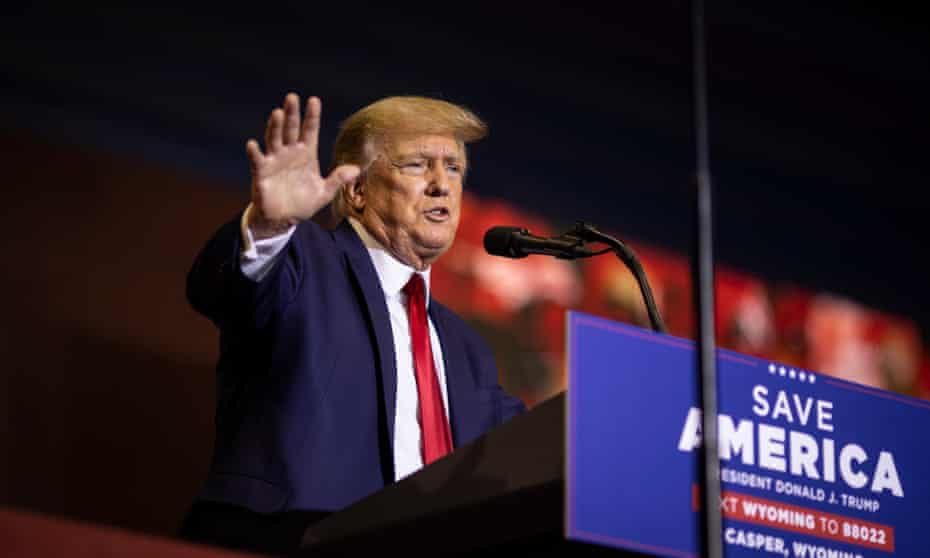
Intro: Addressing the sub-capacity crowd at a rally in Casper for Republican candidate Harriet Hageman, Trump slammed Cheney, saying: “As one of the nation’s leading proponents of the insurrection hoax, Liz Cheney has pushed a grotesquely false, fabricated, hysterical partisan narrative.”
Republicans in the Senate killed that move so the House last summer formed a select committee to investigate the insurrection, chaired by Mississippi Democratic congressman Bennie Thompson but also including Republicans Adam Kinzinger and Cheney, the daughter of former vice-president Dick Cheney.
The committee has since gathered mountains of evidence and taken testimony from numerous witnesses behind closed doors, while being stonewalled by many senior Republicans, and accuses Trump of attempting to lead a type of coup.

Trump calls Capitol attack an ‘insurrection hoax’ as public hearings set to begin

Former president intensifies attacks on Liz Cheney at Wyoming rally and endorses her Republican primary challenger in midterm elections

Former president Donald Trump speaks at a rally on 28 May in Casper, Wyoming

in New York and Agencies

Sun 29 May 2022 19.37 EDT Last modified on Sun 29 May 2022 19.38 EDT

"As the House committee investigating the attack on the US Capitol by extremist supporters of Donald Trump prepares to start public hearings next week, the former president called the insurrection on January 6, 2021, a hoax.

Trump spoke at a rally in Wyoming on Saturday night in support of the Republican primary challenger in the midterm elections to congresswoman Liz Cheney, Harriet Hageman. Cheney sits on the committee and has been vilified by Trump since she voted in favor of his historic second impeachment over the insurrection. . .He added: “Look at the so-called word insurrection, January 6 – what a lot of crap.”

. . .Trump was accused of inciting the deadly insurrection because he held a rally near the White House that morning, during which he urged the crowd to go to the Capitol and “fight like hell” to overturn the election result.

Then as the violent mob, many carrying Trump banners, broke into the Capitol and rampaged through corridors, offices and chambers, attacking vastly outnumbered police officers and sending Democrats and Republicans fleeing for their lives, Trump ignored calls from colleagues and relatives to publicly call his supporters off and only hours later went on TV mildly telling people to “go home”. . .

At the rally in Wyoming , Trump appeared to lament the treatment of those arrested for taking part in the Capitol attack, while falsely claiming that anti-fascist and Black Lives Matter movement anti-racism activists “have killed plenty”.

“Look what they are doing to these people,” he said.

More than 800 people have been charged with federal crimes relating to the riot on January 6, in the biggest federal criminal investigation since the 9/11 terrorist attacks. . ."

Continue to more details provided by Joanna Walter and agencies >> https://www.theguardian.com/us-news/2022/may/30/trump-calls-capitol-attack-an-insurrection-hoax-as-public-hearings-set-to-begin


Sunday, May 29, 2022

CYBERWARFARE: Everything Old is New Again...A Marketing---Battle with China

Intro: While cyber activity undertaken by state actors is often wrapped in highly classified files, many hacking tools developed by the US are no longer secret.
China is widely considered to be one of the most sophisticated and active state cyber actors—involved in spying, hacking for espionage, and gathering data.
Western officials consider the country to be the biggest cyber threat, ahead of Russia, Iran, and North Korea. . .But publicizing details of the long-known incidents still raises plenty of questions. Mandiant’s Read says he wonders exactly how many cyberespionage cases Chinese companies and authorities are finding.
The answer would provide significant clues about their true capabilities. Read says: “Is this 50 percent of what they're finding? Is this 1 percent of what they're finding? Is this 90 percent of what they're finding?”
End of Countries Blaming Each Other of Cyber Espionage?
The move appears to be strategic, says TeamT5’s Che. “Considering the close relationship between China's cybersecurity firms and the Chinese government, our team surmises that these reports could be a part of China’s strategic distraction when they are accused of massive surveillance systems and espionage operations.”

This story originally appeared on wired.com.

The mystery of China’s sudden warnings about US hackers

China has recently begun saber-rattling about American cyberespionage.

For the best part of a decade, US officials and cybersecurity companies have been naming and shaming hackers they believe work for the Chinese government. These hackers have stolen terabytes of data from companies like pharmaceutical and video game firms, compromised servers, stripped security protections, and highjacked hacking tools, according to security experts. And as China’s alleged hacking has grown more brazen, individual Chinese hackers face indictments. However, things may be changing.

Since the start of 2022, China’s Foreign Ministry and the country’s cybersecurity firms have increasingly been calling out alleged US cyberespionage. Until now, these allegations have been a rarity. . .The move may be a strategic change for China as the nation tussles to cement its position as a tech superpower.

[.     ] China’s accusations, which were noted by security journalist Catalin Cimpanu, all follow a very similar pattern. On February 23, Chinese security company Pangu Lab published allegations that the US National Security Agency’s elite Equation Group hackers used a backdoor, dubbed Bvp47, to monitor 45 countries. The Global Times, a tabloid newspaper that’s part of China’s state-controlled media, ran an exclusive report on the research.

Weeks later, on March 14, the newspaper had a second exclusive story about another NSA tool, NOPEN, based on details from China’s National Computer Virus Emergency Response Center. A week later, Chinese cybersecurity firm Qihoo 360 alleged that US hackers had been attacking Chinese companies and organizations.

And on April 19, the Global Times reported on further National Computer Virus Emergency Response Center findings about HIVE, malware developed by the CIA.

The reports are accompanied with a flurry of statements—often in response to questions from the media—by China’s Foreign Ministry spokespeople. “China is gravely concerned over the irresponsible malicious cyber activities of the US government,” Foreign Ministry spokesperson Wang Wenbin said in April after one of the announcements. “We urge the US side to explain itself and immediately stop such malicious activities.”

>> Over the first nine days of May, Foreign Ministry spokespeople commented on US cyber activities at least three times. “One cannot whitewash himself by smearing others,” Zhao Lijian said in one instance.

While cyber activity undertaken by state actors is often wrapped in highly classified files, many hacking tools developed by the US are no longer secret. In 2017, WikiLeaks published 9,000 documents in the Vault7 leaks, which detailed many of the CIA’s tools. A year earlier, the mysterious Shadow Brokers hacking group stole data from one of the NSA’s elite hacking teams and slowly dripped the data to the world. The Shadow Brokers leaks included dozens of exploits and new zero-days—including the Eternal Blue hacking tool, which has since been used repeatedly in some of the largest cyberattacks.

Many of the details in the Shadow Brokers leaks match up with details about NSA which were disclosed by Edward Snowden in 2013. (An NSA spokesperson said it has “no comment” for this story; the agency routinely does not comment on its activities.)

Ben Read, director of cyberespionage analysis at the US cybersecurity firm Mandiant, says China’s state media push of alleged US hacking seems to be consistent, . .

Many of the disclosures in 2022—there are only a handful of previous Chinese accusations against the US—stem from private cybersecurity companies. This is similar to how Western cybersecurity companies report their findings; they are not always incorporated into government talking points, however, and state-backed media is all but nonexistent.

The potential shift in tactics could play into wider policies around technology use and development. In recent years, China’s policies have focused on positioning itself as a dominant force in technology standards in everything from 5G to quantum computers. A raft of new cybersecurity and privacy laws have detailed how companies should handle data and protect national information—including the potential for hoarding previously unknown vulnerabilities.

“One explanation is, possibly, that we are engaged in a kind of ideological—or if you want to put it more prosaically, a marketing—battle with China,” says Suzanne Spaulding, a senior adviser at the Center for Strategic and International Studies and previously a senior cybersecurity official in the Obama administration. . ."

READ MORE >> https://arstechnica.com/information-technology/2022/05/the-mystery-of-chinas-sudden-warnings-about-us-hackers/ 

RELATED CONTENT ON THIS BLOG

25 December 2020

One More "Endless War" CYBERWARFARE > Nation-States & Cyber-Spies / The Blame Game

First reported by Reuters
 

US CyberSpy vs CyberSpy Incompetence

Spy vs Spy was a Mad Magazine comic strip started during the Cold War era in 1961. Drawn by Antonia Prohias, the strip featured two spies one level too clever  such that they inevitably did themselves in with  scheming stunts of self-destruction


INTERNATIONAL REALISM: World Economic Forum Davos 2022

Intro: In fact, Kissinger was speaking like the adherent, which he has always been, of “international realism”—the school of thought that values stability above all else and, in that spirit, touts the interests of great powers and their spheres of interest over the ambitions (however lofty) of less mighty countries.
A different quotation: "Mr. Kissinger, a high priest of realpolitik, is no stranger to controversy. When he was awarded the Nobel Prize in 1973 for his efforts to negotiate an end to the war in Vietnam, critics complained, pointing to the devastating U.S. bombing campaign in Cambodia during his tenure. Two members of the Nobel committee resigned in protest."
>
 
>

When Henry Kissinger gives advice on ending the Ukraine conflict, the West should listen

The realpolitik veteran schools today’s ideologues, but they won’t like the lesson

The ideologues who dominate today's Western foreign policy establishment are largely responsible for escalating tensions with Russia to the point of military conflict in Ukraine. And now the grandmaster of realpolitik — that is, foreign relations shaped by pragmatism and on-the-ground truth rather than wishful thinking — has just delivered a rhetorical blow to NATO’s ambitions over Ukraine.

Henry Kissinger, the Nixon-era US secretary of state and a living legend of international politics, celebrates his 99th birthday this week. On Monday, he took to the stage via videoconference at the annual World Economic Forum in Davos, Switzerland, to offer his advice for resolving the Ukraine conflict.

“Parties should be brought to peace talks within the next two months. Ukraine should've been a bridge between Europe and Russia, but now, as the relationships are reshaped, we may enter a space where the dividing line is redrawn and Russia is entirely isolated,”Kissinger said in a conversation with WEF founder and executive chairman Klaus Schwab.  

Isolating Russia from Europe seems to be the goal of engaging Moscow in a war of attrition by arming and backing Ukrainian fighters to effectively serve as NATO proxies. This would also explain why Washington is so highly invested in the conflict, both financially and ideologically.

===================================

Is the West Losing Patience Over Ukraine?

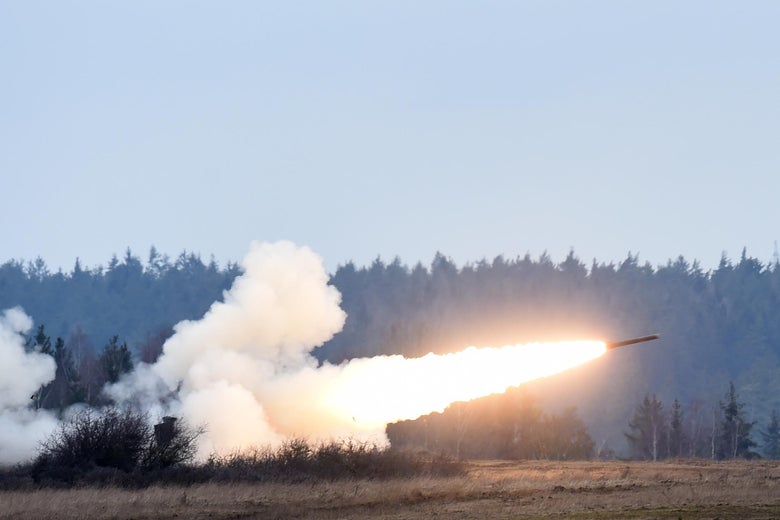
<div class=__reading__mode__extracted__imagecaption>A Multiple Launch Rocket System in southern Germany in 2020. The U.S. has agreed to send these launchers to assist Ukraine.Christof Stache/Getty Images

"It’s been a mercifully long time since Henry Kissinger made headlines, much less sparked a serious debate, but his doleful words this week in Davos, Switzerland, did both.

The gnomish 98-year-old ex-diplomat told the assembled elites at the World Economic Forum that Ukraine must make peace by ceding territory to Russia.

His finger-wagging stirred outrage, not least from Ukrainian President Volodymyr Zelensky, who likened his fellow victim of European tragedy—both are Jews whose family members perished in the Holocaust—to an appeaser of Nazi aggression in 1938. . .

> One flaw of this thinking is that it ignores the many changes in global politics since a half-century ago, when Kissinger’s “triangulation” allowed him, as Richard Nixon’s statesman, to play Washington’s interests off those of Moscow and Beijing. (Things have changed even more so since the Congress of Vienna 200 years ago, when the five great powers of Europe divvied up the continent, as Kissinger described in his career-launching book A World Restored, back when he was a Harvard political scientist.)

First, the end of the Cold War and the subsequent diffusion of global power have diminished the leverage of former power centers and blocs.

Second, in this more anarchic world, the agency of medium-size countries can no longer be cavalierly dismissed. Finally, in most respects, Russia is no longer a great power, and so peace no longer requires treating it as such. . .

--- Some in Europe are beginning to waver on their commitment to end oil or gas imports from Russia. The leaders of France and Italy, while not as explicit on the matter as Kissinger, are pressing Zelensky to make a deal to end the war before a clear (and perhaps unrealistic) Ukrainian victory. It is also becoming increasingly apparent that, outside Europe, especially in the Southern Hemisphere, there is little enthusiasm for this war—and much distress over its far-reaching consequences.

--- However, Kissinger did hit one live nerve at Davos, and that is a growing impatience—even among Kyiv’s most stalwart backers—for how long this war is dragging on and how deeply it is damaging not just Ukraine but the worldwide economy.

--- Five days before Kissinger’s speech, the New York Times editorial page, which has been avid in its support for Ukraine, cautioned: Americans have been galvanized by Ukraine’s suffering, but popular support for a war far from U.S. shores will not continue indefinitely. Inflation is a much bigger issue for American voters than Ukraine, and the disruptions to global food and energy markets are likely to intensify. … Biden should also make clear to … Zelensky and his people that there is a limit to how far the United States and NATO will go to confront Russia, and limits to the arms, money and political support they can muster.

--- The Times’ worry was that the war could widen and escalate, whereas Kissinger’s was about preserving a balance of power in Europe that no longer quite exists. Still, the message is the same: a growing itchiness about the war and a growing desire to shut it down, perhaps prematurely. . .

--- Some in Europe are beginning to waver on their commitment to end oil or gas imports from Russia. The leaders of France and Italy, while not as explicit on the matter as Kissinger, are pressing Zelensky to make a deal to end the war before a clear (and perhaps unrealistic) Ukrainian victory. It is also becoming increasingly apparent that, outside Europe, especially in the Southern Hemisphere, there is little enthusiasm for this war—and much distress over its far-reaching consequences.

Zelensky is well aware—and deeply fearful—of this flagging interest, which is why he continues to give rallying remote speeches almost daily, pressing his allies for more heavy long-range weapons more quickly. The campaign is succeeding. Biden has recently agreed to provide the most cherished weapons on Zelensky’s wish list—the Multiple Launch Rocket System and High Mobility Artillery Rocket System, which, depending on their loads, can hit targets between 100 and 300 miles away. In the fight over Donbas, the Ukrainians have been at a disadvantage: Russian artillery have been able to hit them, but the Ukrainians’ rockets have lacked the range to hit back. MLRS and HiMARS will even the contest—if not reverse the odds. With weapons of such range, Ukrainian troops could fire even deeper still, into Russian territory. This is why Biden had hesitated to send these weapons, and why some worry about the decision to send them now: Yes, it gives the Ukrainians a boost, but if they fire rockets into Russian territory (something Zelensky has agreed not to do), Russia might respond by hitting arms depots and supply lines in, say, Polish territory—and then we’re off to a war between Russia and NATO. That could trigger further escalation—or a panic over the prospect of escalation, which could bring the war to a swift, forced ending, most likely to Ukraine’s disadvantage. . .

REGIME CHANGE? The Biden administration, by stepping up its military aid to Ukraine, is playing a role in setting off this panic, because its own goals in this conflict have steadily expanded. This became explicit last month, when Secretary of Defense Lloyd Austin said that U.S. aims in the war were not only to protect Ukraine as a democratic sovereign country and to help it stave off Russia’s invasion but also to “weaken” Russia as a military power. Some officials were shocked at Austin’s frankness, but no one has pedaled back his words. Regime change is certainly an implicit goal of the onerous sanctions piled on the Russian economy, on its financial tycoons with close ties to Vladimir Putin, and on Putin himself.

And so, the war has entered a new dimension: time. It is not only a contest between Russian and (Western-backed) Ukrainian military forces. It’s also a contest between how long it takes before the West grows leery of letting the war continue and how long it takes before Putin (or his tyranny) collapses. This is one reason the war will intensify, the longer it slogs on—and why there’s every reason to believe it will slog on for as long as either side can make it so."

Reference: https://slate.com/news-and-politics/2022/05/kissinger-ukraine-war-western-impatience.html


Ukraine war brings an unusual moral edge to Davos

 
Analysis by  Columnist
May 25, 2022 at 12:01 a.m. EDT
43 minutes ago · Dr Henry Kissinger full speech at Davos' 22 World economic forum. 1 view May 28, 2022 … ...more ...more. Show less.

>  

RELATED CONTENT

Kissinger: These are the main geopolitical challenges facing the world right now 

  • Former Secretary of State, Henry Kissinger, joined Klaus Schwab, Founder and Executive Chairman of the World Economic Forum, for a conversation on the most pressing issues facing the world.
  • Kissinger says the conflict in Ukraine can permanently restructure the global order.
  • How the USA and China navigate their relationship in this complicated world will be telling for future generations.

When former US Secretary of State, Henry Kissinger, spoke for the first time at the World Economic Forum Annual Meeting in 1980 he said that "we are in an age of global-interdependence". This statement was repeated by World Economic Forum Founder and Executive Chairman, Klaus Schwab, in a discussion with the Nobel-prize winning diplomat at Davos 2022.

Pragmatism and long-term peace

Known for his Realpolitik, Henry Kissinger cemented a global reputation as a pragmatist amidst the Cold War, steering US foreign policy in the 1960s and 1970s. Pioneering the policy of détente, Kissinger sought to reduce tensions with the then-USSR and orchestrated US diplomatic relations with China.

Asked about his perspective on the major issues facing the world today, Kissinger emphasized how the ongoing conflict between Russia and Ukraine could reshape the world as we know it: "Parties should be brought to peace talks within the next two months. Ukraine should've been a bridge between Europe and Russia, but now, as the relationships are reshaped, we may enter a space where the dividing line is redrawn and Russia is entirely isolated. We are facing a situation now where Russia could alienate itself completely from Europe and seek a permanent alliance elsewhere. This may lead to Cold War-like diplomatic distances, which will set us back decades. We should strive for long-term peace."

Established and emerging powers

In speaking about the rise of China, Kissinger reflected on his experience in negotiating with Beijing: "When we opened diplomatic relationships with China in the 1970s, we did it with a sense that we're starting a permanent relationship. That was a very different country. Today, it is a powerhouse with significant economic and strategic interests. How the US and China conduct their relationship in coming years will depend on the patience and diplomacy of its leaders." Henry Kissinger noted that the potentially adversarial aspect of the US-China relationship should be mitigated and common interests should be pursued and upheld. "The US," he says, "must realize that China's strategic and technical competence has evolved. Diplomatic negotiations must be sensitive, informed and unilaterally strive for peace."

Military technologies

"We are faced with the reality that modern technologies are putting countries in situations that they've never been in before," said Kissinger. Nuclear powers and new military technologies, without established criteria for limitations, could spell catastrophe for humankind."

Full Transcript: https://www.weforum.org/agenda/2022/05/kissinger-these-are-the-main-geopolitical-challenges-facing-the-world-right-now/


6 days ago · Veteran U.S. diplomat Henry Kissinger says Washington and Beijing must ... Economic Forum in a rare springtime version of Davos, Kissinger ...
2 days ago · Ukrainian President Volodymyr Zelensky addressing the World Economic Forum in Davos, Switzerland, from Kyiv on May 23, 2022.


SNAGGED ON TELEGRAM: Ukrainian Ex-President Petro Poroshenko at The Polish Border

Intro: "The Chocolate King" had a valid travel letter from the parliament to attend the NATO Parliamentary Assembly in Lithuania.

27 May, 2022 21:29

Ex-president attempts to leave Ukraine – media

Former leader was spotted on the border with Poland, allegedly attempting to exit while facing treason charges
<div class=__reading__mode__extracted__imagecaption>©&#160;Telegram

(© Telegram)

Source: https://www.rt.com/russia/556224-ukraine-poroshenko-poland-border/

"Former president of Ukraine Petro Poroshenko tried to cross the border into Poland on Friday, Ukrainian media reported citing state customs service sources. Volodymyr Zelensky’s predecessor is currently facing treason charges in Kiev.

Poroshenko showed up at the Rava-Ruska crossing, west of Lviv, in a Range Rover SUV on Friday evening, Ukrainian National News (UNN) and Ukrainskaya Pravda claimed. Members of the State Customs Service of Ukraine stationed there reportedly did not want to take responsibility for deciding whether to let him leave the country. However, there was no official confirmation from the relevant officials.

Photos posted on Telegram showed someone of a similar appearance to Poroshenko talking with several customs agents. 

“This is a political order that looks disgusting,” politician Irina Gerashchenko wrote on Telegram, noting that Poroshenko was prevented from leaving the country even though he Poroshenko, who previously had brief stints as trade and foreign minister, found himself the establishment candidate in the May 2014 presidential election. As president, he led the “anti-terrorist operation” to crush the Donbass separatists by force in the summer of 2014 and again in early 2015. Both attempts ended in disaster for the Ukrainian military, with Kiev agreeing to a ceasefire mediated in Minsk. Beset by scandals, Poroshenko lost the 2019 re-election bid in a landslide to Zelensky, who ran on a peace platform.. Gerashchenko is a member of the former president's "European Solidarity" party. 

Poroshenko is technically still a member of the Ukrainian parliament. In December 2021, the current government charged him with treason in the alleged scheme to buy coal from the Donbass separatists in 2014-15. He traveled to Turkey as the charges were announced, but made a show of returning to Kiev in January. A court then refused the government’s request to put him in jail, or even under house arrest.

Known as the 'Chocolate King', thanks to his ownership of the candy giant Roshen, Poroshenko accumulated a substantial business empire in Ukraine during the 1990s, including shipyards and a TV channel. The latter he would later tell the Washington Post, played a key role in the February 2014 Maidan uprising that ousted the elected President Viktor Yanukovich.

Poroshenko, who previously had brief stints as trade and foreign minister, found himself the establishment candidate in the May 2014 presidential election. As president, he led the “anti-terrorist operation” to crush the Donbass separatists by force in the summer of 2014 and again in early 2015. Both attempts ended in disaster for the Ukrainian military, with Kiev agreeing to a ceasefire mediated in Minsk. Beset by scandals, Poroshenko lost the 2019 re-election bid in a landslide to Zelensky, who ran on a peace platform."

READ MORE: Detained Ukrainian opposition leader testifies against ex-president

.

Saturday, May 28, 2022

A FORMER GENERAL 'IN-PLAIN-CLOTHES': Now Spokesperson for U.S. Department of State

Intro: "The Biden administration is inclined toward sending Ukraine advanced LRS, long-range rocket systems, that leaders in Kyiv have requested for months, but no final decision has been made, two U.S. officials tell POLITICO. . .
 “When it’s decided, it’s decided, and then we’ll — then we’ll speak to it,” Kirby said.
The mobile, tracked system can fire 12 guided rockets in under a minute and can move again quickly before enemy artillery can zero in on its location. That mobility would likely play a huge role in fighting in the Donbas, which has developed into a long-range artillery duel.
Ukrainian forces already field multiple-rocket weapons inherited from the old Soviet Union, and the U.S. recently funded the purchase of “Smerch” MLRS from an unnamed allied country to send to the front. The Smerch can fire rockets up to 50 miles.
> Officials in Kyiv have been asking for the MLRS and the lighter High Mobility Artillery Rocket System, since before the Feb. 24 Russian invasion, but the Biden administration has so far held off.
> There have been concerns in the White House over the range of the MLRS, which if placed close to the border could fire deep into Russia, something the Biden team thought would be overly provocative to the Kremlin.
> There is also the cost. The $13.6 billion in military and humanitarian aid the White House approved in early March provided millions of rounds of ammunition, loitering drones, 105 howitzer cannons and around 200,000 artillery shells. An administration official said the thinking was that the huge artillery package could have a greater impact than sending a handful of MLRS that the Ukrainians would likely need more training on. . .
 
The rocket system approval would be the latest in a series of on-the-fly revisions in what the Biden administration said it was comfortable supplying to Ukrainian forces, from defensive weapons to howitzers and helicopters to armed drones.

Part of the gradual change in thinking comes as a result of the length and nature of the war. Before the Russian invasion, Western governments didn’t give the Ukrainian military more than a few days before it collapsed under the sheer weight of the Russian military once they crossed the border. . .

U.S. leans toward sending rocket systems to Ukraine

Kyiv has been asking for the weapons for months, but no final decision has been made.

U.S. soldiers fire an M270 multiple launch rocket system.

(U.S. soldiers fire an M270 multiple launch rocket system. Army photo by Sgt. Michelle U. Blesam)

"The Biden administration is inclined toward sending Ukraine advanced, long-range rocket systems that leaders in Kyiv have requested for months, but no final decision has been made, two U.S. officials tell POLITICO.

It remains unclear how many MLRS could be sent to Ukraine or when. Fourteen countries currently operate the Lockheed Martin-made M270 MLRS, which was first produced for the U.S. Army in 1983.

Certain advanced munitions fired by the MLRS can reach up to 190 miles, but “no long-range strike weapons are being considered” as part of the package, one administration official cautioned.

Instead, the U.S. is weighing supplying rockets that can travel roughly between 20 to 45 miles, further than the shells fired by the M777 howitzers sent to Ukraine in May, which can reach about 15 miles. . .The White House has grappled for months over whether to send Ukraine weapons that would allow greater offensive capabilities.

The Biden administration, and the West more generally, have to date declined to supply the longer-range munitions Kyiv desperately wants, including air power.

---- President Volodymyr Zelenskyy has railed against the U.S. decision not to backfill Poland with F-16s when Ukraine asked for Polish MiG-29 fighter planes early in the war. But despite sending billions of dollars in military hardware to the front, Washington has worried about provoking Vladimir Putin into committing further atrocities or escalating to chemical or nuclear weapons if Ukraine launches larger-scale attacks inside Russia.

EDUCATION IN ARIZONA...and Audits

Intro: A new Census Bureau report says Arizona invested less in the education of our children than all but two other states (Utah and Idaho) in fiscal 2020.
Even Mississippi spent more on its children and isn’t that saying something?...Money alone won’t improve our schools.But a systemic lack of money is guaranteed to result in overcrowded classrooms, fleeing teachers and a depressingly high number of kids who can’t read. . ."
 

Arizona Is Dead Last (#51) In Classroom Instruction Funding When The State Has A $5.3 Billion Surplus

By |2022-05-27T10:30:06-07:00May 27th, 2022|AZ Government, AZ Politics, Education, Tax Policy 


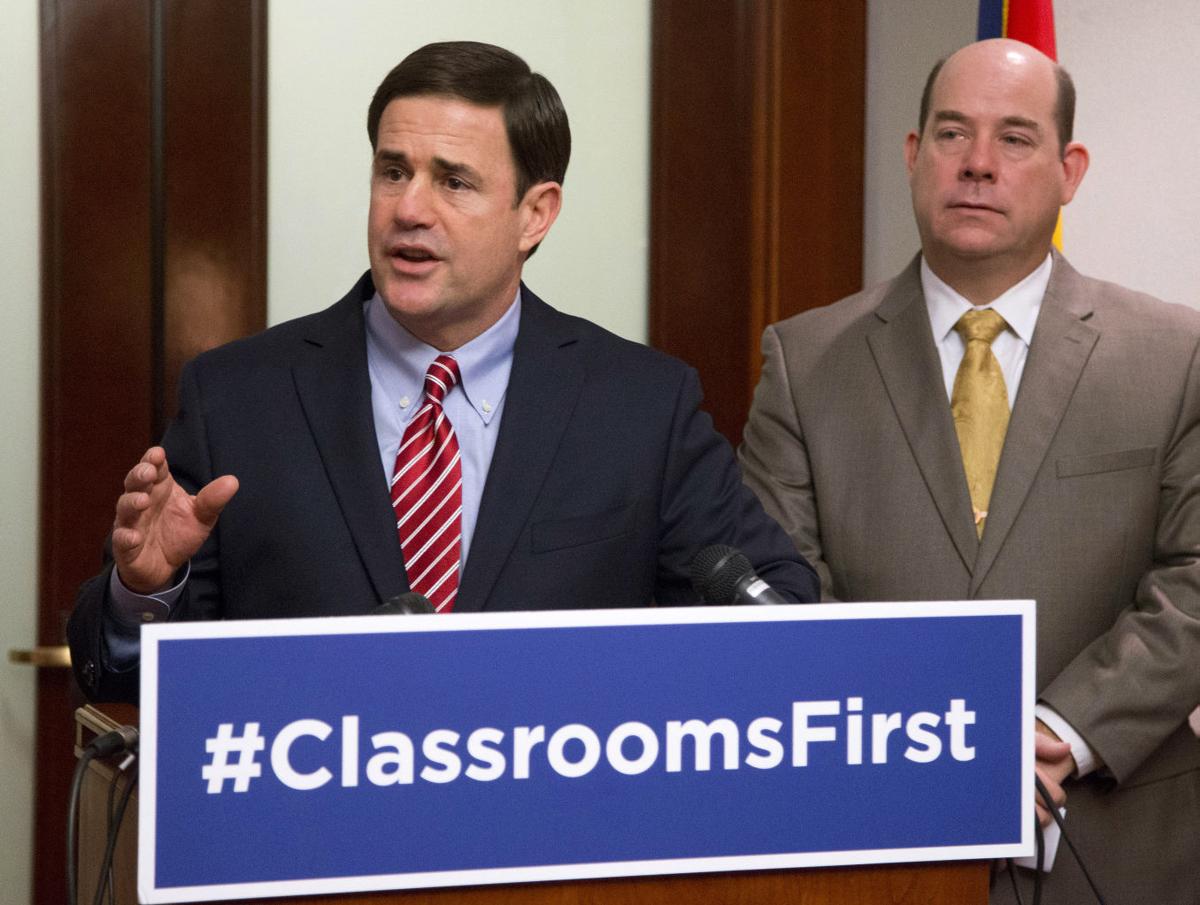
Audit: Ducey’s office misused COVID-19 relief funds

Auditors noted that the governor’s office has replaced the misspent funds


Cartoon Carousel The nation’s cartoonists on the week in politics | By POLITICO STAFF 01/23/2026 05:00 AM EST

Every week political cartoonists throughout the country and across the political spectrum apply their ink-stained skills to capture the fo...