SORRY NOT SORRY

12,517 views Mar 31, 2023 #Travel #Food #WSJ
The Fed just released its weekly commercial bank data dump showing deposit inflows/outflows.
Two things to note:
1) This is for the week up to 3/24/23 (which includes the post-SVB reaction week)
2) 'Large Banks' includes the top 25 banks (which means SVB was among that group, hence, we get no indication of SVB rotation flows, and also the $30 bn deposit transfer to FRC may impact the results)
A slowing growth in money-market fund inflows hinted at a slowing pace of deposit outflows from the US domestic commercial banking system last week (even though the last three weeks have seen MM inflows top $300bn), but that was not what we saw, with deposits (ex large time deposits) tumbling $131bn...
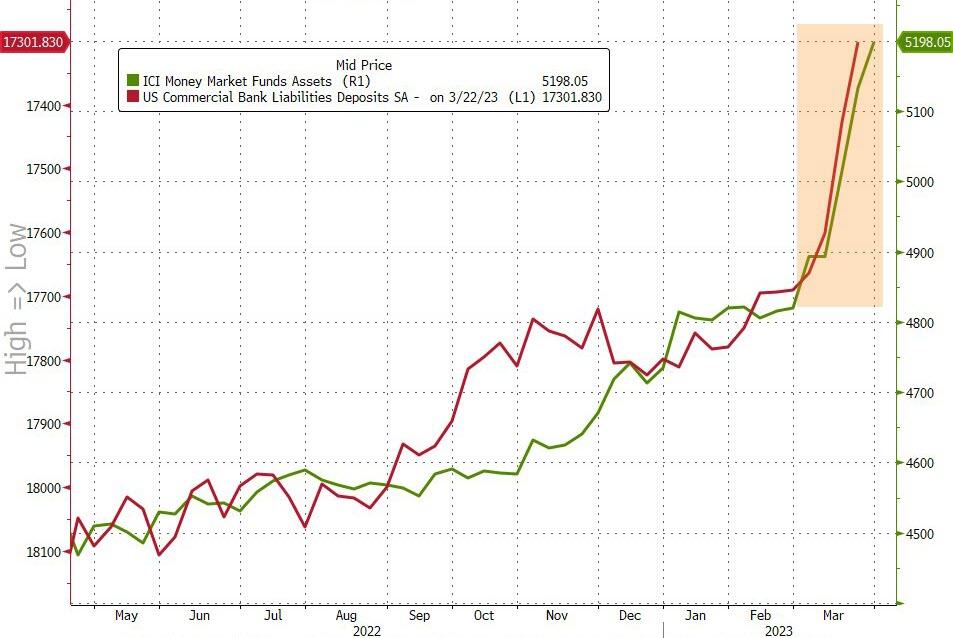
Source: Bloomberg
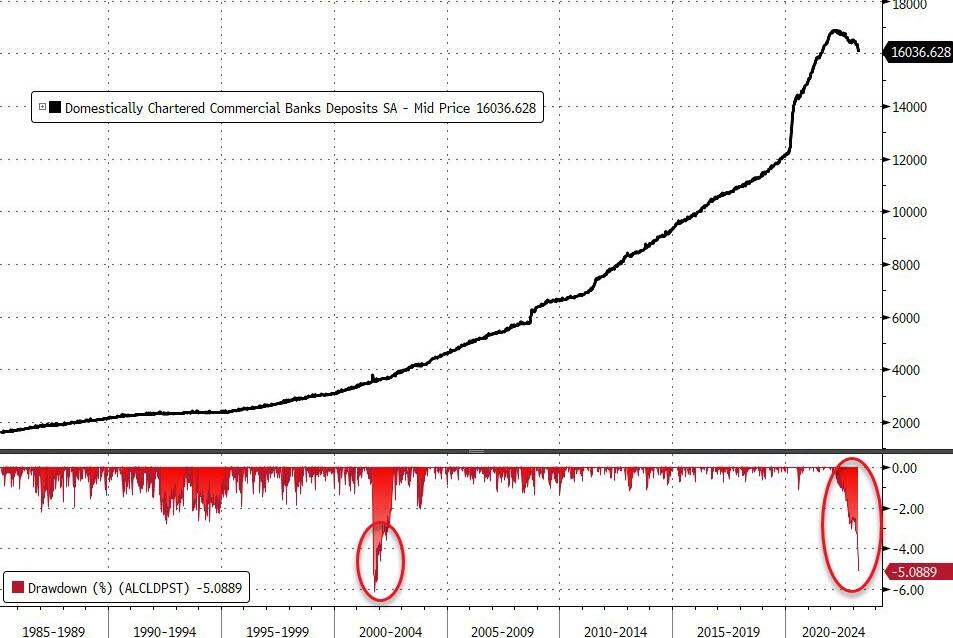
But, while many people's attention has only been drawn to the US domestic bank deposit flows recently, they have been consistently suffering outflows for a year (this data excludes 'large time deposits'). This is the 9th straight weekly decline in deposits...
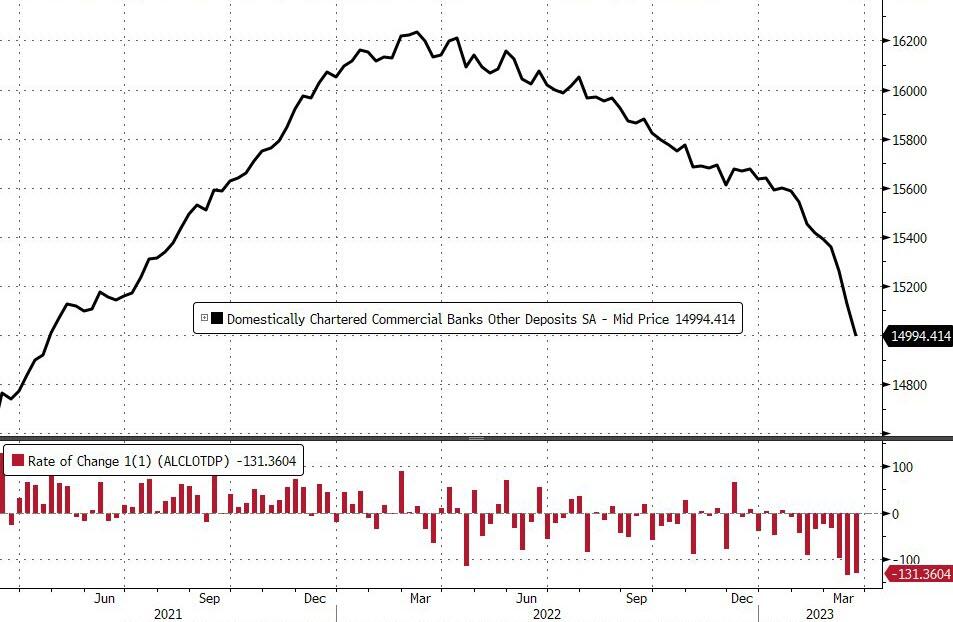
Source: Bloomberg
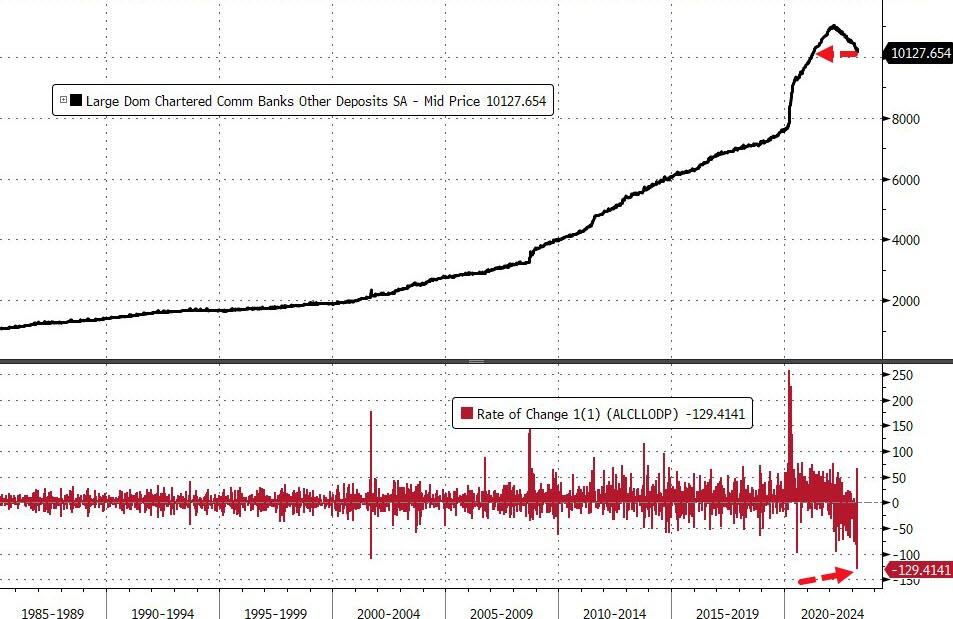
Fascinatingly, both Large and Small banks saw deposit outflows (on a seasonally-adjusted basis) with Large banks losing a huge $129bn of deposits - the biggest weekly outflow ever...
Small banks, on the hand, saw a tiny $1.948 billion outflow (on a seasonally-adjusted basis)...
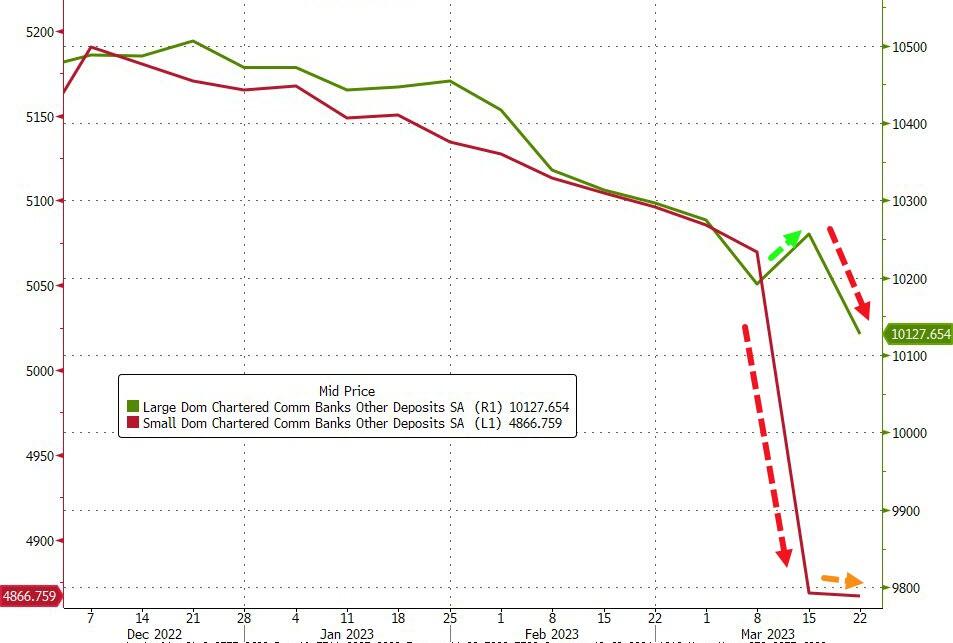
Source: Bloomberg (note different scales)
We note that the skew could be impacted by the $30bn rotation from "big banks" to FRC (a small bank)...
On a non-seasonally-adjusted basis, following the $196BN in small banks last week, we saw a $5.8BN INFLOW for small banks in the week ended March 22
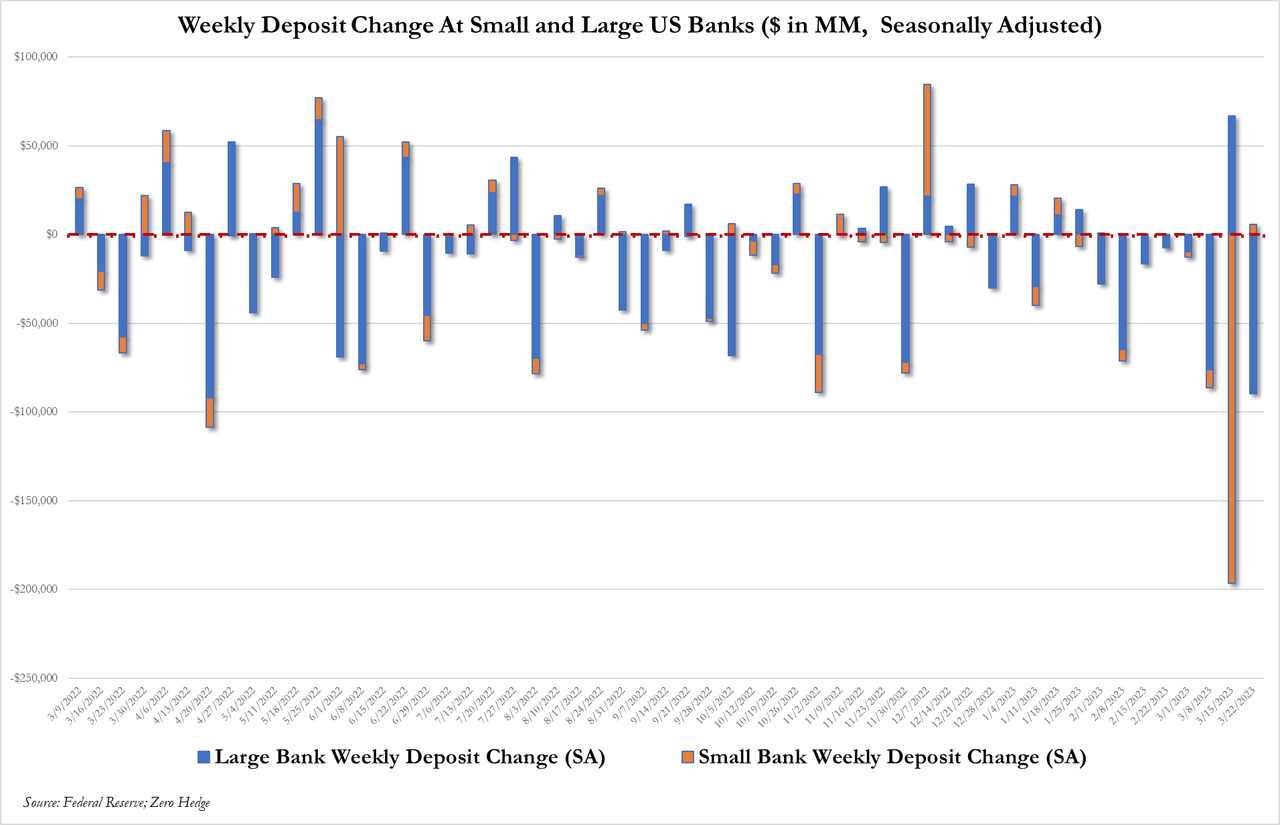
The biggest (SA) large bank deposit outflow on record takes the overall level of deposits (ex-large deposits) to its lowest since March 2021...
In fact, outside of 9/11 (where infrastructure damage and closures prompted a blockage in payments/transfers), the total 5% drawdown in US domestic commercial bank deposits is the largest in history...
Source: Bloomberg
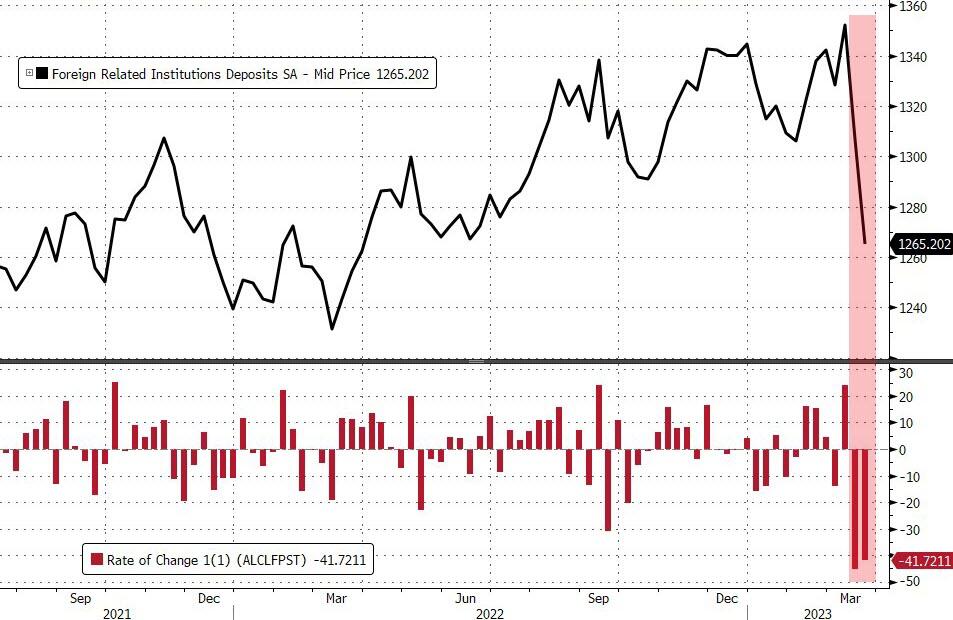
While all of the data above is for domestic US banks, we also saw foreign bank deposits plunge $41 billion last week (slightly less than the $45bn from the week prior)...
Source: Bloomberg
Bear in mind this data includes the post-SVB period, where we had US regional banks all tumbling further and Yellen offering no guaranteed deposits, FRC stock collapse amid bailouts (though that will skew the data due to that $30bn infusion), and the fear of Credit Suisse's collapse... and the ongoing gap between deposit rates and TSY yields...
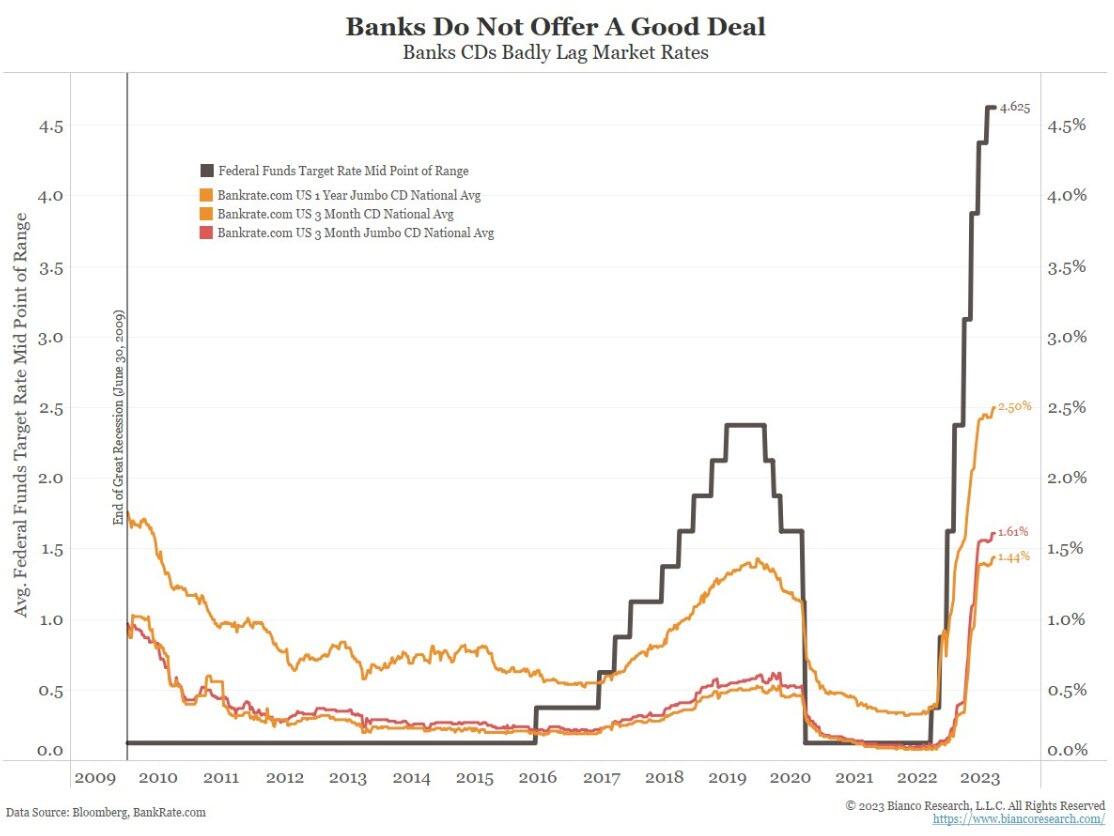
4% rates appears to have been the trigger for rotation (from deposits to MM)...
So with outflows continuing (and the spread between banks and TSY/MM fund yields), will banks start to compete for deposits? (Well not the biggest ones, for sure)...
“There are two key questions raised by the recent deposit turmoil,” Barclays Plc strategist Joseph Abate wrote in a note last week.
“How many deposits do banks ultimately lose to higher yielding money market funds? And how costly is it to replace this funding?”
Until now, when banks have lost deposits they haven’t had to compete aggressively so rates have lagged the Fed’s rate increases, and balances at government-only money fund balances had been flat since the hiking cycle began.
“But now that depositors have noticed, this dynamic is about to change,” Abate said.
And if the small ones start to 'compete' their profitability will collapse even further.
Which probably explains why regional banks just can't bounce...
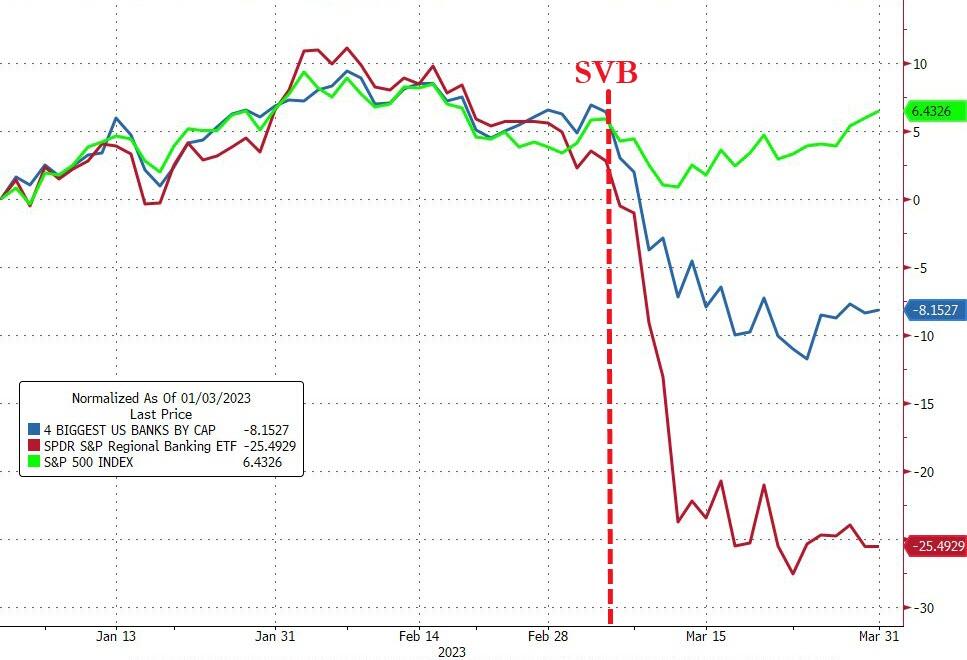
Still think this bank-run is over?
 AI-generated image of an undersea pipeline exploding. Image: Adobe
On Feb. 8, Seymour Hersh published an explosive story on his Substack, “How America Took Out the Nord Stream Pipeline,” that argued President Biden personally ordered an elaborate underwater sabotage operation in the Baltic Sea that critically damaged Nord Stream 1 and 2, the latter of which cost $11 billion and was set to double the amount of gas Russia delivered to Germany.
Hersh’s allegations went against both the official line followed by most mainstream media outlets. Although the Biden administration has long been public about its opposition to Nord Stream — indeed, destroying the pipeline was something it promised to do if Russia invaded Ukraine — the White House has since denied U.S. involvement. This is not surprising, since the action amounted to sabotage against the energy infrastructure of a close ally as winter approached.
Nearly two months after publication, mainstream outlets continue to ignore the story. Jeremy Scahill produced one of the few follow-ups in a March 10 report for the Intercept that noted:
Russia has been doing its own investigation into the sabotage, including underwater surveys. It has not, to date, released any forensic evidence to support its assertion that “Anglo-Saxon” powers or the U.S. were behind the explosions. At a U.N. Security Council meeting in February, Russia’s representative Vassily Nebenzia cited investigative journalist Seymour Hersh’s report accusing the U.S. of carrying out the attack. “This journalist is telling the truth,” he said. “This is more than just a smoking gun that detectives love in Hollywood blockbusters. It’s a basic principle of justice; everything is in your hands, and we can resolve this today.”
Denmark and Sweden have cited procedural matters and national regulations as to why they aren’t collaborating with Russia. But it’s pretty obvious that they have also adopted the position that Russia should be viewed as a suspect in the sabotage and wouldn’t want to invite it into the probe, particularly given Russia’s invasion of Ukraine. It should be noted that Sweden also refused an official joint investigation with its own allies from the onset, opting for a less formal cooperative arrangement. German officials have publicly confirmed their investigation into a “pro-Ukrainian” group and its possible connection to the attack on the pipeline, but have also cautioned that it could be a “false flag” intended to conceal the sponsor.
Russia’s recent maneuvers signal that it is becoming more aggressive in its rhetoric toward the two Scandinavian nations… It is effectively arguing that the three national probes, which are backed by the U.S., are part of the Nord Stream bombing plot, and it wants to pull the U.N. in, where Russia would find a more neutral audience than NATO or the European Union. The backdrop to all of this, of course, is the public display of Russia-China unity that’s unfolded over the past year, culminating with President Xi Jinping’s recent visit to Moscow. China, which is officially co-sponsoring the Russian resolution, has said it believes the attack was carried out by a state actor and that a U.N. investigation is needed to “uncover the truth and identify those responsible.”
The possibility of a separate U.N. investigation remains remote, however. On March 28, the U.N. Security Council rejected Russia’s call for a probe by a vote of three in favor and 12 abstentions. (Consortium News has posted video and transcripts of the meeting.)
A week before the U.N. vote, on March 22, Hersh published a follow-up to his original story on his Substack, titled “The Cover Up.” The piece began by noting that his original report had “gained traction in Germany and Western Europe, but was subject to a near media blackout in the US.” He continued,
Two weeks ago, after a visit by German Chancellor Olaf Scholz to Washington, U.S. and German intelligence agencies attempted to add to the blackout by feeding The New York Timesand the German weekly Die Zeit false cover stories to counter the report that Biden and U.S. operatives were responsible for the pipelines’ destruction.
Press aides for the White House and Central Intelligence Agency have consistently denied that America was responsible for exploding the pipelines, and those pro forma denials were more than enough for the White House press corps. There is no evidence that any reporter assigned there has yet to ask the White House press secretary whether Biden had done what any serious leader would do: formally “task” the American intelligence community to conduct a deep investigation, with all of its assets, and find out just who had done the deed in the Baltic Sea. According to a source within the intelligence community, the president has not done so, nor will he. Why not? Because he knows the answer.
Sarah Miller — an energy expert and an editor at Energy Intelligence, which publishes leading trade journals — explained to me in an interview why the pipeline story has been big news in Germany and Western Europe. “The destruction of the Nord Stream pipelines in September led to a further surge of natural gas prices that were already six or more times pre-crisis levels,” she said. “Nord Stream was blown up in late September. German gas imports peaked a month later, in October, at 10 times pre-crisis levels. Electricity prices across Europe were pulled up, and governments spent as much as 800 billion euros, by some estimates, shielding households and businesses from the impact. Gas prices, reflecting the mild winter in Europe, have now fallen back to roughly a quarter of the October peak, but they are still between two and three times pre-crisis levels and are more than three times current U.S. rates. Over the last year, German and other European manufacturers closed their most energy-intensive operations, such as fertilizer and glass production, and it’s unclear when, if ever, those plants will reopen. Europe is scrambling to get solar and wind capacity in place, but it may not come soon enough to save large chunks of German industry.”
The full version of Hersh’s Substack post is available with subscription here.
WAIT, BEFORE YOU GO…
If you're reading this, you probably already know that non-profit, independent journalism is under threat worldwide. Independent news sites are overshadowed by larger heavily funded mainstream media that inundate us with hype and noise that barely scratch the surface. We believe that our readers deserve to know the full story. Truthdig writers bravely dig beneath the headlines to give you thought-provoking, investigative reporting and analysis that tells you what’s really happening and who’s rolling up their sleeves to do something about it.
Like you, we believe a well-informed public that doesn’t have blind faith in the status quo can help change the world. Your contribution of as little as $5 monthly or $35 annually will make you a groundbreaking member and lays the foundation of our work.
SUPPORT TRUTHDIGLeading up to NSF's Starship Flight 13 launch broadcast, NSF will go live with over six hours of commentary as we stakeout Starship'...


