Monday, October 30, 2023

Bloomberg Opinion: Auto Strikes Over, Market Senses Bigger Problems Ahead


www.bloomberg.com

Auto Strikes Over, Market Senses Bigger Problems Ahead

Liam Denning
1 - 2 minutes

Detroit’s Big Three haven’t seen a relief rally because investors are focused on a rocky transition to electric vehicles.

Liam Denning is a Bloomberg Opinion columnist covering energy. A former banker, he edited the Wall Street Journal’s Heard on the Street column and wrote the Financial Times’s Lex column

Auto Strikes Over, Market Senses Bigger Problems Ahead

byBQPrime|Today at 10:37 AM

Detroit's Big Three haven’t seen a relief rally because investors are focused on a rocky transition to electric vehicles.

Ford's estimated impact on margins of about 60-70 basis points isn't too different from what analysts had expected.

Ford plunged 12% Friday to its lowest level since early 2021.

GM withdrew full-year guidance due to the impact of strikes.

Ford report losing north of $1 billion on issues with product quality.

GM's autonomous driving unit losing its license in America’s de facto capital of autonomous driving.

Both companies attempting to talk up future EV prospects amid the weaknesses of the present reality.

To cap it all, they've reenacted that most venerable of Detroit scenes: caving to the UAW.


As much as Shawn Fain has been the scourge of the Big Three automakers, he was also thereby supposed to offer perverse grounds for optimism. The resolution of the United Auto Workers’ strikes was expected to result in a relief rally for Ford Motor Co., General Motors Co. and Stellantis NV. So much for that.

Ford, which announced a deal with the union last Wednesday, plunged 12% Friday to its lowest level since early 2021. Stellantis followed with its own tentative agreement this weekend and GM did on Monday morning. Investors shrugged.

RELATED 

Stocks could break out of their 'doom loop' this week amid a flurry of catalysts in the bond market and the economy, Fundstrat says

Jennifer Sor
4 - 6 minutes


  • A slew of policy updates and economic data points could help stocks move higher. 
  • A key bond market update is more important than the Fed meeting, Fundstrat's Tom Lee said. 

The stock market could break out of its decline this week, thanks to a series of developments with the potential to move markets, according to Fundstrat's head of research Tom Lee.

Lee, among the most bullish forecasters on Wall Street, said that stocks could finally start ticking higher this week after several months of turbulence, with investors waiting on key policy updates. 

"I think  there is enough incoming data this week along with the negative positioning for stocks to finally break this doom loop," Lee said in a note to Fundstrat clients on Monday.

Markets are expecting key economic data points, such jobs data, manufacturing data, and services data this week. Those datapoints are likely to point to some softening in the economy. Weaker economic data would be good news for investors, as Fed officials have been looking for signs the economy is cooling before committing to ending their campaign of interest rate hikes. 

Investors are now pricing in a 95% chance that the Fed will choose to keep interest rates unchanged on Wednesday, per the CME FedWatch tool. A likely pause this week by the Fed would provide a boost to equities, Lee said.

But there's one particularly catalyst for stocks that's even more important than the Fed's update.

That's the US Treasury quarterly refunding announcement due Wednesday. The update, due shortly before the Fed announces its policy move, will provide a window into the Department's plans for issuance of short and long-term Treasury bonds. According to Reuters, experts say that the Treasury could increase supply of shorter-term bills while pulling back on issuance of longer-dated securities out of concerns over the impact it could have on yields. 

Near-5% Treasury yields have caused panic in the stock market and has helped drive a fresh increase in borrowing costs for consumers and companies. 

"This is a 'supply' event for bonds and as we know, interest rates have been rising. So how the Treasury announces its upcoming mix of bonds, this will be market moving," Lee added.

Other market commentators have been cautioning investors as interest rates look poised to stay higher-for-longer and a potential recession looms over the economy. Markets are currently flashing three warning signs that the economy is beginning to slow, according to Societe Generale, which puts stocks at more risk of downside.

The Verge: A New Theory From the cloud to your computer

This episode of The Vergecast, the fourth and final in our series about connectivity, became about something else. Self-hosting is a nice idea and a totally impractical reality for most people; signing into cloud services and downloading apps is just so much easier to do! 

www.theverge.com

From the cloud to your computer: a new theory of how software works

2 - 3 minutes

For a while, I really thought I could be a self-hoster. After months of talking to people about platforms and security and what it means that we really don’t own any of the data and apps we use every day, my big plan was to buy a mini PC and run my life off my own device.

A lot of Docker experimentation later, I pretty much gave up. (As one person put it to me, if you ever find yourself typing in an IP address and port number, you’ve officially exited the realm of “things most people will ever do.”) And so this episode of The Vergecast, the fourth and final in our series about connectivity, became about something else. Self-hosting is a nice idea and a totally impractical reality for most people; signing into cloud services and downloading apps is just so much easier to do!

But there are plenty of people out there who think we don’t have to choose. They think it’s possible to build software that both belongs to us and works across all our devices, that is collaborative and user-friendly and has an offline mode. They even have a term for this — local-first software — and point to apps like Obsidian as proof that it can work.

After that, we get to one more idea about software: that the solution isn’t to change the way we acquire and access software but rather to change the things we can do to that software. In his book The Internet Con, activist and author Cory Doctorow argues that interoperability might be the solution to most of our tech woes. Interop could turn the internet from a series of walled gardens into a teeming forest of interconnected services that are only as successful as they are good. But that requires some legal changes and some big new ideas about how we build and use software.

Software has connected us and connected everything. So how do we connect to our software? That’s the question of this episode. The answer doesn’t quite look like Plex servers and NAS systems, but it might be the next best thing.

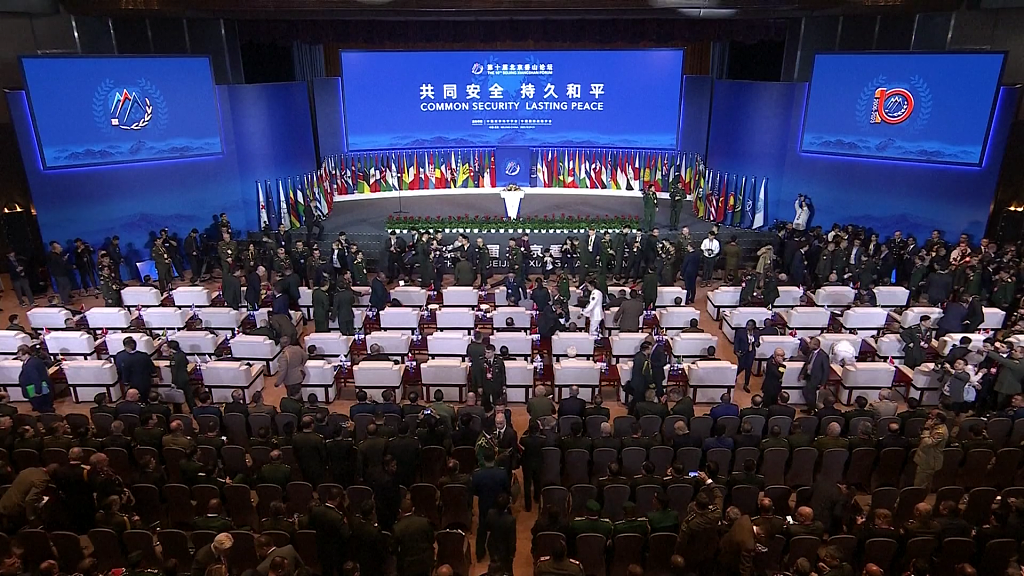
At Xiangshan Security Forum in Beijing, China and Russia take aim at US

A top Chinese military official on Monday slammed certain countries for "deliberately creating turmoil", opening an international defence conference in Beijing with a thinly-veiled swipe at the United States.

Top China Military Official Slams Countries 'Creating Turmoil'


. . .Beijing says representatives of 90 countries are taking part in this week's Xiangshan Forum, a gathering of military and diplomatic officials billed as its answer to the annual Shangri-La Dialogue in Singapore.
_____________________________________________________________________
10th Beijing Xiangshan Forum Opens - YouTube
Uploaded: Oct 29, 2023
409 Views
The 10th Beijing Xiangshan Forum opens on Sunday, with defense and military officials from more than 90 countries, regions and international organizations attending., ...
___________________________________________________________________________
  • Russian Defence Minister Sergei Shoigu is also attending.
  • China is holding the forum without a sitting defense chief, having abruptly announced the sacking of minister Li Shangfu last week without explanation.
Zhang Youxia, one of China's most senior military officials, did not name the nations "creating turmoil" in his address, but Beijing has kept up a steady drumbeat of criticism of the United States for its positions on Russia's invasion of Ukraine and the Israel-Hamas conflict.
  • "As we look across the world today, hotspot issues are arising one after another. The pain of war, chaos and turmoil, and loss of life are constantly playing out," Zhang said. 
  • "However, some countries, for fear that the world may stabilize, deliberately create turmoil, interfere in regional issues, interfere in other countries' internal affairs, and instigate color revolutions," he said.
  • "For the sake of their own selfish interests, they bury nails everywhere. They create many artificial geopolitical conflicts, then preach impartiality while actually favoring one side, making regional situations complex and intractable," he added.
  • "Behind the scenes, they hand out knives and think nothing of provoking people into wars, ensuring that they're the ones who benefit from the chaos."
Speaking after Zhang, Russia's Shoigu also warned that Washington was seeking to provoke instability in Asia.
  • "Having provoked an acute crisis in Europe, the West is trying to expand the crisis potential in the Asia Pacific," he told delegates.
  • "Direct involvement of countries with nuclear arsenals multiplies the strategic risks," he said.
  • "The West's line towards escalation with Russia poses a risk of direct conflict between nuclear powers, which will result in catastrophic consequences," Shoigu added.
China has refused to condemn Russia's invasion of Ukraine and has deepened economic, diplomatic and military cooperation with Moscow since the start of the war. 
RELATED 

Cartoon Carousel The nation’s cartoonists on the week in politics | By POLITICO STAFF 01/23/2026 05:00 AM EST

Every week political cartoonists throughout the country and across the political spectrum apply their ink-stained skills to capture the fo...