Sunday, April 26, 2026

The Co-Intelligence Revolution’s Substack

Launched a year ago
Venkat Ramaswamy and Krishnan Narayanan paint a bold vision of humans and AI working in creative synergy to transform how we live, work, and learn. 
Welcome to the Co-Intelligence Revolution! 
In short:
The next generation of DPIs must be designed to help society learn better together with AI systems.
And in doing so, we can enable societies to sense, respond, and co-evolve together—through intelligence that is co-created, responsibly governed, and aligned toward shared futures of meaningful life-eXperiences.
 

 https://substackcdn.com/image/fetch/$s_!8auJ!,w_1456,c_limit,f_webp,q_auto:good,fl_progressive:steep/https%3A%2F%2Fsubstack-post-media.s3.amazonaws.com%2Fpublic%2Fimages%2F14ba2614-e0d9-4e9e-ae7e-2c476757bd72_2752x1536.png

COIN #185. Toward Co-DPIs for Co-Innovating Social Change — from Learning Loops to Living Infrastructures

Apurva.ai as powering co-intelligent systems where learning circulates and impact scales

Venkat Ramaswamy

In COIN #184, we reflected on the deeply human and philosophical foundations of co-intelligent education. That conversation reminded us that intelligence is not something we possess, but something that emerges—through awareness, interaction, and shared becoming.

Here, we delve deeper into a complementary frontier:

What might it mean to build a Digital Public Infrastructure (DPI) that is fundamentally co-intelligent?


From Digital to Co-Intelligent Infrastructure

Across the world—especially in India—we are witnessing the rise of Digital Public Infrastructure (DPI) entailing identity layers to payment rails to data exchanges. These systems have unlocked scale, inclusion, and coordination at population scale in unprecedented ways.

And this is where the idea of a COIN-DPI emerges.

In Co-Creating the Future with AI (co-authored with Kerimcan Ozcan and Krishnan Narayanan; Palgrave 2026), we advance a simple but profound shift:

Value is produced through Tokenized Dynamic Intelligences (TDIs)—co-creatively generated through interactions and circulating through risk-governed learning loops that drive Sustainable Wellbeing Impacts (SWIs).

As Jagadish Babu, COO at EkStep, reflects:

“The opportunity this book surfaces is not merely technological, but civilizational: a renewed possibility for society to come together—to co-create, steward, and align intelligence toward shared wellbeing and futures we actively choose.”

This is precisely what a COIN-DPI enables.

A COIN-DPI is not a platform. Not an app. Not even a system in the traditional sense.

It is a living architecture of co-intelligence, where:

  • Every interaction generates intelligence

  • Every insight flows across contexts

  • Every action feeds back into learning

  • Every ecosystem evolves toward shared wellbeing


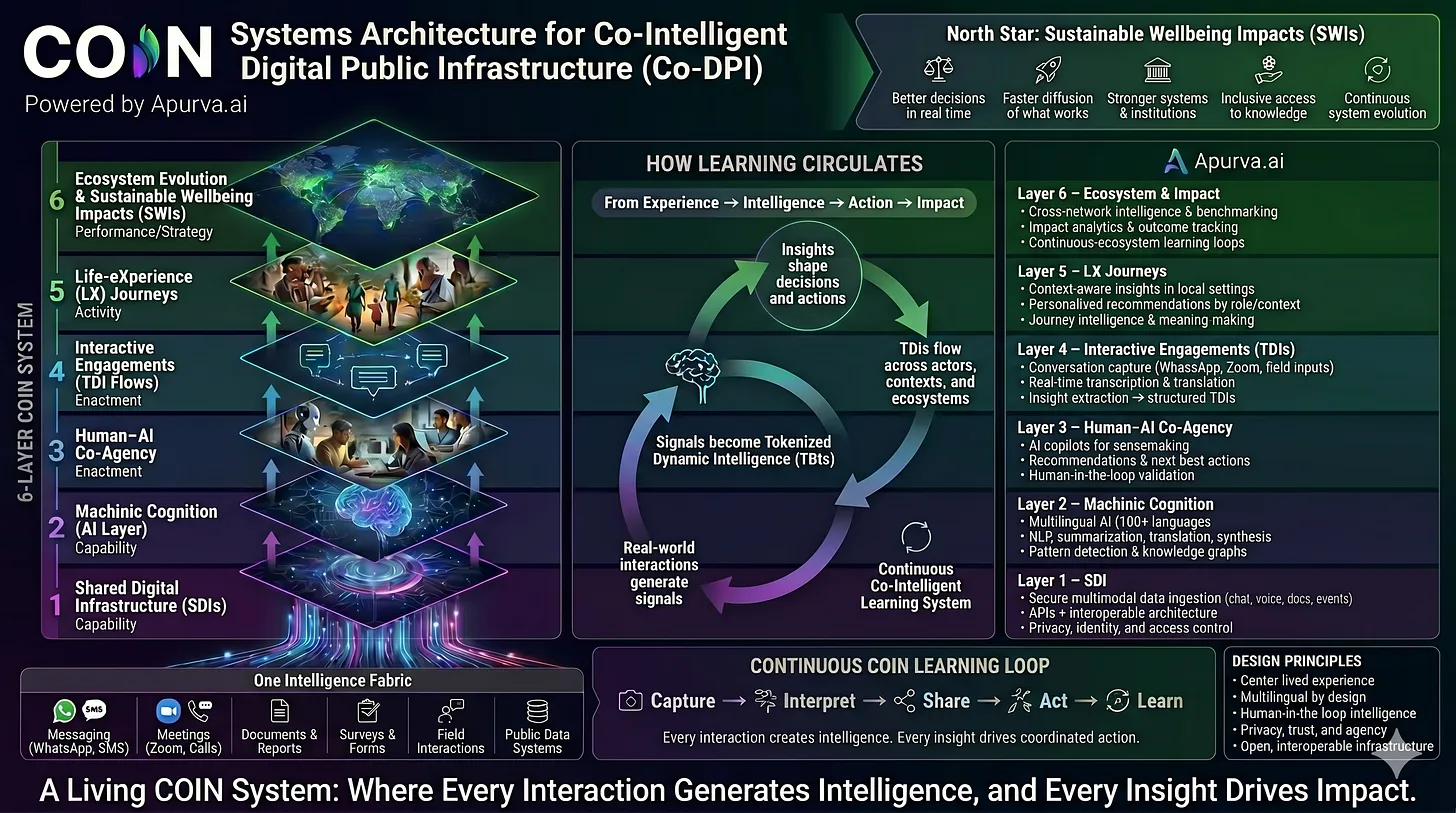
The Six-Layer COIN Architecture as Public Infrastructure

From the perspective of public infrastructure for social change, a COIN Systems architecture entails :

Layer 1 — Shared Digital Infrastructure (SDIs)

Open, secure, interoperable foundations (identity, data, communication, access)

Layer 2 — Machinic Cognition

AI systems that translate, synthesize, and connect intelligence across languages, formats, and contexts

Layer 3 — Human–AI Co-Agency

Not automation—but partnership
Humans interpret, validate, and decide; AI augments, surfaces, and connects

Layer 4 — Interactive Engagements (TDI Flows)

Conversations → Signals → Tokenized Dynamic Intelligence (TDIs)
Not static data—but relations-in-motion

Layer 5 — Life-eXperience (LX) Journeys

Intelligence returns to context—where decisions are made, meaning is created, and action unfolds

Layer 6 — Ecosystem Evolution & SWIs

At scale, these flows enable:

  • Faster diffusion of what works

  • Better decisions in real time

  • Stronger institutions

  • Inclusive access to knowledge

  • Continuous system evolution


U.S. States by Poverty Rates...Color them blue for Infographic

The Supplemental Poverty Measure (SPM) is a comprehensive metric released annually by the U.S. Census Bureau that measures poverty by accounting for noncash government benefits (e.g., SNAP, housing assistance), taxes, and necessary expenses like medical costs. It provides a more accurate, context-aware picture of economic deprivation than the official poverty measure by adjusting for geographic cost-of-living differences and including modern, non-monetary, and tax-based resources.

https://scontent-phx1-1.xx.fbcdn.net/v/t39.30808-6/678535502_1529505275457698_257076046600206310_n.jpg?stp=dst-jpg_s640x640_tt6&_nc_cat=111&ccb=1-7&_nc_sid=13d280&_nc_ohc=8YTca12-ZesQ7kNvwEGdW08&_nc_oc=AdpX7T56hErcAxKIpBf4e-nm5zp8v2TyS5lWi1Ul8FP_AH00IM-RL6-PAcfIvmdaduc&_nc_zt=23&_nc_ht=scontent-phx1-1.xx&_nc_gid=284H1zgC6YD8koNmo23efQ&_nc_ss=7b2a8&oh=00_Af1WunOTwlmTTZ19n1HXzX-ZUZVk2MjkK8_Z4nkL_bqP7g&oe=69F41057

Hush Hush | (from JC Inglesman Phillips April 14, 2026)


Robert Reich: Collective Evolution

https://encrypted-tbn0.gstatic.com/images?q=tbn:ANd9GcSHjt0JzrE_0_024i8oVN5_RlLGX1dfR9s9Tg&s 

"I’m tempted to give Elon Musk the title of world's worst neo robber baron. But when it comes to greedy and irresponsible corporate behavior, one CEO is outdoing even Musk.

"When the history of this sordid second Gilded Age is written, the list of neo robber barons will obviously include Musk as well as 
  • Meta’s (Facebook’s) Mark Zuckerberg, 
  • Palantir’s Alex Karp, 
  • Palantir’s co-founder and board chair Peter Thiel, 
  • Oracle’s Larry Ellison (and his son, David), 
  • Google’s Sundar Pichai, 
  • Blackstone’s Stephen Schwarzman, and the 
  • Trump Organization’s monumentally corrupt Donald Trump, Donald Trump Jr., and Eric Trump.
 
But one greedy, public-be-damned CEO stands out even above Musk, Trump, and the rest. His name: Jeff Bezos. His corporation: Amazon.
It is difficult for the human mind to comprehend all the ways Bezos is shafting Americans.


Start with prices. According to a newly unsealed filing released Monday in an antitrust lawsuit brought by California Attorney General Rob Bonta, Amazon has pressured major brands like Levi’s and Hanes to demand that competing retailers raise prices on their products.
The New York Times’s David McCabe reports on unsealed evidence that Amazon punishes sellers on its marketplace for offering lower prices on other websites, like those of Walmart or Target. 
When it spots a competitor’s lower price, Amazon tells the brands to demand that rival sites raise their prices for the products.
The filing includes an email to Hanes from Amazon, with links to Target’s and Walmart’s lower prices, along with Hanes’s apologetic response that it “reached out to Target and Walmart to have the prices increased.” And an email to Levi’s from Amazon, with links to lower-priced khakis on Walmart’s website, along with Levi’s response that Walmart had agreed to raise its price.
According to the lawsuit, Amazon has been able to exert pressure on different brands to raise their prices because of Amazon’s power and reach.

At a time when most Americans are having trouble making ends meet, Amazon’s push to raise prices — to enlarge its profits (and put more money into Jeff Bezos’s pockets) — is beyond unconscionable.

> This is hardly Bezos’s and Amazon’s first brush with antitrust law. In 2023, the Federal Trade Commission and 17 states accused Amazon of illegally maintaining a monopoly in online retail by squeezing merchants who sell on its site and prioritizing its own products, resulting in “artificially higher prices.”

In September, the FTC agreed to settle another lawsuit against Amazon that accused it of making it difficult for consumers to cancel its Prime subscription service. 
  • Amazon agreed to pay up to $2.5 billion — including $1 billion in penalties and additional payouts to consumers — but didn’t admit or deny wrongdoing.
> Meanwhile, The American Prospect’s Harold Meyerson reports that Virginia is subsidizing Amazon’s “second headquarters” in Crystal City, Virginia — just across the Potomac from Washington, D.C. — with $750 million in taxpayer funds, yet the corporation is wildly behind its job-creation pledge
  • Having promised to create 25,000 new jobs by 2038, it created a mere 1,600 jobs last year and is up to just 29 percent of the number of jobs it promised by now.
Speaking of Amazon jobs: Until earlier this month, attorneys for the National Labor Relations Board were prosecuting Amazon for firing employees that make Amazon deliveries because they’d voted to join the Teamsters, a clear violation of labor laws.
But then, a few weeks ago, the NLRB attorneys — now firmly under control of Trump’s NLRB general counsel — announced they’d reached a “settlement” with Amazon in which Amazon agreed to pay the workers who’d been laid off for more than two years, two weeks’ worth of wages. Two weeks.

Amazon’s workers are among the worst-treated in America.
  • Ryan Haas of The Western Edge reports that on April 6, an Amazon warehouse worker collapsed and died on the floor of Amazon’s warehouse in Troutdale, Oregon. 
  • A co-worker trained in CPR tried to help but was told by a manager to turn around. 
  • For more than an hour, employees said, they were instructed to continue picking items and loading trucks as the man lay dead. 
  • One manager reportedly told workers to “just turn around and not look” and get back to work.
Jeff Bezos couldn’t care less. As of April 2026, his net worth is estimated to be between $259 billion and $269 billion, making him one of the three richest people in the world.

Like the robber barons of the first Gilded Age, Bezos’s consumption is of the conspicuous kind. 
  • He celebrated his wedding last year to Lauren Sánchez with a multi-day star-studded event in Venice, Italy, estimated to cost more than $50 million, featuring guests like Oprah Winfrey and Kim Kardashian, and including a ceremony on the island of San Giorgio Maggiore and a pajama-themed afterparty at the Arsenal.
His “homes” include 
  • three adjacent properties on Indian Creek Island in Florida, costing over $230 million; 
  • the former Warner estate in Beverly Hills, California, which features a 13,600-square-foot mansion and a golf course, which he purchased for $165 million; 
  • a 14-acre compound on Maui with a 4,500-square-foot main house and 700-square-foot pool; 
  • a $23 million mansion in Washington, D.C.; and 
  • a massive multi-lot compound with waterfront frontage in Medina, Washington.


But what puts Bezos at the head of all the other robber barons in this second Gilded Age is his slavish sycophancy toward the worst president in American history.

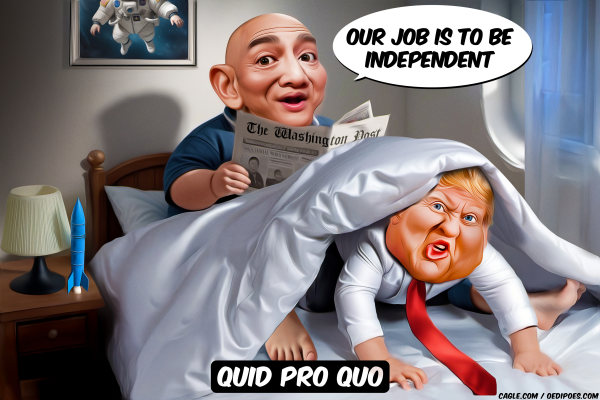
Bezos bought the legendary Washington Post for $250 million in October 2013 and has turned it into a Trump cheerleader — prohibiting its editorial page from endorsing Kamala Harris in 2024 and barring it from writing anything critical about American capitalism or Trump. 
  • (That’s not all Bezos has done to ruin the Post. In February, he fired more than 300 Post journalists, about a third of its staff.)
  •  Then he shamelessly paid $40 million to license the documentary “Melania” plus $35 million to market it — and earned back a tiny percentage. It was a blatant bribe of Trump.
  •  And he does whatever Trump asks. After Trump complained to Bezos about a report that Amazon planned to display for consumers the costs of Trump’s tariffs, Bezos immediately canceled the plan.
Bezos has sucked up to Trump presumably to secure Pentagon contracts for his Blue Origin rocket company, which landed a $2.3 billion NASA contract early in Trump's second term. And to avoid further antitrust lawsuits or labor law scrutiny.

That he has zero scruples does not necessarily distinguish Bezos from the other robber barons of this despicable era.
But his public-be-damned business practices, his especially conspicuous consumption, and his excessive sucking up to Trump make Jeff Bezos the worst CEO of them all.


What can you do? You might share this post and boycott Amazon.
By Robert Reich, see comments for link to article.

The trickle-down hoax on full display.

 https://encrypted-tbn0.gstatic.com/images?q=tbn:ANd9GcTxRoMiyr6VKyUl3JoULqe-UUZEgM_4wZykRA&s 

 https://image.caglecartoons.com/289816/600/jeff-bezos-reading-newspaper-in-bed.png

FT Exclusive: Jeff Bezos is close to a $10bn fundraising deal from  investors at a $38bn valuation for his lab, which is focused on AI that can  understand the physical world and


New York Times: Old People Suck and We Should Take Their Stuff | MATT TAIBBI


It is what it is. . .

 https://scontent-phx1-1.xx.fbcdn.net/v/t39.30808-6/682104355_1278275577824690_7192962308272788523_n.jpg?stp=dst-jpg_s590x590_tt6&_nc_cat=111&ccb=1-7&_nc_sid=13d280&_nc_ohc=Bk3pHeGjTrYQ7kNvwHq3EVB&_nc_oc=AdpNS2lnBwJYMwmBlYckytYhla_2jqGFnhpudmKIqJFu6XJlY3YidCq56oWze7qFqqo&_nc_zt=23&_nc_ht=scontent-phx1-1.xx&_nc_gid=Gku52R6LMTrZiLYjA9vjiA&_nc_ss=7b2a8&oh=00_Af2PDK1_xCigS6jmRp2497rM8dHDBjbhekUri3l8wz2IdA&oe=69F3DAE1

HILTON ROOM 10235 ---The Daily Beast’s Executive Editor witnessed a jaw-dropping security breach


"The Technological Republic: Hard Power, Soft Belief, and the Future of the West" | Book by Alex Karp and Nicholas W.Zamiska

Karp’s manifesto-via-tweet asserts primarily that we can achieve peace through war, and that billionaires brandishing “grand narratives” i...