COIN #185. Toward Co-DPIs for Co-Innovating Social Change — from Learning Loops to Living Infrastructures
Apurva.ai as powering co-intelligent systems where learning circulates and impact scales
Venkat Ramaswamy
In COIN #184, we reflected on the deeply human and philosophical foundations of co-intelligent education. That conversation reminded us that intelligence is not something we possess, but something that emerges—through awareness, interaction, and shared becoming.
Here, we delve deeper into a complementary frontier:
What might it mean to build a Digital Public Infrastructure (DPI) that is fundamentally co-intelligent?
From Digital to Co-Intelligent Infrastructure
Across the world—especially in India—we are witnessing the rise of Digital Public Infrastructure (DPI) entailing identity layers to payment rails to data exchanges. These systems have unlocked scale, inclusion, and coordination at population scale in unprecedented ways.
And this is where the idea of a COIN-DPI emerges.
In Co-Creating the Future with AI (co-authored with Kerimcan Ozcan and Krishnan Narayanan; Palgrave 2026), we advance a simple but profound shift:
Value is produced through Tokenized Dynamic Intelligences (TDIs)—co-creatively generated through interactions and circulating through risk-governed learning loops that drive Sustainable Wellbeing Impacts (SWIs).
As Jagadish Babu, COO at EkStep, reflects:
“The opportunity this book surfaces is not merely technological, but civilizational: a renewed possibility for society to come together—to co-create, steward, and align intelligence toward shared wellbeing and futures we actively choose.”
This is precisely what a COIN-DPI enables.
A COIN-DPI is not a platform. Not an app. Not even a system in the traditional sense.
It is a living architecture of co-intelligence, where:
Every interaction generates intelligence
Every insight flows across contexts
Every action feeds back into learning
Every ecosystem evolves toward shared wellbeing
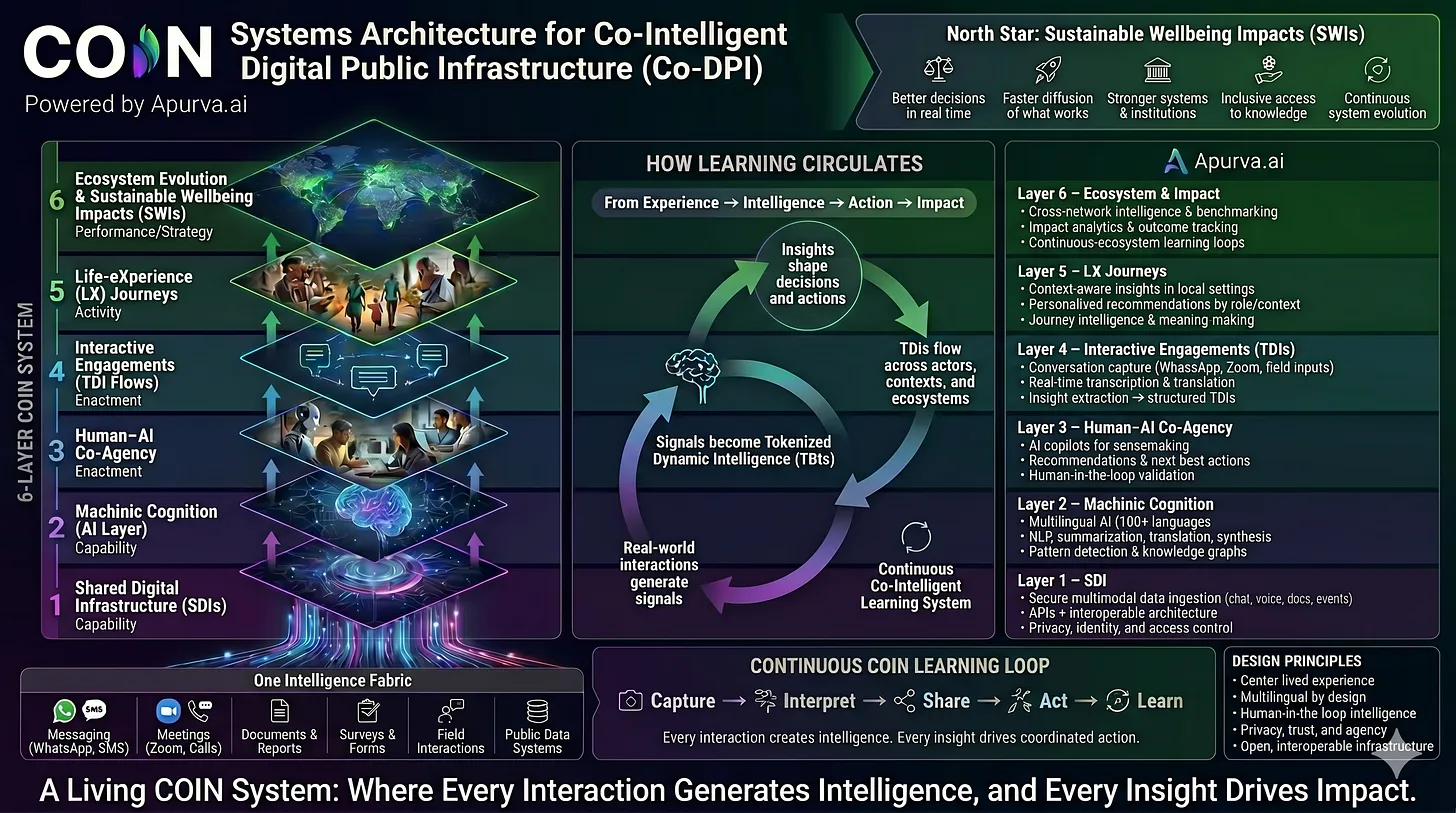
The Six-Layer COIN Architecture as Public Infrastructure
From the perspective of public infrastructure for social change, a COIN Systems architecture entails :
Layer 1 — Shared Digital Infrastructure (SDIs)
Open, secure, interoperable foundations (identity, data, communication, access)
Layer 2 — Machinic Cognition
AI systems that translate, synthesize, and connect intelligence across languages, formats, and contexts
Layer 3 — Human–AI Co-Agency
Not automation—but partnership
Humans interpret, validate, and decide; AI augments, surfaces, and connects
Layer 4 — Interactive Engagements (TDI Flows)
Conversations → Signals → Tokenized Dynamic Intelligence (TDIs)
Not static data—but relations-in-motion
Layer 5 — Life-eXperience (LX) Journeys
Intelligence returns to context—where decisions are made, meaning is created, and action unfolds
Layer 6 — Ecosystem Evolution & SWIs
At scale, these flows enable:
Faster diffusion of what works
Better decisions in real time
Stronger institutions
Inclusive access to knowledge
Continuous system evolution


No comments:
Post a Comment