
Hélène de Lauzun
— July 14, 2025
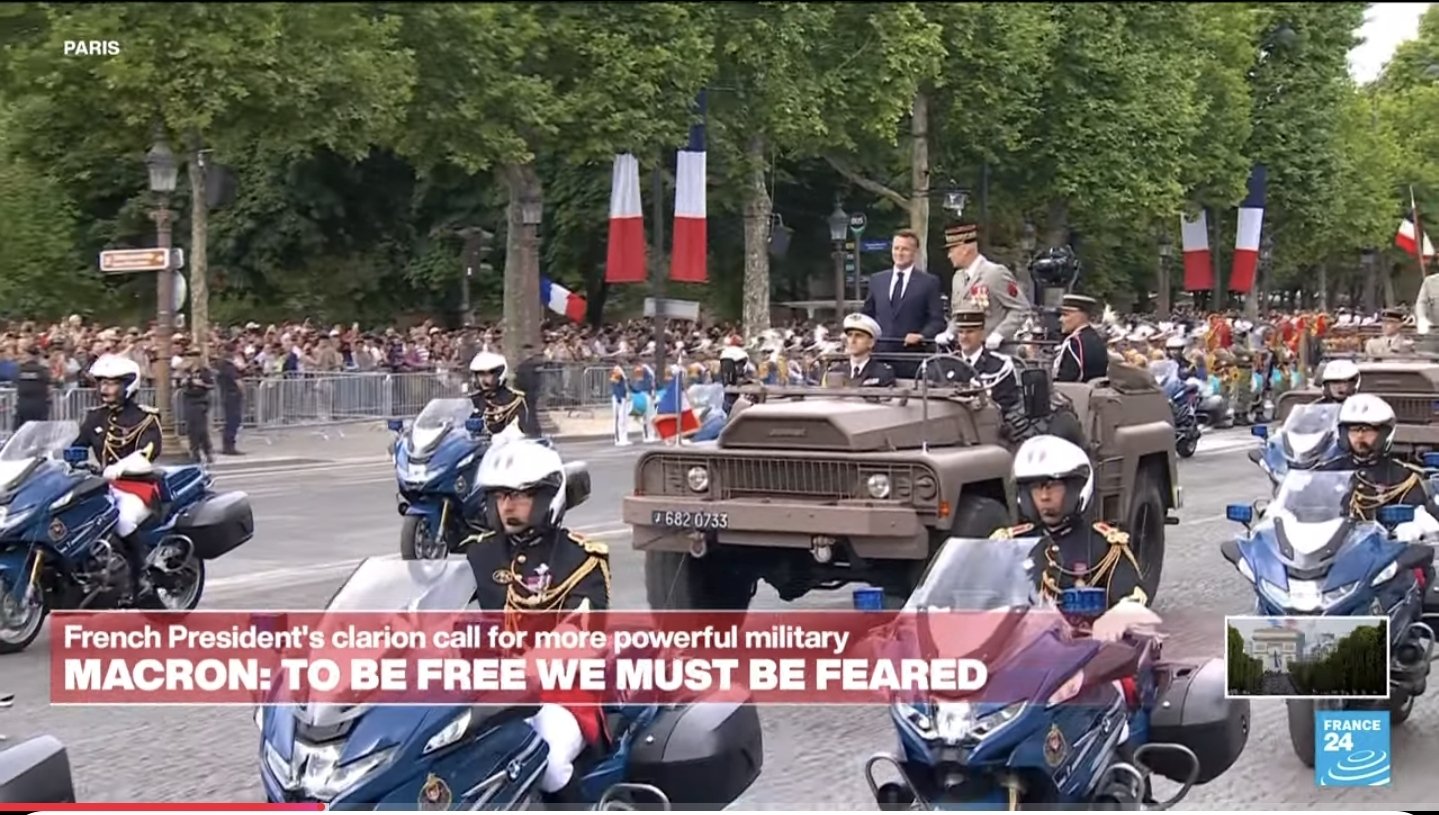
Every year, the national holiday on July 14th is an opportunity for France to remember that it has an army and that it can take legitimate pride in it. Every year, during the parade on the Champs-Elysées, the President of the Republic takes centre stage as commander-in-chief of the armed forces and sets out the strategic guidelines for France’s defence policy.
This year, Emmanuel Macron chose to adopt a serious and alarmist tone for this customary exercise, announcing a substantial increase in the defence budget to respond to a “Russian threat” that he said was specifically targeting France.
The tone was set by an unusual press conference held by French chief of staff Thierry Burkhard on Friday, July 11th—the first such event since 2021. The aim of this statement, ordered by the President while he was on a state visit to England, was to prepare the ground for his own speech, scheduled to take place two days later, on the eve of the traditional armed forces parade.
- According to him, Russia has identified France as “its main adversary in Europe,” citing in particular the submarine offensive carried out by Russia against French ships in the North Atlantic and as far as the Mediterranean.
- In this context, the planned defence budget—€400 billion by 2030, according to the terms of the military programming law passed in 2023, which doubled the budget between 2017 and 2023—is already insufficient and must be supplemented by new investments.
On the evening of Sunday, July 13th, Emmanuel Macron therefore presented his roadmap to the armed forces, to clarify the general guidelines presented by his chief of staff.
- “To be free in this world, we must be feared. To be feared, we must be powerful,” summarized the president of the republic, echoing the advice of Donald Trump:
- “Let’s be clear: we Europeans must now ensure our own security.”
- The action programme of this coalition and the resources it will have at its disposal remain very vague.
Macron could not resist resorting to a certain grandiloquence to highlight the importance of the issues at stake, explaining that France intended to remain “free” in a world that had not been this dangerous since 1945.
- Quick to resort to exaggeration in order to highlight his role as saviour, the French president seems to have forgotten the dark hours of the Cold War when claiming today is the most challenging time France has faced since the end of WWII.




No comments:
Post a Comment