Friday, June 10, 2016

SOLAR MINIMUM/CERN/MINI ICE AGE/TAMBORA/5.2 Quake CA.

Published on Jun 10, 2016
5.2 EARTHQUAKE, SOUTHERN CA. CERN UPDATE. MINI ICE AGE AND THE YEAR WITHOUT A SUMMER, 5.2 EARTHQUAKE, SOUTHERN CA. CERN UPDATE. MINI ICE AGE AND THE YEAR WITHOUT A SUMMER, The year 1816 is known as the Year Without a Summer (also the Poverty Year, the Summer that Never Was, Year There Was No Summer, and Eighteen Hundred and Froze to Death, because of severe climate abnormalities that caused average global temperatures to decrease by 0.4–0.7 °C (0.7–1.3 °F). This resulted in major food shortages across the Northern Hemisphere.
Evidence suggests that the anomaly was predominantly a volcanic winter event caused by the massive 1815 eruption of Mount Tambora in the Dutch East Indies, the largest eruption in at least 1,300 years after the extreme weather events of 535–536. The Earth had already been in a centuries-long period of global cooling that started in the 14th century. Known today as the Little Ice Age, it had already caused considerable agricultural distress in Europe. The Little Ice Age's existing cooling was aggravated by the eruption of Tambora, which occurred during its concluding decades.
http://www.BPEarthWatch.Com

UPDATE! 18 QUAKES NOW! IN SOUTHERN CALIFORNIA..ONE 5.0 Others smaller !


Published June 10, 2016

Thursday, June 09, 2016

Listen Up, Folks! Here's An Idea for Downtown Transformation > Invite BYU

[Updated 12 June 2016]
Happened to catch a quick sound-byte on the radio - here's a link to tune in to the entire promotion titled 
Mesa Hopes New ASU Campus Spurs Downtown Growth [with word "hope" emphasis]
Published: Thursday, June 9, 2016 - 2:44pm
Updated: Thursday, June 9, 2016 - 4:25pm
with Jeff McVay on KJZZ this afternoon for more media hype where he mentioned the LDS Temple as one of the downtown's "great amenities" stating it was the first one constructed in the United States outside of Salt Lake City . . . so, following that forward-thinking to run off a list of amenities [usually used to promote real estate] instead of proposing a Pie-In-The-Sky scheme for an ASU Downtown campus here that would devour and radically transform downtown Mesa just like ASU devoured downtown Tempe with fast-food joints, boisterous bars and booms for private developers in student housing 
QUESTION: Is this the kind of transformation we can believe in? ...or the kind of transformation everyone wants?
Just another one of those slick-and-quick Fiascos from City Hall that would spend over $100 Million of taxpayers' money targeting at attracting only one specific demographic - so-called Millennials? 

Are we not a multi-generational group here in Mesa?
[and who needs to make "a deal with the Devil to import transient students??]

Why not really put Mesa on the map and establish a satellite campus here for Brigham Young University??
. . . THIS  would be the perfect marriage to continue the faith, education, heritage, religion and traditions of this city's founders and pioneers and their descendants [sometimes numbering over 100 from just one "founding father"] who have established an active network of LDS faith-based wards and stakes in all of the six election districts here in Mesa. It is not infrequent that many of those elected - the Mayor and six Mesa City Councilmembers - to serve the public interests in the diverse city's population also served as bishops and presidents of LDS stakes. Other religions organize as parishes for congregations of believers who are less active in local politics and usually do not vote as an entire bloc or ask for high voter turnout to support certain selected candidates.
 
The demographics for the student body enrollment would certainly fulfill all the desires to attract millennialls here [see description below]
  • BYU is recognized as one of the best private religious universities in the U.S.
  • Many elected government officials and employees inside City Hall have earned Bachelor's and/or Master's degrees from this institution of higher learning.
  • Its reputation for department and program excellence goes unchallenged.
  • Its athletic department [Mascot Cosmo The Cougar is shown in image] is strong.
  • Financing the construction would be a cinch since many of the descendants of the pioneers who have earned fortunes in agriculture, business and commerce, and real estate development are certainly generous individuals.
Having BYU students here would, in addition, relieve some of the concerns about rowdy and drunk students, and issues of public safety.


According to Wikipedia  Brigham Young University (often referred to as BYU or, colloquially, The Y) is a private research university located in Provo, Utah, United States.
It is owned and operated by The Church of Jesus Christ of Latter-day Saints (LDS Church), and, excluding online students, is the largest of any religious university and the third largest private university in the United States, with 29,672[5] on-campus students.[9][10][11] Approximately 99 percent of the students are members of the LDS Church, and one-third of its US students are from Utah.[12]
Students attending BYU are required to follow an honor code, which mandates behavior in line with LDS teachings such as academic honesty, adherence to dress and grooming standards, and abstinence from extramarital sex and from the consumption of drugs and alcohol.[13] Many students (88 percent of men, 33 percent of women) either delay enrollment or take a hiatus from their studies to serve as Mormon missionaries.[14][15] (Men typically serve for two-years, while women serve for 18 months.) An education at BYU is also less expensive than at similar private universities,[16] since "a significant portion" of the cost of operating the university is subsidized by the church's tithing funds.[17]

Some may ask:  Why BYU?

 ......but I say Why not?
Boeing targets October test for improved Chinook rotors
09 June, 2016 by Beth Stevenson Phoenix
Boeing is targeting an October test of new CH-47F Chinook rotorblades to increase its maximum take-off weight by 907kg (2,000lb), despite the upgrade not yet being fully funded by the US Department of Defense.
A US Army-owned Chinook is at the manufacturer’s Mesa, Arizona facility where it is undergoing modifications ahead of tests of the honeycomb composite rotorblades, which form part of the service’s Block II upgrade plan.
Full evaluations will begin in October, following preliminary trials the previous month. Once fielded, the upgrade will increase the heavy-lift helicopter’s useful load to 13,600kg, up from 12,700kg at present.
Although the enhancements are yet to be approved by the US Department of Defense, there is an acknowledgment that “we need to work through Block II to keep the aircraft viable”, says Mark Ballew, director of attack helicopter sales at Boeing. A milestone B decision on the upgrade package is expected in the first half of fiscal year 2017.
Boeing is pursuing a Chinook sale to Germany as a replacement for the Luftwaffe’s fleet of Sikorsky CH-53Gs. It may offer Berlin the extended-range model – currently performing “remarkably well” with the Royal Canadian Air Force – which has twice the fuel capacity of baseline F-model.


The airframer considers the Chinook to be the “sweet spot” for Germany in terms of lift capabilities, says Ballew.

ASU Board of Regents: Crash Course + Cheat Sheet

The Arizona Board of Regents is the governing board for the state’s public universities: Arizona State University, Northern Arizona University, and the University of Arizona. The Board provides policy guidance in such areas as: academic and student affairs; financial and human resource programs; student tuition, fees, and financial aid programs; university capital development plans; strategic plans; legal affairs; and public and constituent outreach.
The Board consists of twelve members, eleven voting and one non-voting. This includes the Governor and Superintendent of Public Instruction as ex-officio members, each serving while they hold office, and two Student Regents. Also at the table, and an essential partner with the Board of Regents is the chair of the Arizona Faculties Council – the coordinating body for the faculty governments of the three universities.
Except for ex-officio members and Student Regents, and as noted, the term of a Regent is eight years. As Regents finish their terms, new Regents are appointed by the Governor and confirmed by the Senate.
https://www.azregents.edu/about/board-members

Board Members

Jay Heiler
Chair
Greg Patterson
Vice Chair
Ram Krishna
Secretary
Rick Myers
Treasurer
Ron Shoopman
Regent
Larry Penley
Regent
Mark Naufel
Student Regent
Jared Gorshe
Student Regent
Doug Ducey
Ex-Officio
Diane Douglas
Ex-Officio


https://www.azregents.edu/regents/diane-douglas

ASU Board of Regents Meeting Tomorrow @ NAU Flagstaff / Political + Fiscal

What to look out for in this week's Arizona Board of Regents meeting
By Arren Kimbel-Sannit | 11 hours ago   
June's Arizona Board of Regents Meeting begins tomorrow at Northern Arizona University's campus in Flagstaff, and with it comes a nearly unnavigable stream of executive sessions, budget talks, votes and approvals. 
Here are some of the biggest items that will come up in this week's meeting and potentially affect ASU students
ASASU Council of Presidents Financial Aid Request
During talks for the setting of this coming academic year's tuition at ASU, the Associated Students of ASU Council of Presidents, the governing body consisting of the student government presidents from each campus and the graduate student association, supported the tuition increase so long as the University cooperated with them on a number of requests.
Chiefly, the Council requested that there be a 1.5 percent increase in the average cost of attendance covered by institutional need-based aid. 
Michael Crow, ASU Prez
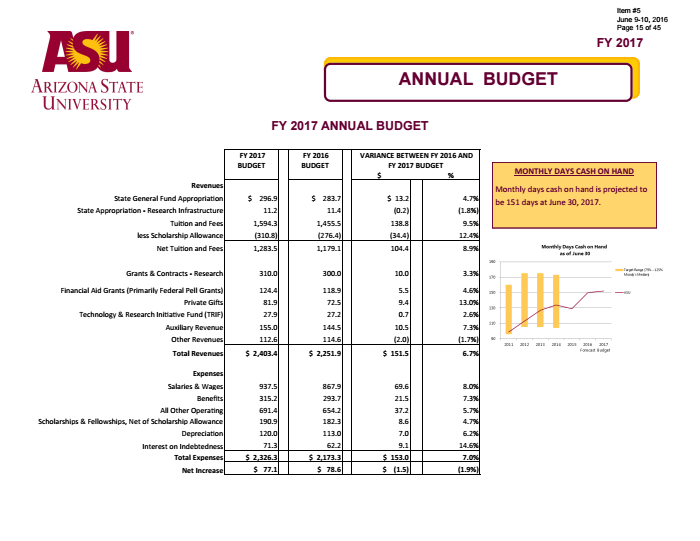
However, in the budget proposed by ASU for the 2017 fiscal year, which set forth for approval by the Regents at this week's meeting, it is not explicitly stated whether or not that request was honored. 
For some in the Council, this is especially surprising as in May, Gov. Ducey signed a bill providing the University with $17,895,100 in funding, of which nearly $15 million was expendable for any need, as well as $7 million in one-time funds usable for any need, which did not make an appearance in the tuition budget. 
That said, statute prevents state monies from being used to fund financial aid, though the money could be used for other purposes to free up funding for financial aid. 
Regardless, financial aid did increase with this budget. The amount of scholarship money taken away from tuition revenue increased by 12.4 percent, which would indicate an increased investment in financial aid. And, the budget describes an investment of $51.6 million in financial aid, of which $35.3 million is institutional. 
However, that is less than the $38.1 million in institutional financial aid described in the original tuition proposal, which came to light prior to the increase in general funding from the aforementioned bill. 
Moreover, the lack of specificity in these numbers and the lack of consistency in the numbers across different documents means it is difficult to tell where the increased funding will go and from where it came. 
An increase in institutional funding would be represented in a figure called average institutional gift aid, which, according to this year's tuition proposal, was on average $7,137 per student in 2015. However, that figure does not appear in the budget, making it even more difficult to tell. 
Since the Regents ultimately have the power to approve or deny the budget, the Council will have to decide whether or not they feel their request was honored, and then could ultimately make their case to the Regents to force an amendment to the budget. 
The issue is as political as it is fiscal: if the request was not honored in the budget and is not at the meeting, the nature and efficacy of student representation would be called into question. 

Approval of ASU Capital Development Plan and Infrastructural Improvements 

The ABOR Business and Finance committee will review the capital development plans from each campus, which include a number of infrastructural and structural improvements to each university. ASU's plan totals $177.3 million
The plan includes improvements to classroom space, general academic space, laboratory space and Armstrong Hall, the current home to the Sandra Day O'Connor College of Law. 
The plan also covers significant renovations to Gammage Auditorium totaling more than $9.1 million, and the $96 million third phase of the Sun Devil Stadium renovation. 
The University also seeks an extension of its lease of space in the Arizona Center adjacent to the downtown Phoenix campus, which holds more than 35,000 square feet of office and classroom space. 
Approval of Intergovernmental Agreement between ASU and City of Mesa
The University made public its plans to create a presence in downtown Mesa earlier this year, the cost of which would be footed by a sales tax increase in the city that will come on the ballot in November. 
Last week, the Mesa city council approved an intergovernmental agreement between the city and the University outlining the plans for the ASU presence, and now, the Board has to do the same. 
If it does, the tax increase will go on the ballot in Mesa, and if the voters pass it, development of the ASU presence can begin. 
The meeting will also include several executive sessions, during which one point of discussion will be the potential for an ASU presence in the city of Payson. This isn't the first time this idea has arisen, but no official agreements or negotiations have been entered into previously. 
That said, the fact that the University is seeking legal counsel about the potential ASU presence in Payson could mean things are in the works. 

Reach the reporter at Arren.Kimbel-Sannit@asu.edu or follow @akimbelsannit on Twitter.

Boeing Rolls Off Apache AH-6i Helos for Saudi Arabia National Guard

Air Platforms
Saudi Arabian National Guard to begin receiving AH-6i helos
08 June 2016
Blogger's Note 1: These helicopters and other deadly attack weapons are responsible for killing hundreds of innocent children in Saudi Arabia's war attacks in Yemen. A scandal has erupted with Amnesty International over the U.N.'s chief Ban-Ki Moon bding pressured diplomatically and financially to remove Saudi Arabia from a list that would restrict sales of weapons ... You can watch and listen to one report by activating the video above  

In another media report from The Intercept it is stated
"U.N. Secretary-General Ban Ki-moon publicly acknowledged Thursday that he removed the Saudi-led coalition currently bombing Yemen from a blacklist of child killers — 72 hours after it was published — due to a financial threat to defund United Nations programs.
The secretary-general didn’t name the source of the threat, but news reports have indicated it came directly from the Saudi government.
The U.N.’s 2015 “Children and Armed Conflict” report originally listed the Saudi-led coalition in Yemen under “parties that kill or maim children” and “parties that engage in attacks on schools and/or hospitals.” The report, which was based on the work of U.N. researchers in Yemen, attributed 60 percent of the 785 children killed and 1,168 injured to the bombing coalition. . . "
Read more by hitting the underlined link above

"Boeing will shortly begin delivering AH-6i Little Bird light attack and reconnaissance helicopters to Saudi Arabia, with the first of 24 platforms set to roll off the Mesa production line in Arizona in the coming days.
With aircraft 61001 now in the final phase of assembly following its return to the line from the paint shop on 6 June, deliveries of the first batch to the Saudi Arabian National Guard (SANG) will begin before the end of the month.
Coincident with the aircraft deliveries, training of US instructor pilots is set to commence in the coming days also. The first SANG student pilots will arrive at Mesa at the beginning of the fourth quarter of 2016, with about seven pilots typically rotating through Mesa for one year at a time before returning to Saudi Arabia.
Boeing was awarded the contract to build the AH-6i helicopters for the SANG in September 2014 (although this was actually revealed by company in late 2013). The imminent commencement of deliveries to the SANG comes approximately seven months after Boeing stood up AH-6i production in December 2015. Running parallel to the AH-64E Apache Guardian's 12-station assembly line at Mesa, the current seven-station AH-6i line (consolidating at five stations for full-rate production) will be putting out two helicopters per month. The last of the SANG's 24 platforms is set to arrive on the line in February 2017.
Blogger's Note #2: Boeing currently receives the 'green' AH-6i airframes from MD Helicopters Inc (MDHI), which builds them at its Monterrey facility in Mexico, ahead of systems assembly and integration by Boeing at Mesa. A company spokesperson said that, while this arrangement will continue for the first 24 helicopters, no decision has yet been taken as to whether or not it will continue after that.
The AH-6i is based on the 1960s-era Hughes Model 369 (OH-6 Cayuse in US Army service) light scout helicopter, and features an enhanced powerplant, payload, and avionics package."
Want to read more?
For analysis on this article and access to all our insight content, please enquire about our subscription options ihs.com/contact