MesaZona > Table of Contents : Here's The Menu. Enjoy

Tuesday, October 04, 2016

City Council Meeting - 10/3/2016

Views: 3
Running time: 23:34
at October 04, 2016 No comments:
Email ThisBlogThis!Share to XShare to FacebookShare to Pinterest

If This Is What We Got, We're In Trouble: That Vision Thing

Nearly every time your MesaZona blogger hears that "vision thing" word Vision it makes me squirm.
Whose vision is it?
Do we see the same things eye-to-eye?
Are they not many perspectives on any subject or object in the viewers' visual field ..... some identified as "real estate development leaders".  
ULI NEXT Global is proud to launch five videos from the new Visionary Leaders Series, featuring interviews with real estate development industry leaders. Hear firsthand how they have achieved success as they candidly share details about their leadership journeys including advice for tomorrow’s leaders, exclusive commentary, unfiltered insights, and tools for success.
ULI NEXT Global is a leadership initiative targeting Full Members, ages 35-45, who have been identified as exemplary leaders at work and within ULI. It is one of the seven programs that comprise the ULI Leadership Network.
Check out more >>  uli.org/next.

Visionary Leaders Video Series: Abridged
ULI NEXT Global Visionary Leaders Series: James J. Curtis III
September 27, 2016  |  Length: 2:39
James D. Klingbeil is the Chairman of Klingbeil Capital Management. In addition to establishing the family real estate business in 1959, Mr. Klingbeil was Co-Founder and Chairman of the Anden Group from...


ULI NEXT Global Visionary Leaders Series: Jim Klingbeil and Jim Callard
September 27, 2016  |  Length: 2:37
James D. Klingbeil is the Chairman of Klingbeil Capital Management. In addition to establishing the family real estate business in 1959, Mr. Klingbeil was Co-Founder and Chairman of the Anden Group from...


ULI NEXT Global Visionary Leaders Series: John McNellis
September 27, 2016  |  Length: 3:25
John co-founded McNellis Partners in 1982. John is a governor and member of the Urban Land Institute (ULI). He has served on the ULI’s national Board of Trustees for the Urban Land...


ULI NEXT Global Visionary Leaders Series: Daryl Carter
September 27, 2016  |  Length: 3:07
Daryl J. Carter is the Founder, Chairman and CEO of Avanath Capital Management, LLC, an investment firm focused on conventional and affordable multifamily investments. Mr. Carter directs the strategy, investments, and overall...
 
 
ULI NEXT Global Visionary Leaders Series Hasu P. Shah
September 27, 2016  |  Length: 2:35
Hasu P. Shah is Chairman of the Board of Trustees of Hersha Hospitality Trust (NYSE: HT), a position he has held since the Company’s inception in 1998. Mr. Shah is also a...


Visionary Leaders Video Series: Full Interviews
at October 04, 2016 No comments:
Email ThisBlogThis!Share to XShare to FacebookShare to Pinterest

Council Study Session - 10/3/2016

Fast one! ...4 minutes
No views
at October 04, 2016 No comments:
Email ThisBlogThis!Share to XShare to FacebookShare to Pinterest

Just In Time Before Early Voting on The November Ballot Starts > Interim MFMD Chief

City announces finalists and selection of interim for Fire Chief
Post Date:10/03/2016 2:27 PM 
Lead There are 3 finalists for the Mesa Fire Chief position.
They are Mary Cameli, Cori Hayes Mike Dunn
 
All currently serving as Assistant Chiefs.
 
Cameli will serve as Interim Fire Chief following the retirement of Chief Harry Beck.
The City of Mesa announced today the finalists for the Mesa Fire Chief position.

“I am confident that we have chosen three highly qualified and talented candidates for the Fire Chief position,” City Manager Chris Brady said. “These individuals know the community, have great relationships with the rank and file members and are committed to the organization and its mission.”


They are all currently serving as Assistant Fire Chiefs with the Mesa Fire and Medical Department. 
The finalists were selected after reviewing several applications from across the country. 

Mary Camel


Cori Hayes


Mike Dunn,


Brady also announced that Assistant Fire Chief Mary Cameli has agreed to serve as the Interim Fire Chief of the Mesa Fire & Medical Department following the retirement of Chief Harry Beck. She will begin her new assignment on Tuesday, Oct. 4, 2016.
Cameli has 33 years with the City of Mesa and currently oversees:
  • Emergency Medical Services Division,
  • Planning and Research Division,
  • Personnel and Wellness and the
  • CMS Healthcare Innovation Grant. 
Education:
  • Bachelor of Arts Degree in Elementary Education and Physical Education from Southern Utah University.  
  • Master’s Degree in Organizational Management from the University of Phoenix.
Cameli will serve as the Interim until a new chief is hired.
The final process to determine the next Fire Chief will begin in mid-October.
 
Public Information and Communications
Contact: Steve Wright
Tel. 480-644-2069
steven.wright@mesaaz.gov

United Mesa Firefighters Executive Board 
Source: http://www.unitedmesaff.com/pages/board15.html


at October 04, 2016 No comments:
Email ThisBlogThis!Share to XShare to FacebookShare to Pinterest

GIS + Agent-Based Modeling

User-Generated Big Data and Urban Morphology
Continuing our work with crowdsourcing and geosocial analysis we recently had a paper published in a special issue of the  Built Environment journal entitled "User-Generated Big Data and Urban Morphology."

The theme of the special issue is: "Big Data and the City" which was guest edited by Mike Batty and includes 12 papers. 
To quote from the website: 
"This cutting edge special issue responds to the latest digital revolution, setting out the state of the art of the new technologies around so-called Big Data, critically examining the hyperbole surrounding smartness and other claims, and relating it to age-old urban challenges. Big data is everywhere, largely generated by automated systems operating in real time that potentially tell us how cities are performing and changing. A product of the smart city, it is providing us with novel data sets that suggest ways in which we might plan better, and design more sustainable environments. The articles in this issue tell us how scientists and planners are using big data to better understand everything from new forms of mobility in transport systems to new uses of social media. Together, they reveal how visualization is fast becoming an integral part of developing a thorough understanding of our cities."

In the paper we discuss and show how crowdsourced data is leading to the emergence of alternate views of urban morphology that better capture the intricate nature of urban environments and their dynamics. Specifically how such data can provide us information pertaining to linked spaces and geosocial neighborhoods. We argue that a geosocial neighborhood is not defined by its administrative boundaries, planning zones, or physical barriers, but rather by its emergence as an organic self-organized social construct that is embedded in geographical spaces that are linked by human activity.
Below is the abstract of the paper and some of the figures we have in it which showcase our work.
"Traditionally urban morphology has been the study of cities as human habitats through the analysis of their tangible, physical artefacts. Such artefacts are outcomes of complex social and economic forces, and their study is primarily driven by traditional modes of data collection (e.g. based on censuses, physical surveys, and mapping). The emergence of Web 2.0 and through its applications, platforms and mechanisms that foster user-generated contributions to be made, disseminated, and debated in cyberspace, is providing a new lens in the study of urban morphology. In this paper, we showcase ways in which user-generated ‘big data’ can be harvested and analyzed to generate snapshots and impressionistic views of the urban landscape in physical terms. We discuss and support through representative examples the potential of such analysis in revealing how urban spaces are perceived by the general public, establishing links between tangible artefacts and cyber-social elements. These links may be in the form of references to, observations about, or events that enrich and move beyond the traditional physical characteristics of various locations. This leads to the emergence of alternate views of urban morphology that better capture the intricate nature of urban environments and their dynamics."
For more >> http://www.gisagents.org/2016/10/new-paper-user-generated-big-data-and.html 
at October 04, 2016 No comments:
Email ThisBlogThis!Share to XShare to FacebookShare to Pinterest

THINKING ABOUT IT: Time To Take The ‘Urban’ Out of Urban Design?

The world's best thinkers on the urban future
Posted October 3, 2016 by Sebastian Miller
Source: Sustainable Cities Collective 

Just liked what Sebastien has to say, your MesaZona blogger has been struggling to wrap his head around this:
For a while now I’ve had an issue with both the term and the definition of ‘urban design’.  What exactly is it?  Compare it to architecture or planning, which are professions that are easy to define and identify, even to a child’s mind.  At its most simple level, architects design buildings, while planners design cities.  We understand those roles because they have boundaries and actions that give them a clear identity.  But not so for urban design.  
We can all identify a well-designed space when we see it, but what part of this is due to good contemporary design?  Did it come about due to robust planning policies that encouraged a vibrant mix of uses?  Was it due to the active participation of community groups?  For most projects, it is probably of all the above… and then some more.  What we understand to be urban design involves a broad spectrum of disciplines, such as landscape architects, planners, architects, engineers, etc.  In addition, there is the involvement of the public, government agencies, and developers.  It’s clearly a ‘team effort’ to produce good urban design interventions. 
There is a misnomer that urban design is limited to city environments or suburban schemes.  However, the principles of urban design can and do operate in rural or natural settings.   As we strive for sustainable cities and look at issues such as green space preservation, food production, flood mitigation, it is obvious that there is no urban exclusivity or defined boundary in the process of urban design. Everything is connected. 
There is nothing new in what is being presented in these descriptions.  The theories and practices have been in circulation for many years, all of which are used regularly by professionals and academics worldwide. 
However, urban design should not be restricted to any one type of gentrification project, road improvement scheme, park design, forest trail, stormwater drainage scheme, or housing estate. 
It demands that all designers within the built environment operate in a broader manner and take into account holistic design principles.  David Adams and Steve Tiesdell sum this up in their book ‘Shaping Places’, where they state that there is a responsibility for urban designers to persuade and educate other disciplines of the impacts that individual decisions have on urban quality.  
If taken up by the industry, a uniform terminology such as I propose would apply equally to designers, engineers, policy makers, developers, and municipalities to give a clearer idea of what we are all trying to achieve.  As development continues at ever increasing rates and densities, it’s time that we break down professional boundaries that prevent us from creating and managing the most successful places possible.
Author Sebastian Miller
at October 04, 2016 No comments:
Email ThisBlogThis!Share to XShare to FacebookShare to Pinterest

Monday, October 03, 2016

The more complex our systems become, the more voters yearn for simplifiers.


Opinion | Niall Ferguson
Simplifiers v. complicationsBy Niall Ferguson   October 03, 2016
Source: The Boston Globe
 
In a memorable phrase, the great historian Jacob Burckhardt warned against “terribles simplificateurs.” But there are also such things as terrible complicators.
Last Monday night we saw the first of three showdowns between a terrible complicator — Hillary Clinton — and a terrible simplifier — Donald Trump. The first question of the night was on the economy. Clinton’s reply was a laundry list of wonkish bullet points. Trump’s was to yell repeatedly that the North American Free Trade Agreement was “the worst trade deal ever.”
Advertisement 
Clinton turned the tables by getting simpler. “I’ve met people who were stiffed by you and your business, Donald.” “I think Donald just criticized me for preparing to be president.” “As soon as he travels to 112 countries . . . he can talk to me about stamina.”
Trump, by contrast, slid haplessly into complexity. On his income tax returns he was slippery. On his five-year quest to prove President Obama was born abroad, he was convoluted. By the time we got to his 10-year-old son’s insights into cybersecurity, he was barely intelligible. At one point, Trump even used the word “braggadocious”— a word so complicated that the publisher of the Merriam-Webster dictionary had to issue a statement explaining it. When you start using five-syllable adjectives derived from Spenser’s “Faerie Queene,” you’ve stopped telling it like it is.
Burckhardt — who first used the phrase “terrible simplifiers” in 1889 — was prophetic about what lay ahead for the world. His “mental picture,” he explained, was of a new generation of “ruffian” leaders who would one day “make short work with voting rights, sovereignty of the people, material well-being, industry, etc.” The reign of the terrible simplifiers would be “the inevitable end of the state
 

The middle decades of the 20th century fulfilled Burckhardt’s dark prophecy. Hitler (born that very year, 1889), Stalin, and Mao were the ultimate terrible simplifiers, though there were many others who simplified as much but slaughtered fewer. Over huge tracts of the world, the rule of law was destroyed by tyrants who offered instead the most brutally simple of slogans: “Work Makes Free.” “Liquidate the Kulaks.” “Smash the Four Olds.”
Yet something quite different has happened in our own time, though once again the rule of law is the victim. In place of terrible simplification, we have terrible complication.
Take the new Trans-Pacific Partnership, which was agreed to last year between 12 Pacific Rim countries, including the United States. The draft legislation sent to Congress is over 5,554 pages long, contains more than 2 million words and, when printed out, stands nearly three feet high.
US legislators thought they had suffered enough between Obamacare (the Patient Protection and Affordable Care Act and the Health Care and Education Reconciliation Act), which altogether totaled 961 pages, and Dodd-Frank (the Wall Street Reform and Consumer Protection Act), which ran to 2,300 pages.
And these are just the laws. Both Obamacare and Dodd-Frank have subsequently excreted great webs of regulation. Since the health care reform was enacted, government agencies have produced 109 final regulations spelling out how the new laws are to be implemented. To get an idea of just how much verbiage this adds up to, assume that each of the 10,535 pages of health care regulations in the Federal Register contains 1,100 words. That gives a total word-count of more than 11 million.
Seriously? Magna Carta — signed by King John 800 years ago last year — was a single sheet of parchment with fewer than 4,000 words. The original draft of the US Constitution was only slightly longer (4,543 words, to be precise). The Declaration of Independence was 1,458 words. Lincoln’s Gettysburg address? The winner at just 272 words. The past was punchy. The present is prolix.
What are the forces responsible for this epidemic of circumlocution and verbosity? The best explanation seems to me the deterioration of standards in both legislation and governance that we see in nearly every democracy. Complexity comes about because professional politicians are more concerned with spin than with substance, the media never cease to howl for “something” to be done about every mishap, the lobbyists ensure that the small print protects the vested interests they serve, and the lawyers profit from the whole damned mess.
The consequences should worry us a lot more than they do, for they extend far beyond unreadably tedious statutes. First, there is the advantage conferred on the corporate insiders, who alone can afford the huge “compliance” departments that are necessary to navigate the sea of verbiage. Second, there is the risk of systemic instability, which grows with every increase in overall complexity. (Anyone who thinks the global financial system has been made more stable by Dodd-Frank should read my former Harvard colleague Hal Scott’s important new book, “Connectedness and Connection.”)
But the biggest danger of all should be now be obvious. The more complex our systems become, the more voters yearn for simplifiers.
The Donald now has just two more chances to dumb down a debate. If Hillary Clinton can keep her habitual complexity in check, I think she wins. If not, he does.
I hate to say it, but it’s terribly simple.

Niall Ferguson is a senior fellow of the Hoover Institution at Stanford University.
Historian, writer, broadcaster, Hoover Institute senior fellow. Latest book is Kissinger, vol. I: The Idealist (Penguin, September 2015).
Stanford, CA
niallferguson.com
 
at October 03, 2016 No comments:
Email ThisBlogThis!Share to XShare to FacebookShare to Pinterest
Newer Posts Older Posts Home
Subscribe to: Comments (Atom)

Zelensky Calls for a European Army as He Slams EU Leaders’ Response

      Jan 23, 2026 During the EU Summit yesterday, the EU leaders ...

  • City Council Meeting - 5/19/2025
  • Chief of War — Official Teaser | Apple TV+
  • World Defense News
    Flash News: Ukraine Intercepts Russian Kh-59 Cruise Missile Using US VAMPIRE Air Defense System Mounted on Boat. Ukrainian forces have made ...

Search This Blog

  • Home

Report Abuse

About Me

My photo
Tim Mello
Education and work in most major East Coast cities like Washington D.C. [Georgetown University], Philadelphia [Temple University], Boston and New York City for 20+ years - all with robust, dynamic, and diverse populations. Here in Mesa by choice with the challenges of living in a "downtown" area motivated to regenerate its city center for residents and visitors.
View my complete profile

Popular Posts

  • City Council Meeting - 5/19/2025
  • Chief of War — Official Teaser | Apple TV+
  • World Defense News
    Flash News: Ukraine Intercepts Russian Kh-59 Cruise Missile Using US VAMPIRE Air Defense System Mounted on Boat. Ukrainian forces have made ...

Total Pageviews

  • ▼  26 (303)
    • ▼  Jan (303)
      • Zelensky Calls for a European Army as He Slams EU ...
      • MAKING A STATEMENT ------- ECOSOC at 80: a turning...
      • BEA News: Gross Domestic Product by State and Pers...
      • Cartoon Carousel The nation’s cartoonists on the w...
      • Image with A Message
      • Intel Dives After Tepid Forecast, BOJ Holds Spurri...
      • STOCK MARKET NEWS Business Insider
      • WEF CLOSING REMARKS: Larry Fink, Børge Brende Clos...
      • January 2026 Political cartoons from the desk of ...
      • NEWS: Al Arabiya English
      • IT WAS A FIREHOSE: Today in Politics | Explainer
      • Trump sues JPMorgan, Jamie Dimon for $5 billion ov...
      • Bloomberg Biz Buzz Clip-Grabs
      • Elon Musk jokes about Trump's Board of Peace: 'A l...
      • SURPRISE SHOCK APPEARANCE ----BREAKING NEWS: Elon ...
      • Daily Beast Headlines: BRIEFING, OBSESSED
      • FRONT PAGE NEWS: WaPo
      • HEADLINE CLIPS | Techdirt Thu 22 Jan 2026
      • ABC15 Arizona · A winter storm is headed towards A...
      • Special report: Inside the founder factory known a...
      • Insights, delivered to your inbox
      • HEATHER COX RICHARDSON POST FROM YESTERDAY | Hea...
      • BETTER LATE THAN NEVER AT ALL: BEA News: Personal ...
      • FREE-MARKET ECONOMY PRINCIPLES FOR THE PEOPOLE OF ...
      • Jared Kushner outlines 'board of peace' plans for ...
      • TRUMP GOES TROLLING --- That was quick!
      • CURIOUS: 🌍 Which Countries Embrace Bing Most?. . ...
      • Take a look...and "When I dunk my cookies: | CLASS...
      • An An ancient and surprising underground city wher...
      • China's plan to 3D-print bricks on the moon using ...
      • Editorial cartoons
      • Humor | Classic Sarcasm
      • The Return of Gunboat Capitalism --- A Thought Exp...
      • A ROBUST PERFORMANCE ---- HKEX chair: Hong Kong Le...
      • If the Great Wall of China were built around Europ...
      • BASICALLY A 3-MINUTE BOOM BOMBHELL --- Lutnick Say...
      • OK Let's live the present moment
      • Thank You, Marie Green for this.Thought-Filled . ....
      • DEMEANING AND UN-DIGNIFIED...So, Trump is rude...T...
      • DONE-RIGHT TRUMP HUMILIATION DUMP IN COLD-SHOULDER...
      • NVIDIA’s CEO says AI “doom” talk is overblown—and ...
      • COLLECTIVE SIGH OF RELIEF.... YOU CAN EXPECT REACT...
      • ARIZONA ASIAN CHAMBER OF COMMERCE: 33rd Annual Lun...
      • Japan PM Takaichi Calls Snap Election Just 3 Month...
      • JAPAN WE HAVE A PROBLEM: Square profile picture Ba...
      • ONE MORE 'ZELFIE" ---- ‘Everyone Must Be in Ukrain...
      • Beijing New Year Celebration Parade 2026 (4K) | No...
      • Terrible Maps · The average age babies start walk...
      • Hashem Al-Ghaili · New GPS data reveals that Gre...
      • Cornerstones of Modern Fantasy Literature. | The H...
      • NEW RIYADH ALIGNMENT: Future Minerals Forum 2026 |...
      • Huang Helps Fuel AI Euphoria at Davos
      • HEADLINES | Russia Today. . .Europe is ‘run by Ge...
      • Putin Offers $1 Bn From Frozen Assets to Trump’s P...
      • Christine Lagarde: From the Roaring 20s to the AI ...
      • Donald Trump has sought informal counsel from Tony...
      • On Cam: Greenland Turns On Trump? Arctic Streets E...
      • "Economic Disaster", JPMorgan CEO Dimon on Trump's...
      • Editorial Cartoon du Jour | POLITICO
      • IN CONTEXT INFOGRAPHIC - Taken from Brilliant Maps...
      • Musk jokes about buying Ryanair — and putting a ‘R...
      • Supreme Court Will Decide if Fed Independence Has ...
      • BREAKING: Air Force One turns around shortly after...
      • Held in Their Own High Esteem
      • HEADLINES The Daily Beast
      • Trump's Air Force One returns to Maryland base aft...
      • LIVE: JPMorgan Chase CEO Jamie Dimon delivers rema...
      • AeroSpace & Defense News 20 January 2026
      • ARIZONA CORPORATION COMMISSION: SWG Lunch on the L...
      • The Supreme Court's Tariff Dilemma: How Legal Unce...
      • Supreme Court ruling on tariffs could trigger bill...
      • Sudden Sell-Offfs, Absurdly Spicy Foods, Leggings ...
      • Trump ‘Plants the Flag’ on Greenland as EU Leaders...
      • DRUDGE REPORT
      • Now ripe for progress . .
      • Building a Private 'Trump UN': The Massive Board o...
      • Davos prepares to bend to Donald Trump’s will | ...
      • Blair Distances Himself From $1 Bln Board of Peace...
      • Graphic Info
      • Bullish Euro Bets, Greenland Threats, U.S. Stock F...
      • No comment needed. . .
      • €300B FANTASY! Orban Calls Out EU’s Never Ending W...
      • Tywin's Advice to Tommen | Game of Thrones
      • Going Green for the weekend. . .
      • Scott Bessent says Greenland ‘can only be defended...
      • EU Holds Emergency Meeting As Trump Imposes TARIFF...
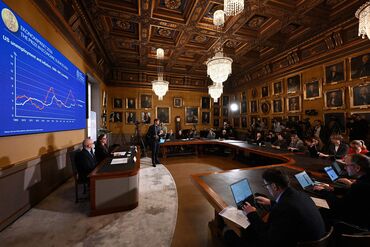
      • Statement from the Nobel Foundation
      • NASA Finally Rolled out SLS Orion to Pad for Testi...
      • Why Japan’s Economy Is at a Tipping Point
      • Wall Street Journal chart on 2025 price outcomes f...
      • EU looks to present united front in response to US...
      • Iran's Khamenei, acknowledging thousands dead in p...
      • NEW RE-SOURCE: News on military, crises and armed ...
      • This Week in Politics | Explainer
      • Man-Packable Bolt-M Loitering Munitions
      • Cabinet Meeting Cold Open - SNL
      • Weekend Update: Trump Presented with Nobel Peace P...
      • INTIMIDATIONS. . . . . . . . .
      • The Rip | Official Trailer | Netflix
      • Macron denounces Trump's 'tariff threats' | DW News
  • ►  25 (5426)
    • ►  Dec (409)
    • ►  Nov (525)
    • ►  Oct (400)
    • ►  Sep (360)
    • ►  Aug (458)
    • ►  Jul (605)
    • ►  Jun (460)
    • ►  May (381)
    • ►  Apr (505)
    • ►  Mar (545)
    • ►  Feb (387)
    • ►  Jan (391)
  • ►  24 (6279)
    • ►  Dec (430)
    • ►  Nov (409)
    • ►  Oct (586)
    • ►  Sep (414)
    • ►  Aug (504)
    • ►  Jul (512)
    • ►  Jun (467)
    • ►  May (576)
    • ►  Apr (604)
    • ►  Mar (549)
    • ►  Feb (603)
    • ►  Jan (625)
  • ►  23 (6134)
    • ►  Dec (625)
    • ►  Nov (633)
    • ►  Oct (622)
    • ►  Sep (733)
    • ►  Aug (695)
    • ►  Jul (716)
    • ►  Jun (606)
    • ►  May (638)
    • ►  Apr (462)
    • ►  Mar (198)
    • ►  Feb (99)
    • ►  Jan (107)
  • ►  22 (2414)
    • ►  Dec (148)
    • ►  Nov (171)
    • ►  Oct (156)
    • ►  Sep (168)
    • ►  Aug (211)
    • ►  Jul (188)
    • ►  Jun (218)
    • ►  May (168)
    • ►  Apr (267)
    • ►  Mar (224)
    • ►  Feb (316)
    • ►  Jan (179)
  • ►  21 (3390)
    • ►  Dec (275)
    • ►  Nov (316)
    • ►  Oct (313)
    • ►  Sep (405)
    • ►  Aug (406)
    • ►  Jul (398)
    • ►  Jun (305)
    • ►  May (222)
    • ►  Apr (170)
    • ►  Mar (231)
    • ►  Feb (178)
    • ►  Jan (171)
  • ►  20 (2398)
    • ►  Dec (293)
    • ►  Nov (340)
    • ►  Oct (227)
    • ►  Sep (247)
    • ►  Aug (151)
    • ►  Jul (80)
    • ►  Jun (121)
    • ►  May (146)
    • ►  Apr (142)
    • ►  Mar (198)
    • ►  Feb (188)
    • ►  Jan (265)
  • ►  19 (1370)
    • ►  Dec (137)
    • ►  Nov (102)
    • ►  Oct (161)
    • ►  Sep (117)
    • ►  Aug (55)
    • ►  Jul (121)
    • ►  Jun (74)
    • ►  May (107)
    • ►  Apr (129)
    • ►  Mar (117)
    • ►  Feb (105)
    • ►  Jan (145)
  • ►  18 (1302)
    • ►  Dec (125)
    • ►  Nov (106)
    • ►  Oct (118)
    • ►  Sep (143)
    • ►  Aug (89)
    • ►  Jul (82)
    • ►  Jun (124)
    • ►  May (121)
    • ►  Apr (66)
    • ►  Mar (98)
    • ►  Feb (98)
    • ►  Jan (132)
  • ►  17 (1657)
    • ►  Dec (120)
    • ►  Nov (154)
    • ►  Oct (96)
    • ►  Sep (123)
    • ►  Aug (128)
    • ►  Jul (119)
    • ►  Jun (168)
    • ►  May (192)
    • ►  Apr (149)
    • ►  Mar (129)
    • ►  Feb (122)
    • ►  Jan (157)
  • ►  16 (1081)
    • ►  Dec (100)
    • ►  Nov (109)
    • ►  Oct (98)
    • ►  Sep (102)
    • ►  Aug (95)
    • ►  Jul (70)
    • ►  Jun (121)
    • ►  May (123)
    • ►  Apr (62)
    • ►  Mar (55)
    • ►  Feb (72)
    • ►  Jan (74)
  • ►  15 (338)
    • ►  Dec (80)
    • ►  Nov (55)
    • ►  Oct (45)
    • ►  Sep (26)
    • ►  Aug (24)
    • ►  Jul (20)
    • ►  Jun (41)
    • ►  May (24)
    • ►  Apr (13)
    • ►  Mar (8)
    • ►  Feb (2)
Awesome Inc. theme. Theme images by rajareddychadive. Powered by Blogger.