Podcast
How Land Use Restrictions Make Housing Unaffordable
This is the fourth in a series of these podcasts that you can listen to with the links provided, download to save and/or listen to later.
To encourage readers to listen to the entire conversation, here are some selected highlights on a number of topics that might be of interest here in Mesa:
The guest today is Emily Hamilton. She is a researcher at the Mercatus Center at George Mason University. Emily, thanks for being on Economics Detective Radio.
Emily recently wrote a paper titled “How Land Use Regulation Undermines Affordable Housing” along with her co-author Sanford Ikeda. The paper is a review of many studies looking at land use restrictions and it identifies four of the most common types of land use restrictions:
Minimum lots sizes,
Minimum parking requirements,
Inclusionary zoning
Urban growth boundaries [we'll skip that here in Mesa, since it's "City Limit-less" LOL]
Minimum lots sizes
This is probably what people most commonly associate with zoning.
It’s the type of Euclidian zoning that separates residential areas from businesses and then within residential areas limits the number of units that can be on any certain size of land. And this is the most common tool that makes up what is sometimes referred to as Snob Zoning, where residents lobby for larger minimum lots sizes and larger house sizes to ensure that their neighbors are people who can afford only that minimum size of housing.
Petersen: So it keeps the poor away, effectively.
Hamilton: Exactly
Minimum parking requirements [here's where things are out-of-whack in Mesa]
Parking requirements are often used as a tool to ensure that street parking doesn’t get too congested.
So when cars first became common, parking was really crazy where people would just leave their car on the street, maybe double parked, or in an inconvenient situation near their destination. And obviously as driving became more and more common and that was just an untenable situation and there had to be some sort of order to where people were allowed to park. But street parking remained typically free or underpriced relative to demand. So, people began lobbying for a parking requirement that would require business owners and residential developers to provide parking that was off streets so that this underpriced street parking remained available. But that brought us to today where we often have just mass seas of parking in retail areas and residential areas, which are paper focuses on. Parking substantially contributes to the cost of housing, making it inaccessible in some neighborhoods for low income people and driving up the cost of housing for everyone who has been using the amount of parking that their developer was required to provide.
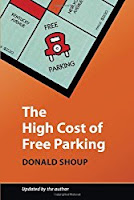
. . . that’s one where you can really see the original justification. And it makes sense, if you have a business and a lot of people are parking and it spills over onto the street then maybe that’s an externality. And it seems reasonable for you to have to provide parking for the people who come to your business, especially if a lot of them are driving there. But we push that too far, is what I’m hearing. . . The externality really comes up when we think about street parking and Donald Shoup—probably the world’s foremost expert on parking—has made the argument that pricing street parking according to demand is a real key in getting parking rules right.
Inclusionary zoning [definitely not the case in Mesa - there is no requirement]
Inclusionary zoning is a rule that requires developers to make a certain number of units in a new development accessible to people at various income levels. Often inclusionary zoning is tied with density bonuses. So, a developer will have the choice to make a non-inclusionary project that is only allowed to have the regular amount of density that that lot is zoned for. Or, he can choose to take the inclusionary zoning density bonus which will allow him to build more units overall including the inclusionary unit and additional market-rate units. Typically, units are affordable to people who are making a certain percentage of the area median income, so people who might not have low income but who are making not enough to afford a market rate unit in their current neighborhood.
Now follow if you can, dear readers, this line of thinking:
Petersen: Okay, so that’s sort of forcing developers to build affordable units that they then will probably lose money on, so that they can build the market rate units that they can make money on.
Hamilton: Exactly. That’s how cities make inclusionary zoning attractive to developers is by giving them that bonus that can allow them to build more market rate housing. In other cities, however, inclusionary zoning is required for all new developments so it really varies from jurisdiction to jurisdiction how it’s implemented.
Just how costly do economists think these regulations are?
What kind of estimates do they have?
HERE'S THE KICKER:
The best jobs are not here in downtown Mesa
typically the most binding zoning rules are also in the most productive cities, where there’s the highest level of demand for people to live.
Because these are where the best jobs are as well as the best urban amenities, a lot of people want to live here ?
So, you know, San Francisco that’s where Silicon Valley is. And so we think of it as a place with super high productivity—tech workers working at Google—and yet with their housing market being one of the most restricted. So not only is there the loss from the housing market itself, that you could sell a lot of housing there and that would increase GDP by itself, but also there are people living in less productive areas doing less productive jobs, who could come and work for Google. But they can’t because they’ve been priced out of the market. Is that where most of the effect comes from?
Hamilton: That’s right. Yeah, I think the effect is also certainly at that top-end of the market where we’re seeing all kinds of blog posts and articles about a person making six figures at Facebook who can’t afford the Bay area.
So those people might choose to go live in say Denver, or Austin, or Phoenix or Mesa or a city that still has plenty of great jobs but isn’t as productive as San Francisco or San Jose.
But then we also see this down the income spectrum, where people who are in the service industry, say waiting tables, could make much more in San Francisco then they can in Houston, or wherever they happen to live. But their quality of life is much better in some of less productive cities because of the cost of housing and other areas of consumption that higher real estate costs drive up.
Petersen: You argue that the costs of these restrictions fall primarily on low-income households so can you talk through how that happens?
Hamilton: Sure. It happens in two ways. First off, you have the low income people who are living in very expensive cities and these people might have to endure very long commutes—you talked about the police officer in Palo Alto who can’t live anywhere near his job. Not that police officers are low income, but just as an example that illustrates the point. Or they have to live in very substandard housing, perhaps a group house that’s just crammed with people maybe even illegally, in order to afford to live anywhere near where they’re working.
ANOTHER BIG KICKER
Hamilton: Right, Bill Fischel at Dartmouth has done a lot of work on why it is that people lobby so hard in favor of rules that restrict development. And he terms it as the Homevoter Hypothesis, where people who own homes have a huge amount of their wealth tied up in their home and so they are in favor of rules that protect that asset and prevent any shocks such as a huge amount of new development that could result in a decline in their homes value. I think you talked about that in your episode with Nolan Gray on trailer parks.
Petersen: Yeah, we talked about William Fischel’s Homevoter Hypothesis. So the essence of that is that people vote in local elections, and they lobby to restrict the supply of housing in their neighborhood, and that increases their wealth by, you know, increasing the land values in that area. How do you deal with that when there’s such an entrenched special interest everywhere to push up land prices?
Hamilton: I think that’s the hugely difficult problem. And at the same time as we have the challenges with the Homevoter system that Fischel plays out, we have a lot of federal policies that encourage homeownership as not just a good community-building tool but also as an investment. So people are programmed by the federal government to see their house as an investment in spite of economic challenges that it presents. David [Schleicher]—a law professor at Yale—has done some really interesting work on ways that institutional changes could limit the activity of homeowners and lobbying against new development. One of his proposals is called a Zoning Budget. And under a zoning budget, municipalities would have to allow a certain amount of population growth each year. So, they could designate areas of a city that are going to only be home to single family homes, but within some parts of the city, they would have to allow building growth to accommodate a growing population.
AND THEN THERE'S ANOTHER KICKER >TILT
The idea behind TILT is that a new development increases the property tax base within a jurisdiction. So, if you have a neighborhood, say a block full of single family homes that is allowed to be sold to a developer in order to build a couple of large apartment buildings, each apartment is going to be less expensive than the previous single family homes, but overall the apartment buildings will contribute more to property tax. And the idea behind a TILT is that part of this tax increment—which is the difference between the new tax base and the previous smaller tax base—could be shared with neighbors to the new development to kind of buy off their support for the development. So, those people who are in some sense harmed by the new buildings, whether in terms of more traffic or a change in their neighborhood’s character, also benefit from the new building financially. So they’re more likely to support it.
What follows is an edited transcript of Garrett's conversation with Emily Hamilton about land use regulations’ effects on affordable housing.


