Wednesday, December 28, 2016

Meeting: You Can Attend In-Person or Conference Call > Get Informed

Stakeholder Meeting
Proposed Changes 
to Arizona Emissions Bank
Dear Stakeholder,
ADEQ, in partnership with the Maricopa County Air Quality Department (MCAQD), is contemplating changes to the Arizona Emissions Bank to allow for the recovery of emission reduction credits that are not recognized by current regulations.
ADEQ and MCAQD invite you to attend a meeting regarding these changes, at which we will identify concerns, propose changes, and gather your input. 
Attend the meeting in person or via conference call:
When: Thurs., Jan. 5, 2017, 10:00 a.m. to 12:00 p.m.Where: ADEQ, 1110 W. Washington St., Third Floor, Room 3175, Phoenix AZ, 85007
Conference Call:
1-877-820-7829 | Passcode: 228497#
In preparation for the meeting, please review the below materials, which include draft language from MCAQD, an example statute from Texas, and AZ's current statute and regulations.

Hey! Got About 7 Minutes to Listen?

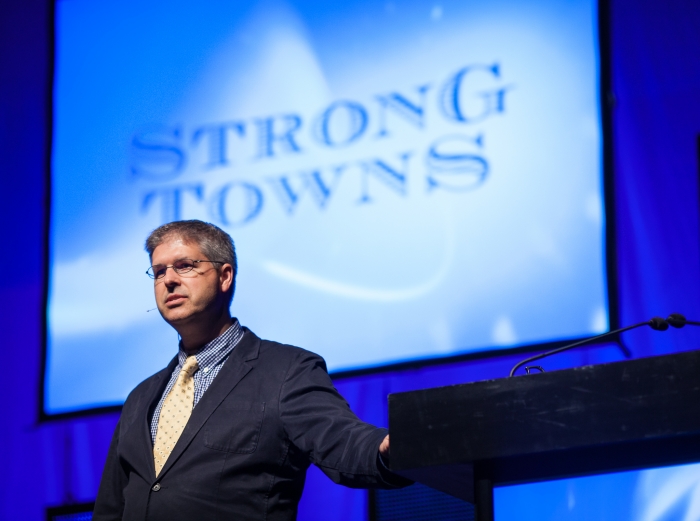
A Talk: Robert Stark interviews Charles Marohn from Strong Towns


Robert Stark and co-host Pilleater talk to Charles Marohn. Charles is a Professional Engineer (PE) licensed in the State of Minnesota and a member of the American Institute of Certified Planners (AICP). Chuck is the Founder and President of Strong Towns. He has a Bachelor’s degree in Civil Engineering from the University of Minnesota’s Institute of Technology and a Masters in Urban and Regional Planning from the University of Minnesota’s Humphrey Institute.
Topics:
How Charles’s background in urban planning exposed him to the problems of sprawl development
Charles’s books 
Thoughts on Building Strong Towns, Volume 1 & Volume II
The fiscal unsustainability of sprawl development
Charles’ point that the key factor in urbanism is 
Incremental Development
Charles’s point that cities must be viewed as ecosystems
The “build it they will come” fallacy, and how traditionally massive infrastructure projects were designed to serve existing population centers(ex.Roman Aqueducts)
How pre-automobile cities tend to be the most viable
Nassim Taleb’s 
Antifragile theory, and how it relates to urbanismThe Density Question, Charles point that density should neither be fetishized nor seen as inherently bad, but must take into account incremental development
How cities such as New York and San Francisco have value independent of their economies, while places like the Silicon Valley would become unviable if their industries collapsed
Zoning laws and land use regulations
The movement to 
Retrofit Suburbia, how it’s a step in the right direction, but has it’s limitations
How cities will contract in the future, with people living in both cities and towns, but that it’s the space in between that’s unviable
Micro Apartments
Political divides, and how when it comes to planning issues on a local level, people tend to be more pragmatic than dogmatic
The Public vs. Private sector role in infrastructure, and how Charles’s point that things that are high risk should be in the private sector, and low risk in the public sector(ex. Wall Street baillouts)
The role of the government in historic preservation and protecting the environment
Housing and affordable family formation

 Audio Player
Click Here to download!

How Not To Be Angry all the Time


Published on Dec 28, 2016
Views: 22,000
At the root of some of our angriest moods lies a surprising emotion: optimism. If you like our films, take a look at our shop (we ship worldwide): https://goo.gl/XF9elh
Join our exclusive mailing list: http://bit.ly/2e0TQNJ
Or visit us in person at our London HQ https://goo.gl/kd4Mkg
FURTHER READING “Angry people sound like gloomy types. We certainly don’t usually think of them as optimists – and yet, beneath their gruff surface, they truly are, much to their cost…” You can read more on this and other topics on our blog TheBookofLife.org at this link: https://goo.gl/uLMl60 MORE SCHOOL OF LIFE Our website has classes, articles and products to help you think and grow: https://goo.gl/HuCT1E Watch more films on SELF in our playlist: http://bit.ly/TSOLself Do you speak a different language to English? Did you know you can submit Subtitles on all of our videos on YouTube? For instructions how to do this click here: https://goo.gl/XpwC9a SOCIAL MEDIA Feel free to follow us at the links below: Facebook: https://www.facebook.com/theschoolofl... Twitter: https://twitter.com/TheSchoolOfLife Instagram: https://www.instagram.com/theschoolof... CREDITS Produced in collaboration with: Jocie Juritz http://www.jociejuritz.co.uk/ https://vimeo.com/jociejuritz

Quakes Striking > Pressure + Heat Building In The Planet

Heads up/Be safe
Published on Dec 28, 2016
Views:5,810
All Links @ http://www.BPEarthWatch.Com

Keeping You Informed + Interested? Thank You for The Hits

Welcome To: MesaZona: Table of Contents

Where you never know what's gonna get dished out . . . subscribe to the feed

Got a good appetite?

Tuesday, December 27, 2016

Here In The New Urban DTMesa: Adaptive Re-Use of An Historic Property

The Alhambra Hotel on the National Register of Historic Places, is in the finishing stages of rehab construction by Kitchell-Pérez/Venue Builders as readers can see in the images from Monday, December 26, 2016 of the front of the building. Students from Benedictine University will be in residence starting sometime next month.
In a recent article  about ReUrbanism: Shaping Communities Through Re-Use, the organization Saving Places makes a strong case to keep what is unique starting off by stating that Adaptive reuse should be the default, and demolition a last resort.
Historic preservation encourages cities to build on the assets they have—unleashing the enormous power and potential of older buildings to improve health, affordability, prosperity, and well-being. Ultimately, it’s the mix of old and new buildings, working together to fashion dense, walkable, and thriving streets, that helps us achieve a more prosperous, sustainable, and healthier future.
By transforming the places we live to places we love, older buildings are a key and irreplaceable component of this future, and we are richer and stronger when they remain.
We all have places that matter to us—places that define us, places that challenge us, places that bring us together and tell our story.
These places help form our identity and our communities. They create opportunities for growth and help us feel at home. They explain our past and serve as the foundation of our future.
These special places - like this building on the west street of the street - arise organically where people choose to come together, and from the local stories they treasure and wish to see persevere.
Current use is for a transitional living center with housing and counseling services on a section of South MacDonald Street just south of Main Street running to First Avenue where two local businesses have been operating for over 60 years.
There's also a sound studio + a shop that makes pool tables.
At one time, the building you see across the alleyway to world famous Nile Theater was once The Mesa Opera House as you can read in a bronze plaque mounted on the inside column at the north corner.
It gives you an idea of what downtown Mesa was like way-back-when.


Fortunately, these older buildings were not torn down . . But when older buildings are destroyed, the engine that keeps neighborhoods growing, innovating, and thriving is disrupted. Fundamental to ReUrbanism is that building reuse encourages economic growth and stimulates vibrant communities. Our Ten Principles for ReUrbanism outline this important work.
New Tool Available The Atlas of ReUrbanism
As the National Trust’s ReUrbanism initiative seeks to support the successful, inclusive, and resilient cities of tomorrow, the Atlas of ReUrbanism is a tool to help urban leaders and advocates better understand and leverage the opportunities that exist in American cities. The Atlas makes the massive amount of data currently available about cities more accessible, allowing for the exploration and discovery of connections between older buildings and economic, demographic, and environmental outcomes. Whether you’re a mayor, planner, developer, activist, or journalist, the Atlas contains useful information about the businesses and residents, buildings and blocks that make cities work for everyone.


The Year of The Bot

2016 was the year of the bot — this is how we got there…
2016 was the year of the bot in journalism.
In this edited extract from the forthcoming second edition of the Online Journalism Handbook, Paul Bradshaw outlines what bots are, how bots have been used by media organisations from early Twitter bots to the recent wave of ‘chatbots’, and some tips and tools for getting started with journalistic bots.
Source: Medium.com
 
‘Bots’ are ‘robots’ — only on the internet. Without the mechanical body of their physical counterparts, all that leaves is a disembodied computer script, normally created to perform repetitive tasks . . .
In the context of journalism and publishing, the term ‘bot’ is normally used to refer to something which users can interact with. Examples include:
  • A bot which automatically publishes updates on a particular social media account when it receives new information from a feed (such as new articles)
  • A bot which can supply article suggestions in response to a query from a user
  • A bot which attempts to provide answers to questions given by users
The Twitter bots: alerting, aggregating and monitoring
Useful for amplifying, revealing and highlighting
A brief history of chatbots
Why news organisations rushed to build chatbots
Chatbot creation tips and tools


Go to the profile of Paul Bradshaw
Paul Bradshaw