Sunday, December 03, 2017
Can't Get New York Out-of-My-Mind :)
Bruce Springsteen w. Billy Joel - New York State of Mind - Madison Squar...
Sign-Of-The-Times > In Real Estate We Trust | The Rise of REITs

How'd we miss this one?
The WSJ's Esther Fung last night detailed the growing phenomenon of selling malls online.That mall sales are going digital shouldn't be surprising in 2017, but check out the recent sale of Vista Ridge Mall in Odessa, Texas.
It could give pause to bottom-fishing mall/shopping-center investors.
The two-level 1.05M square-foot mall was valued at $144M in 2001.
Then e-commerce began to happen. It was appraised at $46M in June of 2016, at $34.5M in February of this year, and ultimately sold for $18.1M.
h/t Aaron Edelheit
Among interested parties:
_________________________________________________________________________________
Related content:

The Retail Apocalypse Is Demolishing Mall Investors
" . . Some of the share prices more than doubled over those years, as part of the commercial property bubble that got so huge that the Fed keeps publicly fretting about it, naming it as one of the reasons for raising interest rates, precisely to tamp down on the valuations. The Fed is worried that an implosion of these inflated commercial property values can take down the banks.Mall REITs were part of this inflated commercial property universe, and they soared with it. That entire universe is now peaking. But separately, mall REITs are also caught up in the relentless brick-and-mortar retail meltdown, as online shopping is taking over. This is a structural shift that will continue to progress. Mall owners are already trying to find a way to “repurpose” their malls. But this isn’t going to be smooth.
As so many times, Private Equity firms are in the thick of it. . .:
Read… I’m in Awe of How Fast Brick-and-Mortar Retail is Melting Down.
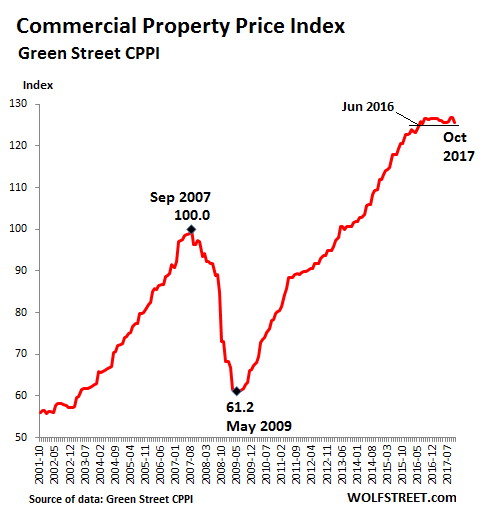
Brick-and-Mortar Meltdown Sinks Property Prices
By Wolf Richter, WOLFSTREET.com:
"Commercial real estate prices soared relentlessly for years after the Financial Crisis, to such a degree that the Fed has been publicly fretting about them. Why? Because US financial institutions hold nearly $4 trillion of commercial real estate loans. But the boom in most CRE sectors is over.
The Green Street Property Price Index – which measures values across five major property sectors – had soared 107% from May 2009 to the plateau that began late last year, and 27% from the peak of the totally crazy prior bubble that ended with such spectacular fireworks. But it has now turned around, dragged down by a plunge in prices for retail space.
The CPPI by Green Street Advisors dropped 1.1% in October from September. In terms of points, the 1.4-point decline was the largest monthly decline since March 2009. The index is now below where it had been in June 2016 . . .
This phenomenal bubble, as depicted by the chart above, has even worried the Fed because US financial institutions hold nearly $4 trillion of CRE loans, according to Boston Fed governor Eric Rosengren earlier this year. Of them, $1.2 trillion are held by smaller banks (less than $50 billion in assets). These smaller banks tends to have a loan book that is heavily concentrated on CRE loans, and these banks are less able to withstand shocks to collateral values.
Rosengren found that among the root causes of the Financial Crisis “was a significant decline in collateral values of residential and commercial real estate.”
But the CRE bubble isn’t unraveling as gently as the chart suggests. Some sectors are still surging, while others are plunging. According to the report, the index, which captures the prices at which CRE transactions are currently being negotiated and contracted, “was pushed down by falling mall valuations.”
Which sector is plunging, and which is soaring?
> Lodging took a 12% plunge that started in 2015, and it never recovered. It has remained essentially flat since, currently with a 1% gain over the beaten-down levels last year.
> The industrial sector is hot. The index jumped 10% year-over-year in October. Industrial includes warehouse space for “fulfillment centers,” as Amazon calls them. They are in hot demand, not only from Amazon, which has been leasing them around the country, but also from other logistics and retail companies
READ MORE > Zero Hedge
Saturday, December 02, 2017
Let's See What $12 Million Buck$ Makes [Originally at $5M] Hmmm ...
 | 
|
Pioneer Park Grand Opening Celebration
The City of Mesa cordially invites you to the Pioneer Park Grand Opening Celebration on Saturday, Dec. 16 at 4:30pm. 526 E. Main Street, Mesa.
Come check out the amazing 9,000 sq. foot iconic playground designed to feel like you're playing in the trees, 15 foot water wall and 850 sq. foot splash pad!
Toxic Waste FromT 2 Former Military Bases Here In Mesa?

Bombs in Your Backyard
The military spends more than a billion dollars a year to clean up sites its operations have contaminated with toxic waste and explosives. These sites exist in every state in the country. Some are located near schools, residential neighborhoods, rivers and lakes.
A full map of these sites has never been made public – until now. Enter your address to see the hazardous sites near you, or select a state
Link > Projects/ProPublica

The State of Arizona has 29: How States Compare Riskiest
Some of these sites are probably near you and you may not even know it.

> Many sites were part of old defense facilities that have long since shut down, and may not be known locally, even though a risk of exposure to contaminants may still be present.
> Even sites where the DOD says it has already completed its response can present an ongoing threat or risk to the public.
> While the data pinpoints a precise location, contamination from that location may well affect a much larger area, including public and private lands

TAKE THE TIME TO TAKE A LOOK AT THE MILLION$ OF DOLLARS SPENT BY THE CITY OF MESA FOR WATER AND WASTEWATER TREATMENTS - $190,000,000

You may want to investigate environmental concerns in an area surrounding a defense site for connections to the pollution there.
Note: The risk level of a site refers to a relative risk assessment made by the DOD to prioritize the cleanup of sites.
Data: All data comes from the Defense Environmental Restoration Program and the U.S. Army Corps of Engineers, and will be released soon at the ProPublica Data Store.
Read our methodology »
Additional design and development by Al Shaw and Mike Tigas
The number of military installations with ongoing “high” and “medium risk” hazardous sites, by state
Calif. 131
Fla. 66
Alaska 65
Texas 62
Hawaii 43
N.Y. 32
Ariz. 29
N.M. 25
Va. 25
Kan. 24
__________________________________________________________________________
For the past year, ProPublica has been documenting the state of toxic pollution left behind by the military across the U.S. As part of this investigation, we acquired a dataset of all facilities that the Department of Defense considers contaminated.
Today we used the data to publish an interactive news application called Bombs in Your Backyard. Here’s how you can use it to find hazardous sites near you — and what, if anything, is being done to remedy the pollution.
The data, which has never been released before, comes from the Defense Environmental Restoration Program, which the DOD administers to measure and document cleanup efforts at current and former military locations.
There are a lot of great local investigative stories waiting to be done with the data. This reporting recipe is meant to help you find and report ones near you.
Fla. 66
Alaska 65
Texas 62
Hawaii 43
N.Y. 32
Ariz. 29
N.M. 25
Va. 25
Kan. 24
__________________________________________________________________________
For the past year, ProPublica has been documenting the state of toxic pollution left behind by the military across the U.S. As part of this investigation, we acquired a dataset of all facilities that the Department of Defense considers contaminated.
Today we used the data to publish an interactive news application called Bombs in Your Backyard. Here’s how you can use it to find hazardous sites near you — and what, if anything, is being done to remedy the pollution.
The data, which has never been released before, comes from the Defense Environmental Restoration Program, which the DOD administers to measure and document cleanup efforts at current and former military locations.
There are a lot of great local investigative stories waiting to be done with the data. This reporting recipe is meant to help you find and report ones near you.
Party Time For BitCoin
Even as investors celebrate a banner year for stocks, the [Bitcoin] party next door is so wild there's no longer any way of ignoring it" ... This from Axios.com Barron's cover story by Avi Salzman:

- "The crypto-rocket shot past $11,000 [this] week just hours after eclipsing $10,000, which itself was mere days after pushing past $9,000. It then slid sharply before surging yet again."
- "Now Wall Street is about to join in the fun. On Friday, the Commodity Futures Trading Commission green-lighted plans by the CME and the Chicago Board Options Exchange to introduce Bitcoin futures ... Nasdaq is planning to offer its own futures next year, while Cantor Fitzgerald will introduce a Bitcoin options product."
- Why it matters: "[G]etting listed on some of the largest exchanges in the country is a tectonic shift for Bitcoin, which has been associated with drug dealing and called a 'fraud' by the chief executive of the nation's largest bank."
- But, but, but ... "Because the futures are cash-settled — traders will receive dollars on the settlement date instead of Bitcoin — the Street technically won't be getting its hands dirty by buying the stuff directly."
- "[T]here is a flip side ... extreme volatility, operational risk, security challenges."
Re/View Who Wants Yesterday's News > Thanks recode!

— Joe Brown and Peter Kafka
U.S. diplomats have dropped plans for President Donald Trump to conduct a visit to Britain in January. Trump had been penciled in for a “working visit” in the first month of 2018 to formally open America’s new London embassy. Relations between Trump and British Prime Minister Theresa May recently deteriorated in a public spat after Trump retweeted anti-Muslim videos from a far-right British group. Meanwhile, the Senate delayed a vote on its proposed tax bill until today. And the White House plans to force out Secretary of State Rex W. Tillerson, and replace him with CIA director Mike Pompeo. Economic advisor Gary Cohn and other White House staff may be headed out as well.
[The Telegraph]
Early Uber investor Shervin Pishevar has been accused by several women of making unwanted sexual advances. The co-founder of Sherpa Capital, Pishevar was arrested in London in late May after a woman accused him of raping her; he was “released under investigation” and never charged. And Russell Simmons, founder of hip-hop music label Def Jam Recordings and CEO of Rush Communications, is stepping down from his companies in the wake of an accusation of harassment and sexual assault. [Emily Chang / Bloomberg]
Pinterest’s president and top business executive, Tim Kendall, is leaving the company to build his own health-care startup, which will focus on fighting device addictions, like an obsession with a phone or laptop. It’s a big loss for Pinterest — Kendall oversees Pinterest’s entire business operation, and the company had been expected to begin the IPO process sometime in 2018.
[Kurt Wagner / Recode]
Meal-kit company Blue Apron, which went public in late June, has replaced its co-founder and CEO, Matt Salzberg. Stepping in is the company’s CFO, Brad Dickerson, who joined Blue Apron in February of 2016 after 11 years at Under Armour, where he was CFO and COO. The company’s stock performance has been the worst of any major company that has gone public this year — its $10 a share opening price has dropped to around $3.
[Jason Del Rey / Recode]
Cruise, the self-driving division of General Motors, has hired a former Uber engineer as its first CTO as it prepares to deploy a network of self-driving cars without safety drivers starting in 2019. AG Gangadhar previously headed the Uber unit that Susan Fowler used as an example in her damning essay about toxic workplaces; Fowler has criticized the appointment.
[Johana Bhuiyan / Recode]
Spotify and Tencent are planning to swap equity stakes ahead of planned IPOs next year.
[The Wall Street Journal]

Subscribe to:
Posts (Atom)
TONIGHT 8-11PM: Live Music Angel Robles
ANGEL ROBLES is k nown for an eclectic set list that spans multiple genres, . . He utilizes loop pedals, acoustic guitars, and backing...

-
 Flash News: Ukraine Intercepts Russian Kh-59 Cruise Missile Using US VAMPIRE Air Defense System Mounted on Boat. Ukrainian forces have made ...
 -
A nor’easter is about to hit the Northeast in May. That’s very unusual.

